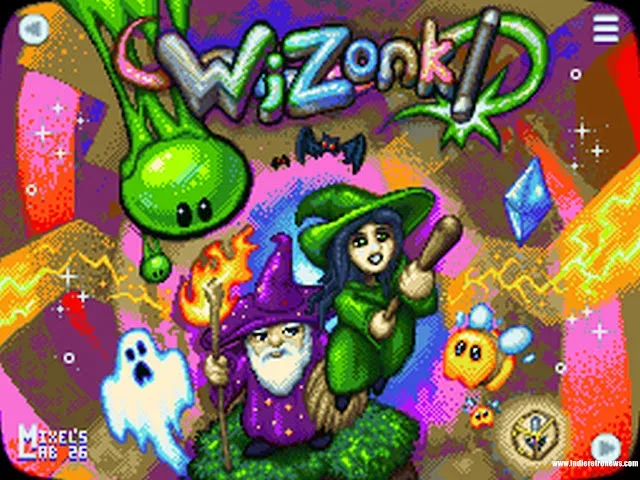

Amiga owners have a new reason to keep a joystick close at hand: Wizonk! Plus has arrived as a larger, polished evolution of Wizonk! Magic Arena. Created by Michael “Mixel” Dawes of Mixelslab, the game combines a compact, stage-by-stage platform adventure with a separate competitive mode designed for as many as four players.
The premise begins at Master Korath’s Flying Fortress in the kingdom of Morikar, a usual meeting point for the realm’s foremost spellcasters. Witch and Wizard arrive late for the contest to become Master Mage, but find no rivals waiting. The fortress is deserted, the competitors have disappeared, and monsters have taken over. That setup feeds into a story campaign that supports either one player or two-player co-op.
It is a notably broad package for a game built around the Amiga. One mode is about clearing tightly contained platforming challenges, looking for secrets and progressing through a mystery. The other turns the magic theme into a competitive arena brawl, with character-specific weapons, pickups, adjustable rules and tournament options. Rather than asking the player to choose between a solo retro platformer and a local multiplayer game, Wizonk! Plus presents both as central parts of the same release.
A single-screen platform adventure with 35 stages
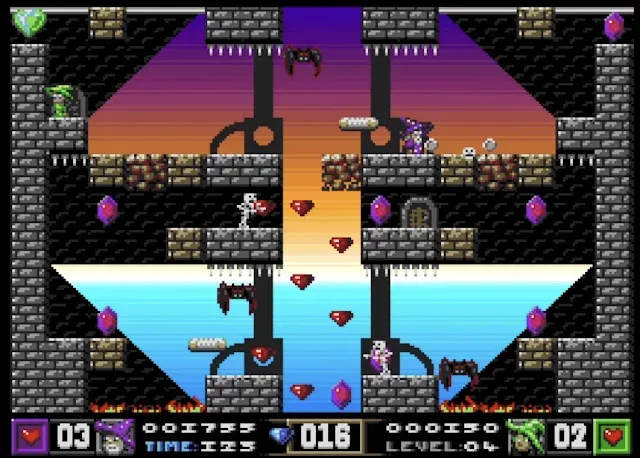
Story Mode is described as a single-screen puzzle platformer. In practical terms, that means the action is focused within one self-contained playfield at a time, rather than across a continuously scrolling world. The format places the emphasis on reading the layout of each room: where enemies are positioned, how hazards affect movement, what route can reach an objective, and whether an apparently awkward corner conceals something useful.
For more context, explore Netflix’s Assassin’s Creed Series Is an Original Roman Story, but Its Director Says It Stays in the Games’ Lore.
Players gather gems to unlock doors as they work through 35 stages. The stages include bosses, hidden areas and enemies intended to complicate progress. Those ingredients suggest that finishing a room is not always just a matter of reaching an exit; collecting enough gems is part of advancement, while secret spaces create an incentive to revisit a stage’s layout with more care.
The game cites Bubble Bobble, Rod Land and Fuzzball as inspirations. That is useful context for the kind of design it is reaching toward: colorful, arcade-rooted platform action built from discrete challenges rather than an open-ended map. It does not establish that the new game copies the mechanics of any one of those titles. Instead, the stated influences frame its combination of platforming, puzzle-solving and highly replayable individual screens.
Two-player co-op is available in Story Mode, allowing a pair to tackle the fortress mystery together. Cooperative play can change the feel of a room even when its objective stays the same: two players can divide their attention across enemies and gem routes, though they must also contend with the extra activity of a shared screen. The release does not detail its co-op rules beyond support for two players, so prospective players should not assume additional systems that have not been specified.
Related coverage includes Wizonk! Plus brings co-op platforming and four-player duels to Amiga.
Secrets are built to persist
One particularly practical feature is the ability to save discovered secrets between sessions. This matters because hidden areas work best when players are encouraged to explore instead of feeling that every discovery must be repeated after shutting down. Here, the game is designed to retain that progress, providing a reason to investigate suspicious routes while avoiding the expectation that players need to keep a separate handwritten record just to preserve their findings.
The campaign also includes a high-score table. That is a distinctly arcade-minded companion to the structured progression of doors, gems and bosses. Completion and discovery are one layer of engagement; score chasing offers another, especially for players who want to replay stages and improve their performance rather than simply move on after seeing an ending.
Magic Arena shifts the focus from monsters to rivals
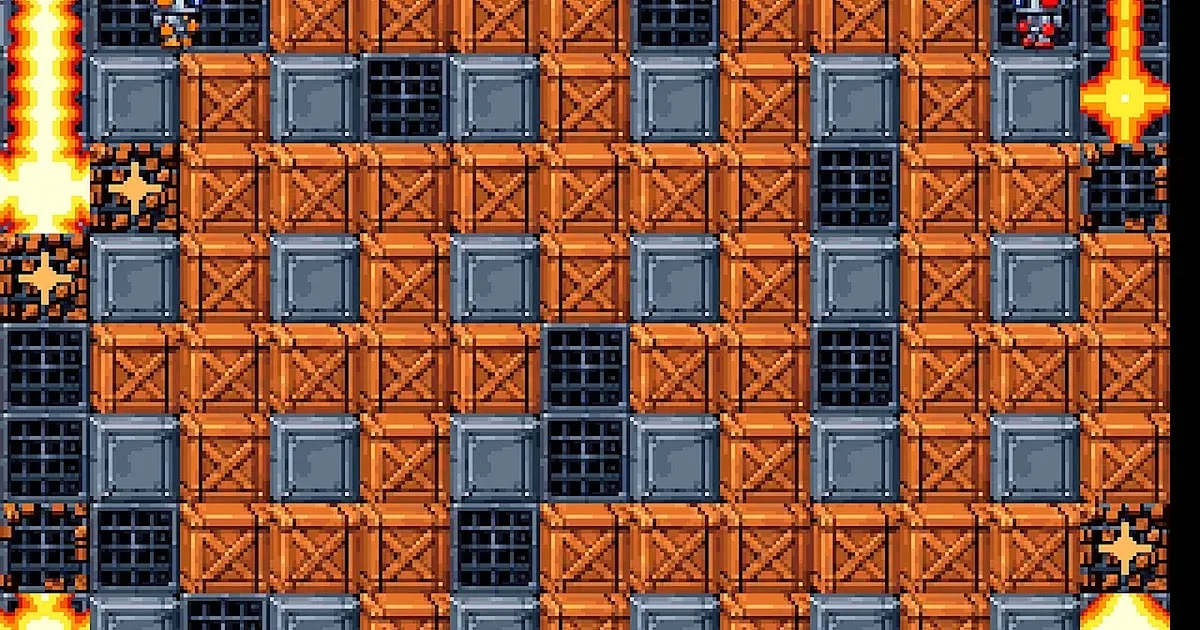
For players who would rather settle the question of supreme wizardry directly, Magic Arena supports up to four players in wizard-versus-wizard deathmatches. This mode has 15 characters, each with its own special weapon, and 25 stages for the contests. More than 25 weapons are part of the broader arsenal, alongside item drops that appear during a match and time boosts that can alter a contest late in the round.
“Deathmatch” here means a competitive multiplayer format where the participants fight one another rather than cooperate against the game’s monsters. The character’s special weapon is only one component of that contest: the availability of additional weapons and mid-match drops means a round can change after it starts. Time boosts add another variable, potentially extending the contest when a player is expecting the clock to settle it.
What makes the mode especially flexible is its rule configuration. Nearly every rule and hazard can be switched on or off. Hazards are stage elements or conditions that can complicate play beyond a rival’s direct attacks, while configurable rules let a group decide how much disorder it wants. A gathering seeking rapid arcade mayhem can leave more variables active. A group that prefers a more deliberate fight can turn down the elements it considers distracting.
That distinction is more meaningful than a simple difficulty setting. Configurable multiplayer rules let the same underlying arena support different kinds of local sessions: a fast, unpredictable match for a crowd, or a more controlled setup when players want the results to rest more heavily on positioning and weapon use. The available information does not identify every toggle, but it clearly positions customization as a major part of Magic Arena rather than a minor menu option.
The mode also includes tournament brackets and disk-saving for ongoing rivalries. A bracket is a structured series of matchups used to determine a winner across multiple rounds. Saving it to disk means a tournament need not be completed in one sitting, which is useful for a group treating the mode as an extended competition rather than a run of disconnected exhibition matches.
Hardware requirements: 1MB is the baseline, but more memory helps
Wizonk! Plus runs on Amiga systems with 1MB of memory, including an A500 configuration with 512KB plus 512KB. That establishes the baseline requirement, but the game’s feature set is not identical across every compatible machine.
On lower-end systems, some features are disabled or reduced. Systems with 2MB Chip RAM and a faster CPU receive more and higher-quality music, greater graphical detail and smoother performance in certain situations. Chip RAM is memory available to the Amiga’s custom hardware, making it relevant to presentation and audiovisual work. CPU, short for central processing unit, is the computer’s main processor; a faster one can help keep action responsive when the screen becomes busy.
The difference is particularly relevant in versus play. Four players, multiple weapons, arena hazards and item drops can make Magic Arena considerably more chaotic than a quieter solo screen. The stated hardware notes specifically identify VS mode as a situation where stronger specifications can produce smoother gameplay. For players preparing a system mainly for local competitive sessions, the 2MB Chip RAM and faster-CPU guidance is therefore more than a cosmetic consideration.
Four-player play also has a separate physical requirement: a parallel-port joystick adapter. The adapter is needed to connect the additional controllers required for a full four-person match. Anyone planning an arena night should account for that accessory rather than assuming four standard joystick connections are built into every setup.
An expanded future for Wizonk
The original Wizonk! Magic Arena remains free on itch.io and can be played online through AmigaLive. However, Mixelslab’s future updates are expected to focus primarily on Wizonk! Plus. That makes Plus the version to watch for players interested in where the project goes next, while the original remains a separate point of entry for those who want to see the earlier arena-focused form.
Dawes is credited with the game’s design, programming, music and art, a scope that helps explain the cohesive pixel-art-and-chiptune identity across its story and competitive components. The game uses the Scorpion Engine by Earok. Its hand-pixeled visuals, chiptune soundtrack and score table are not merely decorative nods to older hardware; they match a structure built around repeatable short-form stages, score improvement and local multiplayer rivalry.
That combination is the clearest case for Wizonk! Plus. Story Mode gives the magical setting a progression-driven mystery with secrets and bosses. Magic Arena supplies the more immediate social side, built to accommodate anything from a casual skirmish to a saved tournament. And the scalable Amiga specifications acknowledge that the most chaotic version of the game asks more of the machine than its basic 1MB entry point.
For retro players who value a game that treats both co-op adventuring and couch competition as worthwhile destinations, Wizonk! Plus puts an unusually complete spellbook on the table.