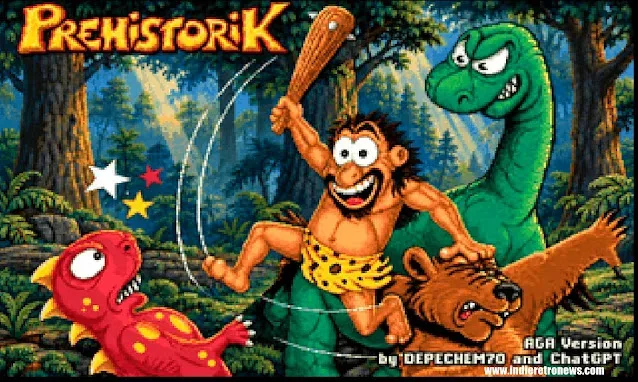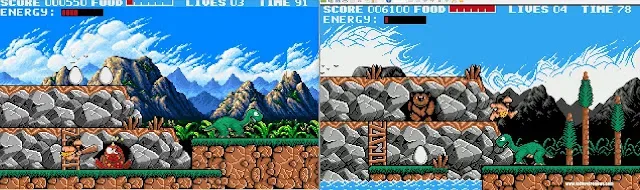
Prehistorik AGA, a fan overhaul by Depechem70, revisits Titus’s 1991 platformer with a much more elaborate visual presentation for enhanced Amiga systems. Rather than describing a new game or a mechanical remake, the project is presented as a comprehensive reworking of the original’s graphics, animation, transitions and technical rough edges, while retaining the bold outlines and offbeat character styling that define its look.
The required hardware makes the intended audience clear: Prehistorik AGA needs an Amiga with AGA graphics and a 68020 processor, plus 2 MB of Chip RAM and 4 MB of Fast RAM. A CD32 edition is also included. That places it firmly in the world of projects made for Amiga users who want to revisit an older game with more capable hardware than the baseline machines for which many early releases were designed.
A visual overhaul built around the original’s identity
The centrepiece is the artwork. Every background, item and environmental texture has reportedly received increased contrast and finer detail, using 256-colour palettes. The stated goal is not to replace Prehistorik’s familiar cartoon language with a radically different art direction. Its heavy outlines and deliberately odd character designs remain in place.
That distinction matters in a restoration-minded fan project. A game can gain resolution, colour variation and more surface detail yet cease to resemble the game people remember if its silhouettes, exaggerated forms and visual priorities are changed beyond recognition. Here, the approach appears to be enhancement rather than replacement: denser scenery and cleaner separation between elements, with the original visual personality still doing the recognisable work.
The word palette refers to the set of colours available to an image on screen. A 256-colour palette gives artists more room for shading, texture and colour transitions than a more restricted selection. It does not automatically make art better, but it can make a meaningful difference where a project uses those colours to clarify materials, lighting and depth. In this case, the reported focus spans scenery, objects and environmental textures instead of being limited to a title screen or character portrait.
More movement in every biome
Animation is an equally important part of the update. Dinosaurs, birds and fish have gained additional animated frames, as have winter-stage inhabitants including polar bears, penguins, walruses and snowmen. Animated backdrops, refreshed boss art and stronger visual feedback when attacks connect are also part of the package.
Extra frames can make movement appear less abrupt by adding intermediate poses between major actions. In a platformer, that can have a broader effect than a single upgraded sprite: living scenery makes an area feel busier, and clearer hit effects can help communicate what happened during a crowded encounter. The supplied details do not claim that enemy behaviour or level layouts have been redesigned. The meaningful change is the presentation of the existing adventure, with more visual activity surrounding it.
The aquatic levels receive a particularly atmospheric set of touches. Bubbles rise through the water while small fish drift around the stage. Winter areas add falling snow beneath a lightly twinkling star-filled sky. These are modest details individually, but they support a common visual goal: turning static level decoration into a setting that looks like it is continuing to exist around the player.
Related coverage includes Prehistorik AGA Reimagines Titus' 1991 Platformer for Enhanced Amiga Hardware.
Bosses have also been reworked graphically. Combined with altered hit cues, that should make major encounters read more clearly on screen, though there is no stated claim of new boss patterns, altered difficulty or added fights. Players should therefore think of Prehistorik AGA as a preservation-oriented upgrade with extensive aesthetic intervention, not evidence of an expanded campaign.
Technical changes go beyond a graphics pass
Prehistorik AGA also addresses room-to-room movement, loading issues, gameplay bugs and graphical bugs carried over from the original. Screen transitions have been smoothed, while the core code and memory architecture have been optimised around the 68020 processor.
Those terms deserve a little unpacking. A screen transition is the change between game areas or rooms. In older games, a rough transition can interrupt momentum even if the platforming itself remains enjoyable. Smoother movement between rooms is therefore a practical quality-of-life improvement, not simply a cosmetic flourish.
Chip RAM is memory shared with the Amiga’s custom hardware, including the graphics and audio systems. Fast RAM is additional memory intended to offer the processor faster access. The stated requirement of 2 MB Chip RAM and 4 MB Fast RAM is not a casual recommendation; it is the baseline listed for this edition. Anyone planning to use it on original hardware will need to check their configuration rather than assuming an older Amiga setup is sufficient.
Likewise, a 68020 is the processor target identified for the project’s optimisation. That focus helps explain why the visual overhaul can include richer colour treatment, more animation and added presentation material while also targeting a smoother experience. It also means compatibility should be judged against the stated AGA/68020 specification, not against the original game’s era alone.
New presentation for WHDLoad and CD32 players
Users playing through WHDLoad or on a CD32 console receive a newly made, family-centred introduction sequence and a fully animated custom ending movie. WHDLoad is a system commonly used to install and run Amiga software from hard-disk-based setups rather than relying on its original disk-loading routine. For this release, it is one of the supported ways to access the added opening and ending material.
The CD32 edition has a specific audio feature: it uses CD audio soundtracks taken from the CDTV release. This is a notable platform-specific addition rather than a blanket promise that every version will have the same soundtrack treatment. Players interested in the CD32 version have a concrete reason to look at that build separately, while those using other compatible setups should focus on the standard requirements and the WHDLoad-supported extras.
For a broader reminder that game software can raise questions around development practices and code ownership as well as nostalgia, see this report on a PC game removed amid a code-copying allegation. That is a separate situation, but it underscores why clear descriptions of what a fan project changes—and what it does not claim to be—are useful.
The unusual idle animation
The strangest new feature is an idle gag. Leave the joystick untouched for more than 20 seconds and Prehistorik’s hungry caveman takes out a vape, producing thick animated vapour clouds that gradually disappear from view.
It is a conspicuous addition to a release that otherwise stresses visual enrichment and a new family-centred introduction. It does not appear to affect play, progression or the listed hardware configuration; it is simply an idle animation triggered by inaction. Players who prefer to avoid it can prevent it from appearing by continuing to provide joystick input before the stated 20-second threshold.
What the project does—and does not—establish
Prehistorik AGA is described as an AI Amiga fan edition in the supplied material, and the project’s framing anticipates a negative reaction to that label. However, the available details do not document a particular AI workflow, name tools, or distinguish which art assets may have used any such process. What is concrete is the resulting feature list: modified art in 256-colour palettes, more animation, revised boss graphics, ambient effects, improved transitions, bug fixes, a 68020-focused optimisation effort, new introductory and ending sequences, and CD32-specific CD audio.
That separation is useful for anyone assessing the release. The label may shape discussion, but prospective users can evaluate the stated changes on their own terms: does an enhanced and more animated version of the original appeal, and does their hardware meet the listed requirements? The original remains an option for players who want its unaltered presentation.
What Amiga players should check first
- Graphics and processor: The release requires AGA graphics and a 68020 processor.
- Memory: It lists 2 MB Chip RAM and 4 MB Fast RAM as required.
- Preferred setup: WHDLoad and CD32 users receive the new intro and animated ending material.
- CD32 audio: The CD32 version specifically uses CD audio soundtracks from the CDTV release.
- Scope: The documented focus is artwork, animation, presentation, transitions and fixes, not an explicitly redesigned game structure.
- Idle gag: The vape animation is said to appear after more than 20 seconds without joystick input.
For retro platformer fans with compatible Amiga hardware, the appeal is straightforward: Prehistorik AGA aims to make a 1991 game look more alive and behave more smoothly without discarding its exaggerated prehistoric cartoon style. Its technical target and memory demands are specific, but so is the ambition behind the overhaul—an older game rebuilt with richer presentation for the Amiga systems positioned to handle it.