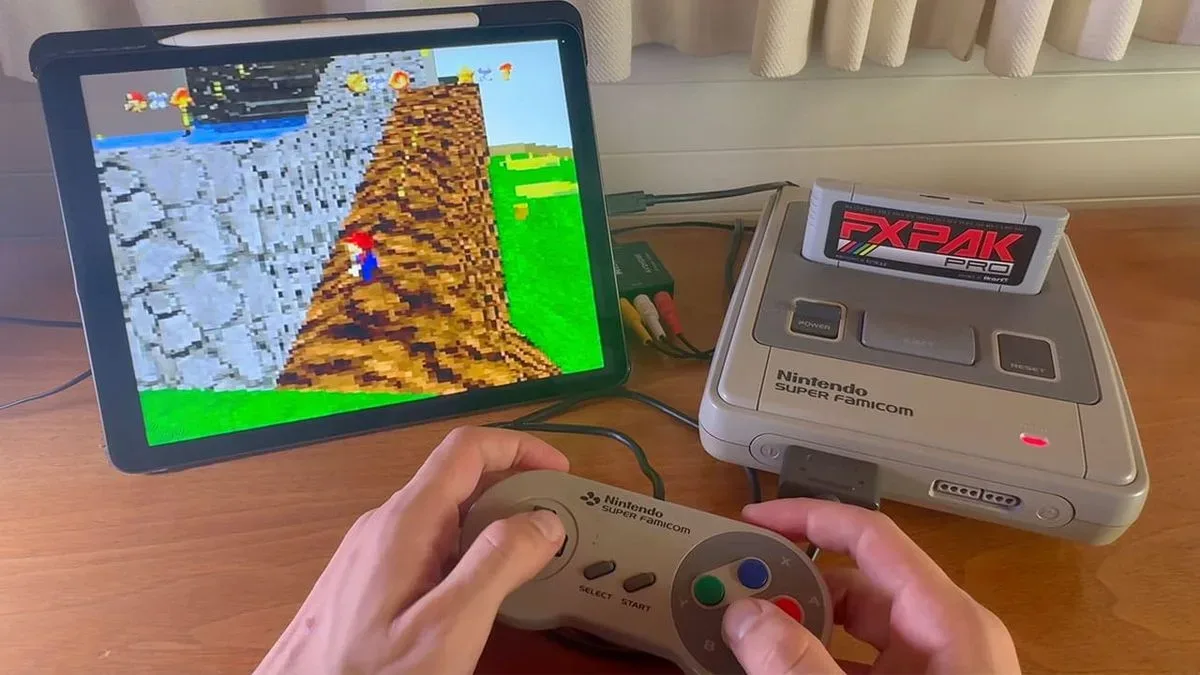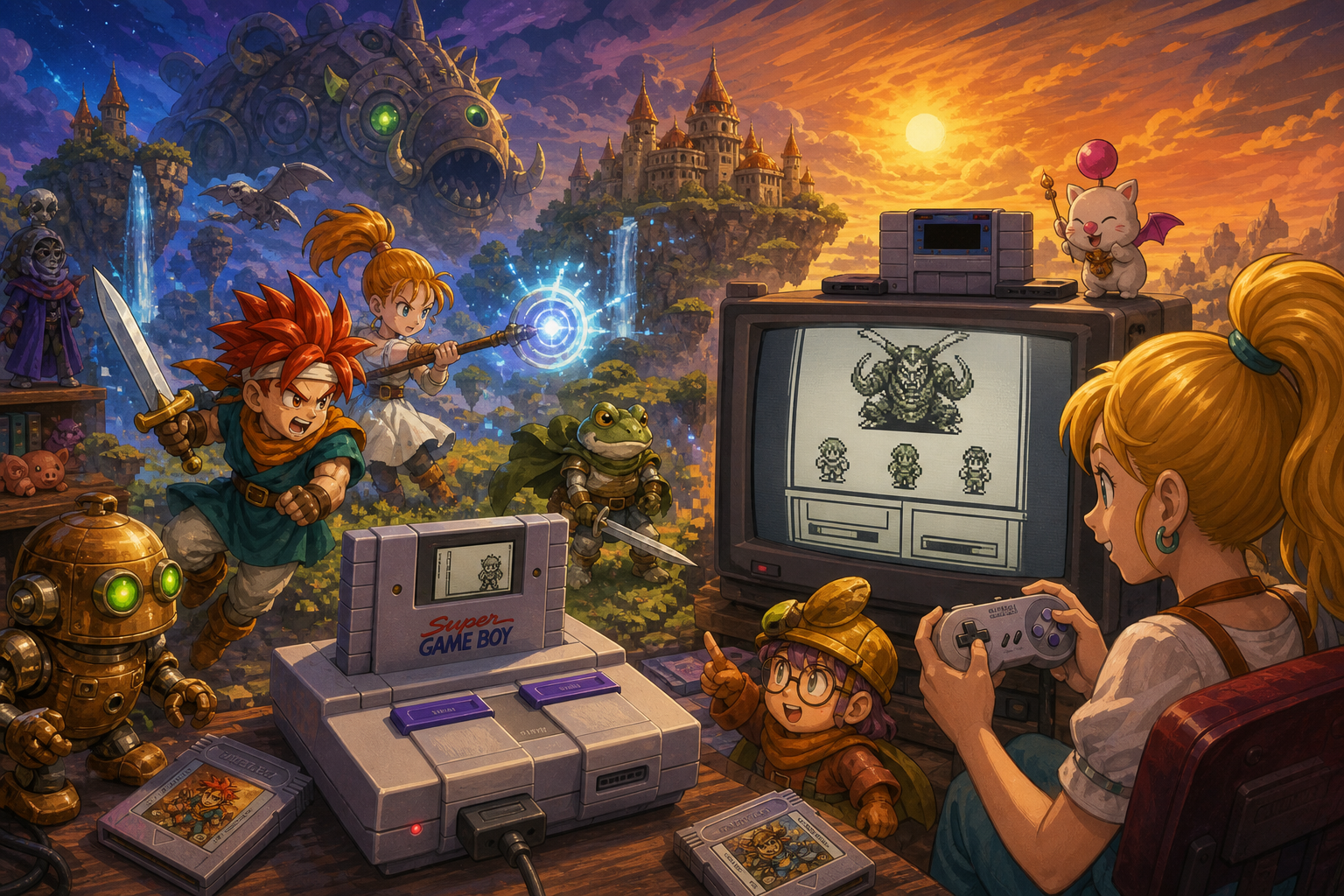
In 1994, Nintendo had an unusual problem: the Game Boy was enormously successful, but its small monochrome screen made it look technologically modest beside the Super Nintendo Entertainment System. The Super Game Boy answered that problem without replacing either machine. It allowed a Game Boy Game Pak to run through an SNES cartridge while adding television display, color palettes, decorative borders and selected console-style enhancements.
Nintendo announced the American adapter in March 1994, with a planned June launch and a stated price of 60 dollars. The product was positioned as an expansion of the Super NES library, but its deeper importance was architectural. Rather than asking the SNES to imitate a Game Boy entirely through software, Nintendo placed dedicated Game Boy circuitry inside the adapter and used the SNES for display, controls, sound output and additional presentation features.
This history follows the Super Game Boy’s design, supported software, regional revisions, documented limitations, reception and legacy. The essential distinction is between ordinary Game Boy software, which generally received a selectable four-color palette, and SGB Enhanced software, which was programmed to use the adapter’s more advanced capabilities. The original unit also lacked Game Link support, a limitation Nintendo addressed only with the Japan-only Super Game Boy 2.
Nintendo’s bridge between handheld and home console
The Super Game Boy was introduced as an SNES accessory rather than as a new standalone console. Its physical arrangement was simple: the Super Game Boy went into the Super NES cartridge slot, and a Game Boy Game Pak went into the adapter’s upper slot. Nintendo’s own history describes the 1994 accessory as expanding the number of games that could be played on Super NES hardware.
The timing mattered. The Game Boy had established a huge audience, but its green-and-gray screen was increasingly old-fashioned beside the SNES’s richer graphics. The adapter extended the useful life of both systems. It gave the SNES another category of software and gave Game Boy games a larger display, while preserving the original cartridges and their basic gameplay identity.
That made the Super Game Boy a bridge rather than a replacement generation. A player did not receive a new version of every Game Boy game. Instead, the same handheld software could occupy a new setting, with the SNES supplying a television-oriented layer around the original game.
The cartridge that contained another console
The Super Game Boy looked like an SNES cartridge because it occupied the SNES cartridge slot. That shape concealed an important technical fact: the device was not simply asking the SNES to emulate a Game Boy through software.
Nintendo’s Game Boy Programming Manual describes the adapter as containing the basic Game Boy circuitry, an SGB CPU, RAM, a system program and an intercommunication device. The Game Boy program therefore ran through hardware designed to reproduce the handheld’s operating environment, while the SNES handled the television-facing side of the experience.
The division of labor was unusual. The adapter’s Game Boy circuitry generated the handheld display and sound behavior. The intercommunication device converted the Game Boy’s two-bit, four-grayscale image into Super NES character data. The Super Game Boy system software then transferred that data through Super NES memory and video memory so the image could appear on the television.
Sound followed a related path. The programming manual explains that unmodified sound from the SGB’s Game Boy CPU was linked to the Super NES audio mixing circuit and played through the television. This gave ordinary games a way to use the SNES’s audio output without turning them into native SNES software.
Calling the Super Game Boy a simple emulator therefore misses the engineering choice. Nintendo built a specialized hardware bridge that preserved Game Boy behavior while allowing the SNES to contribute display, input and selected audiovisual resources.
How four shades became a television image
A standard Game Boy display used four grayscale values. In ordinary software, the Super Game Boy assigned those four values to colors from palettes supplied by its system program. The result was more colorful than the handheld screen, but it was not the same as a fully colorized Game Boy Color game.
The programming manual documents 32 pre-loaded palettes. These palettes could give a familiar game a green, blue, red, yellow or similarly tinted appearance, but they did not automatically give every object its own carefully designed color. A single selected palette could make the image easier to read while leaving the game’s original Game Boy visual logic intact.
SGB Enhanced software could go much further. The programming documentation describes up to four palettes of four colors each on one screen, separate palette areas and character-level color attributes. Developers could use these functions to give the playfield, status area and individual regions different treatments rather than applying one palette to the entire screen.
The play window also occupied only part of the television image. Instead of stretching the Game Boy picture across the entire display, the adapter placed it inside a surrounding frame. This preserved the handheld screen’s proportions and turned the unused television space into part of the presentation.
Borders, graffiti and the SNES control system
The border was one of the Super Game Boy’s most visible features. The system program included nine pre-loaded frames, while enhanced games could transfer their own artwork for the area surrounding the Game Boy screen. Players could also create a temporary frame through the adapter’s drawing mode.
The drawing tools gave the accessory a playful identity that ordinary Game Boy hardware could not reproduce. Users could add graffiti around the play window and, in supported situations, draw over portions of the display. A Super NES Mouse connected through controller port two made those functions and the system windows easier to operate.
The adapter mapped Game Boy controls to an SNES controller. The A, B, Start and Select buttons performed their expected Game Boy functions, while the directional pad supplied movement. The Super Game Boy’s own system window could be opened by pressing L and R together. Either controller could open the system interface, although the manual explains that controller one could not simultaneously operate the game while its system window was active.
Custom color choices could be saved as a password and restored later. That was a useful convenience, but it was not permanent system storage or a broad customization platform. The Super Game Boy was adding a presentation layer around the game, not rewriting the cartridge’s underlying software.
What the original model could not do
The launch Super Game Boy’s most important limitation was its lack of a Game Link connector. Nintendo’s instruction manual explicitly states that the adapter could not be linked using the Game Boy Game Link cable and that simultaneous two-player modes in Game Boy software were inaccessible.
This meant the 1994 model was not a complete replacement for two linked handhelds. A Game Boy title could be played on a television with an SNES controller, but ordinary link-cable trading, linked competition and other communication features were unavailable on the original retail hardware.
The distinction is important because Nintendo’s programming manual describes broader Super Game Boy capabilities, including the ability to read data from multiple Super NES controllers for specially designed two-to-four-player software. That documentation describes what the SGB system software could support through SNES hardware; it does not mean that the original adapter could provide Game Link communication between Game Boy units.
The missing connector also shows the difference between a platform’s theoretical capabilities and a specific product revision. Nintendo had created a path toward multiplayer features through SNES controllers and multitaps, but the launch model was not a universal multiplayer replacement for the handheld.
SGB Enhanced software gave developers a second target
Nintendo identified games that used the adapter’s special functions as Super Game Boy Enhanced titles. Enhanced software remained playable on an ordinary Game Boy, but it could detect the Super Game Boy and send commands to the SNES-side system program.
The programming manual lists several available functions. Games could specify multiple palettes and separate color regions, transfer custom border artwork, trigger SNES-generated sound effects, transfer music data and read input from multiple SNES controllers. Developers could also transfer Super NES program data, making the adapter more than a passive display converter.
This created a spectrum of support. At one end, an unmodified cartridge could receive a selectable palette and a generic border. At the other, a specially programmed title could treat the adapter as a distinct platform with its own audiovisual rules and control options.
The unevenness was part of the product’s character. A player could insert one Game Boy cartridge and see little more than a tinted handheld screen, then insert another and encounter custom framing, changing colors, new sound effects or entirely different content. The Super Game Boy was therefore not one uniform experience across the library.
Donkey Kong demonstrated the idea at full volume
Donkey Kong, released for Game Boy in 1994, became one of the clearest demonstrations of what SGB Enhanced software could achieve. Its Super Game Boy presentation used a dedicated border based on the Donkey Kong arcade tradition, enhanced color design and additional sound work that made the game feel intentionally adapted to television play.
The game was a useful demonstration of Nintendo’s broader strategy. It remained a Game Boy title and could be played on the handheld, yet its Super Game Boy presentation rewarded players who moved it to the SNES. The border framed the action, the color treatment gave areas greater visual separation and the enhanced audio helped the game occupy the living-room environment with more confidence.
That distinction matters historically. Nintendo was not merely using the SNES to make a tiny screen larger. It was inviting developers to consider the adapter as a second context for their software. Donkey Kong showed that a handheld game could retain its identity while gaining a presentation layer designed around another machine’s capabilities.
The result also illustrated the limits of the idea. The enhanced presentation did not turn Donkey Kong into a native 16-bit platformer. Its gameplay, resolution and underlying Game Boy structure remained visible. The achievement was not replacement but translation: the same game became more expressive when its cartridge detected the right host hardware.
Kirby’s Dream Land 2 and Space Invaders went further
Kirby’s Dream Land 2 provided another important example of dedicated Super Game Boy treatment. Its Game Boy software used special color behavior, including different visual treatments for areas and stages, along with a custom border. The presentation demonstrated how developers could use limited color deliberately instead of applying one generic tint to the entire game.
The enhancement complemented the game’s original design rather than overwhelming it. Kirby, enemies, terrain and interface elements remained recognizably Game Boy creations, but the color assignments gave the television version stronger visual organization. The result showed that the SGB’s most effective enhancements were often restrained and contextual.
Space Invaders went in a particularly unusual direction. Its Game Boy cartridge included a separate Super NES-style program that became accessible when the cartridge was used with Super Game Boy hardware. In that case, the cartridge was not merely supplying a Game Boy game with an enhanced border or palette. It was also acting as a doorway to a related home-console experience.
That made Space Invaders a striking demonstration of the adapter’s hybrid nature. The cartridge could provide ordinary Game Boy software, SGB-enhanced presentation and a separate SNES-oriented mode, depending on the hardware environment. It was an extreme example, but it proved that the Super Game Boy could be a platform target rather than just an adapter for old software.
Other titles used the system for enhanced sound, altered presentation and selected multiplayer designs using SNES controllers or multitaps. Those features should not be generalized to every compatible cartridge. Their historical importance lies in the variety of experiments the adapter made possible.
Regional release history and the Super Game Boy 2
The original Super Game Boy arrived during the SNES era, but its story did not end with the first model. Nintendo released the Super Game Boy 2 in Japan in 1998. Its defining hardware change was a communication connector, addressing the original adapter’s most visible weakness by enabling Game Link functionality.
Nintendo’s programming documentation identifies the 1998 model as distinct from the 1994 version and states that it was not released in the United States. The two revisions therefore belong to different regional histories and should not be treated as though every original Super Game Boy quietly gained the later model’s capabilities.
The Super Game Boy 2 also corrected a timing difference present in the original hardware. The first model’s Game Boy software ran slightly faster than it did on standard Game Boy hardware because of the clock relationship between the SNES and the adapter. The later revision was designed to match Game Boy timing more closely.
The release window made the revision historically awkward. By 1998, Nintendo had introduced the Game Boy Color, bringing genuinely color-capable handheld software to the market. The Super Game Boy 2 completed the original bridge concept just as Nintendo was moving toward a new handheld generation.
Game Boy Color-exclusive cartridges were outside the original Super Game Boy’s compatibility target. Some later dual-mode cartridges could operate in their original Game Boy-compatible behavior, but the adapter should not be described as a Game Boy Color system.
Reception, market timing and documented tradeoffs
The contemporary launch framing was straightforward: for 60 dollars, Super NES owners could put Game Boy software on a television. The Los Angeles Times described Nintendo’s planned adapter as a June 1994 add-on, while Nintendo’s own documentation emphasized television play in color and the accessory’s customization features.
That proposition was clever because it used hardware owners already had and did not require publishers to abandon handheld cartridges. Nintendo could extend the value of the SNES while giving the Game Boy library a more comfortable living-room setting. The accessory also offered developers a modest new target without requiring them to produce a completely separate SNES game.
Its weaknesses were equally clear. The original display was not a full-screen conversion, standard games were not automatically fully colorized and Game Link support was absent. The most impressive results depended on developers making a separate effort to use SGB commands, so the quality and depth of enhancement varied considerably from one cartridge to another.
The timing ultimately shaped the product’s reputation. The Super Game Boy made the Game Boy more expressive on television, but Game Boy Color addressed the handheld’s underlying display limitation directly. The adapter was therefore a transitional product: inventive enough to establish a new category of software behavior, but tied to the limits of the monochrome Game Boy generation.
There is no need to claim universal contemporary critical opinion to understand the tradeoff. The documented product design explains both its appeal and its ceiling. It was an inexpensive expansion of an existing library, not a full conversion of that library into native SNES software.
Legacy after the SNES generation
Later hardware broadened the idea of playing handheld software on a television. The Game Boy Player for GameCube supported Game Boy, Game Boy Color and Game Boy Advance software, making it a more capable successor in terms of library coverage. It did not, however, reproduce every original Super Game Boy border, palette and enhancement.
That distinction explains why compatibility is not the same as preserving presentation. A later device may display the same underlying game while omitting the features that made the SGB version distinct. The Super Game Boy’s border artwork, palette behavior, SNES audio effects and selected alternate content were part of a platform-specific experience.
The accessory also represents an important moment in Nintendo’s hardware design. Instead of treating handheld and home-console software as isolated products, Nintendo built a physical and technical relationship between them. The Game Boy supplied the game’s core environment; the SNES supplied display, controls and selected enhancement resources.
That hybrid approach anticipated later efforts to connect portable libraries with living-room systems, even when later hardware used different methods. It also established a historical precedent for treating compatibility hardware as a platform with its own design vocabulary, rather than as a transparent way to run old software.
The Super Game Boy’s legacy is therefore more specific than simply being an early television adapter. It preserved a distinct layer of software behavior that depended on the relationship between a handheld cartridge and a home console.
Conclusion: a small cartridge with a large design idea
The Super Game Boy mattered because it was not merely a way to enlarge a Game Boy picture. Nintendo placed dedicated handheld circuitry inside an SNES-compatible adapter, then built a second presentation layer around it: television color, borders, drawing tools, SNES controls and an optional target for enhanced software.
Games such as Donkey Kong, Kirby’s Dream Land 2 and Space Invaders showed how varied that layer could become. One title might use custom colors and framing, another might add sound effects, and another might contain a separate SNES-oriented program. The adapter’s most interesting software was not simply better-looking Game Boy software; it was software that understood the adapter as a distinct environment.
Its limitations are part of the history. The original model lacked Game Link support, did not turn every game into a fully colorized production and arrived only a few years before Game Boy Color changed handheld expectations. The Super Game Boy 2 corrected some of the original model’s shortcomings, but its 1998 Japanese release came as Nintendo’s portable strategy was already moving elsewhere.
That combination of ambition and constraint makes the Super Game Boy revealing. It was a carefully engineered bridge between two generations, and its best software demonstrated how much character could fit inside that bridge.
The Super Game Boy’s lasting appeal comes from its specificity. It preserved the Game Boy’s software environment while allowing Nintendo and its developers to experiment with a television-oriented presentation that was neither ordinary handheld play nor a conventional SNES port.
That hybrid identity also explains why later compatibility hardware cannot completely replace its historical role. Playing a Game Boy title on a television is one thing; preserving the borders, palettes, sounds and special behaviors designed for the Super Game Boy is another. Nintendo’s accessory remains a compact example of hardware solving a software and presentation problem at the same time.