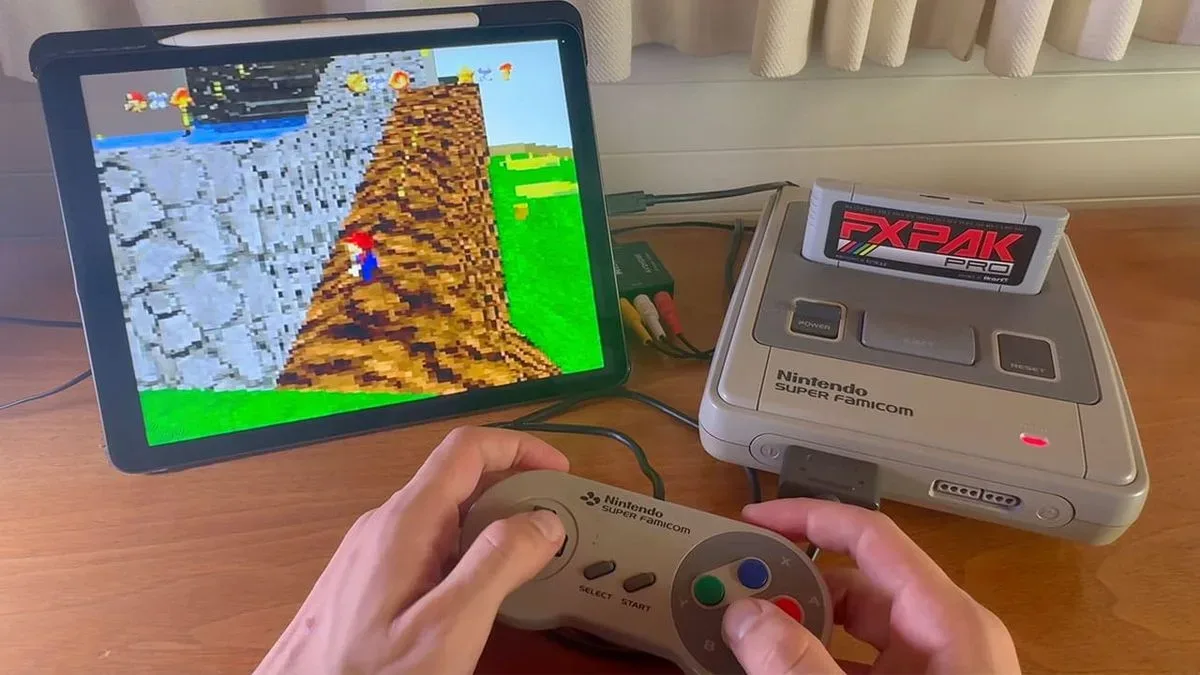
A version of Super Mario 64 running through SNES Super FX hardware sounds like the kind of schoolyard claim that would have required an uncle at Nintendo to verify. Yet Game of Tobi is building precisely that: an in-progress rework that uses the game’s original source code and assets to bring Nintendo 64 Mario into the far more constrained world of the Super Nintendo.
The project is not finished, and it should not be mistaken for an official release or a complete SNES conversion just yet. But its current state is already significant. Finished sections reportedly retain recognizable level elements, Mario’s full set of moves works, and the game is playable despite visible jitter and a dense, squint-inducing image. For a machine associated with sprite-based 2D games, that is an unusually bold technical sight.
Game of Tobi plans to make the work playable on SNES hardware through a flash cartridge, such as the FX Pak Pro, once the results meet the developer’s standards. There is no firm release date in the available information, so the sensible expectation is that this remains a work in progress rather than something players can download or load onto a cartridge today.
For another look at the project’s premise and early technical ambition, coverage of the SNES Super FX rebuild is available here.
For more context, explore Dressmaker’s Steam Surge Has Its Programmer Wondering If a Dressmaking Game Is His Career Peak.
Why the Super FX chip matters
The Super FX was a specialist chip used in certain SNES cartridges to handle work beyond what the base console could comfortably do on its own. It is closely associated with Star Fox, whose polygonal spacecraft and environments gave the SNES an early, striking route into 3D visuals.
Its earlier name, MARIO, expanded to Mathematical Argonaut Rotation I.O. The name points toward the kind of mathematical workload at the heart of the chip’s appeal: calculations involved in rotating and drawing three-dimensional objects. In practical terms, the enhancement hardware helped produce visuals that looked radically different from the SNES games players were used to seeing, even if those models were much simpler than later 3D console games.
That historical context makes this experiment more interesting than a routine platform port. Super Mario 64 arrived as a defining Nintendo 64-era 3D adventure. Running its code and assets through an SNES cartridge enhancement chip is an attempt to bridge two distinct technical eras of Nintendo hardware. It does not make the SNES into an N64; instead, it asks how much of the later game can survive when translated to a system with dramatically tighter resources.
What “running on SNES” means here
It is useful to separate the achievement from an overly broad claim. The project is being developed for the SNES with help from Super FX hardware. That chip is part of the cartridge-side setup, and it is crucial to the experiment. This is not evidence that an unmodified base SNES alone can simply run the Nintendo 64 game as originally released.
Likewise, a successful technical recreation does not automatically mean a perfect one-to-one version. The visible image is reportedly rough in places, performance can be jittery, and only completed levels can be assessed as playable. Those compromises are not incidental details; they are the story of the port. Every recognizable movement, course element, and 3D scene that appears under those restrictions represents a decision about what can be retained and what must be adapted.
The 2MB problem is the real boss fight
The clearest constraint disclosed so far is memory. Game of Tobi has been working with 2MB, an exceptionally tight budget for a game built around 3D environments, movement, and a substantial visual identity. Memory is not merely storage space in an abstract sense. It determines how much game data can be kept available, including the information needed to construct environments and display the assets players recognize.
The developer has described having to “paint frames back to front,” an explanation that conveys just how carefully scenes must be assembled under the limitation. The phrase should not be taken as a claim that the whole game is simply hand-drawn frame by frame. Rather, it illustrates a rendering workflow in which what gets drawn, and in what order, becomes a vital technical concern. When resources are scarce, a developer cannot casually treat every part of a 3D scene as though it has limitless room and processing time.
This is why the project’s rough edges are worth viewing as evidence of the challenge rather than as a simple failure to polish. Modern players often encounter ports where the target hardware has vastly more capacity than the original. Here, the direction is the opposite: a Nintendo 64 game is being reshaped for hardware from the generation before it. The question is not whether every original feature can arrive untouched. It is whether the core language of Super Mario 64—its movement, spaces, and immediate readability—can be made convincing inside an SNES-era technical envelope.
Mario’s moves are an important benchmark
Reports that all of Mario’s moves work are especially meaningful. Super Mario 64 is not remembered only for its courses or its transition into 3D; it is remembered for how Mario controls. A port can resemble the original visually and still miss the point if its central character no longer supports the familiar range of motion.
Preserving Mario’s movement set gives the work a stronger claim to being a playable adaptation rather than a visual demonstration. It also raises the bar for the remaining development. Movement has to coexist with the level geometry, camera or viewpoint presentation, collision behavior, and the performance demands of rendering a 3D game on this unusual hardware combination.
There is still a major distinction between getting the move set operational and delivering a completed game. The available information confirms playable finished areas, not that every original course, objective, interaction, or sequence has been recreated. Anyone following the project should therefore resist turning early footage or demonstrations into a promise of total parity with the Nintendo 64 release.
A familiar challenge for Game of Tobi
Game of Tobi has a track record of working with Super Mario 64 source code and of exploring ways to bring it to different platforms. That experience matters because projects like this are not simply about importing art and pressing compile. Each target platform imposes its own rules around memory, processing, display behavior, and cartridge hardware. A developer needs to understand both the original game’s structure and the new machine’s limitations well enough to make informed compromises.
The SNES effort is said to be performing better than the developer’s earlier attempt to bring Super Mario 64 to Game Boy Advance hardware. That comparison makes intuitive sense without diminishing the ambition of either project. Both platforms present severe limits for a game of this kind, but the Super FX chip gives the SNES build a specialized piece of hardware explicitly associated with 3D calculations. It is not a magic shortcut, but it is a meaningful tool for this particular task.
What prospective players will need
If and when Game of Tobi releases the project, the stated plan is for it to be played on SNES using a flash cartridge such as the FX Pak Pro. A flash cartridge is a cartridge-shaped device that can load compatible game files on original console hardware. In this case, compatibility matters: the project relies on Super FX functionality, so a suitable setup is not an afterthought.
That planned route also explains why this is more than an emulator curiosity. The goal is framed around operation on SNES hardware through a cartridge solution. For retro players, that makes the project a compelling demonstration of what enhancement-chip cartridges can still reveal about the platform decades later.
There are sensible caveats. No release timing has been provided. Further work is explicitly needed. The early version is visually demanding to parse and not perfectly smooth. And because the build is unfinished, its final scope and performance should remain open questions until the developer decides it is ready.
Why this experiment is worth watching
Retro projects are sometimes judged only by whether they reproduce every feature of a beloved original. That is too narrow a lens for this one. The fascination lies in the collision between a landmark Nintendo 64 game and a cartridge chip best known for helping the SNES take its first dramatic steps into 3D.
The Super FX chip once helped make simple polygonal visuals feel futuristic in Star Fox. Now it is being asked to support an interpretation of a game that helped establish the expectations for console 3D adventure. The result may remain compromised, unfinished, and visually austere compared with the original, but it also demonstrates the enduring appeal of understanding old machines by pushing them beyond the assumptions people made about them.
For now, the most accurate verdict is also the most exciting: the SNES Super FX version of Super Mario 64 is real enough to be playable in completed sections, constrained enough to remain an engineering puzzle, and unfinished enough that its eventual form cannot yet be promised.