Sega’s hardware history is often reduced to a neat rise-and-fall story: arcade success, Mega Drive glory, Saturn trouble and Dreamcast’s farewell. The record is more interesting. Sega changed owners, balanced Japanese and overseas divisions, moved between arcade and home markets, and repeatedly used hardware to test ideas that later became ordinary.
This account follows those documented turning points rather than assigning every setback to one executive or one machine. The criteria are corporate identity, engineering decisions, regional launch strategy, software ecosystems, arcade connections and commercial context. Regional dates remain separate, because Sega’s systems were not introduced everywhere at the same moment.
Before the Consoles: Service Games, Japanese Amusement and David Rosen
Sega Corporation identifies June 3, 1960 as its establishment date, but the business grew from earlier amusement operations associated with Service Games. The name itself points to the company’s initial world: coin-operated entertainment, jukeboxes, pinball equipment and machines placed in public venues rather than under a television at home.
David Rosen became a crucial early figure. After operating Rosen Enterprises in Japan, he helped move Sega beyond importing amusement machines and toward developing, manufacturing and exporting original products. That shift mattered because it gave Sega experience with both the machines themselves and the venues in which they earned money.
Sega also expanded through directly operated amusement centers during the 1960s and 1970s. This combination of manufacturing, distribution and venue operation created a practical understanding of arcade play: short sessions, clear visual impact and hardware designed around a particular attraction. Periscope, the submarine-themed machine commonly identified as Sega’s first major original arcade success, became a worldwide hit in 1966 and helped establish the company as an arcade manufacturer with international ambition.
Corporate Ownership and the Arcade Machine Business
Gulf and Western acquired Sega in 1969, making Sega Enterprises a subsidiary of the American conglomerate. That ownership change is important, but it should not be used as a magic explanation for everything that followed. Sega continued developing its arcade business, and its later hardware choices reflected changing technology, market competition, corporate structure and regional management rather than one ownership event alone.
Arcades remained Sega’s technical laboratory. The company learned how cabinet design, dedicated controls, audiovisual presentation and repeat play could distinguish one machine from another. Those lessons later influenced home systems, although a console had to solve different problems: it needed affordable software, a retail distribution network and enough variety to justify repeated use in a household.
This background helps explain why Sega’s home systems often felt connected to the arcade. Arcade conversions offered recognizable software early in a platform’s life, while original console projects tried to reproduce the immediacy associated with coin-operated play. The relationship was productive, but it also meant that Sega had to adapt from a business built around dedicated attractions to one built around long-term software libraries and retail support.
SG-1000 and SC-3000: Sega Enters the Home
Sega entered Japan’s home-console market on July 15, 1983, with the SG-1000. The date is notable because Nintendo launched the Family Computer in Japan on the same day. Sega was not simply copying a finished console formula: it developed the SG-1000 alongside the SC-3000 computer, which used related ideas while adding a keyboard.
The SG-1000 separated that keyboard from the computer concept and concentrated on game-console use. The connection between the two machines shows Sega testing more than one interpretation of home computing. A user could add the keyboard and use related SC-3000 peripherals, so the SG-1000 occupied a space between a straightforward console and an expandable home machine.
The early platform still faced a major ecosystem problem. Sega relied on internal development, arcade conversions and outside partners, yet it did not initially possess the broad software network Nintendo was building. Sega’s own history records difficulty securing a large software lineup, partly because outside companies were cautious about supplying a rival to other hardware makers. That limitation is more useful than a simple claim that one system was technically inferior. A console is a platform of hardware, games, distribution and consumer confidence, and Sega was still assembling that combination.
Mark III and Master System: Building an 8-Bit Alternative
The Mark III followed in Japan in 1985 and became the foundation for the Master System in overseas markets. Sega was now competing more directly in the 8-bit console field, where regional publishing and distribution mattered as much as the machine’s specifications.
The Master System carried Sega’s arcade identity into homes through conversions and familiar visual presentation, while also needing original software that could sustain a library. Its performance differed by territory, a pattern that would recur throughout Sega’s history. The same manufacturer could be stronger in one region and less effective in another because retailers, publishers, advertising and consumer habits were not interchangeable.
The lesson was not that Sega lacked hardware ambition. It was that hardware ambition required local support. Sega’s overseas divisions would later become powerful forces in their own right, but that strength could create tension when regional priorities diverged. The Mark III and Master System therefore belong to the company’s learning period: Sega was developing a console identity while discovering that arcade recognition did not automatically produce home-market dominance.
Mega Drive and Genesis: The Hardware Sega Could Scale
The Mega Drive launched in Japan on October 29, 1988. In North America Sega used the Genesis name, with that regional release arriving in 1989; Europe received the Mega Drive in 1990. Keeping those names and dates separate matters because Sega’s international performance was not uniform and because the Genesis brand became especially important to Sega of America.
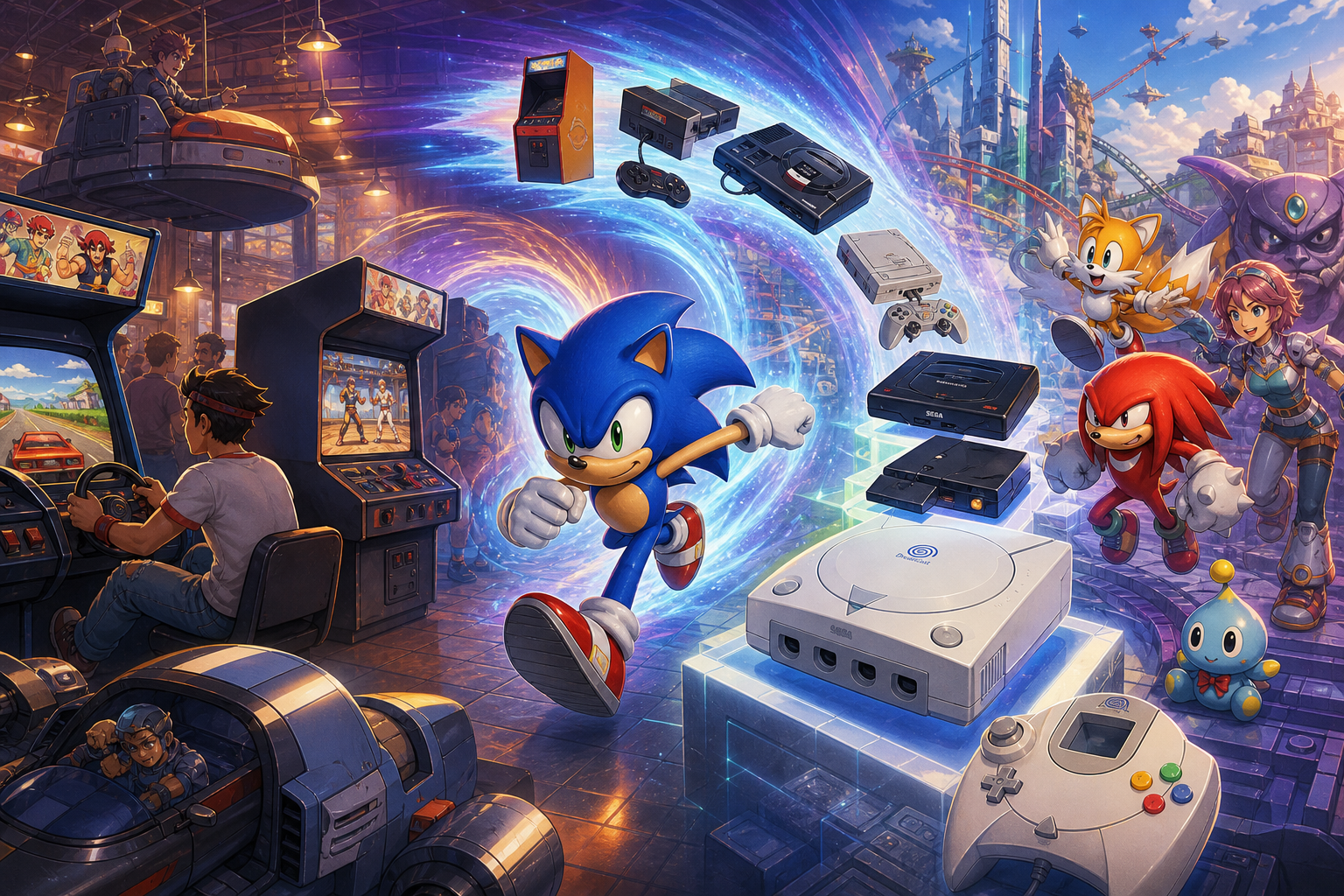
The system gave Sega a stronger technical and commercial base for its 16-bit push. Its library could draw on arcade heritage while supporting action games, platformers, role-playing games and other software that made the machine more than a conversion box. Sonic the Hedgehog, released in 1991, became the defining branding event. The Strong National Museum of Play identifies Sonic as a major factor in Sega’s temporary rise over Nintendo during the 16-bit era.
Sega’s achievement was partly about timing and identity. The Mega Drive offered a faster, more aggressive alternative to Nintendo’s family-friendly image, while Sonic gave that alternative a character people could recognize immediately. This was not a universal victory, but it was the clearest example of Sega turning arcade confidence, hardware capability and software branding into a scalable international platform.

Extensions, Handhelds and the Cost of Momentum
Sega extended the Mega Drive with products including Mega-CD and 32X. Each addressed a different problem. Mega-CD added CD-ROM storage and additional processing, graphics and sound capabilities to the 16-bit system. The 32X pursued a different goal by adding hardware intended to increase processing capability. Treating them as one identical failure erases the design distinctions. They were attempts to prolong or broaden an established platform while the market was moving toward a new generation.
The Game Gear, launched in Japan in 1990, took another route. It offered a color screen and backlighting, positioning itself differently from Nintendo’s monochrome Game Boy. Sega’s handheld could present more colorful versions of familiar games and also support games designed specifically for the device. Its display and capabilities were attractive differentiators, but handheld competition was not decided by screen technology alone. Software supply, battery demands, price, distribution and Nintendo’s established momentum all mattered.
Together these products show Sega trying to maintain speed across several fronts. The problem was not simply that Sega made add-ons; it was that consumers and retailers had to understand how those add-ons fit into an already complicated transition. Momentum can help a company move quickly, but it can also make overlapping hardware harder to explain.
Saturn: A 2D Powerhouse Entering a 3D Transition
The Saturn launched in Japan on November 22, 1994. Sega’s technical material describes a 32-bit system built around two SH-2 processors, with strong capabilities for 2D graphics and emerging 3D presentation. Its architecture reflected a period when the industry was not merely increasing resolution; it was deciding how much of the arcade’s sprite-based tradition should carry into polygonal worlds.
The ST-V arcade board strengthened the Saturn connection by using technology compatible with the home system. This was a logical extension of Sega’s history: a home console could benefit from an arcade hardware relationship, and arcade experiments could inform home releases. Yet the transition to 3D made the competitive landscape more difficult, especially as rival platforms presented simpler technical stories to developers and consumers.
Saturn also performed unevenly by territory. It was comparatively strong in Japan, while its United States outcome was weaker. The North American strategy, including an early launch in 1995, became part of a retailer-relations problem and made the system’s regional story especially complicated. Saturn was therefore not a uniform worldwide failure; it was a system whose technical identity and commercial execution produced sharply different results.
People, Divisions and Regional Strategy
Sega’s corporate identity cannot be understood as one uninterrupted organization speaking with one voice. The company’s history includes Service Games, Sega Enterprises, Gulf and Western ownership, the later CSK period, Sega of Japan and Sega of America, each operating within different commercial environments. Executives such as Hayao Nakayama mattered, but documented decisions are more reliable than stories that attribute every outcome to personal temperament.
Sega of America’s marketing and publishing choices helped define the Genesis era, while Sega of Japan retained its own priorities and market knowledge. Those divisions could reinforce one another when a product traveled well, but their goals did not always align. A strategy that made sense in North America could be less suitable in Japan, and a Japanese hardware decision could arrive overseas with different retailer expectations.
This regional structure is essential context for Saturn and Dreamcast. Launch timing, naming, advertising, software selection and communication with retailers were not background details. They were part of the product. Sega’s history shows that engineering decisions become commercial decisions as soon as a machine has to be manufactured, explained and supported across several markets.
Dreamcast and Katana: Sega Bets on Built-In Networking
Sega developed Dreamcast through a next-generation project that used the internal code name Katana. Its design placed communication near the center of the product rather than treating networking as a later accessory. Dreamcast launched in Japan on November 27, 1998, followed by North America on September 9, 1999, and Europe and Oceania on October 14, 1999.
The console included a removable modem. Sega’s historical account identifies 33.6 kbps service for Japan and 56 kbps hardware for overseas markets, while Dream Passport software and related service efforts attempted to simplify internet access. The approach was ambitious for the period: online play was being presented as a normal console feature, not merely an experiment for specialist users.
The online strategy did not remove every practical obstacle. Services, infrastructure and player communities all had to develop together. Still, Dreamcast demonstrated a clear design direction. Sega was again using hardware to push an arcade-adjacent idea into the home, this time connecting players and services rather than only reproducing cabinet graphics. Phantasy Star Online would become one of the most important examples of that direction.
The Software Showcase and the End of Sega Hardware
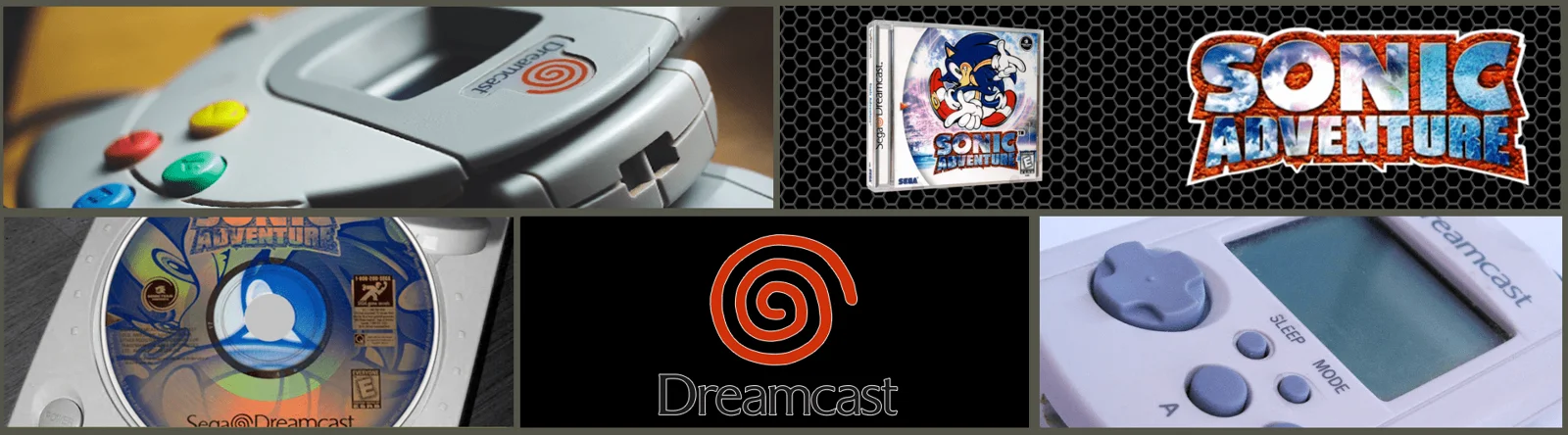
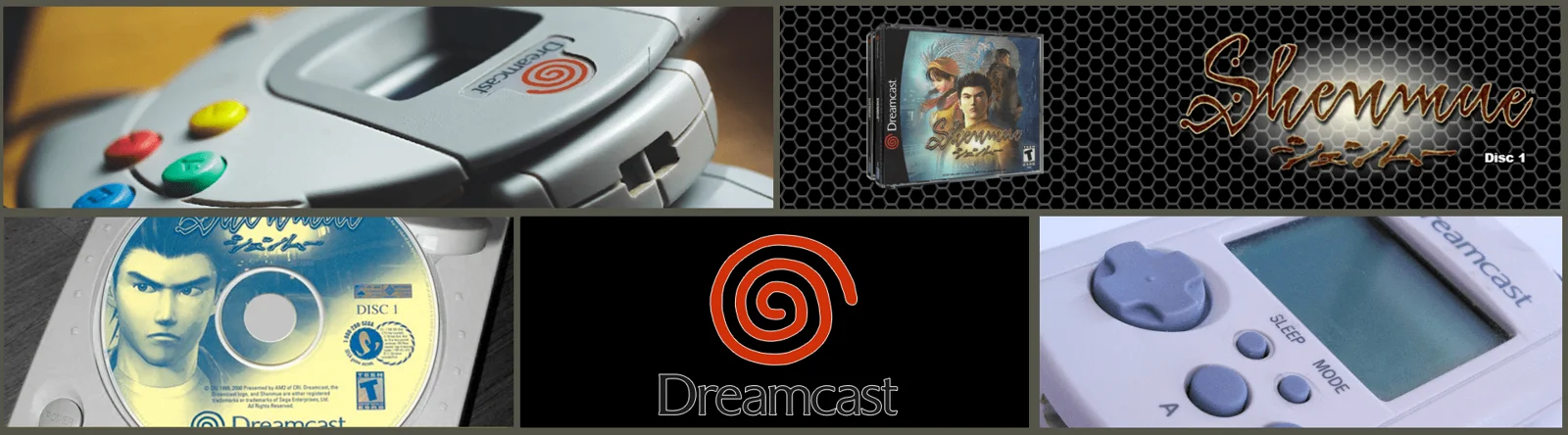
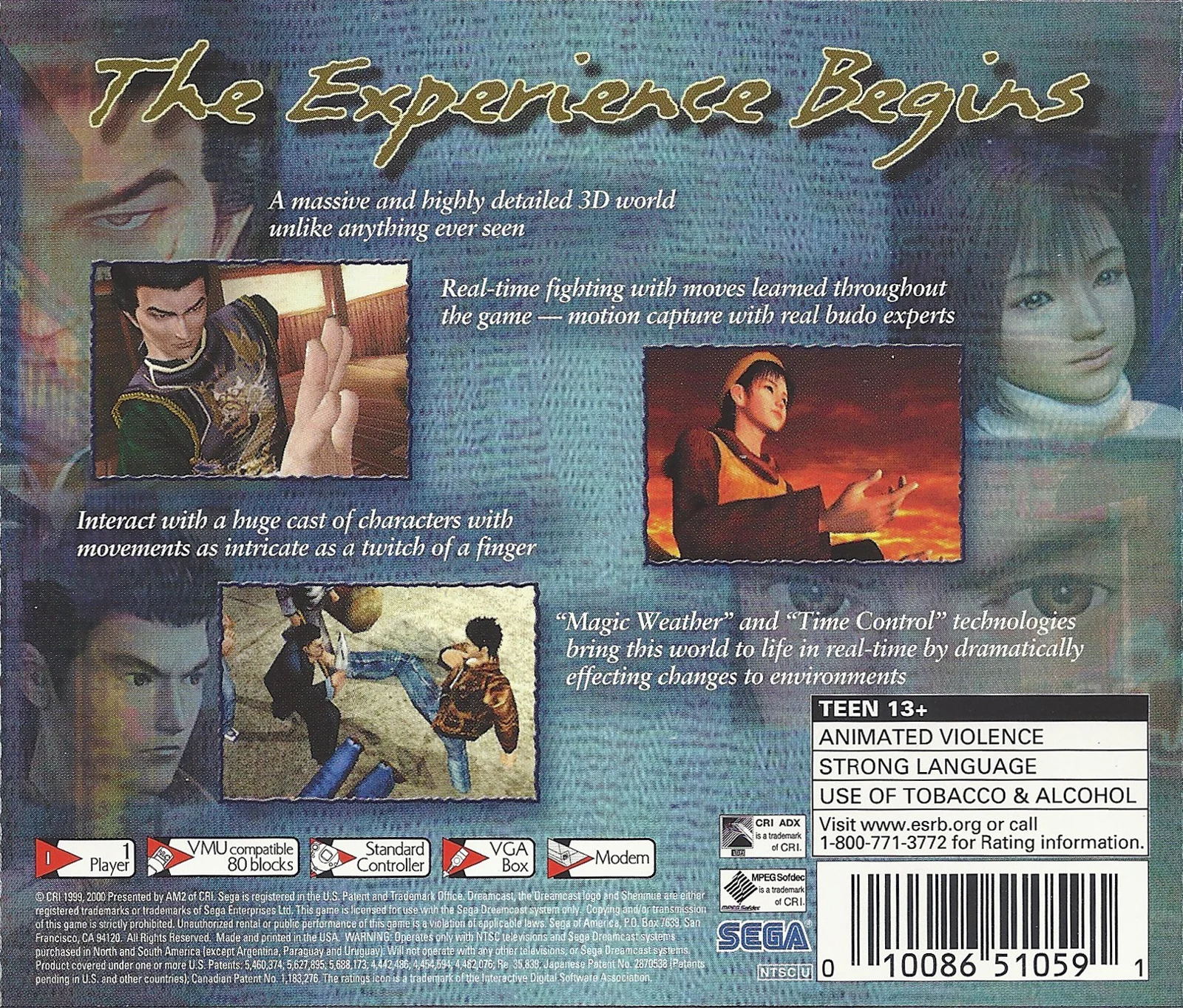
Dreamcast’s software library made the machine unusually difficult to summarize with one genre or audience. Sonic Adventure and Sonic Adventure 2 gave Sega’s mascot a 3D home, while Shenmue pursued detailed environments and an unusually deliberate sense of place. Resident Evil Code: Veronica demonstrated the system’s appeal to cinematic console software. Games such as Grandia II and Skies of Arcadia gave role-playing fans substantial adventures, while Rayman 2: The Great Escape and Legacy of Kain: Soul Reaver broadened the third-party identity of the platform.
Ecco the Dolphin: Defender of the Future showed Sega revisiting one of its own unusual series in a more advanced setting. These games were not interchangeable, and their availability varied by region, but together they show why Dreamcast has remained historically significant even though its commercial life was brief. Sega funded experiments in online play, world simulation, mascot platforming, role-playing and cinematic presentation on one compact system.
Sega announced the end of its console hardware strategy in January 2001, and Dreamcast production and the consumer hardware business were discontinued during 2001. That was the end of a hardware strategy, not the end of Sega as a game company. The company’s later legacy includes ideas that became ordinary elsewhere: arcade-to-home technical exchange, dedicated peripherals, recognizable mascot platforms, console networking and a willingness to make hardware serve unusual game formats.
Sega’s path from arcade machines to Dreamcast was not a simple march toward failure. The company repeatedly converted experience from one market into experiments in another, sometimes finding a powerful fit, as with Mega Drive and Sonic, and sometimes exposing weaknesses in software supply, regional coordination or platform messaging.
The lasting importance of Sega hardware lies in that willingness to test the boundary between arcade and home play. Dreamcast was the final Sega console, but the ideas behind it did not disappear. Networked consoles, arcade-derived technology, distinctive peripherals and software built around strong hardware identities became part of the wider industry Sega had helped shape.