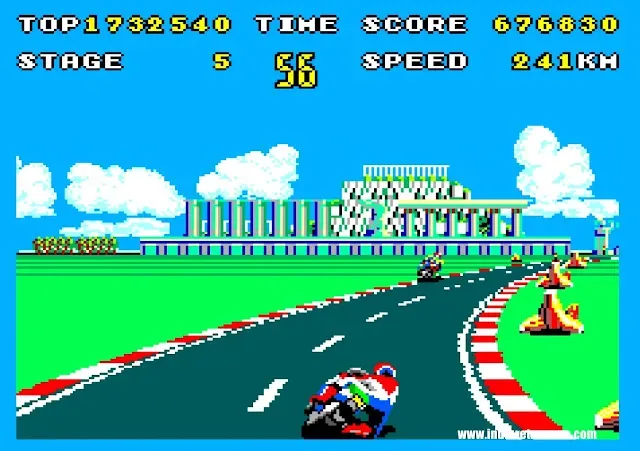
Hang-On Jr. version 1.0 has arrived for the Sega Mega Drive and Sega Genesis. Created by yosoynacho, the release brings the 1986 arcade offshoot of Sega’s motorcycle-racing classic to 16-bit hardware while adding a set of platform-specific options. Its stated performance target is 60 frames per second, and its feature list reaches beyond a straight conversion: an extra MD Mode adds turbo and braking mechanics, while support is included for several control and display configurations, saved scores and configurable sound emulation.
This is a particularly interesting preservation-minded project because Hang-On Jr. is not simply the original arcade Hang-On in a different cabinet. It was a streamlined, lower-cost version developed for Sega System E hardware in 1986, following the 1985 arcade original. That background explains why the Jr. edition has historically had reductions in its visuals and audio compared with its larger sibling, but it also gives the game an identity of its own through course layouts specific to the Jr. release.
A port of the Jr. edition, not a replacement for Hang-On
The appeal here starts with the choice of game. A project based on Hang-On Jr. preserves a particular branch of Sega’s arcade-racing history: one shaped by less powerful hardware and a budget-minded design goal. The new Mega Drive/Genesis version retains the course layouts that distinguish it from the 1985 original, rather than treating the Jr. name as a mere cosmetic label.
That distinction matters for retro players who care about more than a franchise name. Ports can sometimes blur differences between revisions, regions or arcade derivatives in pursuit of a single “definitive” version. This release instead appears to center the Jr. game’s own structure, then provides optional additions in a separate mode. It gives players a reason to approach the traditional version on its own terms, while still allowing the Mega Drive edition to make use of ideas associated with a later entry.
The developer is targeting 60fps for the conversion. In a motorcycle racer built around movement, road reading and reaction time, frame rate is not merely a technical statistic. It determines how frequently motion is updated on screen. A smoother update rate can make the relationship between player input, the changing road and the rider’s position feel more immediate. The stated aim is a responsive arcade-style experience in the home-console setting.
MD Mode adds turbo and braking, with separate records
The headline addition is an exclusive MD Mode. This option incorporates turbo and braking mechanics associated with Super Hang-On. Turbo generally refers to a temporary speed-enhancing mechanic, while braking gives the player an explicit way to reduce speed rather than relying only on steering and momentum. Together, those systems can change how a player approaches a route: when to build speed becomes a decision, and slowing down can become an active response to upcoming turns.
Crucially, MD Mode’s high scores are kept separate from records set in Arcade mode. That is a sensible division for a score-driven racer. Once a ruleset adds mechanics not present in another ruleset, the two score tables no longer represent directly comparable performances. Separate boards preserve the identity of the traditional game while letting the enhanced mode stand as its own challenge.
For players, the split provides a clear choice:
Related coverage includes Hang-On Jr. Version 1.0 Brings Sega’s Streamlined Racer to Mega Drive and Genesis.
- Arcade mode is the place to pursue the traditional Hang-On Jr. rules and its corresponding score records.
- MD Mode offers the added turbo and braking systems, with its own independent high-score competition.
That approach is more thoughtful than replacing the original handling outright. The added mechanics can be useful to players looking for a different feel, but they do not overwrite the core configuration the project is adapting.
Control support reaches beyond a standard pad
The Mega Drive/Genesis release also supports analog input through the XE-1 AP and is compatible with the Sega Mega Mouse. Those options are notable because a racing game’s sense of control often depends on the precision and comfort of steering. Analog control means the game can interpret a range of directional positions instead of only simple on-or-off directional input. In practical terms, that can potentially allow more gradual steering adjustments than a digital directional pad.
The Sega Mega Mouse support is another unusual option for a console motorcycle racer. The supplied details establish compatibility, but do not define a preferred control scheme or explain the exact input mapping. Players interested in experimenting should therefore view it as an additional supported interface rather than assume how it will feel or which method will suit them best.
Providing several input paths is valuable for a retro release because Mega Drive and Genesis setups vary widely. Some players use original controllers and peripherals, while others use alternative hardware arrangements. The feature set recognizes that the hardware ecosystem around an older console is not limited to one controller in one region.
PAL optimisation addresses a real regional difference
Version 1.0 includes PAL 50Hz optimisations. “PAL” refers to video standards used in several regions, and 50Hz describes a refresh environment distinct from the 60Hz standard commonly associated with other territories. A game designed around one timing environment can behave differently in another if timing is not considered carefully.
For a fast racer, that distinction is especially relevant. The supplied information does not detail the exact changes made for PAL systems, so it would be inappropriate to promise identical behavior across every setup. Still, identifying PAL 50Hz optimisation as a specific feature shows that the release accounts for the regional operating environment rather than treating it as an afterthought.
That attention complements the 60fps target without confusing the two claims. The former is the project’s stated performance goal; the latter acknowledges a separate display-timing context. Both are part of the broader challenge of making a responsive game function appropriately across Mega Drive and Genesis hardware circumstances.
SRAM saving makes scores and settings less disposable
SRAM support is included for high scores and custom configurations. SRAM, short for static random-access memory, is a type of memory that can retain data when supplied with backup power. In cartridge-era terms, it is commonly associated with keeping saves or settings available after the console is switched off.
Here, its practical role is straightforward: a player’s score progress and personalized configuration do not have to vanish at the end of every session. For an arcade-style game, saved high-score tables can add meaningful continuity. Improving a result over time is a different proposition when a record persists, particularly when the release distinguishes the traditional and MD Mode leaderboards.
Saved custom configurations are equally important. A game that supports multiple control possibilities and settings becomes easier to return to if players are not required to rebuild their preferred setup every time. The release is still rooted in a short-form arcade design, but SRAM gives that design a more durable home-console rhythm.
A custom Z80 driver recreates the secondary sound-chip approach
One of the more technical elements is the custom Z80 driver intended to recreate the arcade machine’s secondary sound chip. The Z80 is a processor architecture with a long history in game hardware. In this release, the important point is not simply that a technical component has been named: the driver is meant to address the sound behavior associated with the original arcade setup.
Audio is a significant part of arcade character, especially in a racing game where engine-like effects, movement cues and music contribute to the sensation of speed. The original Jr. hardware had historical audiovisual compromises relative to the better-known 1985 arcade game. Recreating its secondary sound-chip behavior is therefore aligned with the project’s interest in the distinct Jr. edition rather than only importing a generic Hang-On presentation.
There is also a dipswitch-menu option to turn the custom Z80 driver off. A dipswitch is traditionally a small physical switch used to set machine options; in this context, the term describes an in-game configuration menu modeled on that kind of arcade adjustment. The toggle gives users a direct choice over this sound feature. The supplied details do not say how the audio differs when it is disabled, but the option is useful for anyone who wants to compare configurations or tailor the presentation to their preference.
What this release means for Mega Drive and Genesis players
Hang-On Jr. version 1.0 is best understood as both a port and a tailored reinterpretation. It preserves the Jr. edition’s separate course designs and traditional mode, yet it is not locked to a museum-piece approach. MD Mode introduces additional mechanics; peripheral support broadens input choices; PAL optimisation recognizes regional display conditions; SRAM gives players persistent records and settings; and the sound driver addresses a specific piece of arcade hardware behavior.
The result is a package with two complementary priorities. One is maintaining the identity of a 1986 lesser-powered arcade variant. The other is making deliberate use of the Mega Drive/Genesis environment rather than presenting the game with no console-focused accommodations at all. The separation of high-score tables may be the clearest expression of that balance: preserve an arcade-oriented ruleset, then offer an enhanced alternative without mixing their results.
It also lands at a time when retro hardware projects continue to explore what dedicated console support can look like beyond a bare-bones conversion. For another recent example of activity around modern retro-focused hardware, see the Transparent SuperStation One console news. Hang-On Jr. takes a different route, focusing on a specific Sega racer and original Mega Drive/Genesis hardware considerations.
For anyone drawn to Sega’s arcade-racing lineage, the key details are clear: this is a Mega Drive/Genesis release of Hang-On Jr., it aims for 60fps, it retains the Jr. edition’s unique courses, and it offers both a traditional Arcade mode and a separate MD Mode with turbo and braking. The peripheral, regional, sound and saving options round out a release designed to make that compact arcade offshoot feel considered on the 16-bit console.