Major story spoilers for Suikoden III follow.
Suikoden III arrived on PlayStation 2 in 2002 with an unenviable job: follow two beloved role-playing games while translating a sprite-driven series into a fully 3D world. Its visual change was obvious, but its more ambitious move was structural. Rather than tell one hero’s march from village to final fortress, Suikoden III asks players to live through the same conflict from several positions inside it.
That approach is called the Trinity Sight System. Early chapters rotate among Hugo of the Grasslands, Zexen knight Chris Lightfellow and the mercenary commander Geddoe. Optional chapters later bring Thomas of Budehuc Castle into the mix, while a further unlockable chapter gives Luc’s side of the story additional weight. The result is not a set of disconnected “what if?” routes. It is a deliberately assembled account of a war, in which every participant possesses part of the truth and almost nobody has enough of it.
For a series often associated with recruiting 108 Stars of Destiny and building an army, that is an especially fitting idea. Suikoden III is concerned with leadership, certainly, but it is equally interested in the distance between an official history and the people asked to survive it.
A war seen from three directions
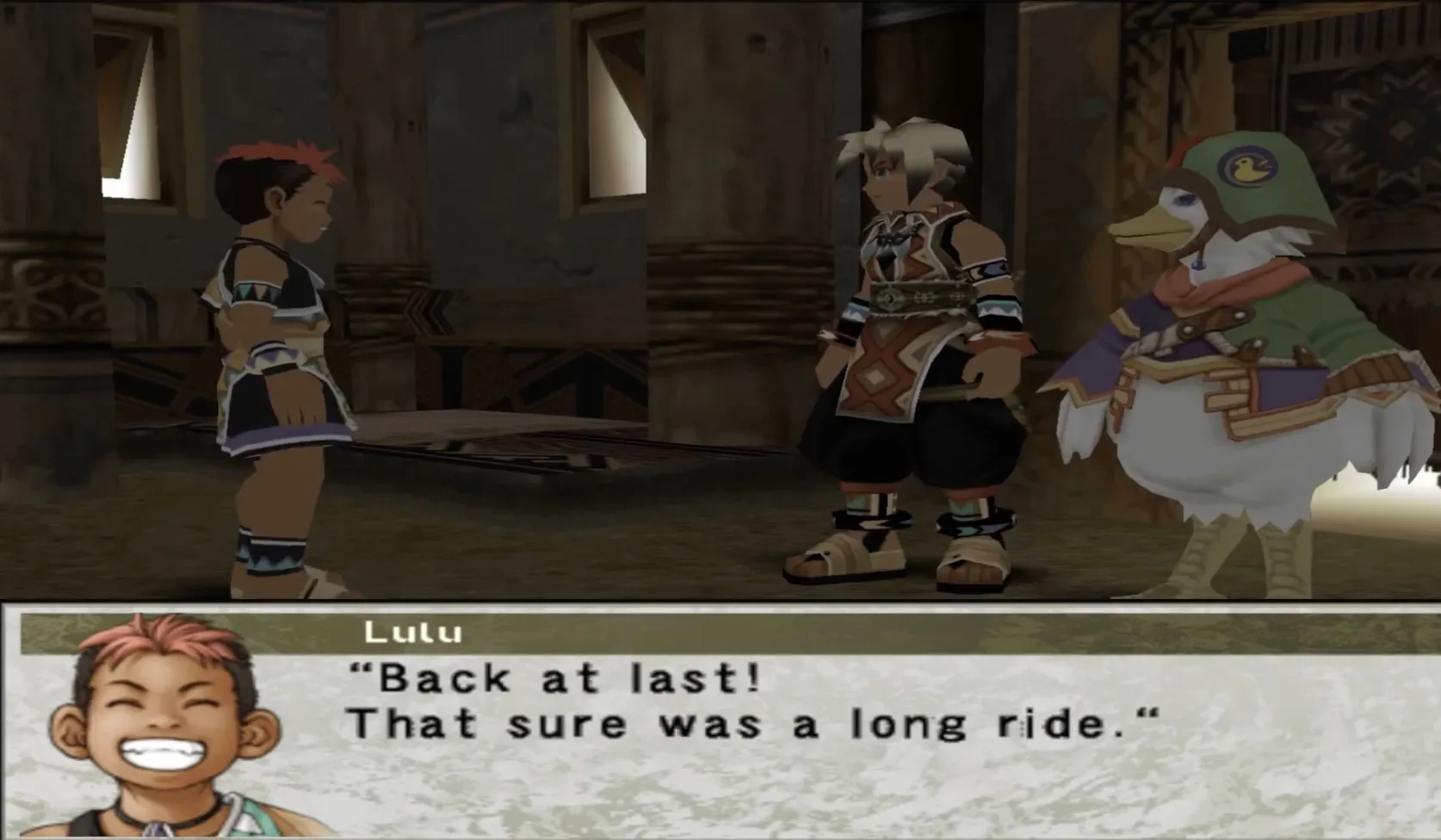
The central conflict pits the Grasslands’ six clans against the wealthy, trade-oriented Zexen Federation. Hugo begins as the most recognizable kind of JRPG lead: a young warrior, son of Karaya’s chief, setting out on a consequential errand with friends including Lulu, Sergeant Joe and the griffin Fubar. His mission to carry a message tied to peace negotiations should be simple. It immediately becomes an illustration of how prejudice, protocol and misinformation can turn diplomacy into disaster.
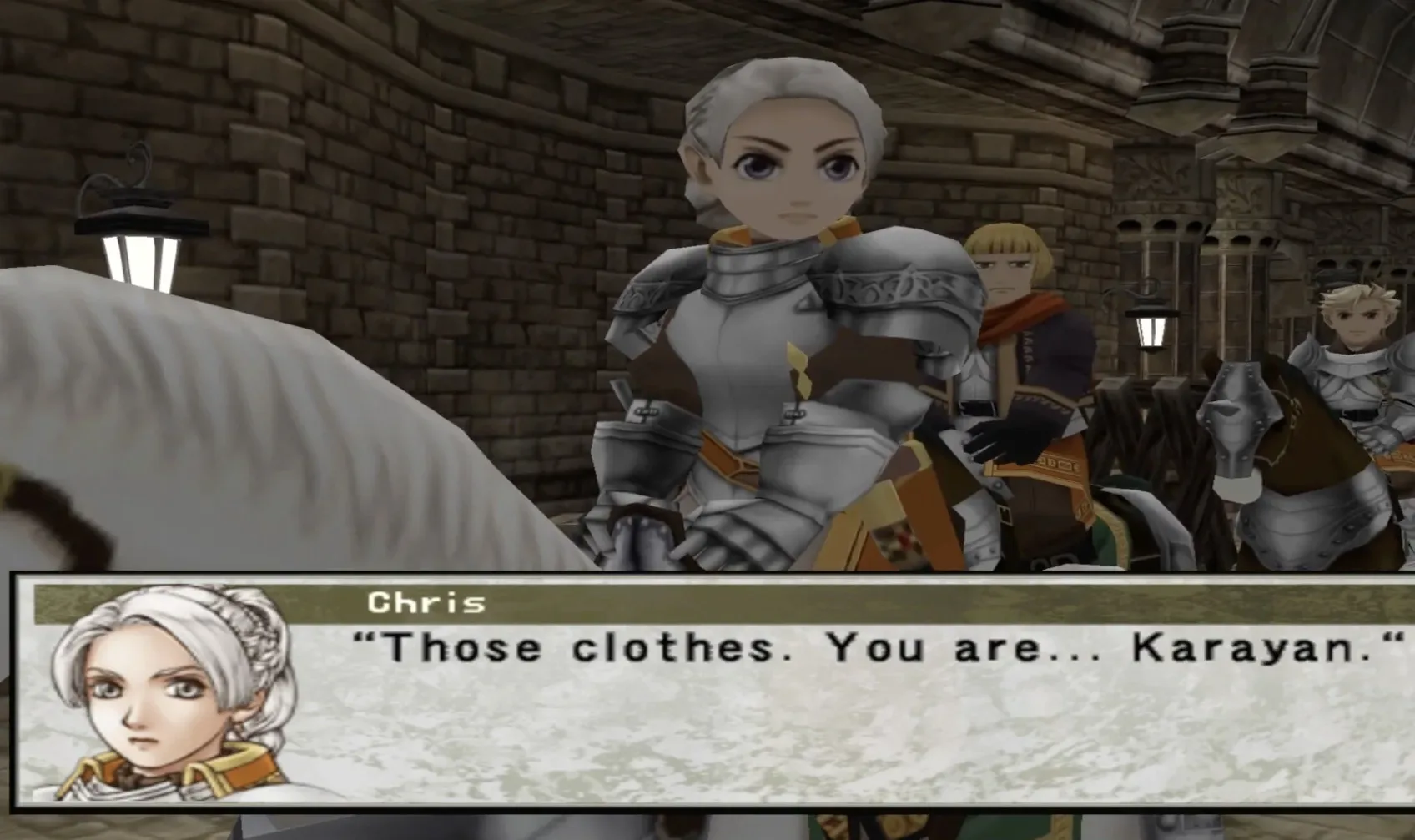
In Zexen territory, Hugo is dismissed and delayed because he is a Grasslander. A meeting that matters to his people is buried under administration and prejudice. He also encounters Chris at Brass Castle. The two are civil enough, but the mood becomes tense when Roland, one of Chris’s knights, makes it clear that Grasslanders are not treated as equals. Hugo recognizes Chris’s family name because he has been entrusted with a pentacle intended for the Lightfellows, along with a cryptic message from the Karayan resident Jimba.
Small details such as that armor and pentacle become vital much later. Suikoden III loves these apparently incidental fragments because they show how personal memory can outlast, complicate or contradict public accounts of war.
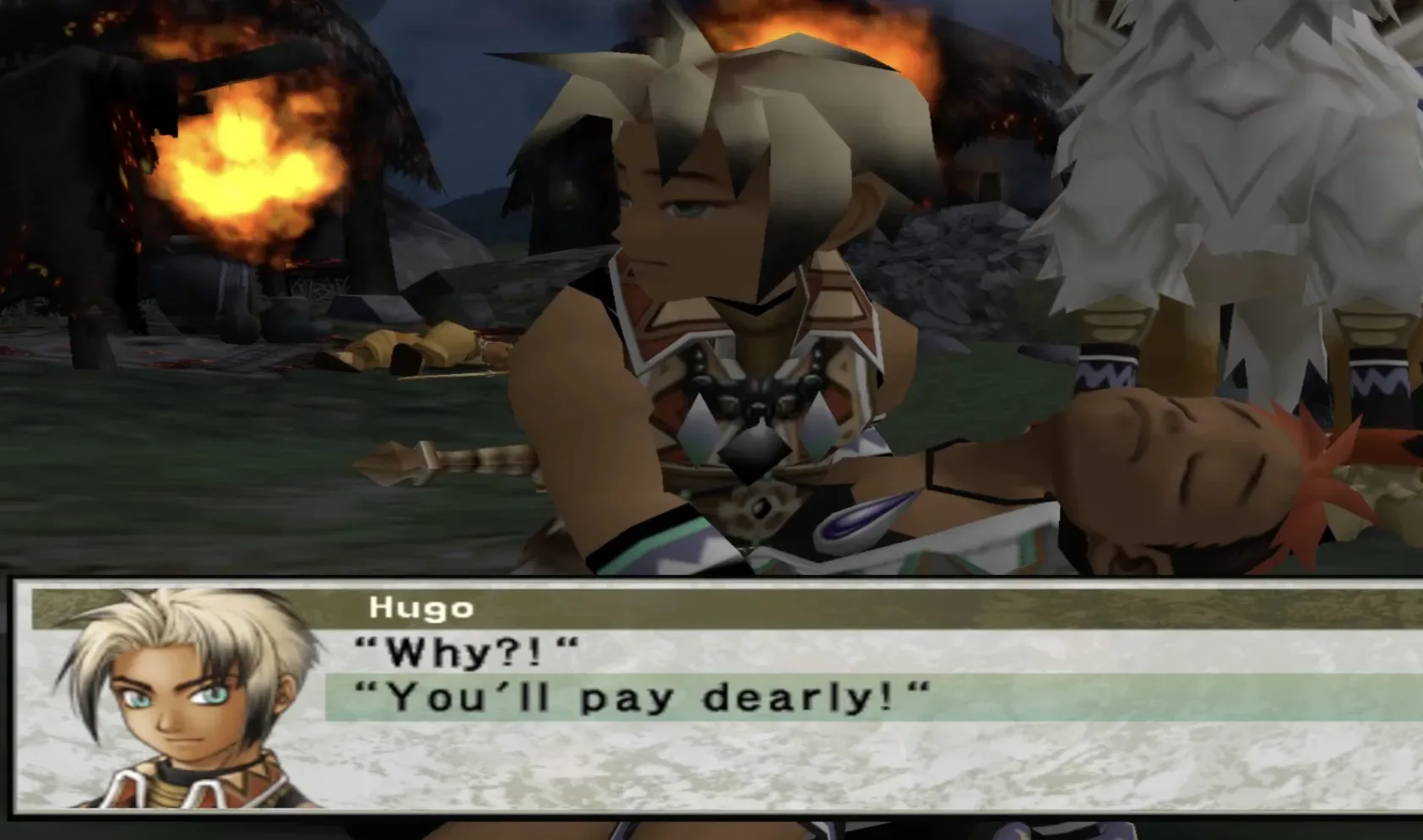
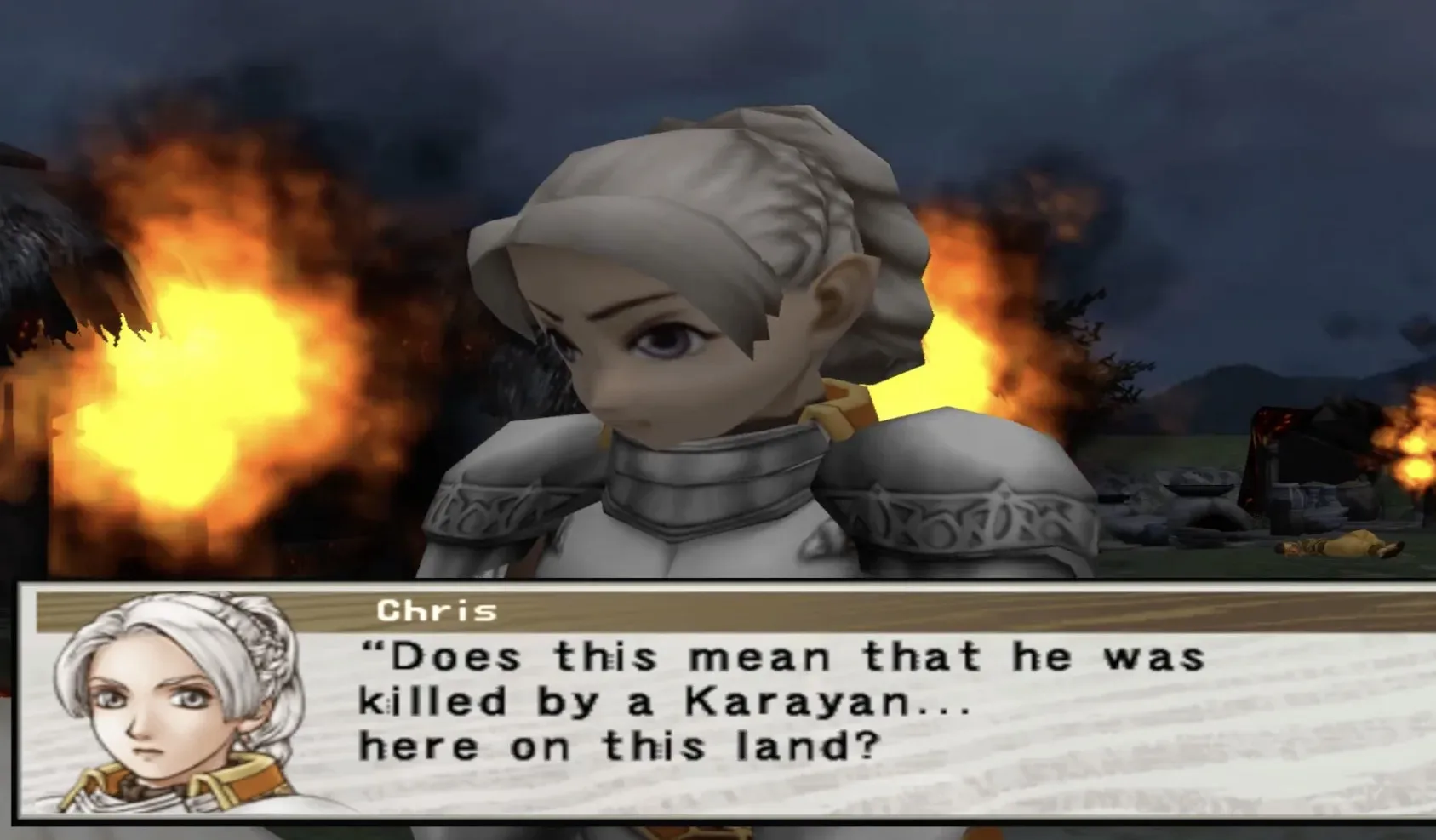
Hugo’s route soon grows devastating. The Grassland-Zexen peace process collapses amid accusations of a surprise attack, and Karaya is subsequently set ablaze. In the violence, Lulu attacks Chris and Chris kills him while defending herself. From Hugo’s viewpoint, this is an unforgivable act committed by a Zexen hero amid an assault on his home. The aftermath, including Lulu’s burial and the task of informing his mother, gives the opening chapters uncommon emotional force.
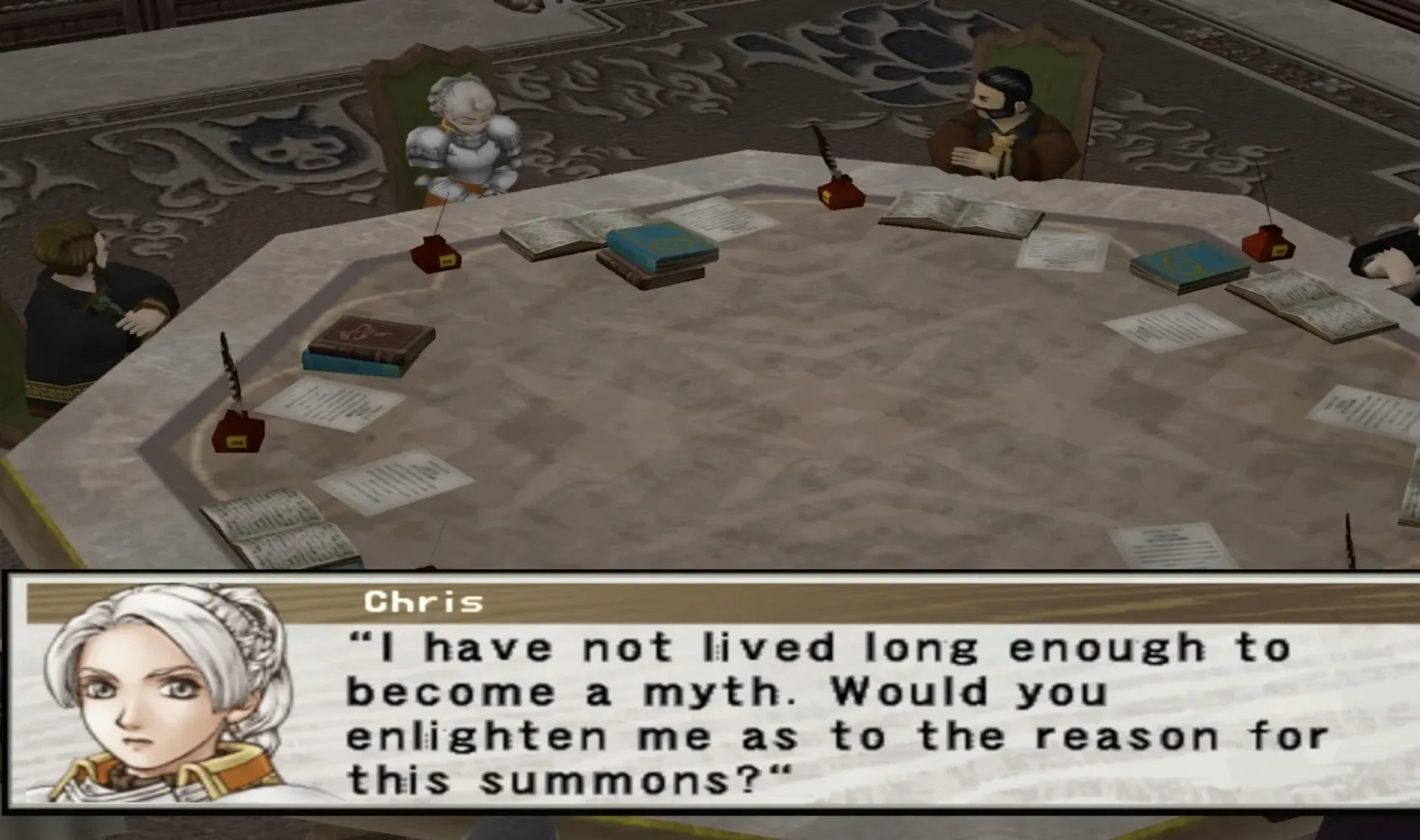
Then Chris’s chapter reframes the same stretch of events without pretending that tragedy did not occur. In Zexen, Chris is celebrated as a heroic figure, but the praise makes her uncomfortable. Zexen’s council sees her reputation as a political instrument, and she understands that her image can be used to influence the population. Where Hugo sees an institution that treats his people with contempt, Chris sees the machinery of that institution from within—and recognizes how little control she has over it.
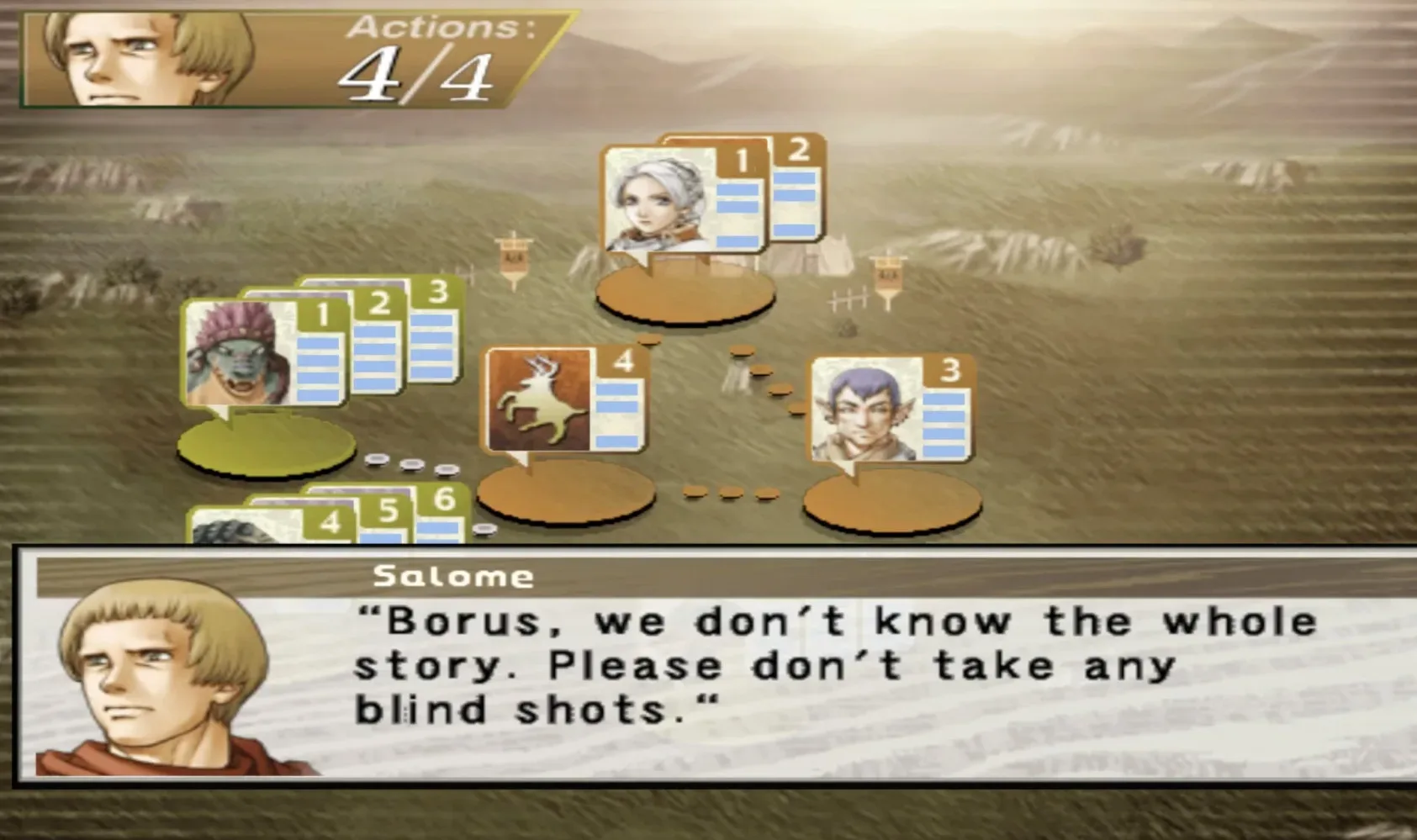
Her version of the crisis adds crucial context. Following an ambush, the Zexen force is under severe pressure. Salome proposes burning a Karayan village to force enemy troops to pull back, with the instruction that civilians should not be harmed. The operation spirals into a massacre after Borus loses control of the soldiers. Chris arrives amid a situation already beyond its stated limits, discovers armor connected to her missing father outside Jimba’s home, and reacts emotionally at the worst possible moment. Lulu’s death remains awful, but it is no longer a neat example of one villain hurting one innocent.
This is what makes the Trinity Sight System more than a novelty. The game does not demand that players decide Hugo was wrong to grieve or that Chris should be excused for all that happened under her command. Instead, it makes room for both realities. Anger can be understandable. So can regret. Neither feeling repairs the dead or instantly dissolves the structures that helped create the conflict.
Geddoe and the missing pieces
Geddoe’s route supplies the third crucial angle. As leader of the 12th branch of the Southern Frontier Defense Force, he and his group move through the margins where the Grasslands, Zexen and Harmonia intersect. Geddoe also carries a larger secret: he is a True Rune bearer who fought beside the original Flame Champion decades earlier.
His chapters place the player close to evidence that neither Hugo nor Chris can see. The apparent assassination of the Lizard Clan chief is particularly important. It suggests that an impostor wearing Chris’s face may have created one of the war’s most explosive provocations. Suddenly, the Grasslander ambush of the Zexen knights cannot be read merely as betrayal, and Chris’s retaliation cannot be separated from a deception she did not know existed.
Suikoden III’s multiple viewpoints are therefore less about radically incompatible versions of events than about withheld information. Each perspective has blind spots. The player gets closer to understanding only by traveling through all of them. That is a substantial narrative achievement for a PS2-era JRPG, and it remains a useful counterpoint to stories where “multiple paths” only amount to different cutscenes around the same simple moral answer.
It also helps explain why the game’s conflict feels larger than a clash with a single monstrous enemy. Earlier Suikoden games feature formidable, memorable opponents, including Luca Blight and Jowy. Suikoden III is more absorbed by the systems that turn fear into policy, propaganda into public certainty, and incomplete knowledge into violence.
Thomas proves that rebuilding is heroic
Thomas’s optional chapters may initially sound quieter than the main campaign. He is the rejected son of a Zexen councilman and a Grasslander mother, sent to oversee the worn-down Budehuc Castle after his father refuses to acknowledge him. He is neither a mighty fighter nor a dazzling magician. He is shy, hesitant and often overwhelmed.
That is exactly why his arc matters. Thomas rebuilds a home by recruiting people, resolving disputes, navigating legal technicalities and creating a trading space where Zexens and Grasslanders can do business together. Repairing Budehuc’s elevator is treated with a level of delight that suits a story about community: progress is sometimes a battlefield victory, but it can also be getting access to another floor of a neglected castle.
His status as the series’ only Tenkai Star who is not the principal protagonist is meaningful. Thomas becomes a leader not because destiny gives him the right clothes or a legendary blade, but because other people begin to trust his sincerity. Budehuc’s free-trade project attracts scrutiny from the Zexen establishment precisely because it operates beyond council control. A modest effort to make room for ordinary people becomes politically dangerous.
The castle’s recruitment focus also connects Suikoden III to the series’ defining pleasure. Players still work toward gathering 108 characters, and recruitment can involve everything from helping Kathy’s horse-related challenge to solving Kidd’s unusual duck murder case. Edge’s Star Dragon Sword also carries a link to Viktor from earlier entries. These diversions are not merely checkboxes; they give the setting texture and make Budehuc feel like a place assembled by personalities rather than an abstract headquarters.
Its rough edges are real
Suikoden III’s storytelling does not erase its design frustrations. Travel uses connected map nodes, but revisiting a cleared region still means entering and walking across that area. Before fast travel becomes available through Viki and the Blinking Mirror, repeated journeys can make the opening feel considerably slower than it needs to be.
The game changes regular combat as well. Six party members are arranged into three linked pairs, so players directly command three units while partners act alongside them. The system encourages planning around pair combinations and special cooperative attacks, including Chris’s links with Zexen knights and mounted pairings such as Hugo and Fubar. Still, players who prefer the complete individual control offered by the first two games may find the adjustment limiting.
Army battles are another compromise. Their simple node-map presentation lacks some of the visual scale associated with Suikoden II’s conflict scenes. Training becomes especially important because skills such as Swing, Accuracy and Heavy Damage can make a major difference, while weapon upgrades remain manageable thanks to the series’ approach of strengthening a character’s existing weapon rather than constantly replacing it.
Those limitations are part of the game’s legacy as a first PS2 Suikoden, a release that took real risks during a hardware transition. For another look at a PlayStation series whose future has prompted questions about whether a return would be a remake or remaster, see our coverage of Killzone’s uncertain PlayStation comeback.
The Flame Champion and a conflict over fate
Once the original Flame Champion is found to have died long before the present crisis, Hugo, Chris or Geddoe can take up the mantle. Hugo is the canonical selection, though each choice offers a different personal emphasis. Chris’s path, for instance, reveals the full significance of Jimba and the armor he kept outside: he is her father, a True Water Rune bearer who stayed away to protect his family from Harmonian pursuit.
By the fourth chapter, the separate routes converge around the new Flame Champion. Yet the game’s final threat remains tied to perspective. Luc, the magician familiar to players of the prior games, becomes playable after all 108 characters are recruited. His route presents a villain motivated by a vision of a desaturated future, one in which the Guardians hunt humanity. Convinced that the future must be prevented, he engineers a wider war so he can assemble the True Runes and destroy his own True Wind Rune.
Luc accepts that his plan could cost more than a million lives. His certainty is horrifying, but Suikoden III refuses to make his fear totally incomprehensible. His vision may be genuine, yet it is still only a possible history. The game leaves room for the disturbing possibility that the desperate attempt to escape fate could help bring that fate into being.
That uncertainty is why Suikoden III remains so compelling. Its heroes do stop Luc, but the ending does not offer a frictionless promise that every wound is healed or every feared future has vanished. Hugo, Chris, Geddoe and Thomas all carry responsibility in different ways. Their world is not saved because one perfect hero defeats pure evil. It changes because people with incompatible experiences finally learn enough to stand together.