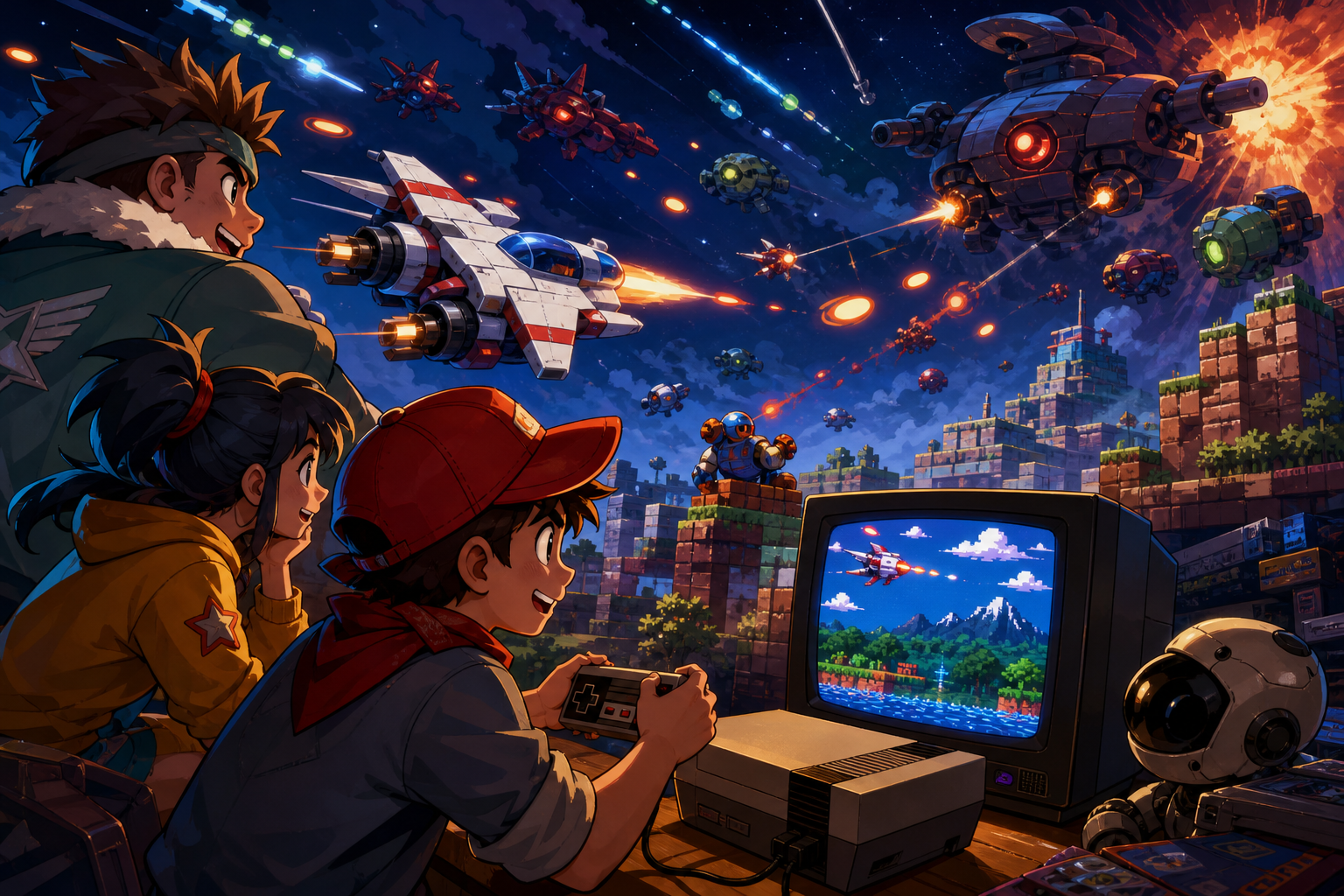
The Nintendo Entertainment System’s shoot ’em ups are easy to overlook beside its platformers, action games and role-playing adventures. That is a mistake. The system received compact arcade conversions, ambitious original designs and hybrid shooters that found clever ways to make limited hardware feel busy, dangerous and unpredictable.
This ranking focuses on North American NES releases and treats shoot ’em ups broadly enough to include spacecraft, aircraft and character-based vertical shooters. Every choice must have scrolling combat at its core, not merely shooting as one feature in a larger adventure. The order weighs weapon design, stage variety, enemy patterns, difficulty curve, multiplayer value and the reasons a game remains interesting after the first clear. Arcade accuracy matters, but it is not the only measure: a strong NES-specific system can matter just as much as a faithful conversion.
10. Gun.Smoke
Gun.Smoke earns the final place because it turns the familiar vertical shooter into a western gunfight. Instead of piloting a ship, the player controls a bounty hunter moving upward through frontier stages, with enemies arriving from roads, buildings and surrounding terrain. That change of viewpoint gives the game an identity that does not depend on science-fiction scenery.
Its three firing directions are the central idea. The arrangement encourages players to think about where enemies are approaching from rather than simply holding fire straight ahead. Weapon pickups and boss encounters add variety, although the basic structure can feel more repetitive than the deeper systems higher on this list. Gun.Smoke is best for players who want a fast, immediately readable shooter with a character-driven setting and a different relationship between movement and aiming.
- Best fit: players who want a western setting and simple vertical shooting.
- Tradeoff: less weapon-management depth than Gradius, Zanac or Gun-Nac.
9. Star Soldier
Star Soldier is a straightforward vertical space shooter built around enemy waves, power-ups and memorized attack patterns. Its appeal comes from clean arcade structure: the screen keeps advancing, enemies demand quick positioning, and the player gradually learns which threats deserve immediate attention. It does not need a complicated story or elaborate menu to communicate its priorities.
The game is a useful choice for players who prefer traditional shooter rhythm over role-playing progression. Power-ups can change the feel of a run, but survival still depends heavily on movement discipline and knowing how formations behave. That makes Star Soldier less forgiving than an entry-level shooter, while also giving repeated attempts a clear purpose. It is a solid representative of Hudson’s space-shooter lineage, even if later NES games offer more dramatic mechanical variety.
- Best fit: fans of direct, pattern-focused vertical shooters.
- Tradeoff: comparatively conventional structure and limited thematic variation.
8. Abadox: The Deadly Inner War
Abadox stands out immediately through its setting. The player fights through the interior of a giant alien organism, turning familiar caves, tunnels and biological hazards into the stage scenery. That visual concept gives the game a stronger personality than a generic outer-space campaign, and its side-scrolling format provides a useful contrast with the vertical games dominating the middle of this list.
The defensive equipment is the important mechanical distinction. Blue power capsules can provide weapons, shields and armor, including an orbiting barrier that changes how closely the player can approach danger. Shooting remains essential, but defensive timing becomes part of the route through hazardous sections. Abadox can be demanding and its presentation is more memorable than its overall balance, but it remains an excellent pick for anyone who wants a shooter whose world design is inseparable from its combat.
- Best fit: players attracted to unusual settings and side-scrolling combat.
- Tradeoff: harsher difficulty and less flexible progression than the top entries.
7. S.C.A.T.: Special Cybernetic Attack Team
S.C.A.T. is one of the NES library’s most useful two-player shooters. Its horizontal stages support one or two cybernetic soldiers, and the player can move in four directions while dealing with enemies entering across the screen. That freedom makes positioning more deliberate than in a strictly ground-bound run-and-gun game, especially when hazards and enemies arrive from above or below.
The twin satellites are the game’s defining weapon idea. They orbit the player until the A button locks them into a firing position, allowing the player to decide whether they should follow movement or cover a particular angle. Weapon pickups add laser, wide-beam and bomb options, while speed and recovery items affect survival rather than simply increasing damage. S.C.A.T. is also known as Final Mission in Japan and Action in New York in Europe, so regional references can make research and discussion confusing. Its campaign is not as expansive as Gun-Nac’s, but its cooperative structure and satellite control make it a strong choice for shared sessions.
- Best fit: two players who want horizontal action and controllable satellite weapons.
- Tradeoff: shorter-feeling progression and less replay variety than the leading vertical shooters.
6. Dragon Spirit: The New Legend
Dragon Spirit: The New Legend replaces the expected spacecraft with a fire-breathing dragon and builds its identity around the contrast between air targets and ground targets. That gives each stage more to read than a single stream of enemies. The player must handle threats above while watching the terrain below, creating a fuller sense of battlefield management than a purely forward-facing shooter.
The dragon theme is not just decorative. Power-ups improve the dragon’s offensive capabilities and can change the way a run develops, while mistakes can cost progress and leave the player vulnerable. The game’s vertical structure remains recognizable, but its fantasy presentation separates it from the many machines-and-stars shooters on NES. It is a good recommendation for players who want shooting mechanics with a strong character premise, though those seeking the most intricate weapon economy will find deeper options elsewhere.
- Best fit: players who want fantasy imagery, vertical action and ground-target pressure.
- Tradeoff: recovery after mistakes can be less comfortable than in games with broader weapon systems.
5. 1943: The Battle of Midway
1943 gives the NES shooter a more structured form of aircraft combat. Rather than treating the player’s plane as a disposable firing platform, the adaptation uses an energy bar, special weapons and upgradeable aircraft characteristics. That adds a layer of resource judgment to the familiar task of clearing enemy formations and surviving boss encounters.
The result is more than a basic arcade conversion. Energy management changes how aggressively a player can approach a stage, while upgrades create reasons to think about the aircraft as a developing tool rather than a fixed avatar. Its historical setting is more grounded than the fantasy and science-fiction alternatives here, and that can make the repeated enemy waves feel more like a campaign. 1943 is a strong middle-ground recommendation: accessible enough to understand quickly, but structured enough to reward planning beyond simply firing continuously.
- Best fit: players who want aircraft combat with upgrades and resource decisions.
- Tradeoff: its military presentation may feel less imaginative than Abadox or Dragon Spirit.
4. Gradius
Gradius belongs near the top because its power meter makes every pickup a decision. Capsules move the player through a sequence of speed, missiles, lasers, options and defensive equipment. Activating the next item immediately can create a stronger ship, but waiting can preserve flexibility or avoid selecting an upgrade at the wrong moment. That risk-and-reward structure gives the game a strategic layer without interrupting the action.
The NES version has clear limitations compared with more powerful versions of the concept, yet the design remains legible and influential. Stage hazards, enemy formations and power-up timing work together, so learning the game means learning both routes and equipment priorities. Gradius is an excellent starting point for newcomers who want to understand why weapon systems matter in a shooter. It ranks below its NES successor because its stage variety and cooperative possibilities are narrower, not because its central idea is weak.
- Best fit: newcomers who want a clear, meaningful power-up system.
- Tradeoff: losing a powered-up ship can make recovery especially difficult.
3. Life Force
Life Force takes the Gradius foundation and gives it a more varied campaign. Its six stages alternate between horizontal and vertical scrolling, so the player must adjust to different approaches to positioning, enemy entry points and hazards. That change of direction helps the game feel like a sequence of distinct challenges rather than one repeated corridor.
The simultaneous two-player mode is a major reason Life Force deserves its own ranking position. Cooperation changes how players manage power-ups, screen space and incoming threats, although it can also make the action crowded. The weapon system retains the familiar decision-making of the Gradius family, while the stage structure gives it a broader rhythm. Life Force is the best choice here for players who want a recognizable upgrade system paired with variety and co-op rather than a purely solo endurance test.
- Best fit: co-op players and fans of alternating horizontal and vertical stages.
- Tradeoff: screen congestion and shared mistakes can make difficult sections harder with two players.
2. Zanac
Zanac is the list’s most aggressive shooter before the top spot. Its vertical stages move quickly, enemy appearances can feel relentless, and the player must make weapon decisions while the screen is already demanding constant movement. The game is associated with an adaptive enemy-generation approach, which helps explain why repeated runs do not simply become a matter of memorizing one fixed sequence.
That pressure rewards players who learn to control the pace of the screen rather than react to every threat at the last second. Weapon selection matters because different situations call for different ways of clearing formations, and losing control can cause danger to compound rapidly. Zanac is not the friendliest first shooter, but it offers exceptional replay value for players who enjoy improvement through repeated attempts. Its intensity and responsiveness put it ahead of the more methodical entries.
- Best fit: experienced players who enjoy fast pressure and adaptive-feeling enemy patterns.
- Tradeoff: its speed and recovery demands can overwhelm beginners.
1. Gun-Nac
Gun-Nac is the strongest overall NES shoot ’em up because it combines a flexible weapon system, confident pacing and a personality all its own. Its vertical shooting is wrapped in a deliberately whimsical science-fiction setting, so the game never feels like an anonymous sequence of metallic corridors. The tone makes the action memorable without replacing the mechanical focus that keeps each stage moving.
The weapon economy is the real reason it takes first place. Players can collect different weapon types, improve their firepower and choose among several bomb types. Money earned during stages can be spent in a supply shop between areas, where the player can buy weapons, firepower increases, wings and additional bombs. That structure gives a run more shape than a simple stream of temporary pickups. Gun-Nac also offers selectable difficulty levels and a ricochet option, giving experienced players reasons to return after learning the basic route.
Gun-Nac does not erase the achievements of Gradius, Life Force or Zanac; it wins because it balances their best qualities with a more welcoming sense of progression and a setting that is impossible to confuse with another NES shooter. It is the most complete package here for players who want weapon experimentation without giving up the immediate rhythm of a scrolling shooter.
- Best fit: players who want the strongest mixture of weapons, pacing, humor and replay value.
- Tradeoff: its purchasable systems are less purely arcade-like than Star Soldier or Gradius.
The best starting point depends on the kind of shooter you want. Gun-Nac is the broadest recommendation, Gradius explains the classic power-meter design, Life Force is the co-op pick, Zanac supplies the sharpest pressure, and Abadox or Dragon Spirit offer the strongest departures from standard spacecraft imagery.
Taken together, these games show that NES shoot ’em ups were not one uniform style. Horizontal and vertical scrolling, alternating stage directions, character-based firing, controllable satellites, defensive shields, aircraft upgrades and purchasable weapons all fit within the system’s compact format. The most rewarding choice is the one whose central system matches the way you enjoy learning a shooter.