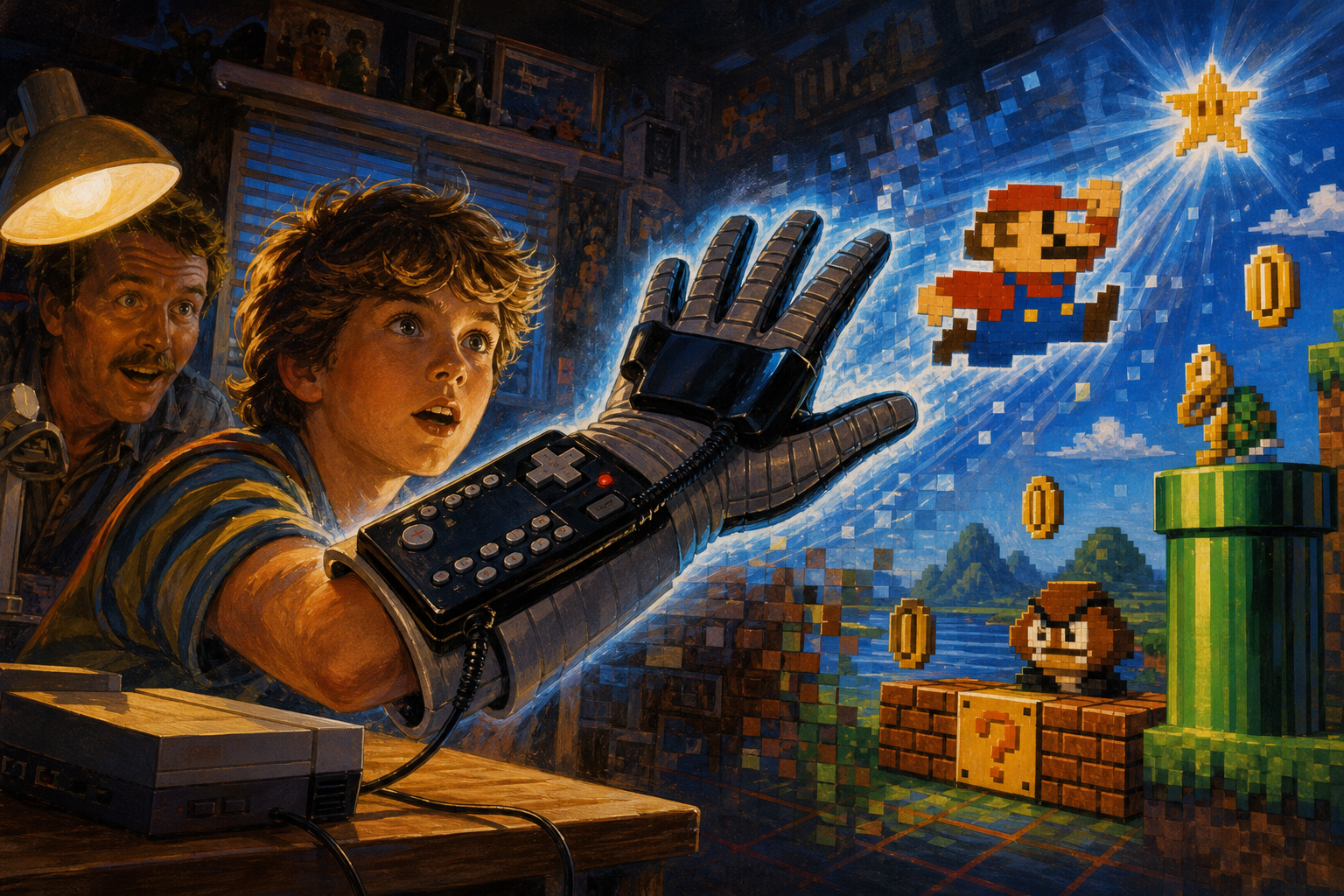
The Power Glove arrived in North America in 1989 as one of the most visually dramatic accessories ever licensed for the Nintendo Entertainment System. It was not a Nintendo-designed controller, and it was not a self-contained virtual-reality system. Instead, it was a Mattel product developed around technology associated with early data gloves, reshaped for a mass-market console and television.
Its promise was easy to understand. Put on the glove, move your hand through the air and control games without relying entirely on the familiar NES controller. The product’s advertisements and demonstrations suggested boxing with your fist, steering vehicles with your hand and directing characters through gestures. The reality was more complicated: calibration was part of normal use, the sensing area imposed restrictions, and most NES games had been designed around a directional pad and two face buttons.
That tension makes the Power Glove worth studying. It was an ambitious attempt to bring experimental interface technology into an ordinary home, but it arrived before the hardware and software ecosystem could make the idea dependable. This history follows its research roots, physical design, software support, regional versions, launch reception and continuing influence without treating the accessory as either a miracle of engineering or a simple punchline.
From DataGlove research to a mass-market NES product
The Power Glove’s ancestry reaches back to VPL Research and the DataGlove, a high-cost interface associated with early virtual-reality work. VPL’s technology was designed to interpret hand position and finger movement for computer systems. That made it important in research and demonstration environments, but the equipment was far removed from the price, simplicity and durability expected of a children’s electronic toy.
Abrams/Gentile Entertainment adapted the basic idea for a very different purpose. Rather than create a new console or a complete virtual-reality environment, the company developed a wearable controller that could communicate with Nintendo’s existing hardware. The choice gave the project an enormous potential audience: NES owners already had televisions, game cartridges and a familiar controller standard. The challenge was converting complex physical movement into signals that an eight-bit console could use.
Mattel handled the North American product, while Nintendo licensed the accessory rather than designing and manufacturing it directly. That distinction matters. The Power Glove belonged to Nintendo’s licensed hardware ecosystem, but it was not a first-party Nintendo controller in the same sense as the standard NES gamepad. Its development, marketing and software strategy involved companies trying to translate laboratory technology into a commercial toy on a very compressed schedule.
A glove, an ultrasonic sensor array and a control panel
The consumer Power Glove combined three important elements: a wearable glove, a sensor assembly placed near the television and a forearm-mounted control panel. The Mattel instruction material describes three connected sensor units arranged around the display. The glove emitted high-frequency ultrasonic signals, and the sensor assembly used those signals to determine the hand’s position and orientation within a defined area.
Finger-bending sensors added another layer of input. The glove could detect selected changes in the player’s hand shape, allowing certain gestures to be mapped to commands. It did not reproduce every finger as an independent, high-resolution input, and the pinky was not treated as a separate gameplay control in the consumer design. The system therefore offered a simplified interpretation of the hand rather than a complete digital model of it.
The forearm panel made the Power Glove partly a motion controller and partly an alternative NES controller. It included a directional pad, A and B buttons, Start and Select, a numeric keypad, Program and Enter controls, a Center function and features associated with rapid fire and slow motion. This mixture was practical but also revealing. The glove looked like a futuristic interface, yet it still needed conventional buttons and a familiar control layout to cover the games that motion input could not handle gracefully.
Centering was essential. The player established a reference point before using motion commands, and the manual’s sections on the sensing zone and calibration show that positioning was not a minor technical detail. The glove worked within a particular area in front of the television, and successful play depended on keeping the hand inside that area and repeating the calibration process when the relationship between player, sensor and screen changed.
Compatibility was broader than meaningful support
The Power Glove could send ordinary NES controller inputs, which gave it wider compatibility than a short list of specially programmed cartridges. Its directional pad and buttons could operate games that had never been written to recognize glove movement. The instruction material even supplied programs for familiar titles, translating selected standard commands into glove movements or finger actions.
That compatibility should not be confused with meaningful motion support. A conventional NES game expects a player to provide discrete directional inputs and button presses with precise timing. The Power Glove could imitate some of those inputs, but it did not automatically make the game understand continuous hand position. In many cases, the accessory simply placed an imprecise translation layer between the player and the controls.
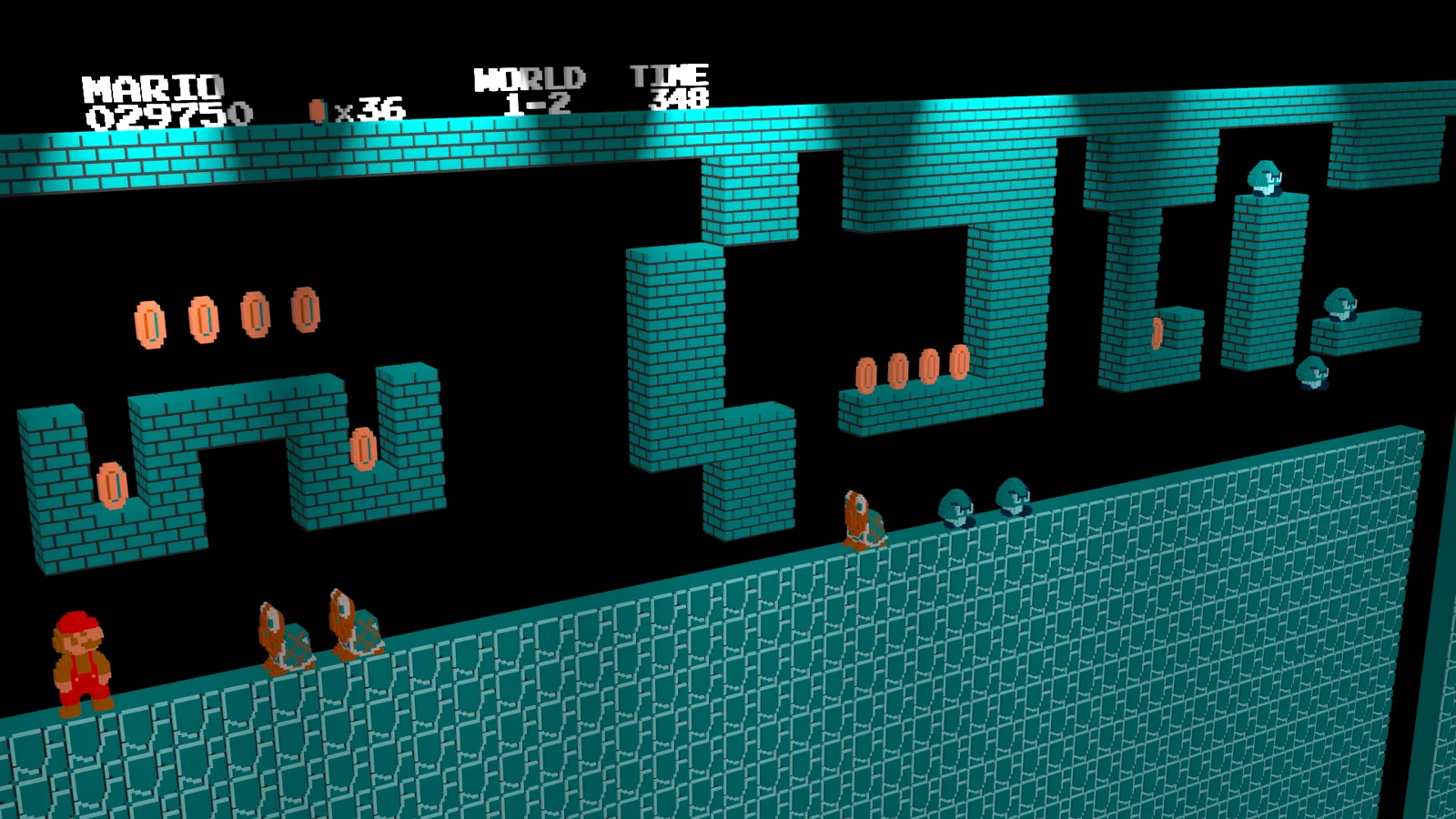
This difference is especially clear with games such as Super Mario Bros., Super Mario Bros. 2 and Super Mario Bros. 3. Each could be approached through the glove’s conventional or programmed controls, but none was transformed into a purpose-built gesture experience merely by connecting the accessory. Platform games depend on repeatable movement, quick braking and reliable jumps. Any delay or uncertainty in the translation from hand motion to controller input could become more noticeable than it would be during a slower game.
The same principle applies to Final Fantasy. The NES role-playing game could accept standard controller commands, but its menus, exploration and battles were not designed around spatial hand tracking. The Power Glove’s broad electrical compatibility therefore helped its sales pitch, while the small number of games that used its distinctive features determined whether the hardware felt justified.
Super Glove Ball was the clearest software demonstration
Super Glove Ball is the strongest documented example of a game built around the Power Glove’s unusual capabilities. Its instruction manual describes actions including catching, throwing, punching and curving a ball through hand movements. Those actions gave the accessory a direct conceptual role: the player’s hand was meant to correspond to the on-screen interaction rather than merely replace a directional pad.
The game also retained conventional control options. That detail is historically useful because it separates dedicated glove functions from ordinary NES compatibility. Super Glove Ball was not simply a cartridge that happened to work while the glove was attached. It attempted to demonstrate why the accessory had sensors and gesture commands. At the same time, the continued presence of standard controls acknowledged that the glove was not a universally sufficient interface.
Its design also exposes the limits of the technology. A player’s hand can move in several dimensions and express speed, direction and intention simultaneously. The NES, by contrast, receives a small vocabulary of digital commands. Super Glove Ball had to reduce those movements into recognizable actions, which made the experience less like directly manipulating a virtual object and more like performing gestures the game could classify.
The timing of the software mattered as well. Historical accounts of the development describe the hardware reaching the market before the most convincing dedicated software was ready. That weakened the launch proposition. A new controller needs software that makes its difference immediately understandable; without that software, buyers were left trying to adapt existing games to a control method those games had never required.
Bad Street Brawler and the limits of the Power Glove library
Bad Street Brawler is regularly mentioned alongside Super Glove Ball because it was associated with the Power Glove Gaming Series. It belongs in the accessory’s history, but its status requires more careful language than simply calling it a dedicated Power Glove game. Contemporary branding and later accounts do not always distinguish between a game designed around the glove’s motion system and a game promoted as compatible with or supportive of the accessory.
That distinction matters because the Power Glove software ecosystem was small. When only a few titles are associated with a peripheral, marketing labels can become more influential than the underlying design. A game may work with the hardware, offer a special control program or appear in promotional material without providing the same kind of glove-centered interaction found in Super Glove Ball.
The library’s size created a commercial problem that the hardware alone could not solve. The glove’s appearance could attract attention in a shop window or television commercial, but owners needed compelling reasons to keep using it. If the best-supported games were limited and the broader library felt awkward, the accessory quickly became a novelty rather than a new standard.
This was not only a question of quantity. The available games also needed to demonstrate a genuine advantage over the normal NES controller. A title that merely replaced a precise button press with a broad gesture did not necessarily give players more expressive or more reliable control. The Power Glove needed software designed around its strengths, not just software that tolerated its presence.
North American Mattel hardware and the Japanese PAX version
The North American Power Glove was a Mattel product released for the NES in 1989. Japan received a separate PAX-branded version for the Famicom. These products shared the same broad concept, but they should not be treated as identical releases with one universal date, one package design or one interchangeable software ecosystem.
The regional distinction reflects the different hardware and business environments surrounding the NES and Famicom. The North American console used its own physical connectors and retail conventions, while the Japanese Famicom had different controller arrangements and market expectations. A regional licensee could therefore adapt the branding, packaging and connection hardware even when the underlying tracking concept remained similar.
Available historical catalog records identify the Japanese product as a PAX Power Glove for Famicom, with a 1989 listing in some collections and later Japanese retail references placing its market appearance around 1990. The safest conclusion is that the PAX version belongs to the same late-1980s and early-1990s release period, but a single precise worldwide launch date would blur separate regional histories.
The software context was also different. The North American product was promoted with Power Glove programming and a small group of associated NES titles. Japanese availability did not simply reproduce that same lineup. Regional packaging and game support should therefore be checked separately rather than assuming that a Famicom Power Glove was a direct import equivalent of Mattel’s NES model.
Why the promise was difficult to deliver
The Power Glove’s problems came from several interacting factors rather than one isolated defect. The player had to assemble or position the sensor array, remain within its sensing zone, establish a center point and perform movements that the system could interpret. Each stage introduced opportunities for confusion or inconsistency before the game itself had begun to test the player’s skill.
Latency was another important concern. A standard NES controller communicates simple digital states: a button is pressed, a direction is held or a command is released. The Power Glove had to measure movement, interpret it and convert it into the console’s limited input language. Historical accounts from people involved with the project describe a noticeable gap between physical movement and on-screen response, especially when compared with the directness of a normal controller.
The translation problem was especially severe for fast games. A hand moving through space can be expressive, but a platform game often needs a small directional correction or a button press at an exact moment. Broad gestures are not automatically better than compact inputs. Without a clear visual reference for the center of movement, players could also make exaggerated motions simply to ensure that the system noticed what they were doing.
Ergonomics added a further complication. The glove was worn on the hand, but the control panel sat along the forearm, and the player still had to keep the arm within a restricted relationship to the television. The result was neither a normal gamepad nor an unrestricted virtual hand. It asked the player to perform dramatic movements while obeying the limitations of a carefully arranged sensing space.
Marketing magnified the gap. Demonstrations could show a confident user making large, legible gestures under controlled conditions. Everyday play demanded repeatability, calibration and software that understood those movements. A striking demonstration sold the concept, but only good games could make the concept sustainable.
The Wizard made the Power Glove a cultural object
The Power Glove received a major visibility boost from The Wizard, a Nintendo-associated film released in North America on December 15, 1989. The film placed the accessory in a dramatic gaming scene and connected it with the futuristic image that Mattel’s advertising had already established. Its timing, shortly before Christmas, helped make the glove part of the season’s larger Nintendo conversation.
The movie was not evidence of the controller’s actual accuracy or general software support. A cinematic demonstration compresses the process of setup and emphasizes spectacle. It does not show how often calibration must be repeated, how well ordinary games respond or how tiring the control method may become during extended play. The film’s importance was cultural and commercial rather than technical.
Contemporary accounts describe strong early interest, substantial retailer orders and a large initial wave of attention. They also describe disappointment once buyers encountered the practical limitations of the hardware and the small amount of software that made meaningful use of it. Sales figures vary depending on whether a source is discussing orders, shipments or units sold, so they should not be merged into one definitive total.
The larger pattern is consistent: the Power Glove benefited from the popularity of the NES, an eye-catching design and unusually prominent entertainment marketing, but those advantages could not compensate for an experience that often felt difficult to calibrate and awkward to control. Its public image became larger than its useful software library.
A short retail life and a long afterlife
The Power Glove’s commercial run was brief, but its design continued to attract attention because it represented a recognizable step toward later motion-control ideas. It was one of the earliest mass-market gaming products to make wearable gesture input part of the living-room experience. That achievement remains significant even though the controller did not become the NES’s default interface.
Later motion-control systems benefited from advances in sensing, processing power, software design and user-interface conventions. The Wii and Kinect made body movement central to their marketing and game design, while modern virtual-reality systems built much more sophisticated relationships between physical action and on-screen response. The Power Glove did not directly cause those systems, but it belongs in the same history of attempts to make games feel less like button-operated machines and more like spaces the player can inhabit.
The accessory has also been revisited by hackers, artists, musicians and interface researchers. Its sensors and distinctive form make it an appealing platform for experiments beyond the original NES use. These projects are part of the product’s cultural afterlife, not evidence that the original commercial design worked as intended. They show that an unsuccessful controller can still provide an interesting technical foundation and a memorable visual language.
That is why the Power Glove remains more important than the old joke attached to it. It was not a successful replacement for the NES controller, but it was not an empty prop either. It contained a serious attempt to reduce advanced gesture technology to consumer hardware, and its failure exposed the importance of latency, calibration, ergonomics and software support.
The Power Glove made a bold promise in a form that anyone could understand: put on the glove and control the game with your hand. Its roots in DataGlove research, ultrasonic tracking system, finger sensors and dedicated software show that the idea was more substantial than a costume accessory. The product represented a genuine attempt to bring experimental interface technology into a mainstream console household.
Its limitations were equally instructive. Calibration, restricted sensing, delayed interpretation, awkward ergonomics and limited dedicated software all weakened the experience. The NES library was built around precise digital inputs, while the Power Glove asked players to make physical gestures that the console could only partially understand.
Seen in that context, the Power Glove is best remembered as an ambitious experiment rather than a failed replacement for the NES gamepad. It helped popularize the dream of motion-controlled play, anticipated later interest in gesture interfaces and left behind a durable lesson: futuristic hardware only becomes compelling when the games, sensing technology and player expectations are designed around the same idea.