The GameCube does not have one single racing identity. It has the precision and danger of F-Zero GX, the shifting water of Wave Race: Blue Storm, the team-based chaos of Mario Kart: Double Dash!! and several stranger experiments with hoverboards, tubes and cel-shaded cars. This list treats racing broadly, including kart, futuristic vehicle, watercraft, hoverboard, street and circuit racers. It excludes driving sections inside action games, party games that are not primarily races and annual sports releases.
The ranking weighs handling identity first, followed by course quality, solo structure, replay value, local multiplayer, technical ambition and regional accessibility. Realism is not automatically an advantage. A game can rank highly because it turns an unusual vehicle into a memorable racing system, while a more conventional racer may place lower if it offers fewer reasons to return. The selections are all GameCube releases, although some were also available on other systems with different features or presentation.
10. Tube Slider
Tube Slider is one of the GameCube’s most specialized racers: a futuristic contest built around enclosed tube-like courses rather than roads, water or conventional tracks. Its appeal comes from threading a machine through narrow, visually abstract spaces while managing speed, positioning and the danger of losing control. The game offers eight futuristic vehicles and ten tracks, giving its unusual concept a more substantial foundation than its obscurity might suggest.
Its limitation is breadth. Tube Slider is harder to recommend as a first racing game because its concept is narrow and its audience is mainly made up of players who enjoy obscure futuristic racers. It lacks the broad character appeal of Mario Kart and the layered challenge of F-Zero GX. Regional availability is also important: the GameCube version was released in North America, while the planned Japanese release was canceled, and it was not a standard European release. Choose it for novelty and preservation-minded curiosity, not as the safest all-purpose racer.
- Best for: players who want an unusual futuristic racing concept.
- What it does well: turns enclosed tube courses into the entire identity of the game.
- Tradeoff: a narrow audience, limited profile and unusual regional availability.
9. XGRA: Extreme-G Racing Association
XGRA takes the futuristic motorcycle idea in a different direction from F-Zero GX. Its machines are built for aggressive arcade racing, and the courses emphasize speed, hazards and combat-flavored pressure. That gives it a useful place in a GameCube racing library: it is not another car game, but it also does not ask players to approach every corner with the same precision demanded by F-Zero.
The comparison with F-Zero GX is unavoidable, but the two games should not be merged. XGRA is more interested in spectacle and confrontation, while F-Zero builds its identity around extreme speed, line choice and technical mastery. The GameCube release arrived in North America on November 24, 2003, followed by Europe on March 5, 2004. It suits players who want futuristic motorcycles and arcade aggression, but those seeking the deepest handling challenge should move higher up the list.
- Best for: fans of futuristic motorcycle racing with an aggressive arcade edge.
- Meaningful difference: its identity is closer to hazardous combat racing than pure precision driving.
- Regional note: North American and European releases arrived on different dates.
8. Sonic Riders
Sonic Riders replaces cars with hoverboards and builds races around air management, tricks and character-specific board behavior. That changes the basic question from simply braking for a corner to maintaining the resources and momentum needed to keep a run alive. The hoverboard concept gives the game a stronger movement identity than a standard kart racer, especially when ramps, jumps and tricks are connected into a faster route.
The catch is the learning curve. Sonic Riders is not ideal for someone expecting immediate, forgiving racing. Its systems can feel opaque until the player understands how air, tricks and board characteristics interact. The GameCube version supports up to four players, making it a legitimate party option, but its specialized controls can create a wider skill gap than Mario Kart. Choose it for a group willing to learn an unusual racing language rather than for effortless first-round accessibility. The game received releases in North America, Japan and Europe, so it is one of the more widely available unusual choices here.
- Best for: players who enjoy mastering specialized movement systems.
- What makes it different: hoverboards, air management and trick-based momentum.
- Tradeoff: a steeper learning curve than conventional kart racing.
7. Auto Modellista
Auto Modellista is one of the GameCube’s most visually distinctive circuit racers. Its cel-shaded presentation gives ordinary automobiles an expressive, illustrated quality, while its tuning system adds more garage depth than a typical character racer. Players can adjust parts and systems including tires, brakes, suspension, transmission and engine-related components, creating a stronger connection between preparation and track performance.
That customization is also the game’s main demand. Auto Modellista is not as immediately legible as a pick-up-and-play racer, and its handling and presentation may feel unfamiliar to players looking for realistic motorsport. It is best framed as an arcade racer with a setup layer, not as a full simulation. The GameCube version reached North America and Europe on September 30, 2003, following its Japanese release. Choose it when tuning and style matter as much as winning a race.
- Best for: players who want cel-shaded cars and meaningful tuning.
- What it does well: combines expressive presentation with adjustable vehicle parts.
- Tradeoff: less conventional handling and presentation than a traditional circuit racer.
6. Need for Speed: Underground 2
Need for Speed: Underground 2 brings street-racing progression and vehicle customization to the GameCube. Its appeal lies in the relationship between the city, event selection and the car being developed over time. Players who enjoy choosing visual and performance changes, then taking that customized machine into different types of street events, will find a broader structure here than in a simple race-select menu.
It is an arcade-oriented driving game rather than a strict simulation, so its strengths are accessibility, spectacle and customization instead of exacting circuit realism. That makes it a strong recommendation for players who want a street-racing atmosphere, but a weaker fit for anyone who prefers closed tracks and tightly controlled lap strategy. The GameCube edition is one of several multiplatform versions, so features and presentation should not automatically be assumed to match the PlayStation 2, Xbox or PC editions. Its urban progression earns the ranking, while its less focused circuit identity keeps it below the more concentrated arcade racers.
- Best for: players who want customization and an urban street-racing structure.
- What it does well: combines licensed cars, event variety and progression.
- Tradeoff: less precise and less circuit-focused than a dedicated track racer.
5. Kirby Air Ride
Kirby Air Ride looks simple at first because its machines largely accelerate automatically. That apparent simplicity hides a different control philosophy: steering, drifting, charging and choosing when to use a machine’s abilities matter more than managing a conventional accelerator and brake layout. Its three major modes also give it unusual range. Air Ride supplies the traditional race framework, Top Ride changes the perspective and track presentation, and City Trial turns a free-roaming area into preparation for a later competitive event.
City Trial is the reason this game remains especially valuable for local groups. Players gather upgrades and experiment before the final contest, creating stories that do not resemble a standard championship. The limitation is equally clear: people wanting a deep traditional racing career may find the structure too unusual or too light. Kirby Air Ride released in North America on October 13, 2003 and supports four players. It is best for groups who value variety and shared surprises over formal motorsport progression.
- Best for: four-player groups and players who enjoy unconventional modes.
- What makes it different: Air Ride, Top Ride and City Trial offer three distinct racing structures.
- Tradeoff: its simplified control model may not satisfy traditional racing specialists.
4. Burnout 2: Point of Impact
Burnout 2 turns dangerous driving into its central reward loop. Traffic, near misses, boost management and aggressive overtaking are not distractions from the race; they are the means by which a player creates speed. That gives the game an unusually immediate risk-and-reward structure. It also broadens its appeal with a campaign, pursuit events and Crash mode, where spectacular pileups become a separate challenge rather than merely an occasional accident.
The GameCube version supports one or two offline players, so it works both as a solo arcade campaign and as a split-screen choice. Its biggest limitation is that players seeking clean motorsport lines may dislike its traffic-heavy design and deliberate encouragement of reckless driving. Burnout 2 is not trying to model a disciplined circuit weekend. It ranks highly because its handling, boost economy and crash events form a coherent identity that few other GameCube racers reproduce.
- Best for: players who want traffic, danger and aggressive arcade racing.
- What it does well: turns risky driving into speed and makes crashes part of the game’s structure.
- Tradeoff: not suitable for players seeking clean, simulation-style circuit racing.
3. Wave Race: Blue Storm
Wave Race: Blue Storm makes the water itself the central opponent. Personal watercraft respond to waves, jumps and changing conditions, so a successful line is not simply painted onto the course. Players must read the surface, preserve control through uneven water and decide when a jump or shortcut is worth the risk. That gives each course a character that ordinary asphalt racers cannot easily imitate.
The game also includes stunt-oriented play and four-player racing, extending its appeal beyond a single competitive format. Its precision can be demanding, particularly for players accustomed to forgiving kart handling. Wave Race: Blue Storm is not a boat-themed version of Mario Kart; its rhythm depends on water movement, balance and route judgment. It ranks third because its handling model remains unusually specific, its environments influence the race directly and its local multiplayer gives the GameCube a racing experience no other entry here can quite replace.
- Best for: players who enjoy precise watercraft handling and environmental route choice.
- What it does well: makes wave conditions materially affect steering, jumps and race rhythm.
- Tradeoff: demands more control and patience than a casual kart racer.
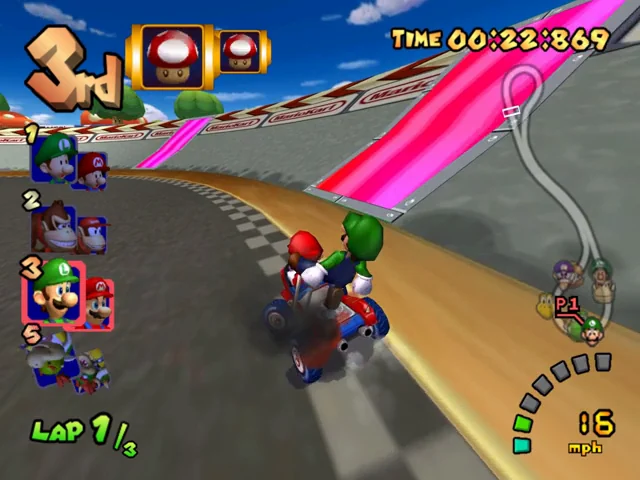
2. Mario Kart: Double Dash!!
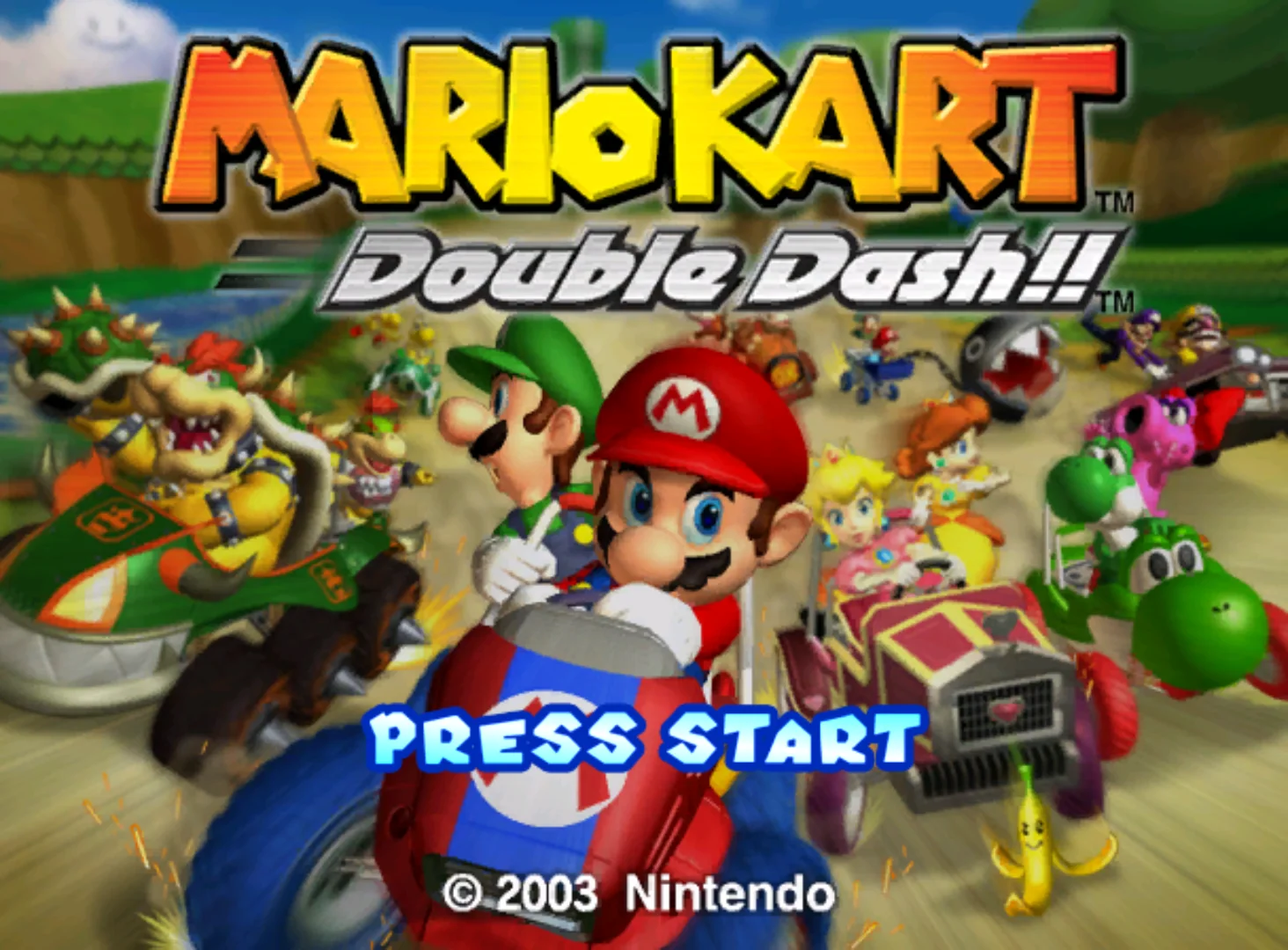
Mario Kart: Double Dash!! is the GameCube’s most immediately accessible racing game, but its two-character team system gives it more mechanical identity than a simple sequel label suggests. One character drives while the other handles items, and players can switch roles during a race. In cooperative play, two people share a kart and must coordinate steering, item use and timing. In competitive play, character pairings and exclusive special items give the roster more strategic texture than the basic controls imply.
The game is also unusually strong as a local multiplayer package. Its tracks are readable enough for newcomers while still offering shortcuts, hazards and item timing for experienced players. The limitation is that it does not pursue the precision of F-Zero GX or the environmental handling of Wave Race. Its solo structure is also less demanding for players seeking a long technical campaign. Even so, Double Dash!! ranks second because it combines accessibility, recognizable characters, excellent couch multiplayer and a team mechanic that makes the GameCube edition distinct.
- Best for: mixed-skill groups and players who want immediate local multiplayer.
- What it does well: turns driver-and-item-handler teams into a meaningful racing mechanic.
- Tradeoff: less technically demanding and less solo-focused than the top-ranked racer.
1. F-Zero GX
F-Zero GX is the GameCube’s most complete high-skill racing statement. Its futuristic machines move at extraordinary speed, but speed alone is not the point: track geometry, braking, boost use, machine characteristics and survival all interact. Races can include up to 30 competitors, producing a crowded contest where a clean line and precise timing matter more than simply memorizing the fastest-looking route. The result is a racer that rewards practice without reducing every event to the same kind of lap.
Its story mode gives the drivers and machines a structured solo frame, while vehicle tuning adds another layer for players who want to refine a preferred setup. The game can be intimidating, and its demanding handling is a poor fit for anyone seeking a gentle introduction to racing. That difficulty is exactly why it takes the top spot. F-Zero GX combines technical ambition, distinctive machines, serious solo content and a handling model that feels unmistakably its own. For players seeking the deepest racing challenge on GameCube, it is the clearest destination.
- Best for: players who want speed, precision and a demanding solo challenge.
- What it does well: combines 30-racer fields, technical tracks, story content and vehicle tuning.
- Tradeoff: its difficulty and speed can overwhelm players seeking an immediately forgiving racer.
The best GameCube racing game depends on the kind of racing you want. F-Zero GX is the choice for technical mastery, Mario Kart: Double Dash!! for mixed-skill multiplayer, Wave Race: Blue Storm for reading moving water, Burnout 2 for dangerous traffic and Kirby Air Ride for varied local competition. Auto Modellista and Need for Speed: Underground 2 serve customization-minded players, while Sonic Riders, XGRA and Tube Slider reward people willing to learn more specialized futuristic systems.
Taken together, these games show why the GameCube’s racing library is more varied than its most famous kart racer suggests. The system offers clean circuits, chaotic streets, changing waves, hoverboards, team-based karts and machines that barely resemble cars. Start with the handling style that interests you most, then use the rest of the list to explore the corners of the library that conventional racing recommendations often miss.