The GameCube has more platformers than its most obvious mascot suggests. Alongside Super Mario Sunshine, the system offers unusual experiments such as Billy Hatcher and the Giant Egg, hardware-specific design in Donkey Kong Jungle Beat, and third-party adventures that approach platforming through combat, collectibles or speed.
This ranking counts games whose main structure depends on traversing stages or spaces through jumping, climbing, rolling, movement abilities or platform-specific challenges. Platform-action hybrids qualify when traversal remains central, but action-adventure games, first-person shooters, strategy games, role-playing games and racing games do not. The ranking weighs movement feel, level and challenge variety, originality, campaign consistency, replay value and how clearly each game expresses a distinct platforming idea.
All ten selections received GameCube releases in North America, Europe or both. Release timing, packaging and optional features varied by territory. The list also focuses on the GameCube editions rather than importing features from later ports or remakes.
10. Vexx
Vexx is the GameCube’s answer to players who wanted a more severe and combat-heavy 3D platformer. Its dark fantasy world gives the hero clawed battle-gauntlets, defensive abilities and environmental challenges that make movement feel more deliberate than in a typical mascot adventure. Traversal, combat and exploration are tied together rather than separated into entirely different modes, so reaching a distant platform often means reading an enemy encounter or finding a safer route through a hostile space.
The game earns its place through atmosphere and ambition. It offers a convincing sense of place, useful movement upgrades and collectibles that reward returning to earlier areas. Its limitation is consistency: some challenges feel carefully constructed while others are less readable or more demanding than their rewards justify. Players who want a darker alternative to Mario’s bright collectathon will find plenty to appreciate, but newcomers seeking effortless movement should start higher on this list.
- Best for players who enjoy combat mixed with exploration.
- Tradeoff: uneven challenge balance and less immediately readable movement.
9. Ty the Tasmanian Tiger
Ty the Tasmanian Tiger is a friendly, conventional 3D platformer built around Australian imagery, broad environments and collectible objectives. Ty’s boomerangs give the game a clear identity, while Thunder Eggs and world-specific tasks provide reasons to explore beyond the direct route. Its structure is easier to understand than the more experimental entries here: enter an area, learn its obstacles, collect what you can and return when a new ability opens another path.
That clarity makes Ty a useful recommendation for players who want a traditional collectathon without the density of a sprawling adventure game. The downside is that its movement and objectives rarely surprise for long. The worlds are pleasant and readable, but the central mechanics do not evolve as dramatically as the games above it. It is a solid introduction to the genre, particularly for players who value approachable exploration over technical platforming.
- Best for beginners and fans of straightforward 3D collectathons.
- Tradeoff: familiar movement and objectives offer less mechanical surprise.
8. I-Ninja
I-Ninja gives its platforming a brisk martial-arts personality. The small hero runs through compact, level-based environments using sword attacks, shurikens, darts and acrobatic movement. Upgrades and grade-based challenges encourage more than simply reaching the exit, while the game’s energetic presentation keeps ordinary traversal from feeling anonymous. Its stages frequently ask the player to combine combat with jumps, switches and environmental hazards.
The strongest sections understand that a ninja should feel mobile, not merely powerful. The weakest sections allow combat to crowd out the platforming, and the difficulty curve can feel less even than the game’s playful tone suggests. I-Ninja suits players who like their platformers to move quickly and reward replay through performance grades. Those seeking calm exploration or finely tuned jumping challenges may find its action emphasis distracting.
- Best for players who want speed, combat and score-oriented replay.
- Tradeoff: platforming can take a back seat when encounters become frequent.
7. Pac-Man World 2
Pac-Man World 2 translates the familiar arcade character into a linear 3D platformer with a clear movement vocabulary. Pac-Man jumps, rolls, butt-bounces and attacks while collecting pellets, fruit and other recognisable series items. Its stages are more directed than Super Mario Sunshine’s open areas, which gives the campaign a steady forward rhythm and makes it easier to understand what each level expects.
The game’s accessibility is its main strength. It teaches its verbs quickly, varies the scenery and uses Pac-Man’s classic imagery without requiring the player to know the arcade games. However, repetition becomes more noticeable over a longer session, and some challenges are less elegant than the basic movement. Pac-Man World 2 belongs here as a dependable, approachable platformer rather than a system-defining one: a good fit for players who prefer linear progression and familiar controls.
- Best for players who prefer guided stages and simple controls.
- Tradeoff: repeated movement patterns and occasional awkward challenges limit variety.
6. Wario World
Wario World narrows the 3D platformer into a compact blend of jumping, treasure hunting and close-range brawling. Wario can punch, grab and throw enemies or scenery, balance on balls, use whirlwinds and search for hidden routes. The physicality matters: obstacles often feel like objects to manipulate rather than decorative walls, and combat is integrated into the act of moving through each stage.
Its focused design is refreshing on a system known for larger adventures. Wario World wastes little time establishing its core loop, and the short, self-contained stages make it easy to appreciate the strength of its movement and environmental interaction. The compromise is scale. It does not offer the same breadth of exploration or world-building as the higher-ranked games, and players expecting a huge collectathon may find the campaign comparatively contained. It is best for anyone who values punchy mechanics over size.
- Best for players who like platforming with tactile brawling.
- Tradeoff: focused stages provide less exploration breadth than larger adventures.
5. Billy Hatcher and the Giant Egg
Billy Hatcher’s giant egg is one of the GameCube’s most distinctive platforming ideas. Instead of treating a power-up as a temporary advantage, the game makes the egg the centre of movement, combat and progression. Rolling it through environments, growing it with food and hatching it at the right moment creates a rhythm unlike conventional jumping games. Momentum becomes a puzzle: the player must think about where the egg is going, what it can break and when it is ready to hatch.
That originality carries Billy Hatcher above more polished but safer competitors. Its stages provide unusual objectives and reward experimentation, while the colourful presentation gives the strange system a welcoming surface. The learning curve is real, however, and camera demands or egg handling can make some situations feel less precise than the concept deserves. The GameCube edition also includes optional Game Boy Advance connectivity and multiplayer material, but the solo campaign is the reason to play it.
- Best for players seeking a genuinely unusual movement system.
- Tradeoff: the egg mechanics take time to understand and can create camera pressure.
4. Sonic Adventure 2: Battle
Sonic Adventure 2: Battle is a platforming hybrid built from three very different play styles. Sonic and Shadow deliver fast stages centred on running, jumping and route selection. Tails and Eggman bring shooting and vehicle-like movement, while Knuckles and Rouge search for scattered objectives in open spaces. The GameCube version adds Battle-focused appeal, including split-screen modes, Chao raising and Game Boy Advance connectivity, but its central single-player attraction remains the variety of those stage types.
The speed levels can be exhilarating because they turn memorising routes and reacting quickly into the main challenge. The broader campaign also provides substantial replay value through its 30 levels and 150 missions. That breadth is simultaneously the limitation: a player seeking hours of pure jumping will spend significant time shooting or hunting treasures. Sonic Adventure 2: Battle ranks highly because its best platforming stages are memorable and its structure offers unusual variety, not because every mission serves the same genre ideal.
- Best for players who enjoy speed, replayable missions and varied character styles.
- Tradeoff: shooting and treasure-hunting stages dilute the pure platforming focus.
3. Rayman 3: Hoodlum Havoc
Rayman 3: Hoodlum Havoc is one of the GameCube’s most balanced platform-action games. Rayman’s jumping and hovering remain important, but the campaign continuously changes how those abilities are used through temporary powers, combat encounters, cage rescues, collectibles and score-driven objectives. Its worlds feel distinct without abandoning the basic movement language, and the game is comfortable shifting from a traversal problem to a fight and back again.
The result is a campaign with stronger pacing than many larger 3D platformers. Power-ups change the player’s priorities without permanently replacing Rayman’s core abilities, and the level design generally gives the mechanics room to matter. Its combat-heavy moments will not satisfy players who want uninterrupted precision jumping, while some collectibles are more compelling for completionists than casual players. Nevertheless, Rayman 3 offers an unusually complete package: expressive presentation, varied movement challenges and enough optional scoring to reward a second pass.
- Best for players wanting polished movement, combat and varied worlds.
- Tradeoff: combat and score systems sometimes compete with pure platforming.
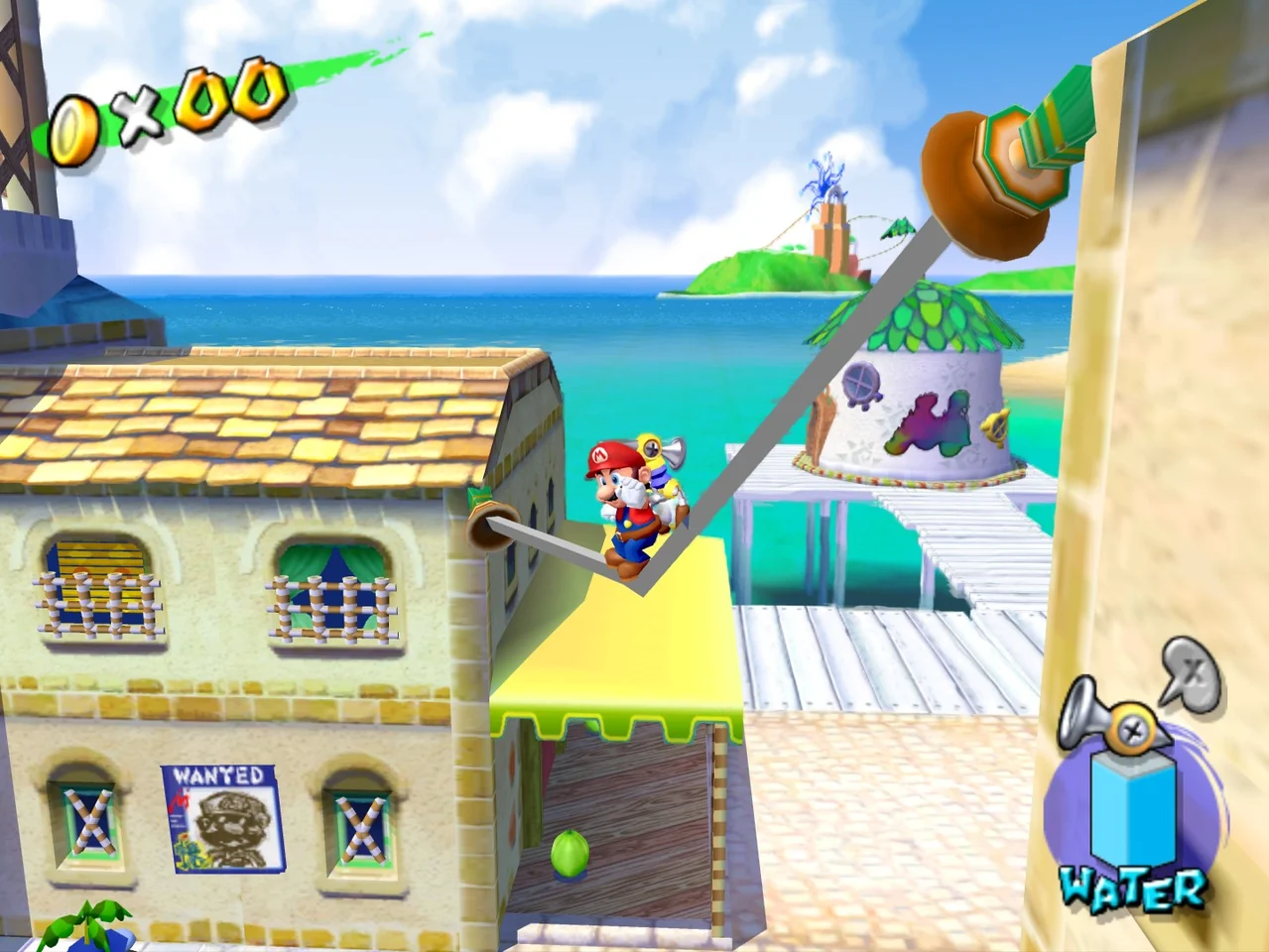
2. Donkey Kong Jungle Beat
Donkey Kong Jungle Beat is the most specialised game on this list. Its original GameCube design is built around the DK Bongos, turning movement, attacks and acrobatic chaining into a rhythmic physical exercise. Donkey Kong bounds between platforms, grabs items, defeats enemies and strings actions together for a higher score. The stages are built around momentum and flow rather than slow surveying, making a successful run feel like one continuous performance.
That focus gives Jungle Beat a remarkable sense of identity. It does not need a large inventory or a sprawling hub to make traversal interesting; its scoring system makes familiar jumps worth repeating and refining. The same focus is its largest limitation. The bongos are central to the original GameCube experience, creating a hardware and edition consideration that does not apply to ordinary controller-based platformers. Players who want broad exploration may find the game narrow, but anyone interested in rhythm, acrobatics and score improvement should place it near the top.
- Best for rhythm-minded players and people who enjoy mastering a route.
- Tradeoff: the signature GameCube experience is tied to DK Bongos, and exploration is limited.
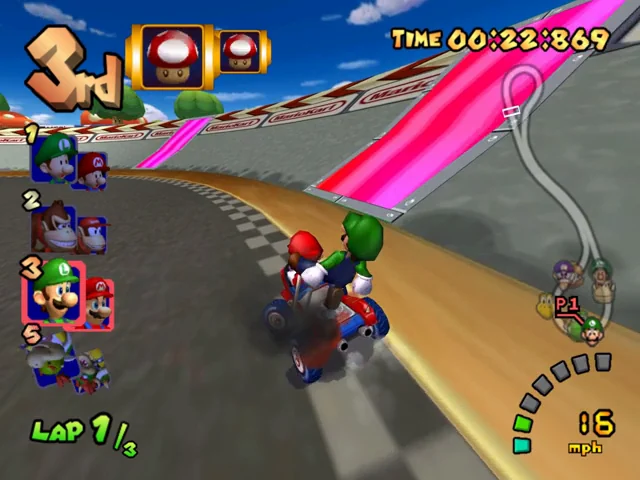
1. Super Mario Sunshine
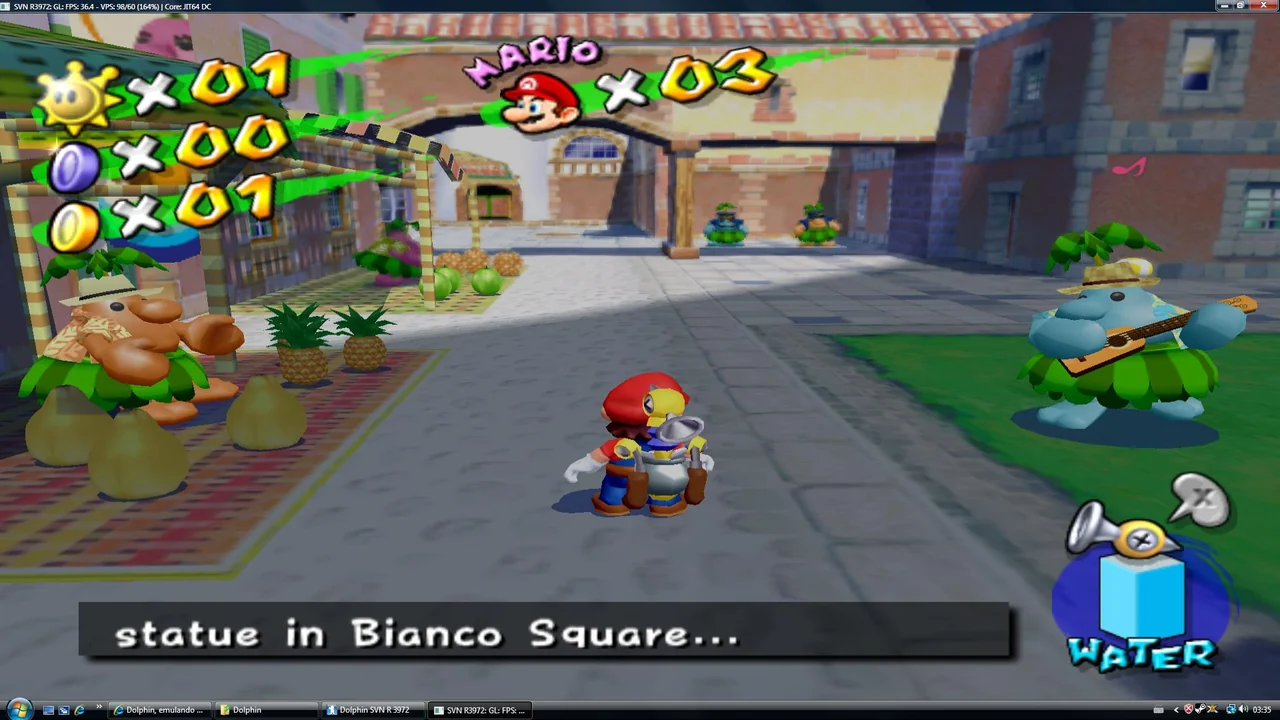
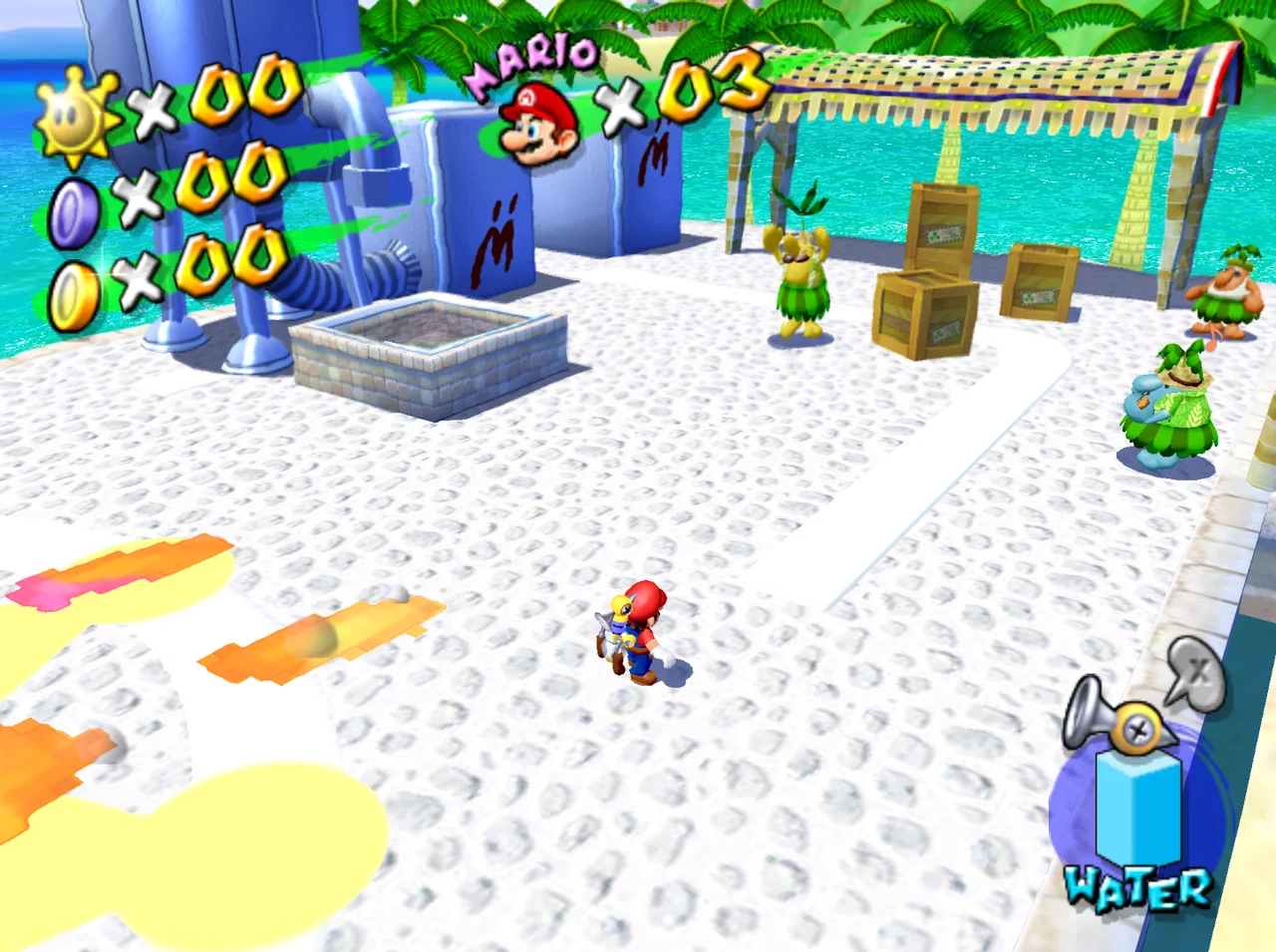
Super Mario Sunshine is the GameCube’s broadest and most expressive platformer. Mario’s standard jumps and acrobatics are joined by the FLUDD water backpack, whose spraying, hovering and other functions change how players approach movement, enemies and environmental problems. Isle Delfino works as a connected hub for individual objectives, so the game can alternate between open exploration, focused obstacle courses, secret stages and collectible hunting without losing Mario’s basic physical clarity.
Its greatest achievement is the way FLUDD expands movement without replacing it. A hover can rescue a jump, but it can also change the route through a space; spraying can solve an environmental problem or expose a new possibility. The campaign is not perfectly even, and some objectives create more frustration than others, particularly for players who prefer consistently precise challenges. Still, Sunshine offers the strongest combination of movement, variety, experimentation and replayable discovery on the system. It is the best starting point for most players and the clearest expression of GameCube platforming’s range.
- Best for players who want movement experimentation, exploration and many objective types.
- Tradeoff: the campaign’s uneven objectives and camera demands can interrupt its strongest ideas.
The right starting point depends on which part of platforming matters most. Super Mario Sunshine is the broad recommendation for movement, exploration and variety; Donkey Kong Jungle Beat is the specialist choice for rhythm and score chasing; Rayman 3 is the polished platform-action option; and Billy Hatcher is the best pick for an unusual central mechanic.
The GameCube’s platformer library is strongest when it stops trying to make every game look alike. Some entries build huge worlds, some compress the experience into performance-focused stages, and others make combat or strange equipment part of traversal. That variety is why the system can support ten defensible choices without pretending that every action game is a platformer.