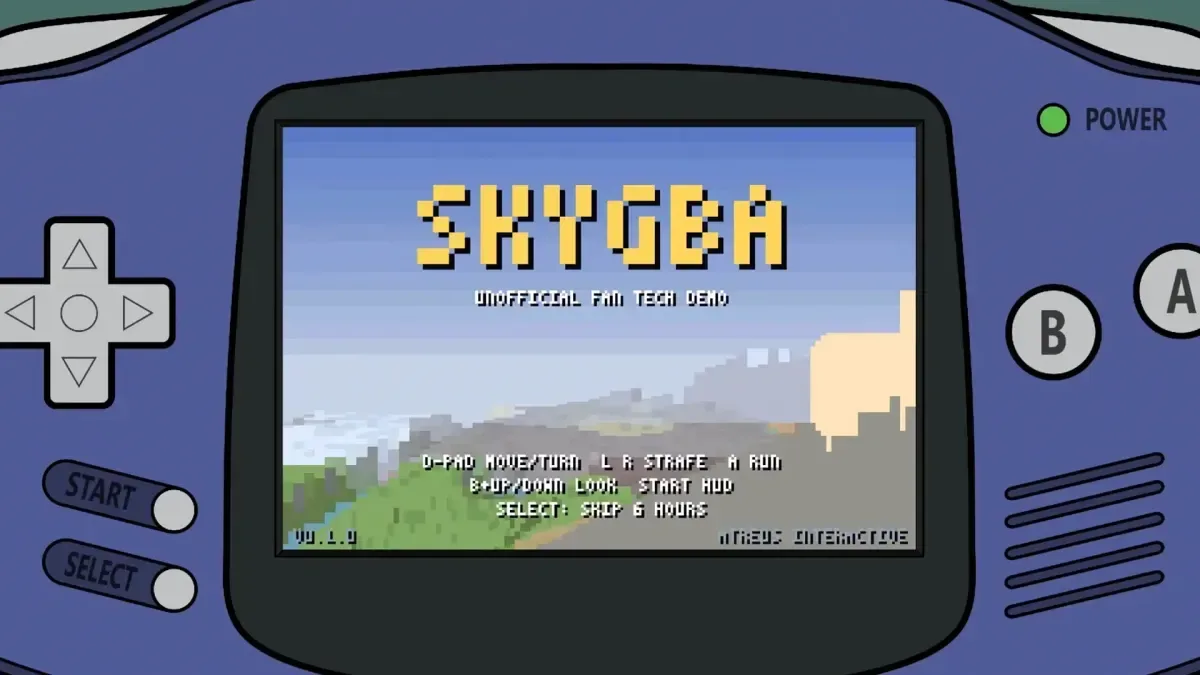
There are ambitious retro projects, and then there are projects that look at a handheld with a directional pad and a handful of face buttons and decide that a giant fantasy world should somehow fit inside it. SkyGBA, a work-in-progress effort from YouTuber Atreus, falls firmly into the latter category: an attempt to bring Skyrim exploration to the Game Boy Advance.
The first public look is explicitly a tech demo, not a finished port. It shows movement through a limited portion of Tamriel, with Whiterun among the places represented, using the Game Boy Advance’s display and processing capabilities. It is rough, visually basic, and a long way from demonstrating a complete version of Skyrim. But it is also doing the one thing an early project needs to establish: showing that a player can move around a recognisable kind of game space on hardware that was never built with this scale of modern open-world game in mind.
That distinction matters. SkyGBA should currently be read as a proof of concept rather than a promise of a full handheld release. The appeal is not that the project has already recreated every system associated with Skyrim. The appeal is the technical and creative question it raises: what does an enormous exploration game become when it is redesigned around a far more constrained machine?
What SkyGBA currently appears to be
At this stage, SkyGBA is focused on exploration. The available description identifies movement with the GBA’s D-pad through a small selection of locations, including Tamriel and Whiterun. That makes the demo an early foundation rather than evidence that the larger game’s quests, combat, characters, menus, inventory, progression, audio, or other systems have been rebuilt.
It is important not to fill in those blanks for the project. A character moving through a 3D-style environment and a full game are vastly different milestones. In a technical demonstration, a developer may be testing a particular combination of ideas: drawing a world, accepting controller input, moving a player position through that world, and maintaining an acceptable pace while doing so. Each is meaningful. None automatically brings along the rest of a game.
The current visual presentation is also plainly an area for future work. Atreus has indicated that more attention could lead to further effort to make the port look better. That is a conditional statement, not a production schedule or a release commitment. For now, the meaningful claim is simply that SkyGBA exists as an early experiment and that its creator is considering continued refinement.
Why “port” is a bigger word than it sounds
A port is a version of software adapted to run on a different platform. The word can cover many approaches, from a very close recreation to a heavily reworked adaptation that preserves only selected elements. In SkyGBA’s case, the hardware gap makes that distinction particularly important.
The Game Boy Advance is described here as a 32-bit handheld, but “32-bit” alone does not tell us whether a machine can reproduce another game’s visual style, simulation, control design, or content volume. It is a broad technical label, not a guarantee of equivalence. The useful question is whether a particular version can be designed within the handheld’s limits: its display, processor, controls, and the practical amount of game data the developer can manage.
Related coverage includes SkyGBA Aims to Bring Skyrim's World to Game Boy Advance.
That is why this sort of work often resembles translation more than simple transfer. A direct one-for-one conversion may be impossible or undesirable. A developer may need to simplify environments, redraw visuals, change how distant terrain is represented, reduce the number of simultaneous tasks, and rethink how players interact with the game. The supplied material does not say exactly which methods SkyGBA uses, so it would be premature to credit it with any specific engineering technique. Still, the demo’s pared-back appearance is consistent with the core reality: a project like this must make choices.
Analysis: the most interesting outcome may not be a miniature replica of Skyrim. It may be a version that finds a satisfying handheld identity by retaining exploration as its centre while changing the form around it. That would still be a substantial design challenge, and it would be more honest than measuring every early build against the expectations of a much larger game.
The control problem is as real as the graphics problem
Visuals are the immediate talking point in a Game Boy Advance experiment, but controls may be just as decisive. The early demo uses the D-pad for movement. That is a sensible starting point for exploration, yet a complete game requires a wider set of interactions than walking through an environment.
Button mapping is the process of assigning actions to the buttons available on a controller. On a limited handheld layout, every assignment has consequences. If a game needs a button for interacting, another for menus, another for attacks or actions, and others for additional commands, the developer must decide which inputs are always available and which can live in a secondary interface. A command that was effortless on another device may need to become a menu selection, a context-sensitive action, or something removed entirely.
This is not automatically a flaw. Handheld games often succeed because their systems are designed around a small, readable set of controls. The risk comes when a project tries to preserve too many assumptions from a game created for a different input setup. A SkyGBA build that aims for playability would need its own clear control language rather than merely squeezing a larger scheme onto fewer buttons.
For viewers of the demo, this makes movement a useful but narrow benchmark. It proves that the basic connection between player input and exploration is functioning. It does not yet answer the harder question of how a complete interaction model would work. Until more is shown, that remains one of the project’s largest open design questions.
A map is not just scenery
Exploration games make heavy demands even before combat or story systems enter the equation. A map needs to be represented, displayed, and navigated. The player’s location needs to update. The game needs to communicate what is near, what can be reached, and where the player is headed. In a small early demo, the creator can focus on a contained area. Scaling that experience across a broader world is a different proposition.
That does not mean a larger version is impossible; it means scale is a design choice, not merely a quantity setting. A project can suggest a world through carefully chosen locations, compact connections, and stylised visual shorthand. It can also become difficult to follow if areas lose their landmarks or if technical compromises make navigation unclear.
The mention of a “sprinkling” of Tamriel and Whiterun is therefore appropriate framing for what is shown. It signals a fragment of a world, not a verified claim that the whole world has been recreated. In fact, a focused slice may be the strongest way for SkyGBA to develop. One polished route, district, or local space could establish how the art, movement, and controls fit together before the project reaches for broader coverage.
Why early demos are worth watching without overhyping them
Retro hardware projects can attract attention for the spectacle of an unlikely pairing: a very large game idea meeting a much older portable machine. That spectacle has value, but it can also create unfair expectations. A short clip can make a project seem closer to completion than it is, particularly when the familiar name attached to it brings decades of player expectations.
The sensible way to follow SkyGBA is to appreciate both sides. The demo is a neat technical curiosity because it gets a player moving through a Skyrim-inspired representation of familiar places on Game Boy Advance. It is also unfinished, and the remaining work is likely to be defined by tough questions of visual clarity, world scope, and controls.
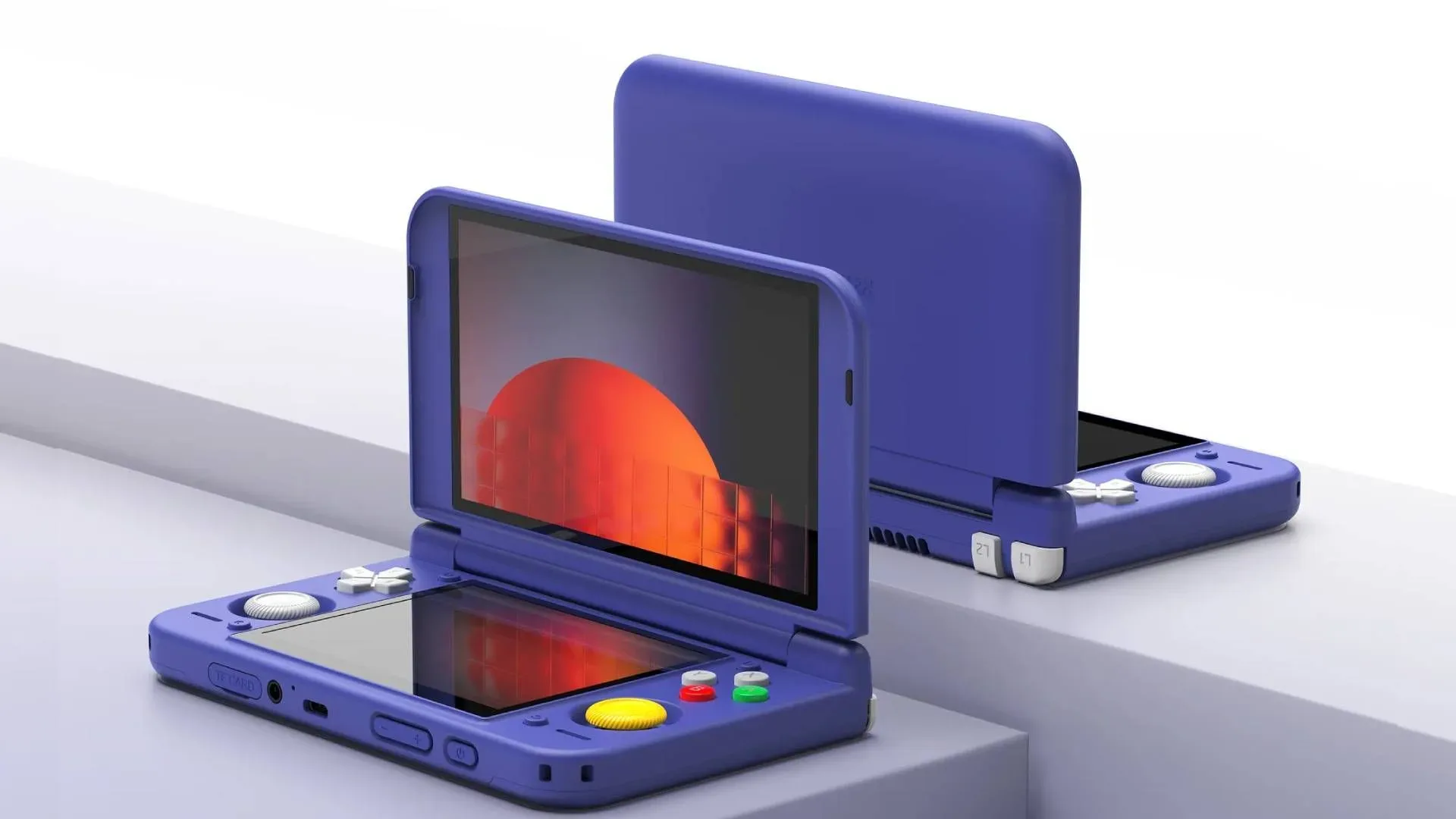
For retro handheld fans, that tension is the story. The Game Boy Advance version does not need to compete with a larger-platform experience on identical terms to be interesting. It needs to show what this hardware can convey when its restrictions are treated as part of the design. The broader retro-handheld scene continues to produce projects built around that spirit; for another recent handheld-focused story, see this look at the Retroid Pocket Duo Lite+.
What to watch for next
If SkyGBA continues, future updates will be more revealing when they demonstrate concrete progress rather than simply a larger-looking map. Useful signs would include improved readability of the environment, a clearer account of what the player can do beyond movement, and evidence that the controls support those actions comfortably.
- Visual legibility: Can players distinguish routes, buildings, terrain, and important interactable points on the handheld display?
- Stable exploration: Does movement remain understandable and responsive as the represented area grows?
- Control design: How are essential actions assigned to the GBA’s limited inputs?
- Defined scope: Is the project aiming for a small playable interpretation, a showcase map, or something more expansive?
- Project status: Are new builds shown, or does the experiment remain a single early proof of concept?
For now, SkyGBA is best appreciated for what it demonstrably is: an unusual, early attempt to turn a small piece of Skyrim’s exploratory appeal into something that can run on Game Boy Advance hardware. It has not solved the enormous problems inherent in that goal. It has, however, put those problems on screen—and that is where any genuinely compelling retro port has to start.