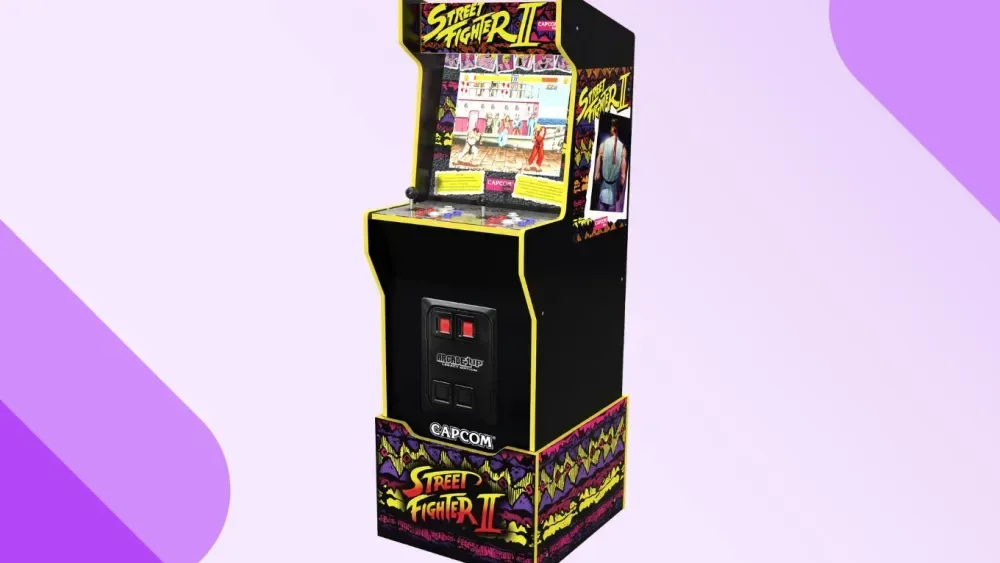
Street Fighter II was built for the arcade floor: a cabinet, two players standing shoulder to shoulder, a visible crowd, and the persistent practical problem of whether anyone had another quarter. Arcade1Up’s Street Fighter II Legacy Arcade Machine translates much of that identity into a home-focused format while making a few deliberate changes to the old routine. The cabinet includes two sets of controls, a 17-inch LCD screen, a light-up marquee, replica-style artwork and decorative coin-door details—but no actual need to feed it coins to keep playing.
The machine is currently listed at Walmart for $949.99. It is an all-in-one cabinet rather than a single game packaged in a replica shell, with several versions of Street Fighter II and additional Capcom titles included. Built-in Wi-Fi expands its purpose beyond local matches through online multiplayer and global leaderboards. That combination is the key to understanding what this product is: not an original-era arcade unit, and not merely a small plug-in retro compilation, but a contemporary home arcade cabinet centered on a famous fighting-game lineage.
What is included in the Street Fighter II Legacy cabinet?
The headline attraction is not one version of Street Fighter II. Arcade1Up’s cabinet includes a run of major releases:
- Street Fighter II: World Warrior
- Street Fighter II: Champion Edition
- Street Fighter II: Turbo
- Super Street Fighter II: The New Challengers
- Super Street Fighter II: Turbo
That list matters because “Street Fighter II” can mean substantially different versions of the same foundational game. A fighting game’s version is not simply a new label on the box. Successive editions can alter a roster, the pace of play and the options available to players. For a cabinet designed around the series, including multiple entries gives owners room to move among distinct stages of its evolution rather than locking them to a single interpretation.
Alongside the Street Fighter II releases, the cabinet contains Street Fighter, Darkstalkers, Strider, Commando, Final Fight, Ghosts ’n Goblins and 1944: The Loop Master. The collection therefore reaches across several Capcom arcade styles: one-on-one fighting, side-scrolling action, run-and-gun shooting and vertical shooting. In practical terms, that broader library makes the machine more flexible for a household or game room in which not every visitor wants to play competitive fighters.
There is also behind-the-scenes footage included with the cabinet. While the provided details do not specify its scope or format, its presence helps position the unit as both a game machine and a presentation of the Street Fighter II legacy.
The cabinet format: designed for a room, not a countertop
With the included riser, the cabinet stands just under five feet tall. A riser is the base section that elevates the main arcade body, helping the controls and display sit at a more traditional stand-up-cabinet height. It is a straightforward feature, but an important one: this is furniture-sized gaming hardware, intended to occupy a defined spot in a game room, home office or basement rather than disappear into an entertainment-center shelf.
Its display is a 17-inch LCD color monitor. LCD means liquid-crystal display, a flat-panel screen technology. The original arcade experience associated with Street Fighter II came from a different display era, so buyers should regard the screen as a modern component inside a nostalgic cabinet format. The supplied information emphasizes its color and graphics; it does not make a claim that the display recreates the exact characteristics of an original arcade monitor.
The exterior is designed to evoke the coin-op look with a light-up marquee and faux-molded coin slots and doors. A marquee is the illuminated header at the top of an arcade cabinet, generally used to identify the game. Here, the cosmetic coin details preserve a recognizable piece of arcade visual language, while the absence of an actual pay-per-play requirement changes the everyday experience completely. It can be switched on for an extended session without a running cost per continue.
The control deck has two joysticks and action-button layouts for local two-player play. That is central to the cabinet’s appeal. The Street Fighter II name carries a strong competitive association, and a two-player layout makes a quick head-to-head set possible without bringing extra controllers or configuring a second device. It also gives the unit a social role even when it is not connected online.
Local rivalry and online competition solve different problems
Wi-Fi is one of the machine’s most notable modern additions. The cabinet supports online multiplayer and global leaderboards. Online multiplayer lets players compete over an internet connection rather than requiring both opponents to be in the same room. A global leaderboard is a ranked list that compares scores or performance among participating players. The specific ranking rules, supported modes and matchmaking details are not identified in the available information, so prospective owners should avoid assuming features beyond those named.
Still, the split between online and local play is useful. Local play is immediate and physical: two people use the cabinet at once. Online play potentially broadens the pool of opponents when nobody else is around. The leaderboard element adds a more public layer to what is otherwise a private home setup. For players curious about multiplayer preparation and the distinction between casual sessions and competitive play, our guide to party racing, rivalries and competitive preparation explores some of those broader considerations in another multiplayer genre.
There is a limit to what this cabinet should be expected to replace. It cannot reproduce the chance encounter of finding a Street Fighter II machine in a pizza restaurant, cinema, gas station or dedicated arcade. What it can do is turn the game from a destination into a persistent fixture at home. The cabinet’s design preserves some of the visual ceremony of an arcade machine, while Wi-Fi makes it possible to seek competition beyond whoever happens to be visiting.
Why the five Street Fighter II editions are the centerpiece
The included Street Fighter II sequence offers a compact historical path through the series. World Warrior establishes the starting point in the list. Champion Edition and Turbo follow, while The New Challengers and Super Turbo represent the later Super Street Fighter II releases included here. Even without treating every version as a separate game-room attraction, their coexistence is valuable for people who want to revisit more than one period of the series.
For a casual owner, the practical advantage is variety. A player can choose a familiar entry or compare versions without changing hardware. For a returning fan, the names themselves may be the feature: Street Fighter II is often remembered as one monolithic arcade phenomenon, but the cabinet makes clear that it had multiple key iterations.
That approach also gives the product a better argument as a long-term room fixture than a cabinet with only one title. The non-Street Fighter games add genre variety, but the core appeal remains the ability to access several versions of one of arcade gaming’s most recognizable fighting series from the same physical control station.
Buying considerations: space, use case and edition names
The price and footprint call for a more deliberate decision than picking up a controller or a digital collection. At $949.99, this is a premium home-game-room purchase. Since it stands just under five feet tall with its riser, buyers should think about where it will live, how often it will be played by two people, and whether the cabinet’s visual presence is a benefit or a burden in that space.
The product is a stronger fit for someone who values the cabinet form itself—the upright stance, the shared control panel, marquee and arcade-style artwork—than for someone who only wants access to the games. The supplied details support the former experience: a purpose-built machine meant to be seen as well as used.
There are retailer-specific versions to keep straight. The Street Fighter II Legacy Arcade Machine described here is available through Walmart. A Supreme Edition is available through Sam’s Club, while a World Warrior Edition is sold through Wayfair. Those names should not automatically be read as identical packages. The available information does not provide a feature-by-feature comparison, so the sensible approach is to verify each retailer’s current listing, included games and hardware details before treating one edition as interchangeable with another.
Walmart’s version is described as shipping to a customer’s home for free through Walmart+. Walmart+ is the retailer’s subscription and rewards program, with a 30-day free trial mentioned among its offerings. Delivery benefits and other membership terms may matter for a large arcade cabinet, but they are separate from the machine’s own specifications. Buyers should consider the cabinet on its hardware, library and intended use first, then decide whether a membership offer is relevant to their purchase.
A home cabinet that acknowledges both nostalgia and convenience
Arcade1Up’s Street Fighter II Legacy Arcade Machine leans into a simple premise: Street Fighter II is more compelling in an arcade-shaped setting than as an icon on a menu. It backs that premise with a two-player control layout, recognizable cabinet styling, a riser and a multi-game library. At the same time, it does not insist on historical purity. The LCD monitor, Wi-Fi multiplayer, leaderboards, behind-the-scenes footage and no-quarter continuation system are explicitly modern conveniences.
For the right buyer, those compromises are the point rather than a contradiction. The machine preserves the ritual of walking up to an upright cabinet and challenging another player, while removing the coin dependence and location limits that defined arcade play. Its strongest case is for Street Fighter II fans who want several major versions of the series in a dedicated home setup, with local competition at the center and online play available when the room is empty.