Whalefall has an irresistible elevator pitch and a difficult task: put one diver inside a sperm whale, give him vanishing oxygen and an imminent encounter with stomach acid, then make an audience feel every inch of the impossible escape. Director Brian Duffield’s 105-minute, PG-13 adaptation of Daniel Kraus’ 2023 novel takes that setup seriously—perhaps too seriously. The result is an undersea survival thriller with a genuinely grotesque central environment but little of the escalating dread, emotional access, or visual wonder needed to turn a single-location ordeal into compelling cinema.
Austin Abrams plays Jay Gardiner, a young man diving near Monastery Beach outside Monterey, California, to search for the body of his father, Mitt. Mitt, a hard-edged seaman, has taken his own life after mesothelioma left him unable to dive. Jay’s search quickly turns into an even more implausible emergency: he becomes tangled with a giant squid, which is then swallowed by a sperm whale. Jay goes with it.
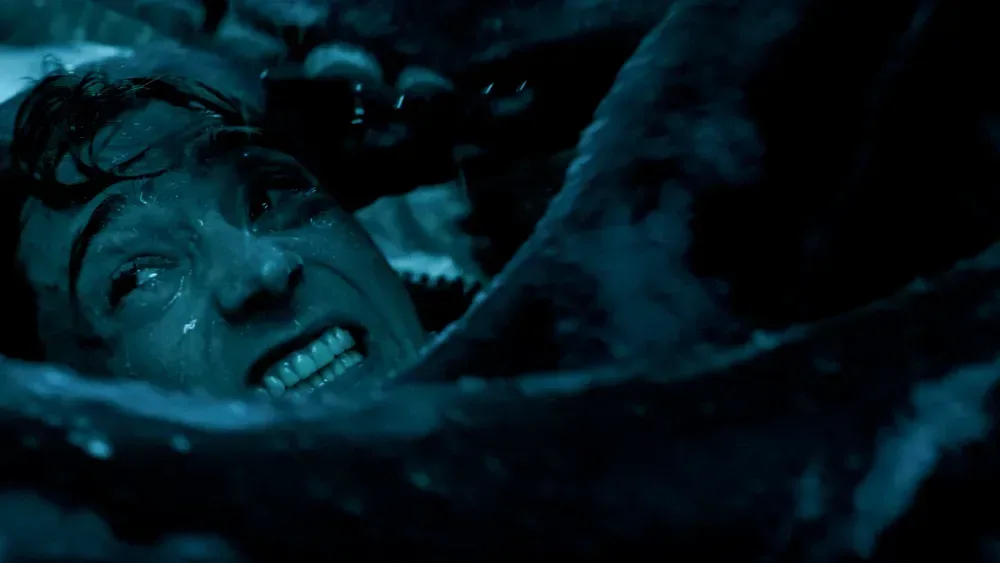
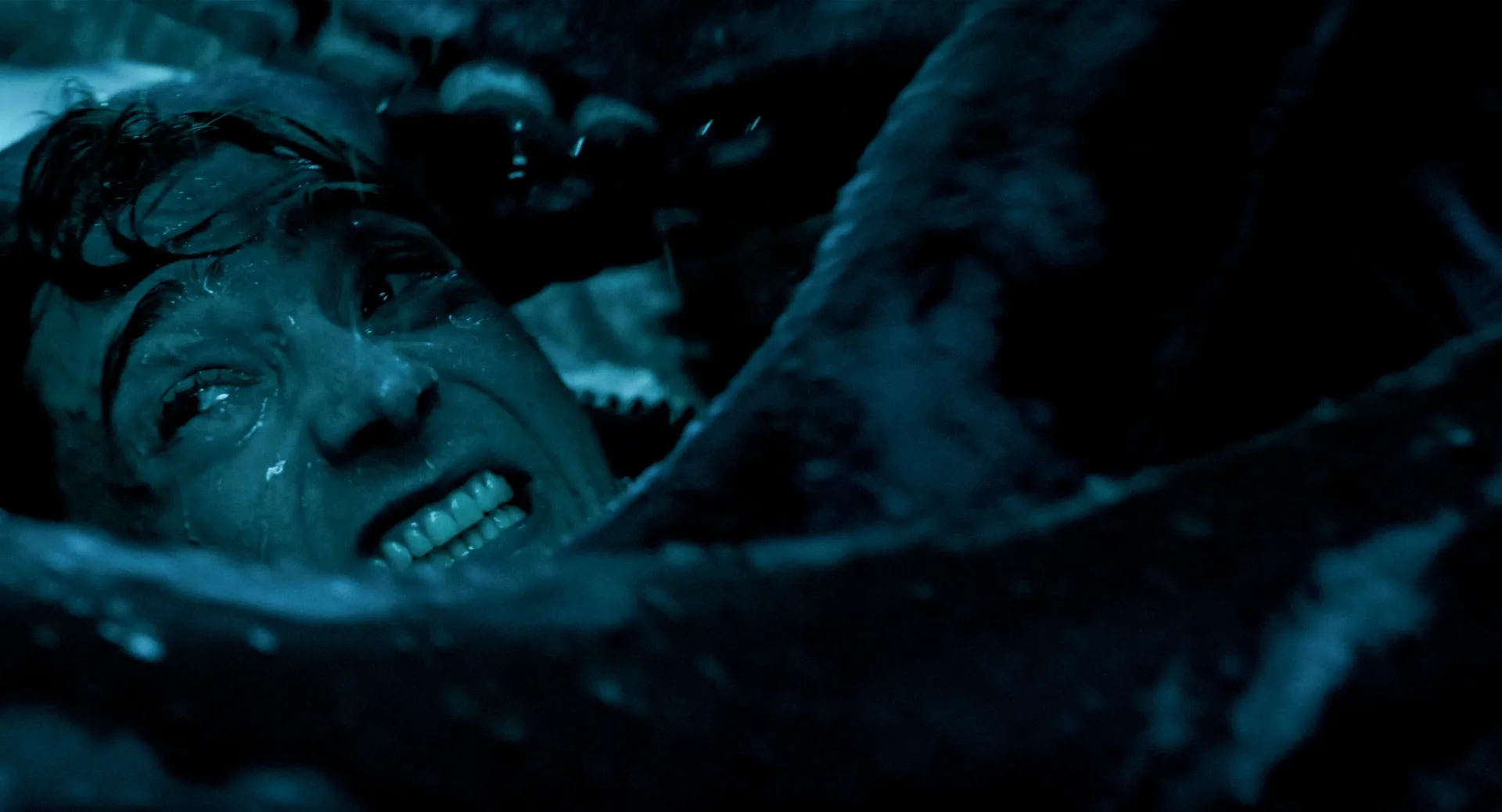
That is not merely the opening attack or a short-lived set piece. It is the movie’s fundamental condition. Jay spends most of Whalefall trapped inside the animal, trying to avoid being drawn from a glowing blue digestive chamber into the red-lit inner stomach, where acid threatens to dissolve him. There is no crew of rescuers offering constant radio support, no spacious ocean floor to explore, and no second human character sharing the immediate predicament. The movie has built itself a biological escape room, then sealed the door with blubber.
A survival premise with nowhere to breathe
The appeal of a survival thriller usually comes from a steady exchange between limitation and ingenuity. The hero has too little air, too little light, too little information and too little time; the story needs to make each discovery or decision change the odds. Whalefall certainly gives Jay limitations. His breathing apparatus makes spoken dialogue scarce, leaving Abrams to convey alarm through movement, muffled sounds and facial reactions. But that decision also limits the connection between character and viewer.
There is a difference between a character being isolated and a film making its audience feel isolated from that character. Jay is visibly in terrible danger, yet the confined setup offers only a narrow range of emotional notes: panic, discomfort, another burst of frantic effort, then panic again. Instead of making the whale’s interior feel progressively more threatening, the film’s literal rendering of its setting can make the ordeal feel static.
Its imagery is deliberately visceral. Jay moves among wet, shifting forms of tissue, and the digestive spaces are divided by color: phosphorescent blue closer to the entrance, hellish red deeper in. A jellyfish already swallowed by the whale becomes a makeshift source of light. Those are clear attempts to provide visual landmarks and practical obstacles inside a place that otherwise has no ordinary geography. Yet the spectacle is less terrifying than it is persistently unpleasant, with body-horror décor that can feel more like a themed attraction than a nightmare.
What “whalefall” means—and why it matters to the film
The title has a real ecological meaning within the story’s thematic ambitions. A whalefall is the event of a dead whale sinking to the ocean floor, where its carcass can support a rich marine ecosystem. It is an image of death becoming sustenance, decomposition creating the conditions for other life. That is a substantial idea to attach to Jay’s journey: a son searching for a dead father, pulled into the body of another enormous marine creature, and forced to face a legacy he might rather flee.
But the movie’s immediate survival mechanics and its family drama do not appear to combine smoothly. The ecological concept remains more suggestive than dramatically integrated. It points toward renewal, inheritance and the ocean’s impersonal life cycle, while the film keeps returning to a much narrower question: can Jay physically get out?
Jay’s father is the real force pulling him backward
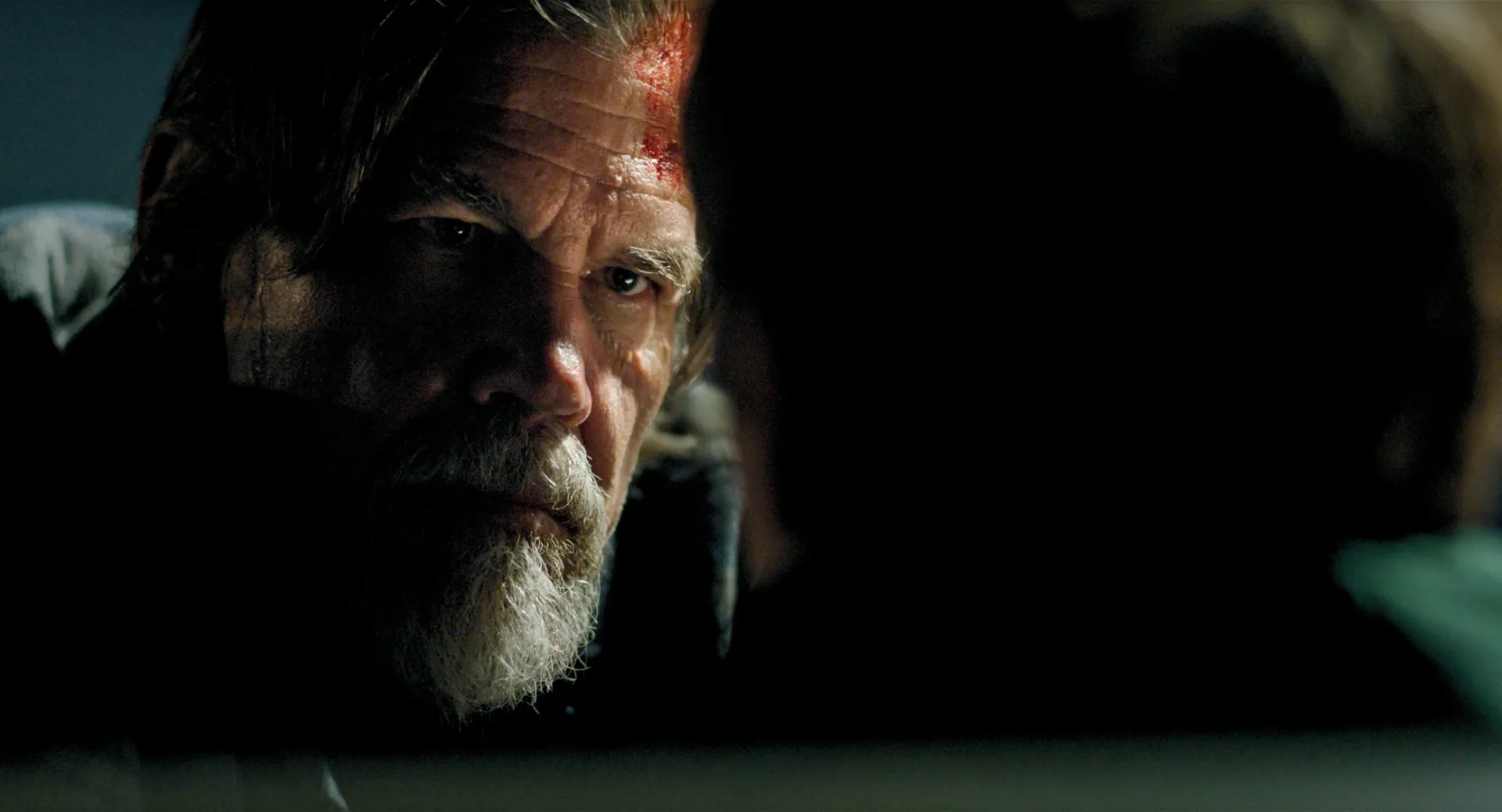
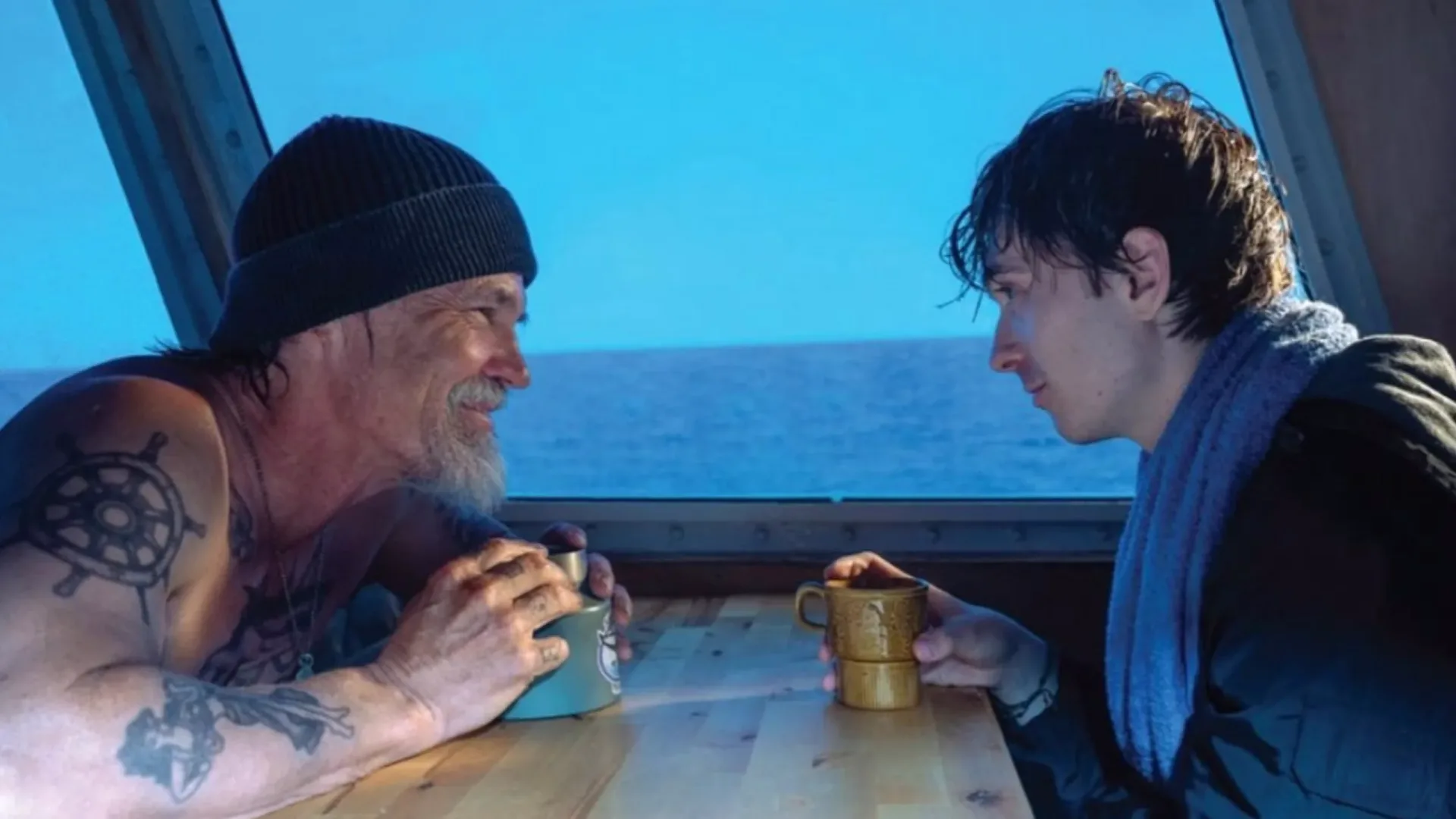
The whale is the obvious antagonist, but Whalefall frames Jay’s relationship with Mitt as the deeper confinement. The film repeatedly cuts away to flashbacks charting the father and son’s deteriorating connection. Josh Brolin plays Mitt as an aggressively macho and damaging presence: tattooed, intimidating, and convinced that cruelty will equip his son for a harsh world. He is presented as a man whose lessons are hard to distinguish from abuse.
These flashbacks give the film a potential emotional engine. Jay’s escape is supposed to become more than a fight against the whale’s anatomy; it is also a test of whether he can transform the survival knowledge passed down by his father without simply accepting the father’s cruelty. By the latter half, Jay comes to see that Mitt taught him skills that may be necessary to survive.
That is a thorny idea, and it needs particular care. A story can acknowledge that a harmful parent passed along useful knowledge without treating the harm as justified or spiritually cleansing. Here, the father’s characterization is so broadly harsh that the emotional reconciliation implied by Jay’s realization risks feeling unearned. The movie reaches for catharsis through inherited toughness, but it is difficult to separate that payoff from the troubling notion that the abusive parent was right all along.
Brolin has a forceful screen presence, though the material gives him an especially emphatic version of the brutal father archetype. Abrams, meanwhile, is asked to carry the main timeline with relatively few words and extensive physical distress. He had a more freewheeling, indie-leaning energy in Zach Cregger’s horror hit, but this role requires a gradual emergence of resolve from a character initially presented as overwhelmed. The movie does not fully make that transformation persuasive.
Literal effects undercut an inherently absurd situation
There is a fine line between embracing an audacious B-movie premise and letting it become accidental camp. Whalefall wants viewers to accept its scenario as a serious ordeal of grief and perseverance. Its production design, effects work and performance style aim for grim immersion. But the more specifically it illustrates its whale interiors, the more it risks inviting the wrong kind of attention.
Technical terms help clarify the problem. Body horror is horror built around vulnerability, mutation, invasion or the unsettling reality of physical bodies. It can be frightening because it makes flesh unfamiliar or uncontrollable. Claustrophobia, meanwhile, is the fear of confinement; in film it is often created through tight framing, restricted movement, oppressive sound and the sense that there is no exit. Whalefall plainly pursues both sensations. However, the elaborate wet walls, undulating surfaces and color-coded digestive spaces reportedly generate more revulsion and bemusement than fear.
That leaves the film in a tough position. A creature feature needs its creature to remain mysterious or majestic enough to sustain dread. A survival film needs its environment to create a varied sequence of problems. A grief drama needs human memory and motivation to carry weight. Whalefall has elements of all three, but the whale’s interior—so much of the movie’s actual screen space—does not develop into a compelling arena for any of them.
The novel’s interiority is hard to reproduce underwater
Kraus’ novel was both acclaimed and a bestseller, which makes the adaptation’s difficulties more understandable rather than less notable. A book can inhabit Jay’s thoughts continuously. It can move between memory, dread, self-reproach, practical calculation and private understanding without requiring the character to speak aloud. A film can reproduce some of that through images, flashbacks, music and performance, but Whalefall puts its lead in a situation where normal communication is severely restricted.
Duffield co-wrote the screenplay with Kraus, and the screen version retains the story’s most cinematic hook: a person alive in an impossible biological prison. But the very choice to show so much of that prison appears to reduce the ambiguity and psychological room that might have made it haunting. The adaptation turns what could be an intensely internal experience into an extended tour through mucus, membranes and digestive peril.
That may still be a draw for viewers specifically seeking an extreme, oddball creature-survival movie. The premise is not coy, and the film’s PG-13 rating suggests its gross-out imagery is being channeled into a relatively broad commercial framework rather than uncompromising gore. Anyone looking for another piece of screen-focused pop-culture coverage can also find it in our look at The Lowdown Season 2.
Whalefall’s cast and craft
- Director: Brian Duffield
- Screenplay: Brian Duffield and Daniel Kraus
- Lead cast: Austin Abrams and Josh Brolin
- Also featuring: Elisabeth Shue, John Ortiz, Jane Levy and Emily Rudd
- Cinematography: Aaron Morton
- Editor: Pietra Scalia
- Music: Joseph Trapanese
- Runtime: 105 minutes
- Rating: PG-13
Whalefall is a movie built around the promise of being impossible to ignore. A grieving diver gets swallowed by a whale while hunting for his father’s remains: it is bold, specific, primal and undeniably memorable as a sentence. On screen, though, the film’s dedication to its literal setting works against it. The emotional story is squeezed between repeated flashbacks, while the suspense is trapped in an environment that becomes more tedious than terrifying. Its central survivor may be fighting for breath, but the thriller itself never quite finds enough oxygen.