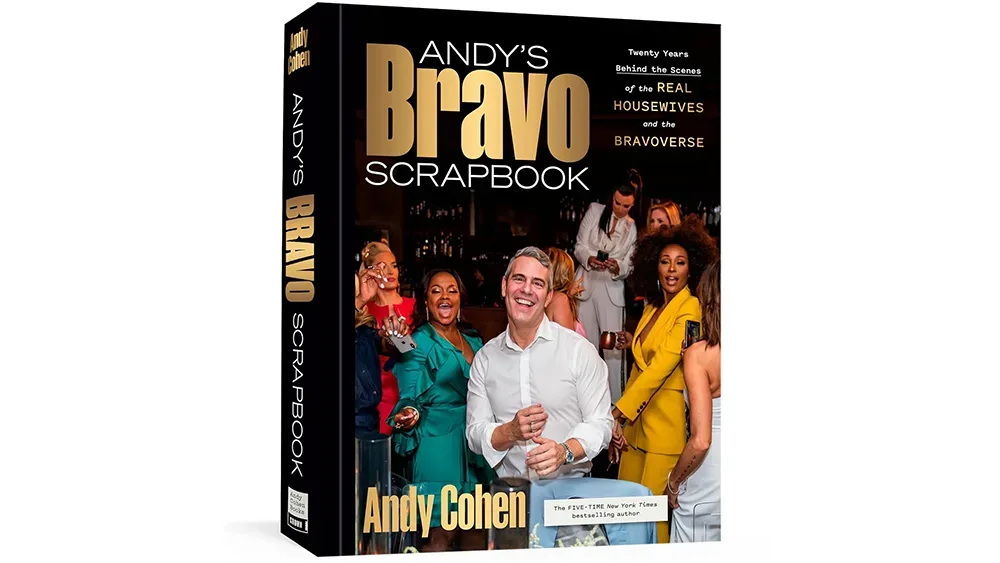
Reality television has long depended on the fleeting moment: an argument that erupts at a reunion, a look across a dinner table, a cast trip that goes spectacularly sideways. Andy Cohen’s new book, Andy’s Bravo Scrapbook: Twenty Years Behind the Scenes of the Real Housewives and the Bravoverse, is built around a different proposition. It gathers the moments that happened around, before and after the episodes into a physical archive.
Released Oct. 20, the 320-page hardcover marks 20 years of The Real Housewives. It contains more than 600 photographs from Cohen’s own collection, alongside stories from his time as a Bravo host and executive producer. Crown is publishing the book through the Andy Cohen Books imprint. The hardcover is listed at $38, while digital and audiobook editions are also available.
For viewers, the appeal is not simply a chronological guide to a giant television franchise. The material is positioned as a personal record: images accumulated through digital-camera years, the BlackBerry era and successive generations of iPhones. That device-by-device progression matters because it frames the collection as something closer to an evolving working archive than a set of studio publicity stills.
A scrapbook, rather than a conventional franchise history
The word scrapbook sets a useful expectation. A traditional history generally organizes its evidence into a single, polished account. A scrapbook can be more immediate and associative, making room for candid pictures, backstage encounters and items that acquire meaning because of who was present or what was happening around them. In this case, Cohen’s photographs are the organizing material, with his recollections supplying context.
That distinction is important for a TV property whose public identity is usually defined by edited episodes. A reunion special, for example, is a produced television event: the audience sees the final sequence and its deliberate structure. Backstage reunion photographs can point instead to the production environment surrounding that event—without replacing the program itself or claiming to reveal every part of how it was made.
Cohen has said that he took his camera everywhere during his two decades at Bravo. The book’s scope reflects that habit. It reaches back to the early period of The Real Housewives of Orange County and follows the franchise’s expansion into a global phenomenon, while also reaching beyond the Housewives banner.
Which Bravo worlds are represented
The collection includes material connected to The Real Housewives of Beverly Hills, New York City, Atlanta, New Jersey, Miami and Salt Lake City, among other installments. It also covers several other major Bravo series: Vanderpump Rules, Southern Charm, Summer House, Married to Medicine and Shahs of Sunset.
That breadth gives the book a broader purpose than documenting one cast or one city. It is an archive of what fans often call the “Bravoverse”: the interconnected cluster of Bravo personalities, shows, reunions and off-camera relationships. Here, the term does not mean that every series shares one scripted fictional continuity. Rather, it describes a media ecosystem in which casts, hosts and viewers recognize the wider network culture around individual programs.
Related coverage includes Andy Cohen’s ‘Bravo Scrapbook’ Collects 20 Years of Reality TV History.
For collectors of television books and network ephemera, the format could be the key attraction. A hardcover filled with hundreds of photographs is a materially different object from a streaming-library tile or social-media post. It offers a fixed, paginated selection from a much larger body of images. The digital edition may be practical for reading, and the audiobook may foreground the accompanying stories, but neither format duplicates the visual, browseable function of a photo-heavy hardcover.
That does not automatically make any copy a rare collectible. The supplied details identify a standard hardcover release, not a numbered edition, signed edition or limited-run product. Buyers interested in those distinctions should avoid assuming special scarcity unless a particular retailer or event listing explicitly establishes it.
The fashion change tells a larger story
While discussing the book, Cohen highlighted one especially visible transformation over the franchise’s life: reunion fashion. He contrasted the clothing from early reunions with the much more elaborate red-carpet-style presentation associated with the cast today.
“Looking at the clothes that the Housewives used to wear in the early reunions, and now they’re dressed like the Met Gala,” Cohen said.
The observation is a compact way to understand why a photographic retrospective can be useful. Fashion does not just date an image; it can show how the stakes and self-awareness around a franchise changed. Early clothing, a BlackBerry in the background, or an older camera image can each place a moment in a particular stage of the network’s history. By contrast, later reunion styling can reflect the degree to which these televised gatherings have become events in their own right.
It is also a reminder that reunion episodes are not merely post-season discussions. Their visual identity has become part of the broader show culture. The wardrobe, staging and sense of occasion carry their own public conversation alongside whatever disputes are revisited on screen.
Why Cohen’s vantage point is central
Cohen’s position makes this more than a fan-curated photo book. As a host and executive producer, he has worked near both the public-facing and behind-the-scenes sides of Bravo programming. The book is therefore framed through one person’s access and memory. Its previously untold stories are part of that personal perspective, not an all-purpose institutional record of every show or every person involved.
That limitation is not necessarily a weakness; it is the premise. A personal archive is valuable precisely because it has an authorial point of view. The practical implication for readers is to approach it as Cohen’s collected account of this period, anchored by images he retained over time. It may be most rewarding for readers who want visual context around familiar cast members and franchises rather than a detached critical study of reality TV.
The release is Cohen’s sixth book. His earlier bestsellers include Most Talkative, The Andy Cohen Diaries and The Daddy Diaries. Those titles help establish that the new book belongs to an existing publishing career, but its visual emphasis distinguishes it from a straightforward memoir or diary format.
A physical record in a heavily digital TV culture
The book arrives at a time when much of television fandom is experienced through clips, social posts, streaming menus and rapid online commentary. Those formats can preserve a moment, but they also make it easy for the surrounding context to scatter. A hardcover scrapbook imposes a curated sequence: selected photographs, stories and shows share a single object rather than being dispersed across feeds and platforms.
That tangible quality may be particularly appealing to fans who enjoy keeping a shelf of pop-culture artifacts. It is part of a wider appeal of physical media and physical documentation—the idea that a curated object can be revisited without relying on a changing platform interface. For a related look at the continuing discussion around tangible entertainment formats, see Nintendo’s physical-media message and the renewed attention on disc production.
Of course, the scrapbook is not presented as a substitute for the programs. It is a companion piece, and its stated contents suggest a balance between the polished mythology of a successful TV brand and the incidental images generated by years of working around it. The inclusion of digital cameras, BlackBerrys and iPhones reinforces that the book is partly a record of changing habits of personal documentation as well as changing reality-TV celebrity.
Launch appearances and what buyers should know
Cohen is marking the release with live events, including a New York appearance at Cooper Union on Oct. 20 and a Chicago stop on Oct. 29. The provided release information confirms the appearances, but does not establish any event-exclusive edition, signing policy or bundled item. Anyone considering an event purchase should check the relevant organizer’s current details rather than infer extras from the book’s launch schedule.
For prospective readers, the clearest purchase decision comes down to format. The $38 hardcover is the edition that best matches the project’s core selling point: more than 600 photographs presented as a personal visual archive. The digital version offers another reading option, while the audiobook is likely most relevant to listeners interested in Cohen’s stories rather than the image-led experience.
Andy’s Bravo Scrapbook ultimately captures a particular kind of entertainment history: not just the on-screen confrontations and reunion spectacles viewers remember, but the years of candid documentation around them. Across 320 pages, Cohen’s archive offers a deliberately personal route through the Housewives’ 20-year milestone and the wider Bravo slate that grew alongside it.