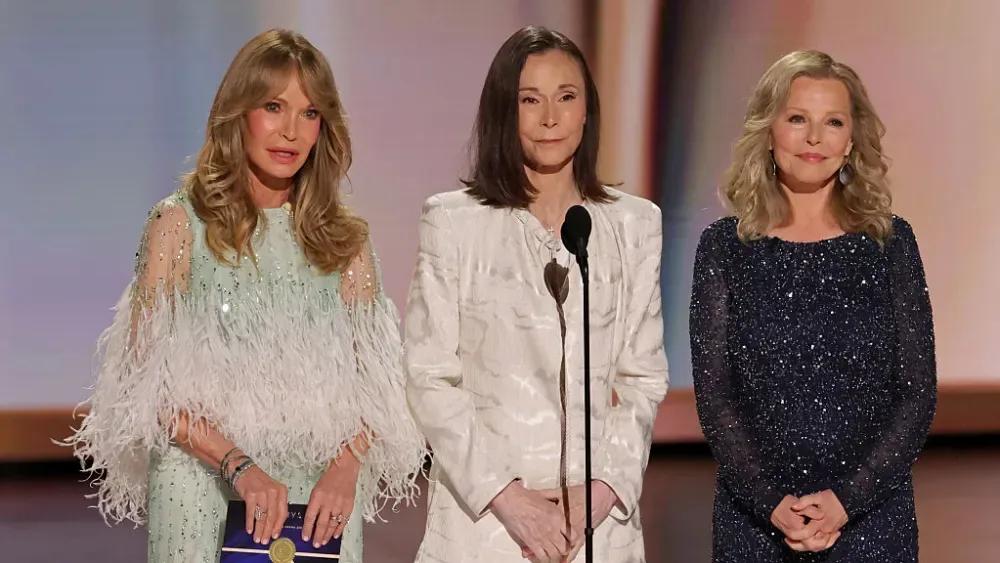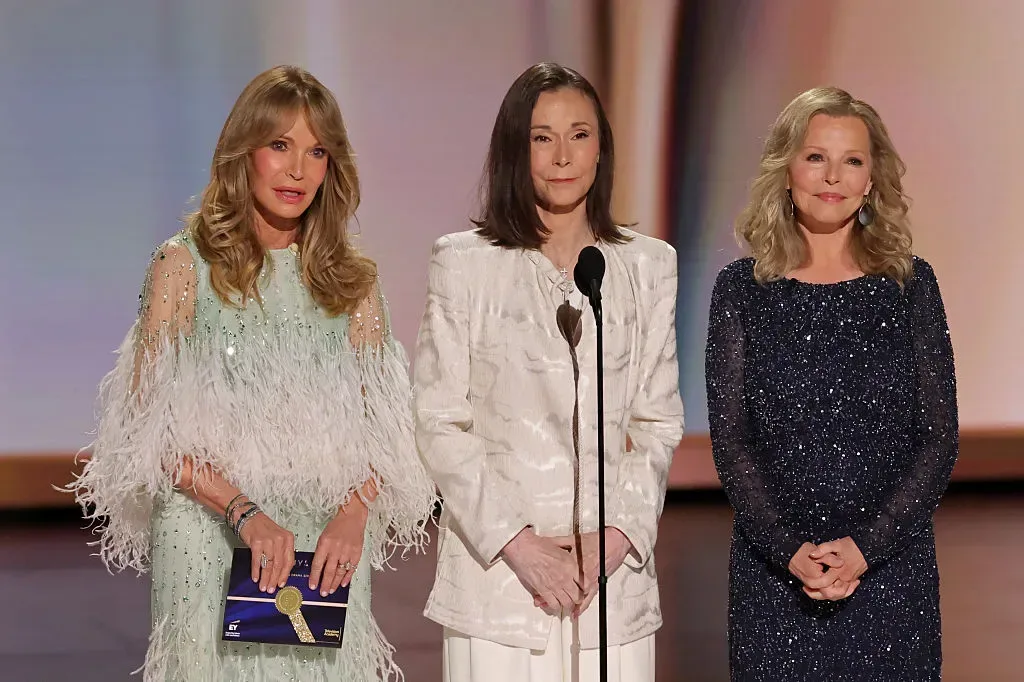
Three Angels returned to the assignment briefing at the 78th Emmy Awards—only this time, the mission involved an awards envelope rather than a case file. Kate Jackson, Cheryl Ladd and Jaclyn Smith reunited on the Emmy stage to recognize 50 years of Charlie’s Angels, bringing a major piece of 1970s television history back into the spotlight.
The audience greeted the trio with a standing ovation. Before they presented the Emmy for Best Drama to The Pitt, the actors took time to remember their late co-star Farrah Fawcett, whose Jill Munroe was an essential part of the original series’ identity and enduring cultural reach.
Smith said Fawcett remained present in the shared recollections of fans and colleagues. Jackson called her the brightest of the Angels and stressed the scale of the affection people still hold for her. Ladd, meanwhile, nodded to the extraordinary afterlife of Fawcett’s famous poster, an image that became an unmistakable artifact of the era and continues to evoke the show for collectors and pop-culture fans alike.
It was a brief television moment, but it carried the weight of a long-running legacy: one that includes hit-network-TV status, Emmy recognition, instantly recognizable promotional imagery, evolving casts, and a premise so direct that it could be understood from the sound of a speakerphone.
A reunion built around the original Angels’ legacy
Charlie’s Angels ran on ABC for five seasons, from 1976 through 1981. Created by Ivan Goff and Ben Roberts, the adventure-crime drama centered on three women working as private detectives for the unseen Charlie Townsend. Charlie delivered assignments remotely, communicating through a speakerphone and operating with help from his assistant, Bosley.
That framework was simple enough to be endlessly flexible. One week could call for surveillance, another a stolen-object mystery, an undercover identity, a dangerous criminal operation, or a case that placed the detectives in an unfamiliar world. The cases gave the series its engine, while the chemistry and distinct personalities of its central trio supplied the appeal that helped turn the program into a defining television phenomenon.
Jackson played Sabrina Duncan, the cool and capable detective associated with calm decision-making. Smith played Kelly Garrett, while Ladd took on Kristine “Kris” Munroe. Fawcett originated the role of Jill Munroe. Together, the performers made the Angels more than a title treatment or a lineup in a publicity still. Their characters became the public face of the series and a lasting shorthand for 1970s prime-time television.
The Emmy-stage appearance specifically brought Jackson, Ladd and Smith together, and the tribute made clear that Fawcett was central to the occasion even in her absence. The 50-year milestone is an opportunity to recognize not merely a successful show, but the people whose work gave it a personality durable enough to be remembered decades later.
Related coverage includes Charlie’s Angels Stars Reunite at 78th Emmys, Honor Farrah Fawcett.
Farrah Fawcett’s place in the cultural memory
Fawcett’s fame extended well beyond her time on the series. Her association with Jill Munroe and her poster made her one of the most recognizable stars of the period. Ladd’s comment at the Emmys put that poster in a practical, wonderfully specific context: it did not just circulate as advertising or magazine imagery. It occupied bedrooms, garages and other personal spaces, becoming part of the visual furniture of its time.
That matters when considering television memorabilia and fandom. Some programs leave behind props or scripts that speak most directly to dedicated collectors. Others create images that travel much farther, becoming instantly identifiable even for people who have not watched an episode in years. The Fawcett poster belongs to the latter category. It is inseparable from her public image and closely bound to the broad cultural footprint of Charlie’s Angels.
In that sense, the tribute was also a reminder that television legacy is not limited to broadcast archives. It survives in photographs, promotional materials, cast reunions, reruns, recollections and the objects that audiences held onto. For more on how award-show tributes can prompt wider discussions around television legacy, see this look at Emmy In Memoriam questions and TV legacy tributes.
The series had Emmy history before this return
The reunion was not the first time Charlie’s Angels had a connection to the Emmys. During its original run, the series received four Emmy nominations. Those nominations included Outstanding Achievement in Film Sound Editing for a Series in 1977, as well as acting nominations for Jackson and David Doyle.
Jackson was nominated for Lead Actress in a Drama Series in both 1977 and 1978. Doyle, who played John Bosley, received a Supporting Actor in a Drama Series nomination in 1977. Those honors are useful context for an often-overlooked part of the show’s history. Charlie’s Angels is frequently recalled through its stars, costumes, title sequence, premise and enormous pop-cultural profile, but it also earned recognition within the television academy’s awards system while it was on the air.
Its sound-editing nomination similarly underlines the production work behind a show that could move from mystery to action to glamorous danger in a single episode. The series’ format demanded more than a catchy concept: every week needed a case, a setting, a sense of jeopardy and a way to keep the three leads at the center of the action.
From a rejected idea to a network-TV landmark
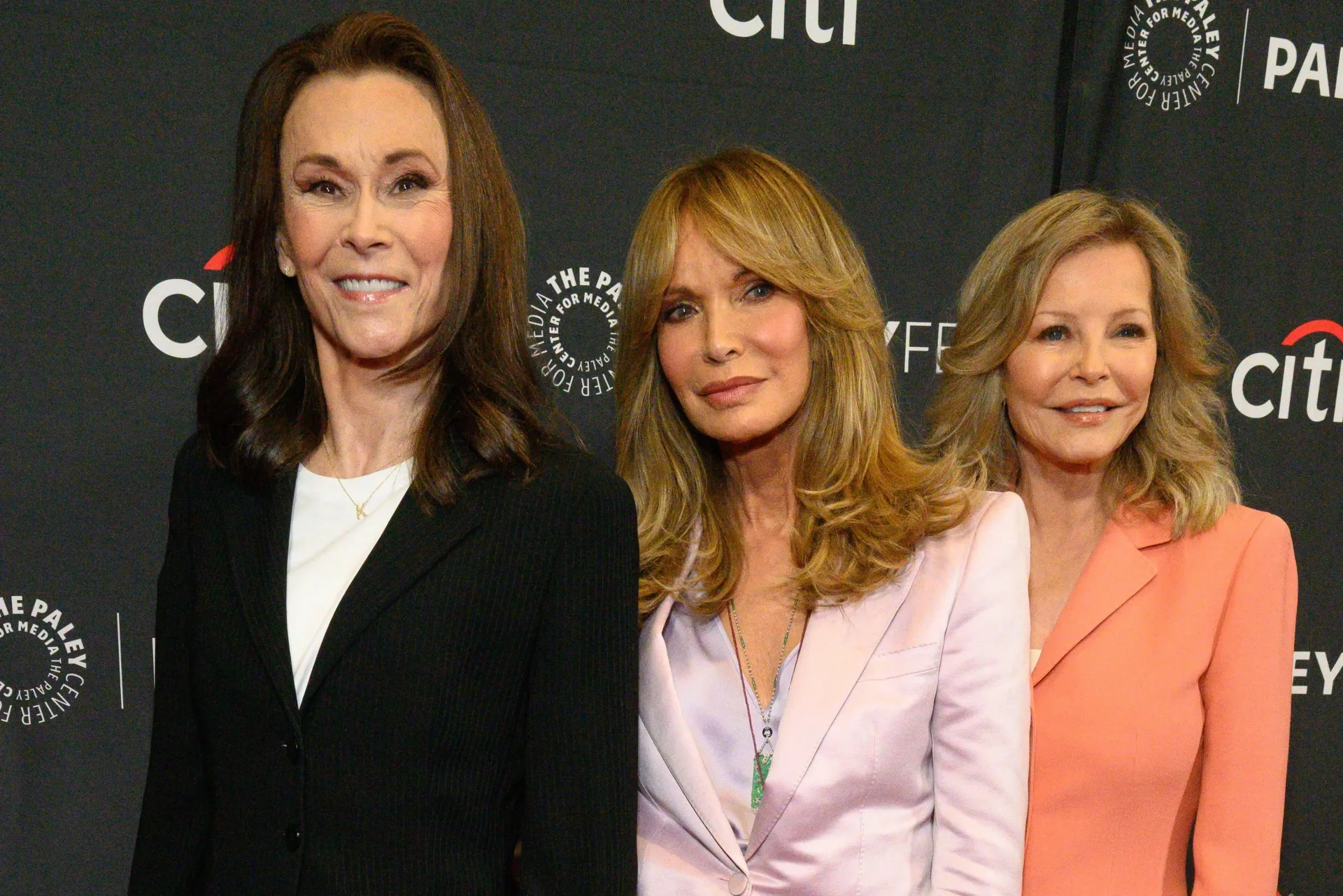
Earlier in 2026, Jackson, Ladd and Smith gathered for a PaleyFest panel in Hollywood to mark the anniversary and discuss their experience with the show. Jackson shared a revealing piece of its origin story. As her previous series, The Rookies, was nearing its end, executive producer Leonard Goldberg presented her with a project then called Alley Cats.
The early concept involved three female private investigators, but it also featured whips and chains. Jackson’s initial reaction was strongly negative. Goldberg told her that the project was available after all three networks had passed on it, a detail that did not exactly make the pitch sound more promising. Yet the concept did not stay in that form. It developed into Charlie’s Angels, the show that would soon become a major network-TV fixture.
That origin story is a useful antidote to the illusion that cultural landmarks arrive fully formed. What audiences eventually see as inevitable—a title, cast, presentation and formula that feel perfectly aligned—may have begun as a less polished proposal that needed substantial adjustment. In this case, an idea Jackson initially regarded as a terrible fit evolved into one of the era’s best-known series.
The phrase “one more mission” works for the Emmy appearance because it speaks to the series’ core setup, but it also neatly describes what made the reunion effective. Jackson, Ladd and Smith did not need to recreate the show or revisit every chapter of its history. Their presence together immediately connected viewers to the program’s familiar cast dynamic. Their remarks about Fawcett then gave the moment a warmer and more personal purpose.
Why the 50-year mark resonates
Anniversaries can be mechanical exercises in counting years, but Charlie’s Angels has several reasons to remain meaningful at 50. The show’s title still carries immediate recognition. Its original stars are closely identified with their roles. Fawcett’s image remains iconic. And the series has a clear place in the changing story of women-led action and detective television, even as modern audiences may revisit its conventions through a contemporary lens.
The Emmy reunion did not treat that history as a museum piece. It used the gathering of Jackson, Ladd and Smith to honor Fawcett and acknowledge the ongoing emotional connection between the program and its audience. The standing ovation suggested that the connection remains real.
At an event designed to recognize current television, the original Angels made room for memory: of Sabrina, Kris, Kelly and Jill; of Bosley and Charlie’s distant voice; of the 1976-to-1981 ABC run; and of a series that once emerged from a dubious early pitch to become an enduring pop-culture reference point. Fifty years later, the assignment is still clear. Charlie’s Angels remains impossible to mistake for anything else.