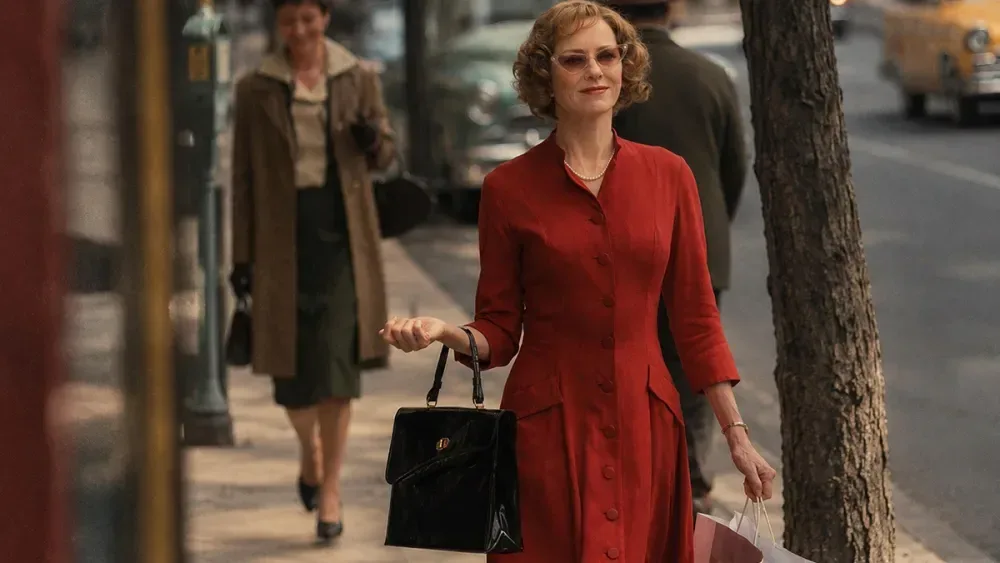
Naomi Watts is the reason to see The Housewife, even as the film surrounding her never entirely decides how much confidence it has in its own central mystery. Director Ben Shirinian’s debut feature is a mid-1960s New York drama built around Hermine Ryan, an Austrian immigrant homemaker whose apparently settled life in Queens is threatened by inquiries into the past. It draws on a real Nazi-hunting case, but its most compelling subject is not the machinery of investigation. It is Hermine herself: a woman who has made a life through careful presentation, evasions and, perhaps most revealingly, an unstable relationship with the stories she tells herself.
That focus gives the film a potentially unnerving angle. A procedural thriller generally derives momentum from people assembling facts: a reporter finds a lead, an official evaluates evidence, witnesses fill in missing pieces. The Housewife includes those components, yet it is more vivid when it stays near the person attempting to contain those facts. Watts plays Hermine with enough anxiety, charm and defensive precision that the audience can read danger in a smile before the screenplay begins underlining it.
A polished life with cracks already showing
Hermine has moved to the United States with her husband Russell, played by Luke Evans, after the pair met in postwar Austria. By the time the story begins, she has lived in New York for nearly a decade. She remains conscious of her Germanic accent and anxious about the citizenship interview ahead of her, despite enjoying the outward markers of acceptance: church acquaintances welcome her, and her oatmeal-raisin cookies have become a local favorite.
Those domestic details matter because the film’s tension comes from the uneasy gap between Hermine’s practiced normality and the strain Watts places underneath it. The performance makes the character’s public self feel less like a simple disguise than a routine she must repeatedly perform in order to believe it. Her citizenship interview with immigration official Anthony DeVito, played by Michael Imperioli, becomes an especially pointed setting for that performance. Hermine can articulate an appealing version of the American dream, but the very fluency of the presentation raises questions about what has been omitted.
Shirinian directs the mostly Queens-set story with a sober, polished period look. The production values lend weight to the setting, while Michael Merriman’s camera work, Jon Devries’ editing and Kevin Lau’s music support the film’s serious register. The approach is handsome rather than flashy, appropriate for a tale in which ordinary suburbia is meant to conceal difficult truths.
But visual gravity and narrative subtlety are not the same thing. The film frequently signals that Hermine has secrets before it needs to, and Alyssa Hill’s script can repeat implications that Watts has already made plain through posture, timing or expression. The result is a strange imbalance: the lead performance works in fine gradations, while the storytelling sometimes circles it with a thick red marker.
The investigation is present, but not persuasive enough
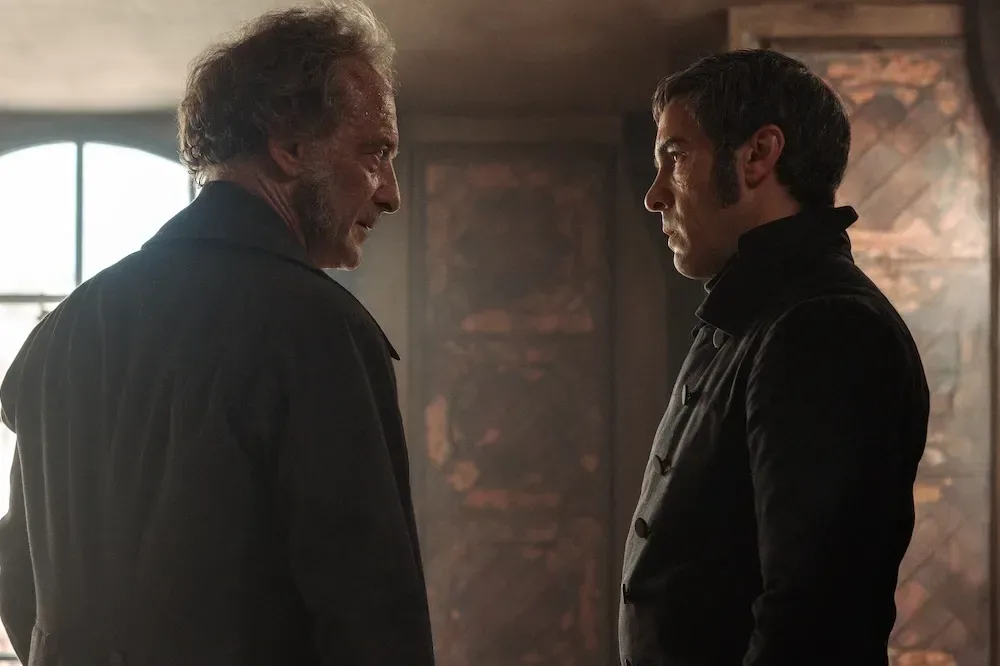
Tye Sheridan plays Joseph Lelyveld, a reporter who arrives at the Ryans’ home asking to speak to Russell. His inquiry follows a tip from Austrian Nazi hunter Simon Wiesenthal, though the film does not give Wiesenthal a particularly substantial presence. This is a consequential absence. A story framed around a Nazi-hunting case could use the larger investigative effort to build pressure, clarify stakes and provide a meaningful counterweight to Hermine’s account of herself. Instead, the surrounding process often feels like a delivery mechanism for information.
That is the chief limitation of the film’s procedural side. A procedural is a narrative structured around the steps of an investigation or institution—interviews, records, leads, evidence and official decisions. Its suspense depends not only on what is discovered, but on how the discovery changes the people involved. Here, Sheridan’s journalist is too often given dialogue that explains rather than probes. He gathers necessary details, but he does not become a fully persuasive intellectual or emotional opponent for Hermine.
Related coverage includes ‘The Housewife’ Review: Naomi Watts Holds Together a Fractured Nazi-Hunting Drama.
Imperioli’s DeVito is similarly underdeveloped. His role at the citizenship interview creates a natural source of tension: an immigration official is positioned to evaluate Hermine’s official narrative at precisely the moment it is most vulnerable. Yet the character does not gain enough dramatic force to become the foil the story needs. A foil is not merely an antagonist; it is a character whose contrasting outlook or methods sharpen our understanding of the protagonist. Neither DeVito nor Joseph consistently pushes Hermine into revealing dimensions that Watts has not already suggested on her own.
Evans, meanwhile, is held back by the structure. The delayed introduction of Russell is designed to preserve uncertainty, but the maneuver is so conspicuous that it risks advertising its own purpose. The film seems intent on manufacturing a late reveal where it might have been more powerful to let the audience sit openly with Hermine’s shifting self-justifications. The mystery is less interesting than the person at the center of it.
That disconnect is especially apparent because the premise already carries enormous moral weight. The story does not need extra coyness to generate dread. It needs the confidence to examine the ways a respectable domestic identity can coexist with denial, calculation and self-protective revision. Watts gives it that confidence even when the screenplay does not.
Watts makes uncertainty the film’s real subject
The strongest choice in The Housewife is its refusal, at least for much of its running time, to make Hermine legible in only one way. She is not played as a stock villain waiting for a mask to fall. Watts instead suggests someone who is constantly adjusting: attentive to what others expect, skilled at making herself sympathetic, and capable of changing the shape of a personal history when scrutiny arrives.
That makes the performance simultaneously inviting and alarming. Hermine’s nervousness could initially be attributed to immigration status, social alienation or the pressure of a citizenship interview. The film gradually asks the viewer to reconsider those apparent explanations. Watts does not abruptly discard one interpretation for another. She lets them remain in tension, which turns Hermine into a more unsettling figure than any mechanical plot twist could create.
This is the quality the film should trust most. The description “unreliable perspective” applies here in a specific sense: the audience is encouraged to assess events through a character whose version of her own past cannot simply be accepted. An unreliable perspective is not just a surprise-device. At its best, it makes viewers actively weigh language, behavior and omission. Hermine’s stories change under pressure, and the most absorbing question becomes whether she recognizes the changes herself.
The screenplay occasionally hints at another ambiguity in the connection between Hermine and Joseph, suggesting a possible age-gap attraction. That thread could have complicated the power dynamics between subject and reporter, or revealed another means through which Hermine tries to shape the encounter. It is introduced with some intrigue but receives little development. The film repeatedly approaches murkier, riskier territory, then moves away before it can fully investigate it.
For a different fictional angle on Nazis and dinner-party espionage, readers can also look at The Rocketeer: Infiltrator! #3, though The Housewife is pursuing a far more sober and historically grounded kind of unease.
A rushed final stretch undercuts the slow burn
The Housewife runs 102 minutes, a brisk length that helps it avoid becoming static but ultimately works against its final movement. The first hour takes its time establishing Hermine’s uneasy social world and withholding key information. Once the film turns toward courtroom drama, however, it begins to compress character shifts and consequences that deserve greater space.
That structural change matters. A courtroom drama shifts conflict into testimony, competing accounts and formal judgment. Such a setting can be powerful for this story because it asks public institutions to confront private lies. But it also demands room for testimony to land and for competing versions of events to be examined. Here, the courtroom portion feels comparatively cursory after the deliberate buildup.
Lena Olin provides the final act with some of its most potent material as a Holocaust survivor who carries crucial and horrific knowledge. In only two scenes, Olin brings a contained intensity that cuts through the film’s tendency to explain itself. Her presence demonstrates what the drama can do when it stops treating the past as a mystery-box component and allows the human cost of truth-telling to dominate the frame.
The shift also compresses Watts’ careful work. Earlier scenes let her show Hermine recalibrating in small increments; later developments force those gradations into a faster, narrower channel. The performance remains committed, but the film hurries away from the very ambiguity that had made it distinctive.
An assured lead inside an uneven debut
Shirinian takes on difficult material with seriousness and a clear eye for period atmosphere. His debut has an elegant surface, a strong cast and a central performance that sustains attention even when the narrative takes too much trouble to conceal what the viewer can already sense. The supporting ensemble includes Debi Mazar, while Evans, Imperioli and Sheridan all serve important functions within the story, even if the screenplay leaves several of those functions thinner than they should be.
Hill’s script is at its best when it lets Hermine’s conduct do the talking. It is less effective when it treats exposition as a substitute for dramatic discovery or reaches for signposts that diminish the tension. The real frustration is that the film understands its richest subject: the precarious construction of a new life by a person who cannot safely separate herself from the old one. It simply does not devote enough of its final stretch to that subject.
Still, Watts turns Hermine into more than a historical-case protagonist. She is the unstable center of every room she enters, trying to preserve a version of herself while the surrounding world begins to test it. That controlled, slightly unknowable screen presence carries The Housewife through its underpowered investigation and hurried resolution. The film is watchable as a serious period drama, but Watts’ performance is what makes it linger.
Film details
- Director: Ben Shirinian
- Screenplay: Alyssa Hill
- Cast: Naomi Watts, Tye Sheridan, Michael Imperioli, Luke Evans, Lena Olin and Debi Mazar
- Running time: 102 minutes