Victor Hugo’s Les Misérables has survived so many transformations that its basic architecture is nearly impossible to encounter fresh: a former convict seeks redemption, a policeman makes law into an obsession, poverty turns private misfortune into catastrophe, and a younger generation eventually meets history at the barricades. Fred Cavayé’s new French-language film makes a determined effort to compress that enormous design into 179 minutes. It has a formidable cast, battlefields, digital cityscapes, packed taverns and courtrooms, and the kind of visual sweep audiences have been taught to read as “prestige epic.”
Yet this version’s biggest problem appears to be the gap between scale and feeling. The production reportedly cost $37 million, and its resources are plainly directed toward conveying a 19th-century world at maximum volume. But lavishness is not automatically drama. A wide battlefield, a busy street or a camera floating over a reconstructed city can establish scope; it cannot by itself make the moral choices inside that world land with force. Cavayé’s film seems to have the furniture of Hugo’s epic without consistently locating the emotional, psychological and political pressure that makes the story endure.
That makes the three-hour running time especially notable. The issue is not simply that the movie moves slowly. Mickael Dumontier’s editing is described as brisk, while Christophe Julien’s score pushes the material toward action and adventure. Rather, the concern is that the film moves through events too efficiently. It gets the audience from one famous plot point to the next, but gives less room to the inner lives and social conditions that make those points more than narrative obligations.
A non-musical return to a famously musical property
This is not a new adaptation of the stage musical. Nobody breaks into song, and the film instead approaches Hugo’s story as an expansive historical drama. That choice could have created space for a rougher or more intimate account of poverty, punishment, labor and state power. The absence of musical numbers, however, does not necessarily signal realism. The approach here is still overtly stylized and monumental, complete with aerial imagery, digitally constructed city vistas and large groups of costumed performers.
“Epic” in this context means more than length. It usually describes storytelling built around broad historical settings, major public events, substantial casts and personal stories positioned against social upheaval. Cavayé supplies those components. The tougher task is ensuring that the private and public sides of the story illuminate one another. Hugo’s novel is sprawling precisely because it constantly connects Jean Valjean’s individual fate to institutions: prisons, factories, policing, class, religion and revolutionary politics. Reducing a 1,462-page novel to one feature is a practical necessity, but it also raises the stakes of every omission and shortcut.
The film’s streamlined form may be a poor fit for material whose meanings accumulate over decades and across an ensemble. A miniseries structure might have permitted more room for the supporting characters, the social setting and the long-term shifts in Valjean and Javert’s relationship. Instead, the adaptation has to choose whether it is a broad survey of Hugo’s world or a concentrated duel between two men. It appears caught between those aims.
Vincent Lindon inherits a monumental role
Vincent Lindon plays Jean Valjean after Ryan Fartout portrays him in his younger years. Valjean begins as a laborer whose theft of bread to feed his starving family becomes a chase-and-fight sequence, followed by a prison sentence that grows ever longer. Once released, he is embittered and marked by his past. Christian compassion from Monseigneur Myriel, played by Frédéric Pierrot, changes the direction of his life.
Years later, Lindon’s Valjean is living as M. Madeleine: a respected glass-factory owner and the mayor of Montreuil. That reinvention is central to the character. Valjean is not merely escaping the past; he is trying to build a life in which responsibility toward other people matters more than the identity imposed on him by the penal system. The tragedy, of course, is that a new name cannot guarantee a new relationship with authority. When Javert arrives in Montreuil, the old machinery begins turning again.
Lindon is an inherently consequential casting choice for a role with a long lineage in French-language adaptations. The supplied cast list also gives the film a substantial roster around him: Noémie Merlant as Fantine, Camille Cottin and Benjamin Lavernhe as the Thénardiers, Megan Northam as Cosette, Vassili Schneider as Marius, and Marie Colomb as Éponine. The issue is less a lack of performers capable of carrying this material than whether the script allows them to move beyond archetypes.
Javert receives more backstory, but not necessarily more depth
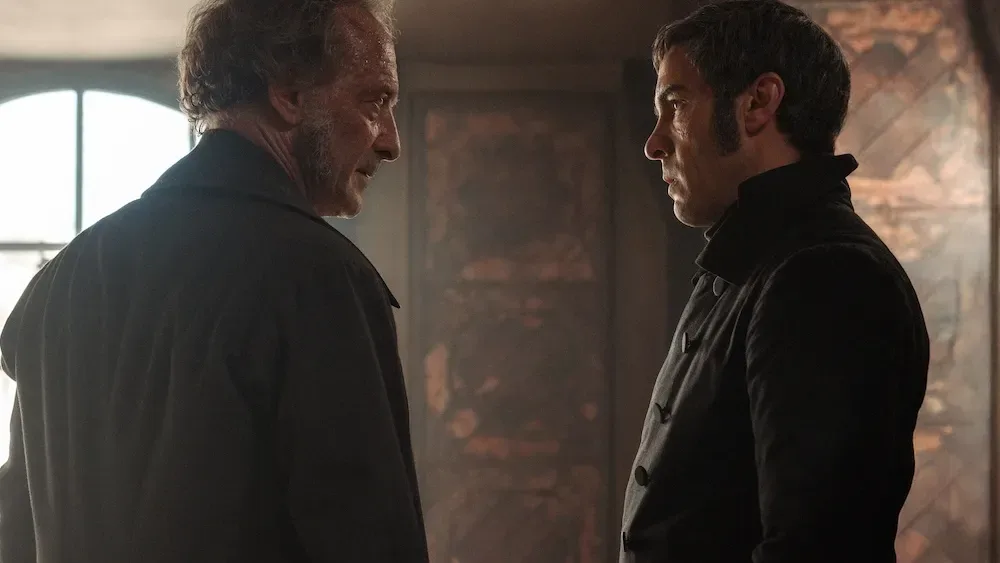
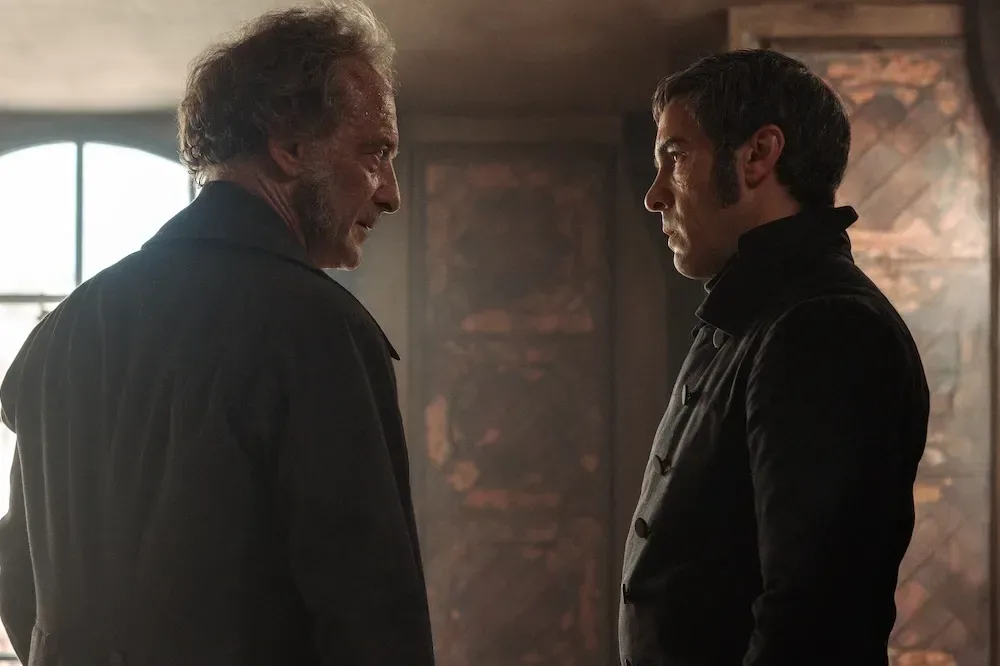
Tahar Rahim plays Inspector Javert, the officer who comes to suspect M. Madeleine is really Valjean. Javert is one of literature’s defining embodiments of rigid legalism: a person who treats the law not as an instrument meant to serve justice, but as an absolute moral order. In this adaptation, the character is given an explicitly traumatic past. His mother forced him to steal as a child and abandoned him after he was caught taking a pocket watch. His adult cruelty is also expressed through self-hatred, including repeated mirror-smashing, and apparitions of his mother.
Backstory can clarify a character, but it does not automatically make a character complex. There is a difference between explanation and insight. Explanation identifies a childhood wound; insight shows how that wound becomes a worldview, an instinct and a pattern of choices. The material as described leans on recurring visual signals—mirrors and watches—to communicate Javert’s damage. The watches function both as markers of wealth and reminders of time passing, but symbolism becomes blunt when it is repeatedly underlined rather than allowed to emerge from the drama.
That tendency reflects the broader concern with the film’s treatment of the novel. Hugo’s central conflict is not merely Valjean versus Javert. It is mercy versus a legal order that cannot recognize human change. If the adaptation turns that conflict into a rapid sequence of pursuit, revelation and confrontation, it risks making the inspector’s pursuit feel like plot machinery instead of a profound ideological collision.
Fantine, the Thénardiers and the cost of speed
The story’s cruellest arc belongs to Fantine. On the way to Montreuil with her daughter Cosette, Fantine encounters the Thénardiers, who run a tavern. Camille Cottin’s Mme Thénardier persuades her to leave Cosette there, then extracts ongoing payments for the child’s care. The Thénardiers are first introduced scavenging gold teeth from dead soldiers at Waterloo, an image that quickly defines them as opportunists willing to profit from disaster.
Fantine eventually loses her factory job. To survive, she sells her hair, then her teeth, and ultimately her body. By the time M. Madeleine understands what has happened, she is dying. The sequence is one of the novel’s clearest arguments that misery is systemic rather than accidental: people do not fall because they lack virtue, but because every available institution has made their fall easier. Valjean’s promise to care for Cosette is meaningful precisely because it arrives after society has failed Fantine at every turn.
A three-hour film can certainly tell that story. But it needs to make the chain of cause and effect palpable, not simply report the stations of Fantine’s suffering. When social detail is sacrificed for speed, poverty can start to resemble a tragic costume rather than a material condition shaped by employers, public judgment and economic desperation. The same issue applies to the Thénardiers: their grotesque opportunism can add energy and menace, but they need to exist within a larger system of exploitation rather than simply serve as colorful villains.
The political story remains background scenery
Cosette, now played by Megan Northam, falls for Marius, played by Vassili Schneider. He comes from privilege but is involved in left-wing resistance and is friends with Éponine, the Thénardiers’ daughter. Marie Colomb’s Éponine reportedly stands out within the ensemble. Those relationships should widen the movie from Valjean’s private redemption into a story of young people confronting the political world they are inheriting.
Instead, the final barricades associated here with the Paris Commune are presented largely as bloody visual background. That is a major limitation for an adaptation of a work so deeply invested in the relationship between social injustice and political unrest. A barricade is not merely a production-design opportunity or action setting. In the story’s emotional language, it is where personal loyalty, class division, idealism and violence collide.
The film’s apparent reluctance to develop labor resistance and the working poor is especially conspicuous because it otherwise spends so much effort on historical scale. Background detail is not the same thing as historical engagement. A movie can fill the frame with uniforms, props, period streets and enormous crowds while sidestepping what those things are meant to say. For viewers looking for a version of Les Misérables that sees Hugo’s politics as more than a garnish, that distinction matters.
What this adaptation offers—and what it leaves behind
Cavayé’s Les Misérables has the ingredients of a major national adaptation: a director who also wrote the screenplay, a high-profile French cast, camera work by Denis Rouden, a major period setting and a long runtime intended to signal seriousness. It also benefits from the indestructible narrative pull of Valjean, Fantine, Cosette and Javert. Even in abbreviated form, these characters bring extraordinary dramatic stakes with them.
But familiarity can become a trap. This is one of the most adapted stories in modern culture, spanning books, films, television, theatre, radio, comics and the world-famous musical. A new version needs more than competent plot compression and expensive images to justify its existence. It needs a point of view: a fresh moral emphasis, a vivid understanding of the present through the past, or an unusually intimate reading of the characters.
Here, the ambition seems to be definitiveness—an all-purpose, handsomely appointed version that contains the expected beats. The result, however, sounds less definitive than interchangeable. Viewers interested in contemporary screen criticism of large-scale filmmaking may find a useful comparison in this look at a brisk but predictable action caper: pace and polish can keep a story moving, but neither substitutes for surprise, texture or conviction.
Les Misérables remains an enduring narrative because misery, mercy and institutional cruelty remain enduring subjects. The new film understands the outline of that claim. Its reported weakness is that it does not dig far enough beneath the outline to make the story feel newly necessary.