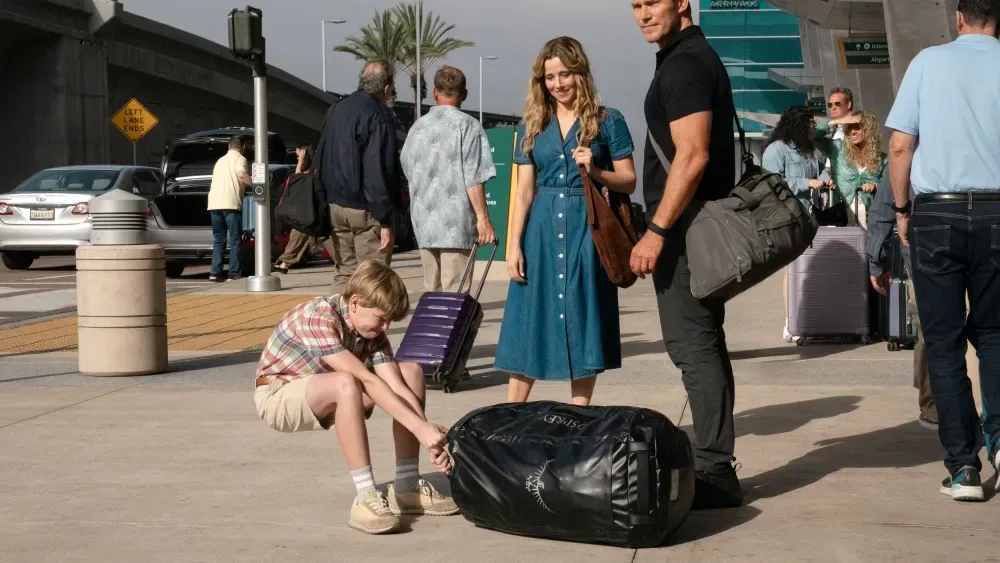
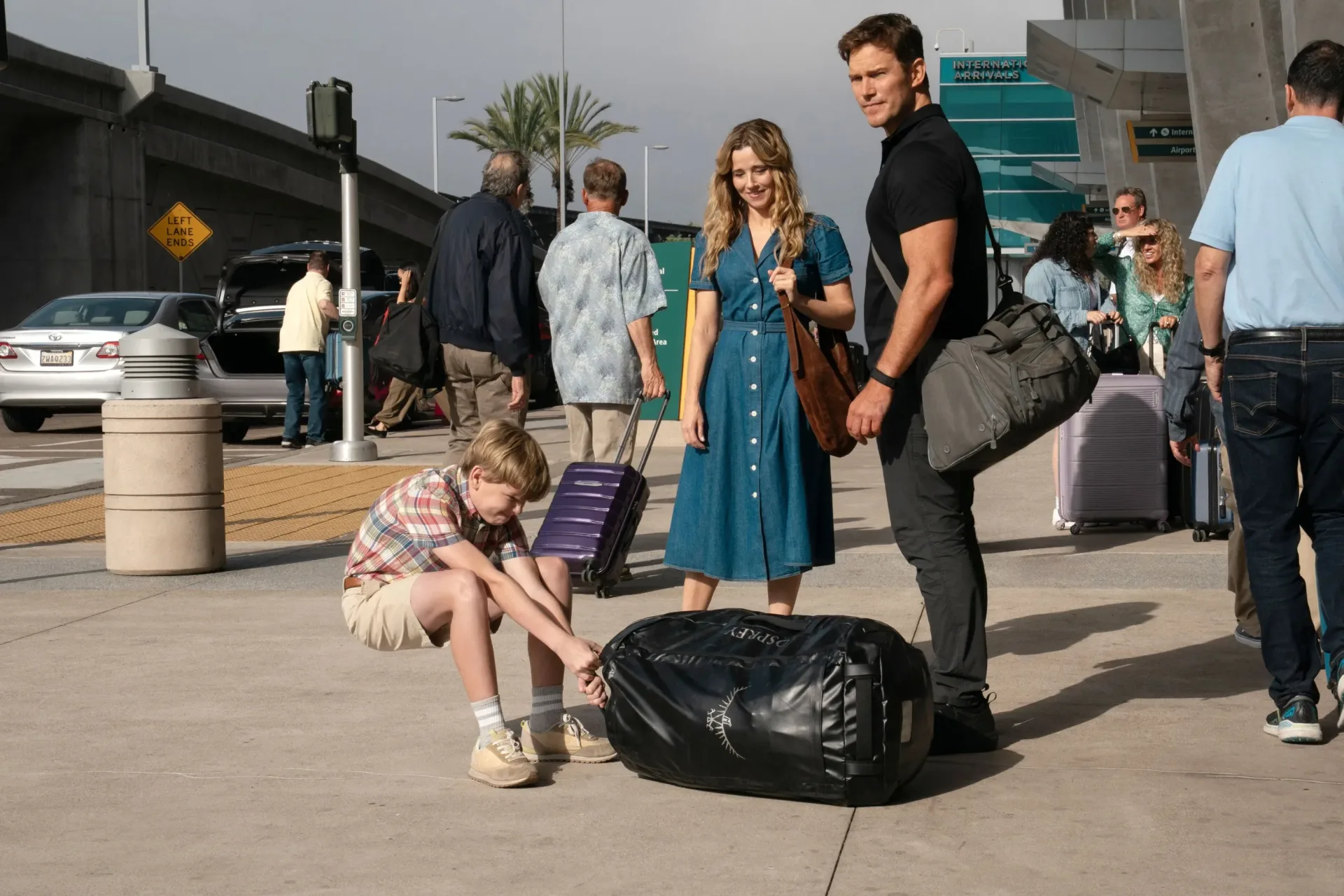
Way of the Warrior Kid arrives with an inherently workable summer-movie setup: a boy being bullied asks his injured, highly disciplined uncle for help, then discovers that confidence is more complicated than learning how to throw a punch. The problem is that the film’s most accessible story—the one belonging to the kid—is repeatedly crowded out by the adult drama built around Chris Pratt’s wounded Navy SEAL.
Directed by McG and written by Will Staples from Jocko Willink’s book, the 106-minute, PG-13 film follows Marc, played by Jude Hill, during a summer in San Diego. Marc is clumsy, insecure and targeted by a school bully named Kenny. His uncle Jake, played by Pratt, is a decorated Navy SEAL recovering from an injury and carrying grief from a failed rescue mission. When Marc asks Jake to train him, Jake puts his nephew on an exercise regimen while insisting that strength should not become an excuse to seek a fight.
That is a sensible lesson for a kid-focused movie. It is also the foundation of the film’s central tension: Jake wants Marc to become tougher, but not violent; Marc wants to stop being afraid, but initially treats physical readiness as the path to doing so. The story has room to explore the difference between confidence—the belief that one can handle a difficult situation—and aggression, which is using force or intimidation to control it. Yet the movie reportedly lands its ideas with a heaviness that leaves too little space for Marc’s perspective to grow naturally.
A kid’s coming-of-age story with a very large co-star
Marc should be the natural anchor. His problem is immediate and recognizable: he wants to get through school without humiliation and recover a sense of control. He is also grieving his deceased father, a loss the movie connects to Jake’s own unresolved trauma. On paper, that parallel can give the uncle-nephew bond real weight. Jake has lived through situations Marc cannot comprehend, while Marc’s everyday fears could remind Jake that emotional pain does not need to arrive with military stakes to be real.
But the adult plot appears to pull the story off balance. Jake is not simply a relative home to recover. He is a soldier intent on returning to active duty, haunted by the loss of a comrade and by a mission involving children held hostage overseas. That material is clearly meant to explain his rigid outlook and reluctance to process pain. It also makes him a much larger dramatic presence than the story needs if its primary promise is Marc’s growth.
There is a distinction worth making here. A supporting adult can have a fully formed inner life without becoming the narrative’s gravitational field. The strongest youth stories generally let the adult mentor illuminate the young character’s choices. In Way of the Warrior Kid, the structure seems to work the other way around too often: Marc’s milestones become evidence in Jake’s emotional recovery. Rather than a boy’s story enriched by an uncle’s scars, it becomes two films competing for screen time.
That imbalance is especially notable because the source material is part of a larger series. Willink has written five books about Marc and Jake, which suggests the pair have enough material to sustain an ongoing relationship. A first installment does not need to solve every burden Jake carries. It only needs to make Marc’s summer feel complete. Trying to launch both a child’s empowerment arc and a veteran’s trauma-and-return-to-service arc within one feature can make each feel abbreviated.
The movie’s best idea is hiding in plain sight: Band Jam
One of the film’s more distinctive details is Marc’s love of a music-game stand-in called Band Jam. When he plays, the direction transforms the world around him to express the confidence he feels in the game. These flourishes are more than decorative. They offer a visual route into Marc’s head: gaming is a place where he feels coordinated, capable and present in a way that daily life does not always allow.
Related coverage includes Way of the Warrior Kid Review: A Family Story Split Between Two Missions.
That is an unusually useful starting point for the movie. Marc’s gaming is not merely a gag about an adult dismissing screens. It could be a bridge between virtual competence and real-world courage. Rhythm games ask players to track patterns, stay composed under pressure and keep going after mistakes. None of that makes someone automatically prepared for a bully, of course, but it can be a believable metaphor for learning focus and self-trust.
The film reportedly recognizes that Marc feels empowered while playing, but does not fully translate that feeling into Jake’s training or worldview. Jake mostly delivers “warrior” values from above rather than meeting Marc where he already has a language for performance, setbacks and practice. That is a missed chance. The uncle does not have to become a Band Jam enthusiast or wear plastic instrument straps to communicate. He simply needs to understand that Marc already knows what progress feels like; he needs help carrying it beyond the console.
For a site that appreciates how games can shape the way people understand challenge, this is the most frustrating near-miss. Games often externalize confidence through clear feedback: learn a sequence, miss a note, try again, improve. Marc’s story could have used that grammar. The film instead favors broad military vocabulary, turning personal development into a string of literal lessons. Discipline, resilience and situational awareness can all be meaningful concepts, but they have to be translated for the specific person learning them.
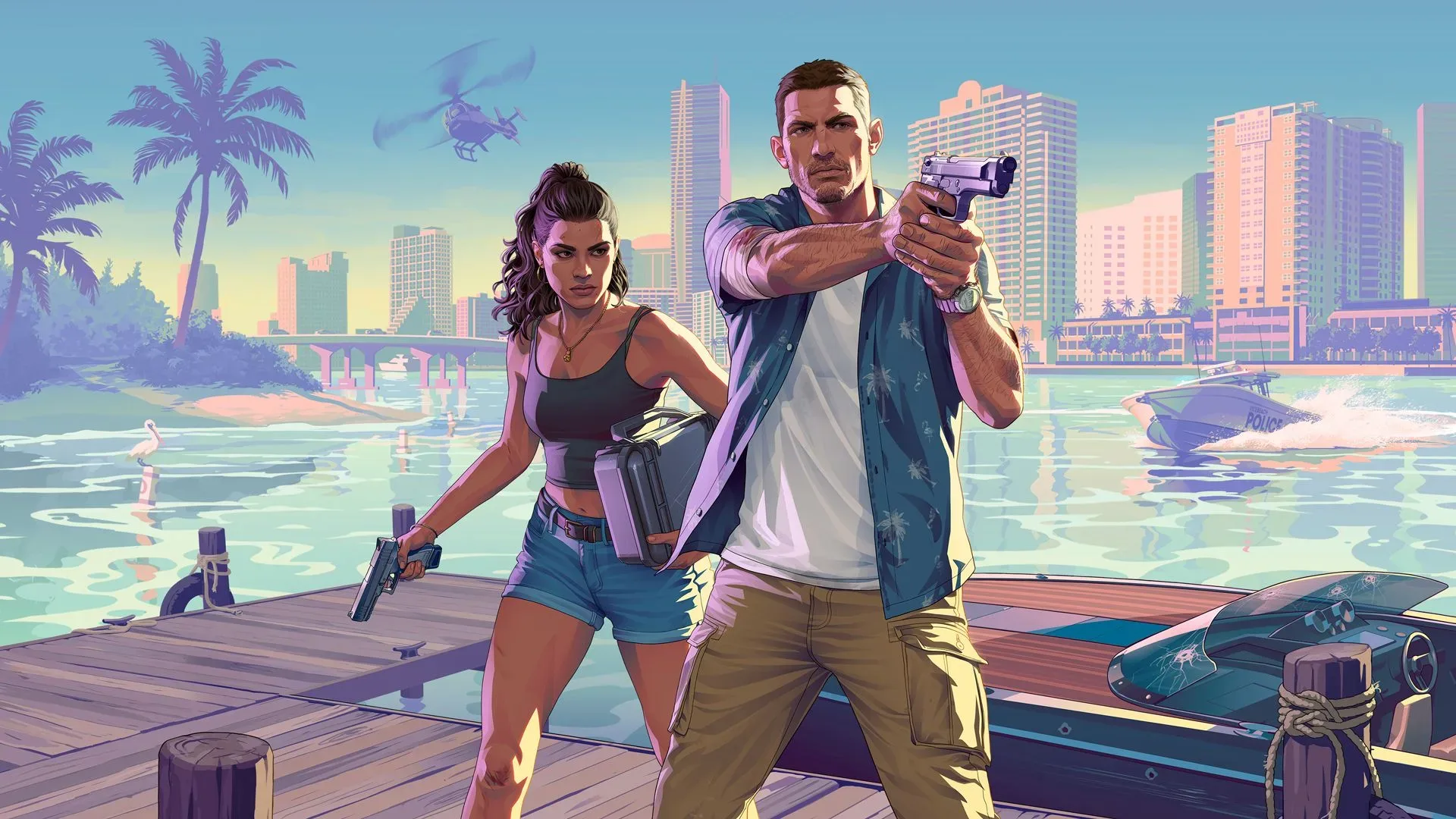
That disconnect also separates this film from stories that understand a young character’s hobby as part of their identity rather than a hurdle to outgrow. Games are not automatically a substitute for community, fitness or conflict resolution. They can, however, be a space where a kid rehearses competence. Marc’s Band Jam scenes sound like the film understands that instinct visually, even if the larger script does not build on it enough. For another look at how games can turn ordinary actions into expressions of player identity, see our take on GTA 6’s small choices and big sense of agency.
The anti-fight message is right, but the route matters
To its credit, Way of the Warrior Kid does not appear to embrace the easiest bully-story fantasy. Marc does not simply train all summer so he can win a climactic fistfight and receive instant social approval. The film’s stated message is that defeating a tormentor does not require physical retaliation. That is a stronger and more responsible direction than treating violence as the final level boss of adolescence.
Still, a story can reject one simplistic ending and stumble into another. The reported resolution is larger and less plausible than the grounded scenes surrounding it, pushing the movie toward a heightened children’s-adventure mode. That tonal leap matters because the drama begins in an emotionally recognizable place. A bike thrown into a bay, fear of the school bus, an awkward attempt to ask someone out—these are all situations that work because they feel close to the scale of a child’s life.
When a movie gives a kid an elaborate stage on which to prove himself, it can accidentally recreate the same wish-fulfillment it meant to avoid. The healthier alternative is often smaller: asking for help, speaking up, refusing to perform fear, making a decision that breaks a bully’s hold without pretending every conflict has a neat victory screen. The film’s grounded visual approach reportedly shines in a scene where Marc asks his dream girl on a date and the camera makes him feel unsteady and disembodied. That is exactly the kind of subjective filmmaking this material needs more of.
It places the audience in Marc’s discomfort rather than explaining it at him. And it recognizes that courage can look awkward. A kid need not become a miniature action hero to make a brave choice. He may just need to say something while his voice is shaking.
Performances trapped in a crowded mission briefing
Pratt’s casting creates an obvious challenge. He has the star power to sell a character with physical authority and the accessible charm to play an uncle a kid might eventually trust. Yet Jake is written as severe, damaged and notably joyless, leaving limited room for the playful energy that can make a mentor character feel inviting rather than instructional. The performance therefore has to balance the character’s pain against the film’s family-oriented ambitions. Based on the material at hand, the balance does not consistently click.
Hill has the more delicate job. Marc must start as someone visibly uncomfortable in his own body and gradually find self-possession without abruptly becoming a different person. The character’s awkwardness needs specificity; otherwise it can read as a performance of adolescence designed by adults who remember being 12 mostly through embarrassment montages. The film gives Hill emotionally intelligible situations, but its literal storytelling can make it difficult for the performance to breathe.
Linda Cardellini plays Sarah, Jake’s sister and Marc’s mother. She is positioned amid familiar single-parent pressures: concerned, supportive and stretched thin. Sarah also sits at the emotional junction of the film’s two main men, yet the focus on Jake and Marc gives Cardellini limited room to expand the character beyond the framework. Levi McConaughey plays Kenny, the bully whose actions set Marc’s journey in motion.
What the film leaves behind
Way of the Warrior Kid is made by a substantial behind-the-camera team: McG directs; Shane Hurlbut serves as cinematographer; Peter S. Elliot edits; and Steven Price provides the music. The production is an Apple Studios release, with Skydance Media, Wonderland Sound and Vision, Everard Entertainment, Indivisible Prods. and FilmNation Entertainment also listed among the production companies. Those credits do not settle whether a story works, but they underline why the movie’s split focus is disappointing. There is enough polish in the concept, particularly in the Band Jam visualizations and Marc-centered subjective moments, to suggest a clearer movie was within reach.
The sharpest criticism is not that the film wants to address bullying, grief, fitness and trauma. Family films can handle more than one serious subject. It is that each subject needs a point of view and an audience. Marc’s story requires language that speaks to children without condescension. Jake’s story requires room for adult emotional complexity. Combining them can work only if the adult’s experience deepens the child’s journey instead of taking command of it.
Here, the clearest lesson seems to be the simplest one: stories about kids need to trust what kids notice, fear and value. Marc’s game, his messy confidence, his grief and his small social risks are not side quests. They are the main quest. When the movie stays there, it has the makings of a grounded and empathetic coming-of-age tale. When it shifts toward spectacle and Jake’s oversized burden, the emotional controller slips out of Marc’s hands.