Top Dawg Entertainment has prevailed on appeal over one part of a civil lawsuit brought by Linda Luna and Ayah Altayri. A California appeals court ruled that the women’s identity-disclosure claim against the label and other defendants must be removed, while leaving their allegations of sexual misconduct, assault, battery, negligence, breach of contract and related conduct to continue in the trial court.
The ruling is narrow but significant. It does not decide whether the underlying allegations are true, and it does not end the broader lawsuit. Instead, it addresses whether the defendants could be held liable for publicly identifying the two plaintiffs after they initially filed their December 2024 case using the pseudonyms Jane Doe and Jane Roe.
For more on the appeal’s outcome, see the related case update.
The appeals court’s central finding
The appellate panel found that Luna and Altayri had not asked the trial court for permission to litigate anonymously before Top Dawg Entertainment’s public response identified them. In the panel’s view, filing under pseudonyms alone did not create a legal right to keep their identities private.
For more context, explore Amazing Spider-Man #1000 Tops Comic-Shop Sales Chart by a Huge Margin.
“We are, of course, sensitive to the nature of Plaintiffs’ allegations, and they may have had a strong argument to remain anonymous,” the panel wrote. “But it was incumbent on Plaintiffs to present their request to the trial court as soon as possible.”
That distinction is the core of the decision. Courts can, in some circumstances, permit plaintiffs to proceed under pseudonyms, particularly where highly sensitive allegations and risks of harm are involved. But the appeals court said that protection must be requested from, and granted by, a court unless a specific statute supplies it. The women had not made that request at the relevant time, the panel concluded.
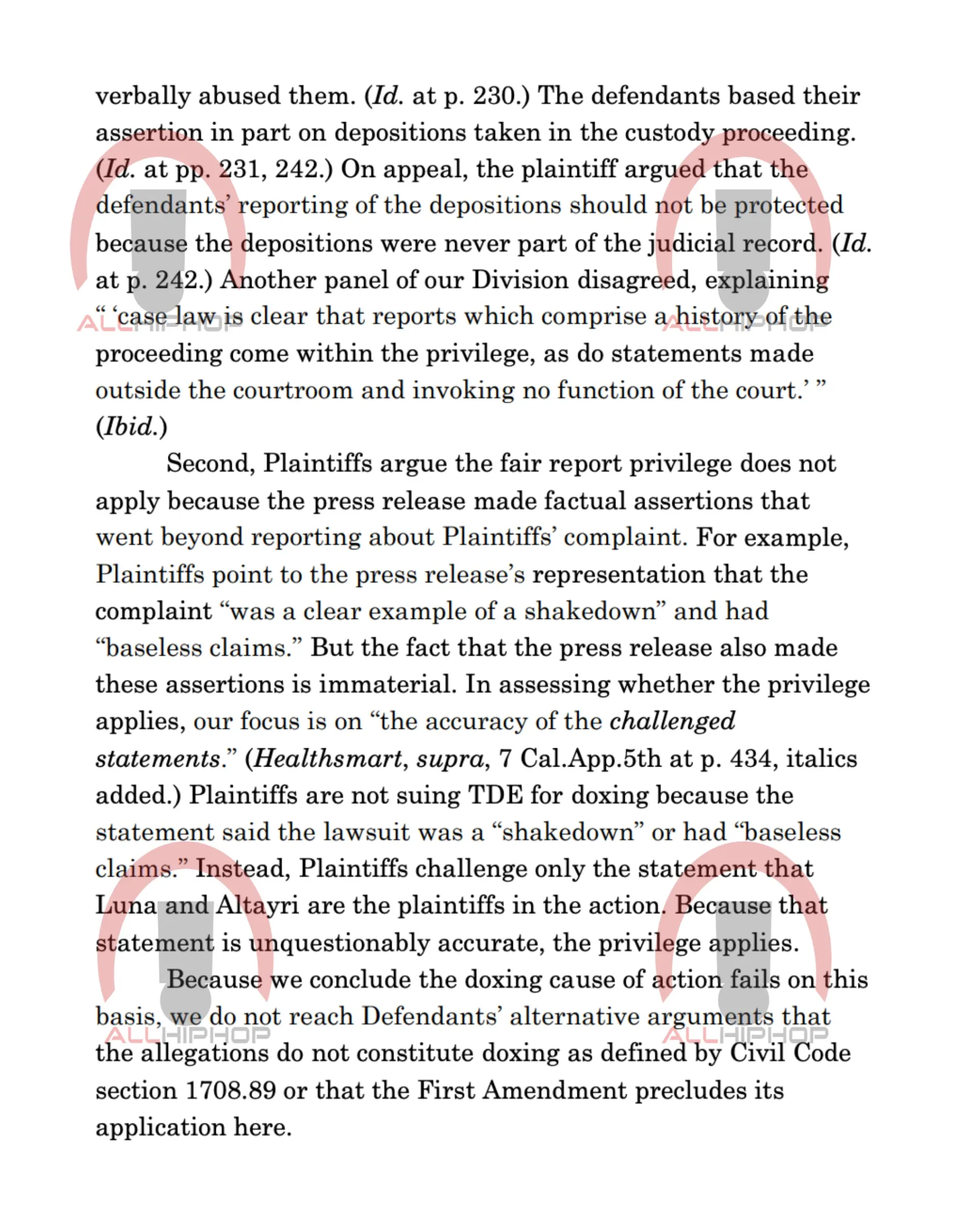
The court also held that naming Luna and Altayri as the people who filed the case fell within California’s fair report privilege. In plain terms, that privilege can protect accurate reporting or statements about official proceedings, including litigation. The panel reasoned that the defendants’ statement accurately identified the people behind the lawsuit, notwithstanding their unilateral use of placeholder names in the complaint.
“Luna and Altayri are in fact the plaintiffs in this action,” the court wrote. “The fact they unilaterally chose to use pseudonyms but had not yet requested permission to do so does not alter this fact.”
What claim has been removed—and what remains
The ruling eliminates the claim commonly characterized as doxxing or identity disclosure. In the amended complaint, Luna and Altayri alleged that Top Dawg Entertainment exposed their identities without consent in a way likely to invite third-party harassment. Luna alleged that she was harassed after the disclosure and that two clients stopped working with her, causing economic harm as well as emotional distress.
The term doxxing is often used broadly to describe releasing a person’s identifying information online or publicly, especially where doing so may expose them to harassment. In this case, the legal dispute was not simply about whether the names became public. The issue was whether the disclosure supported a viable civil claim given the nature of the court proceeding, the lack of a prior anonymity order and the fair report privilege.
A trial judge had previously allowed that claim to proceed in June 2025, concluding that TDE could have denied the allegations without identifying the accusers. The appeals court disagreed with that legal rationale. It ordered the identity-disclosure count removed and awarded the defendants their costs on appeal.
That outcome does not resolve the women’s other claims. The case now returns to the trial court, where the remaining allegations can be litigated. No finding described in the appellate ruling determines the merits of Luna and Altayri’s accounts of alleged misconduct, nor does it establish the truth of the defendants’ denials.
The allegations in the wider lawsuit
The lawsuit names Top Dawg Entertainment, Brandon Tiffith, Anthony “Moosa” Tiffith Jr. and David Harrell. It alleges that the company tolerated misconduct by people within its organization and failed to respond adequately when concerns were raised.
Luna says she performed public-relations and brand-marketing work and was not paid for services she provided. She alleges that Brandon Tiffith, identified as TDE’s chief marketing officer, attempted to force oral sex after the two had been drinking. Luna also alleges that Moosa made comments about her appearance in connection with working relationships and hiring.
She further alleges that she reported Brandon Tiffith’s conduct to TDE founder Anthony Tiffith Sr., but that her account was dismissed rather than addressed. These are allegations in a civil complaint; they have not been adjudicated by the appellate ruling on the identity-disclosure issue.
Altayri’s allegations stem from her time at a home owned by TDE while she was supporting an artist signed to the label. She alleges that Harrell took her to his apartment, urged her to consume alcohol while she was under the legal drinking age, touched her intimately, tried to remove her pants and threw her onto a bed before she escaped.
Altayri also alleges that a TDE affiliate identified as B-Dawg made nonconsensual sexual contact. She contends that executives learned of both alleged incidents soon afterward but did not respond adequately. The plaintiffs’ legal theory seeks to place responsibility not only on individual defendants but also on the company, based on its alleged handling of reports and workplace culture.
TDE’s response and the dispute over public identification
The conflict over anonymity intensified after the plaintiffs’ lawyers issued a January 31, 2025 press release publicizing the allegations. The next day, TDE attorney Marty Singer issued a public response that named Luna and Altayri, rejected their accounts and described the allegations as fabricated.
Singer also denied that either woman had been a TDE employee, said messages and other communications contradicted their claims, and characterized the matter as a shakedown involving a $48 million demand. Those assertions are the defendants’ position in the dispute, not findings made by the appeals court.
On February 5, the women amended their complaint to add the identity-disclosure claim. They alleged that revealing their names was intended to encourage others to harass them. The appeals court’s decision means that theory cannot proceed on the facts and legal framework before it, because the plaintiffs had not first obtained judicial authorization to remain anonymous and because identifying them was protected as an accurate account of litigation.
Why the procedural issue matters
The decision illustrates a practical point about civil litigation: a pseudonym typed into a complaint is not necessarily the same as court-ordered anonymity. A plaintiff may have strong reasons to seek privacy, but those reasons generally must be presented to the judge through a motion or supported by an applicable statute. The court then weighs privacy interests against the public nature of judicial proceedings and the opposing side’s ability to defend itself.
Here, the appellate panel expressly said the women may have had a compelling argument for anonymity. Its ruling was not that the alleged circumstances could never justify protection. Rather, it found that the procedural request was not made in time to establish the claimed right before the public identification occurred.
The fair report privilege was equally important. This doctrine is designed to protect accurate accounts of government and judicial proceedings. The panel treated the identity of the actual litigants as a factual aspect of the case, even though the original complaint used Jane Doe and Jane Roe. Because no anonymity order had been secured, the court concluded the defendants’ identification of the plaintiffs qualified for the privilege.
What happens next
The appellate decision strips out one claim and directs the case back to the trial judge. The remaining lawsuit still includes allegations concerning sexual harassment, assault, battery, negligence, breach of contract and the defendants’ alleged failure to act on reported misconduct.
At this stage, the ruling should not be read as a verdict on the underlying accusations or the company’s defenses. It settles a specific appellate question: whether Luna and Altayri could maintain an identity-disclosure claim when they had filed pseudonymously without first obtaining court permission to do so. On that issue, the appeals court sided with TDE and the other defendants.
For the parties, the immediate consequence is clear: the identity-disclosure count is gone, appeal costs were awarded to the defendants, and the broader civil dispute continues in the lower court.