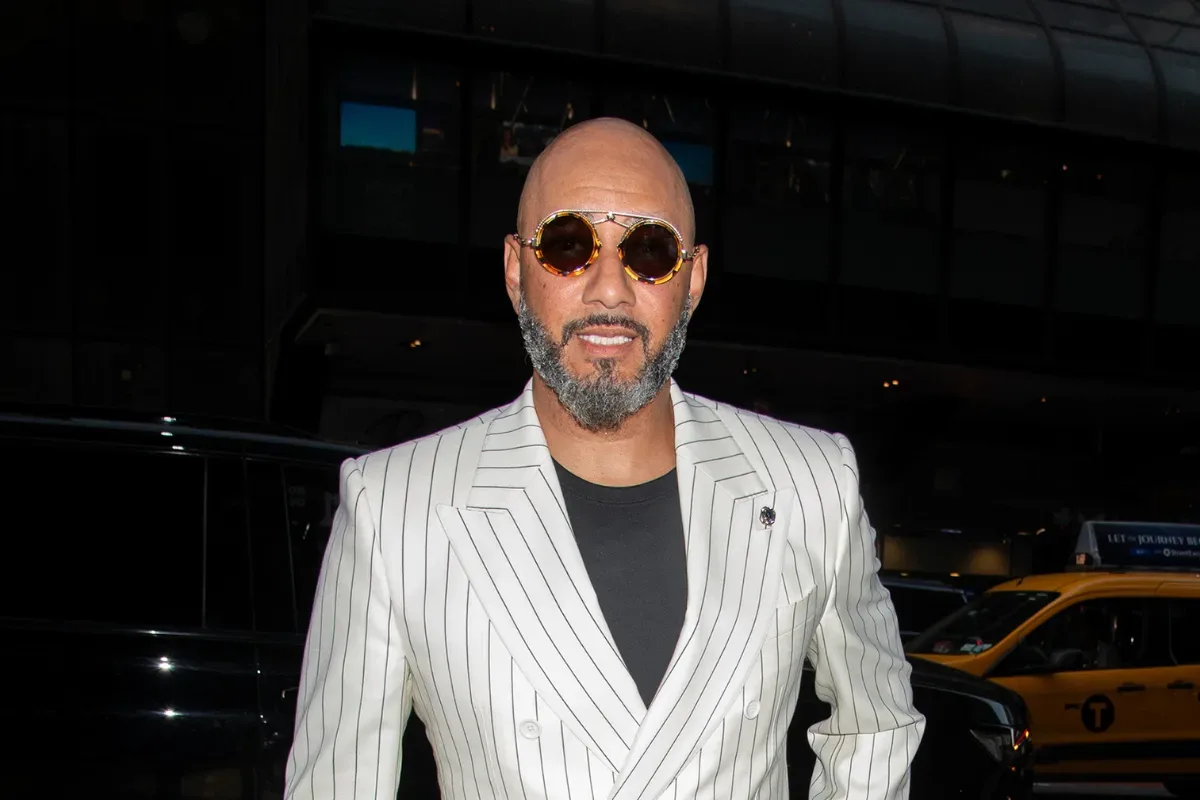
Swizz Beatz has revisited a business decision involving Eve and Patrón tequila that, in hindsight, sounds enormous. Speaking on The Real Report with Tony Yayo and Uncle Murda, the producer recalled Eve telling him she had been offered shares in the brand but wanted payment upfront instead.
His account is a recollection of a past conversation, not a newly documented deal disclosure. Swizz estimated that the proposed ownership could have been between 10% and 15% of the company, but he did not say when the offer occurred, who made it, what conditions applied, whether it was formally completed, or whether Eve ultimately received a separate cash payment. Those missing details matter. Still, the story has drawn attention because Patrón was later fully acquired in a transaction that placed its enterprise value at $5.1 billion.
Swizz said the conversation began after Eve introduced him to Patrón in Las Vegas. In his telling, she recognized that the company had room to grow, but chose certainty in the present over a stake whose eventual worth could not be known at the time.
Swizz recalled Eve’s position as essentially wanting a check rather than shares.
That is an understandable choice in any business context. Equity can become highly valuable, but it can also remain illiquid, meaning the holder cannot necessarily turn it into usable cash whenever they want. It may carry restrictions, tax implications, dilution risk, or no guaranteed buyer. A cash payment is immediate and certain; shares tie the holder’s outcome to a company’s future performance and to the terms of the agreement.
What the reported percentage would mean — and what it does not prove
The 10% to 15% range is Swizz Beatz’s estimate, not a confirmed term sheet. It should not be treated as proof that Eve owned, was contractually entitled to, or turned down a precisely calculated portion of Patrón. There is also no stated date for the proposal. That makes it impossible to responsibly apply the later $5.1 billion enterprise value as though it automatically represented the value of a specific offer made to her.
In plain terms, equity is an ownership interest in a company. A holder can benefit if the company grows in value or is sold, but the final outcome depends on the percentage owned, the share class, the company’s debt, investor rights, taxes, and the exact terms negotiated. Enterprise value, meanwhile, is a measure used to value the business as a whole. It is not simply a cash pile divided evenly among every potential shareholder.
That distinction is especially important in retellings of missed-opportunity stories. A later headline valuation can make an earlier decision look obvious, but it removes the uncertainty that existed at the time. Patrón’s subsequent success does explain why Swizz wishes the decision could be revisited. It does not establish what the proposed shares were worth when offered, whether they would have stayed intact through later ownership changes, or what a cash alternative may have looked like.
Patrón’s climb was closely connected to pop culture
The recollection lands against a real cultural backdrop. Eve had a visible association with the brand’s broader place in music: she and Lil Jon appeared on Paradiso Girls’ 2009 track, “Patrón Tequila.” The song helped put the liquor name in front of music audiences during an era when premium bottles, nightlife and rap were especially intertwined.
Patrón’s own growth followed a dramatic trajectory. The company’s sales rose from 70,000 cases in 2000 to nearly 2 million in 2010. Its marketing leadership later credited pop culture as an important force in the brand’s first two decades, while commentary on the company’s rise pointed to records, clubs and bottle-service culture as meaningful parts of its audience-building story.
That does not mean any single song or artist can be credited for Patrón’s business performance. Brand growth is larger than a cultural reference, involving distribution, marketing, consumer demand and product positioning. But music’s role in turning a product name into a familiar status symbol helps explain why an ownership conversation involving Eve now attracts attention.
Hip-hop’s relationship with brands is often discussed as though a mention and a formal partnership are the same thing. They are not. A lyric, appearance or association can create cultural visibility without giving the artist ownership, control or a share of later corporate gains. An equity deal is fundamentally different: it would make the artist a participant in the company’s financial upside and downside rather than solely a person connected to its public image.
That distinction is also why these stories remain relevant across entertainment. Public culture can help transform a brand into a recognizable signal, while ownership determines who participates in the value created as that recognition grows. Similar questions about who benefits from culture, exposure and corporate success continue to follow music and media projects, including stories with legal and industry stakes such as the upcoming documentary examining Young Thug’s YSL case.
From party image to super-premium positioning
By 2016, Patrón was working to broaden the way it presented itself. The company put more marketing emphasis on tequila production, supported a higher-end product line and attempted to move beyond a public identity rooted mainly in celebrations, clubs and bottle service. That shift matters because brands can use cultural recognition as a starting point, then seek a more durable position based on product identity and premium credentials.
Bacardi had already purchased a 30% stake in Patrón in 2008. A decade later, it announced an agreement to buy the remainder of the company, assigning the business an enterprise value of $5.1 billion. Bacardi completed the deal on April 30, 2018, becoming Patrón’s sole owner.
The acquisition gave Bacardi a bigger role in the expanding tequila business, and the company said it became the largest player in the U.S. super-premium spirits market through the purchase. “Super-premium” is a market category generally used to distinguish higher-priced, upscale-positioned products from standard offerings. In Patrón’s case, that positioning had substantial commercial weight by the time of the full acquisition.
Why the anecdote has lasting appeal
There is a temptation to reduce the story to a simple lesson: always take shares. The facts available do not support that. The lesson is closer to this: ownership can be powerful when an individual has enough information, financial flexibility and comfort with risk to wait for a company’s uncertain future.
An upfront payment can be the right decision for reasons that never appear in a retrospective anecdote. People may need dependable income, may not have confidence in the business, may prefer not to tie their finances to a single private company, or may face terms that make an apparent percentage less attractive than it sounds. None of those considerations were detailed in Swizz’s retelling, so they should not be assumed about Eve’s situation.
What is clear is why he frames it as a missed opportunity. Patrón became a much larger business, its name became deeply embedded in pop and nightlife culture, and Bacardi’s 2018 deal supplied an attention-grabbing benchmark for its eventual scale. The possibility that someone close to that cultural moment may have been offered a meaningful piece of the company gives the story its enduring sting.
For artists and audiences, it is also a reminder to separate visibility from ownership. Being early to a trend, helping make a product recognizable or having a genuine connection to a brand does not automatically create a financial stake. Where an ownership opportunity does exist, its real significance lies in the paperwork: the percentage, timing, restrictions, rights and exit conditions. Swizz Beatz’s account provides a compelling hindsight narrative, but the unknown terms remain as important as the later valuation.