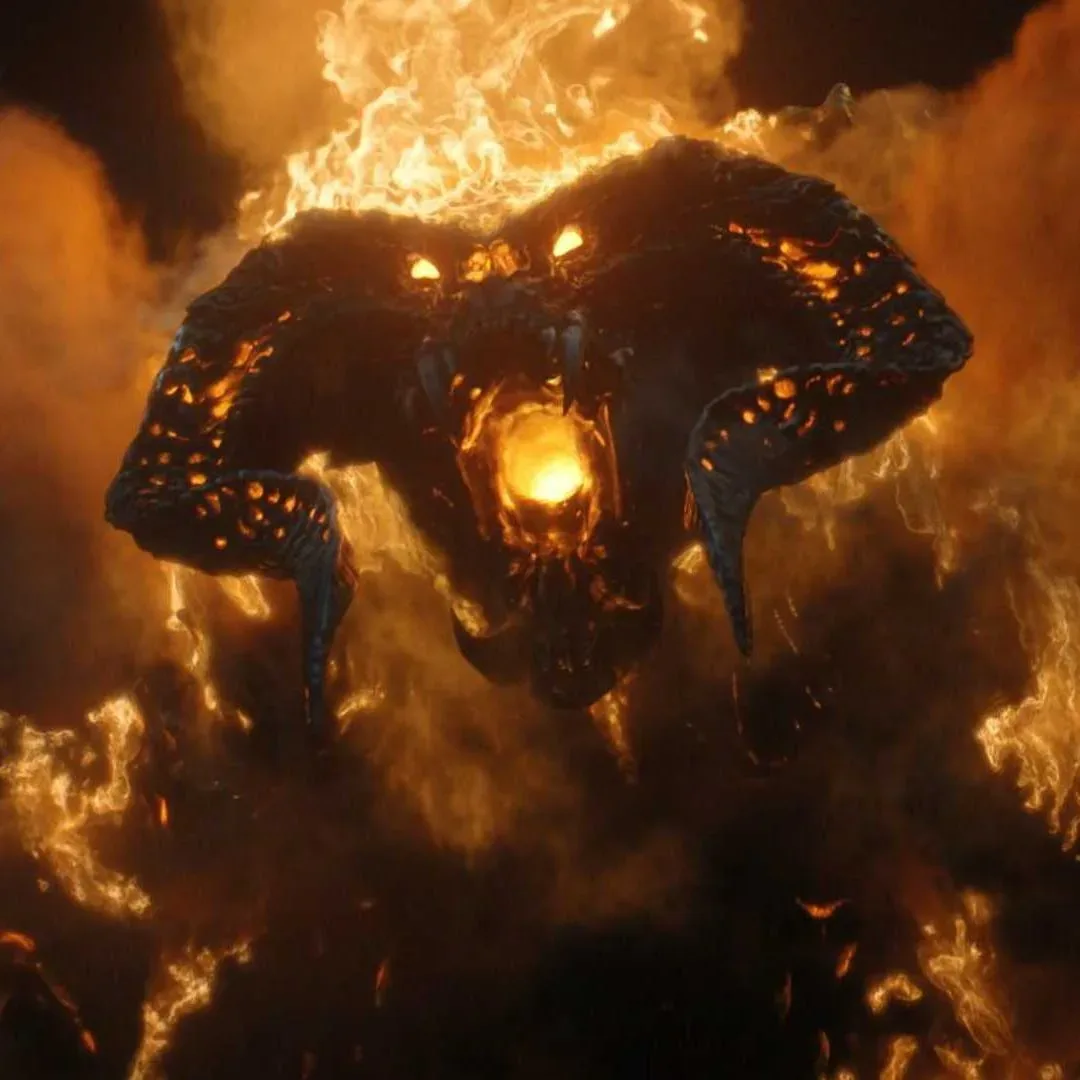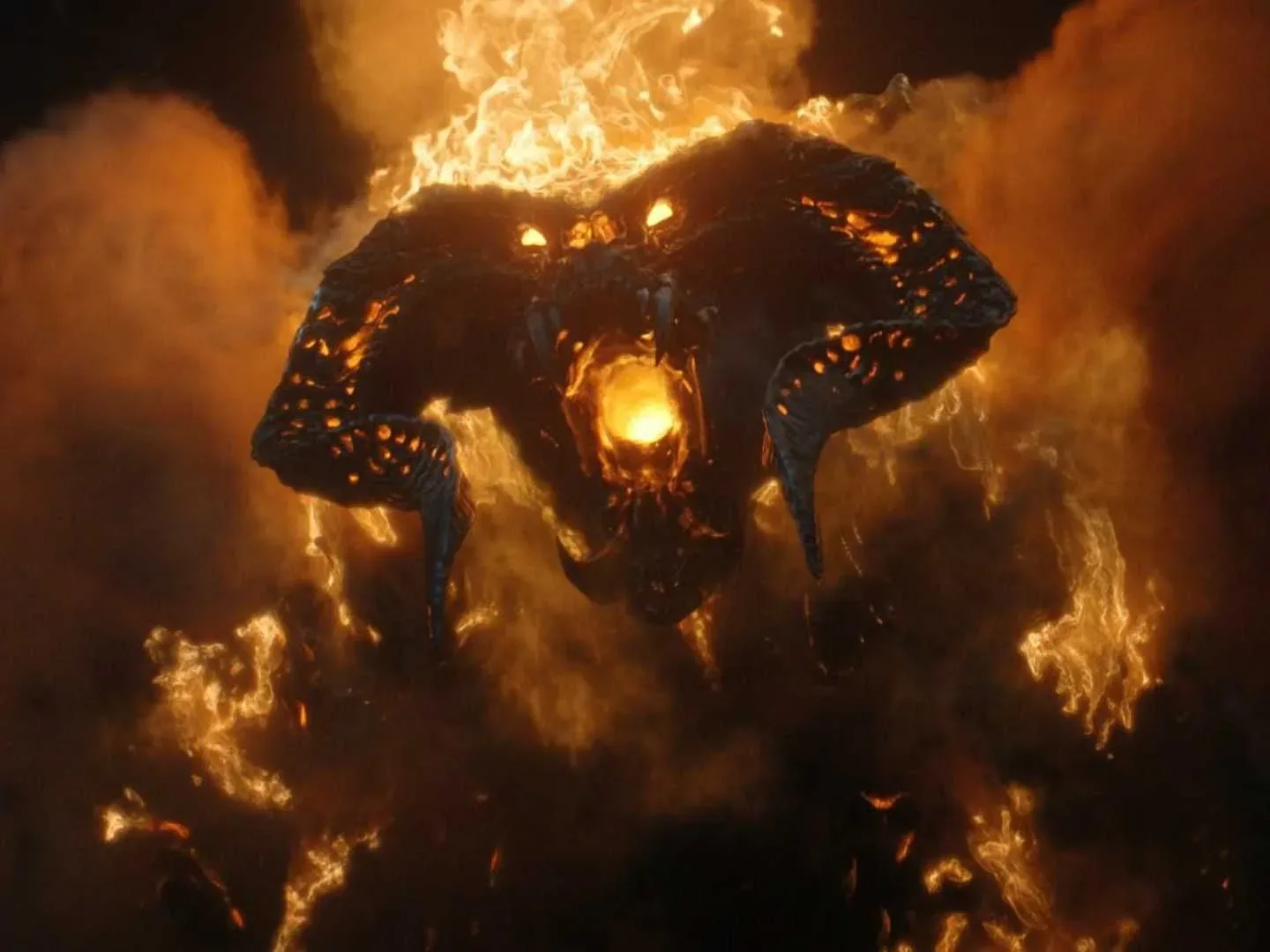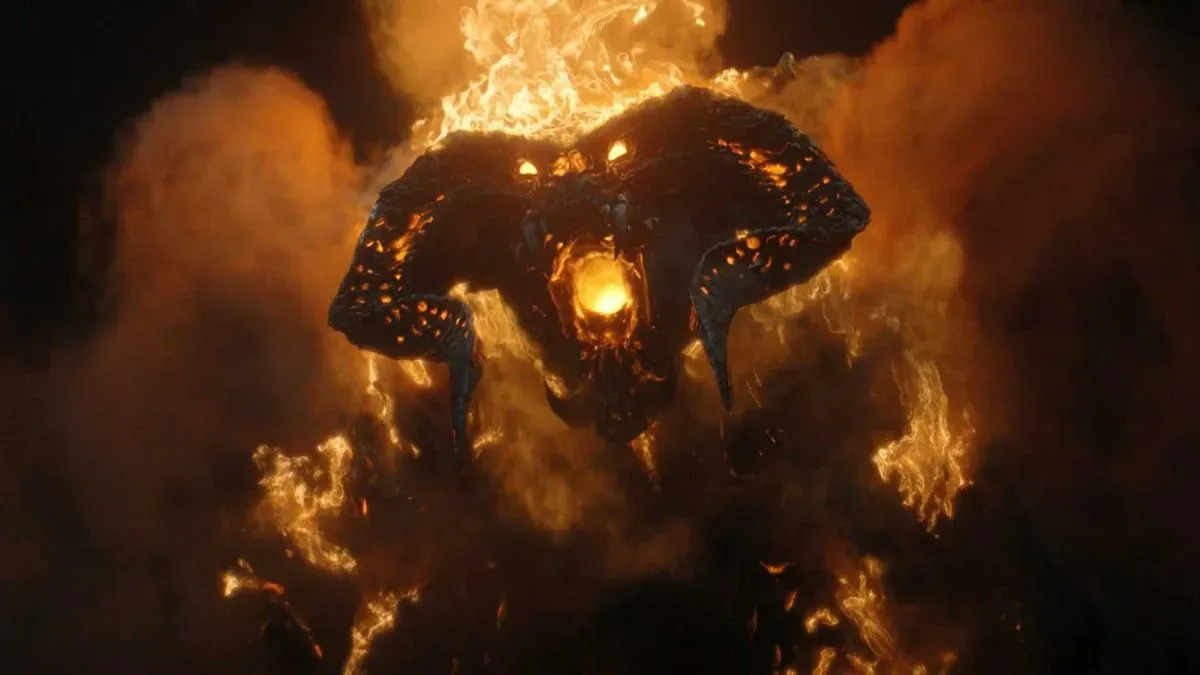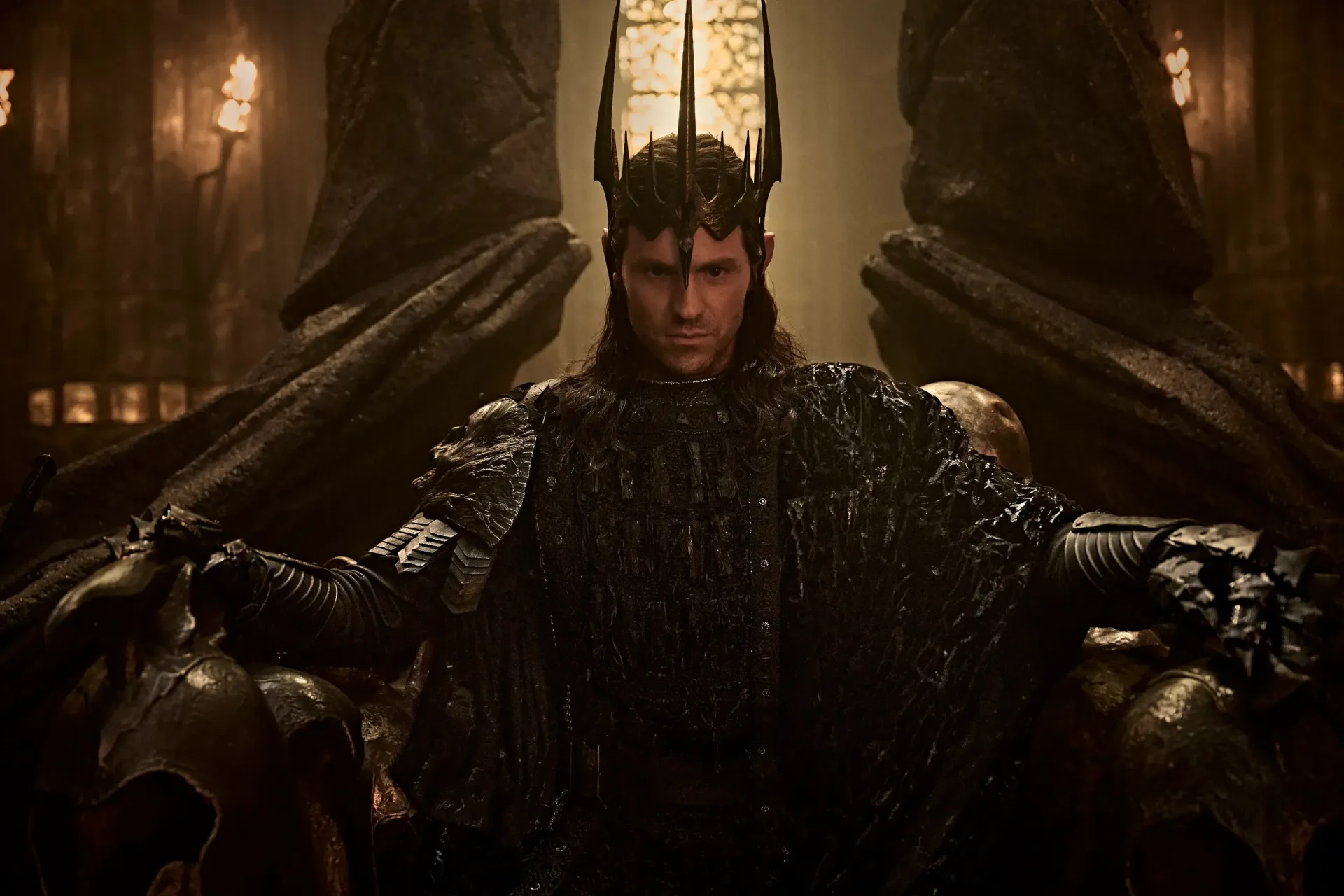
Simon Pegg did more than provide a voice for the Balrog in The Rings of Power season 3, episode 7. For the episode’s major scene between the fiery creature and Sauron, Pegg came to set and performed opposite Charlie Vickers, who plays Sauron.
The arrangement gave Vickers a live scene partner even while he was acting toward a practical visual-effects reference: a large light mounted on a crane to mark the Balrog’s eventual position. Director Stefan Schwartz said Pegg had a microphone on set and delivered the creature’s dialogue during takes, allowing the two performers to rehearse the exchange and adjust its rhythm together.
That is a meaningful production detail for a sequence built around a character who will largely be completed through visual effects. A digital creature can be absent from the physical set, but its voice, timing, intention and presence do not have to be. Pegg’s participation meant the Balrog and Sauron’s conversation could be played as a direct encounter rather than assembled from isolated performances later.
A voice performance with a physical scene partner
Episode 7 places the Balrog opposite Sauron at a crucial point: Sauron seeks the knowledge needed to forge the One Ring in Mount Doom’s fires and survive the process. The scene has to sell several ideas at once. Sauron is pursuing power and knowledge; the Balrog is an imposing, volatile force; and the interaction needs enough character to justify the dramatic weight placed on it.
Schwartz described Pegg’s early arrival as a reflection of his interest in the role. Pegg had reportedly been told that his work would not begin until after lunch, yet arrived in the morning. During breaks, the actor and director discussed the Balrog’s history. That preparation matters because the creature’s dialogue is not simply a sound effect laid under a shot. It is part of an exchange with Sauron, and its vocal delivery has to communicate an attitude toward him.
For Vickers, the moving crane light provided a target for eyelines and blocking. An eyeline is the direction an actor looks so that, once shots and effects are combined, it appears that characters occupy the same space. It is a small but essential piece of screen grammar. If an actor’s gaze is even slightly misplaced, the finished interaction can feel disconnected.
The light could establish where the enormous Balrog would be, while Pegg supplied the less mechanical half of the equation: someone to react to. Rather than treating every line as an abstract cue, Vickers could hear the performance in the moment, answer it, and try variations with the other actor present.
The benefit was that the scene could be rehearsed and explored in different ways while Pegg was there to play it opposite Vickers.
Schwartz’s description points to a hybrid approach. The Balrog’s body and scale require visual effects, but the emotional transaction between the characters was treated as a conventional two-performer scene wherever possible. That distinction is especially valuable in a conversation rather than a purely action-driven encounter. Viewers need to read thought, leverage and escalation, not only spectacle.
Why the Balrog needed more than flames
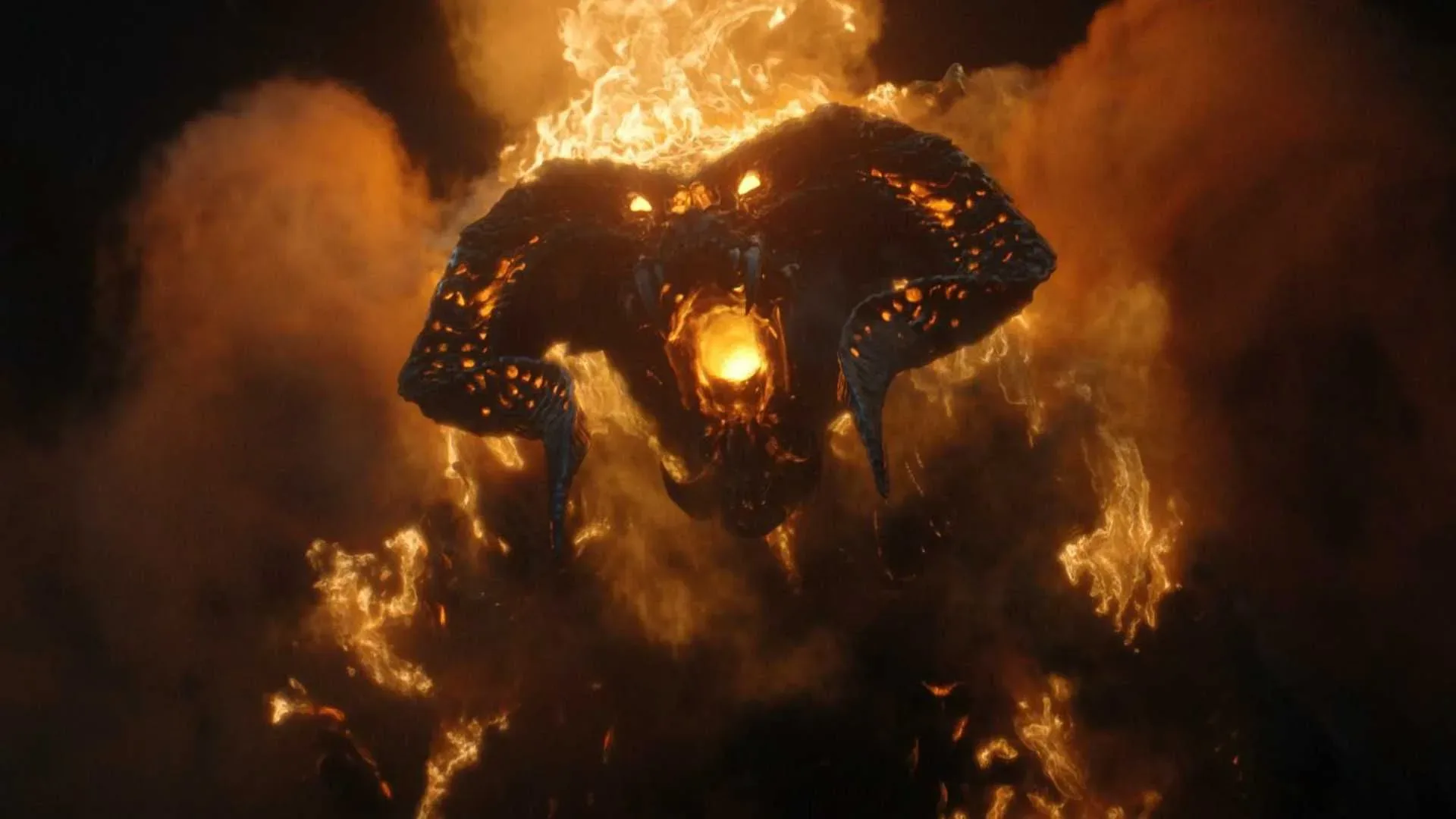
Creating the Balrog visually presented a separate challenge. Schwartz noted that the creature has not been shown extensively before, yet it needed to register emotion, anger and a degree of composure. That is a demanding brief for a character whose most immediate visual language is fire, heat and mass.
The production’s answer was a colour progression tied to the Balrog’s state. Schwartz said the creature begins in cooler tones, warms as it becomes emotional or angry, and moves toward a much more intensely flaming appearance at peak anger. In practical storytelling terms, that turns colour into a readable emotional signal.
Colour temperature describes whether light appears relatively cool, tending toward blue, or warm, tending toward orange and red. Film and television productions use it to guide feeling and attention. Here, the approach provides a visual scale for the Balrog’s mood: cooler shades suggest restraint, while warmer and more flame-heavy imagery indicates that the creature’s anger is breaking through.
It is not merely decorative. A very large digital character can be difficult to read if every moment is delivered at the same visual intensity. When a monster is already wreathed in flame, increasing the brightness, warmth and apparent ferocity of that flame gives the audience an immediate clue that the emotional stakes have shifted. The design is doing character work as well as spectacle work.
Schwartz also identified “coolness” as an emotion the Balrog had to convey. That suggests the scene was not designed as an uninterrupted rage display. The creature needs a sense of control before the escalation can mean anything. Pegg’s live vocal performance and the colour-based visual design therefore appear to be solving related problems: one gives the Balrog a conversational presence, and the other gives it a changing visual temperament.
The practical value of on-set performance in a VFX scene
Visual effects can make creatures, environments and scale possible, but actors still need usable reference points to maintain spatial and emotional continuity. A marker may tell a performer where to look. A stand-in can establish height and position. A live voice can establish pace, interruptions, volume and emotional pressure.
In this case, Pegg’s presence appears to have supplied all of the latter. The performers could find pauses naturally, respond to changes in intensity and make the final portion of the scene feel like a genuine face-to-face exchange. Schwartz said that, by the end of the conversation, Pegg was right there with Vickers and the pair were clearly acting with one another.
That phrasing is important because high-effects productions can otherwise place actors in a kind of performance vacuum. An actor may have to imagine the scale, posture and reaction of a character that does not yet exist in the frame. The work can still succeed, but it demands substantial inference. Giving Vickers Pegg’s voice and presence reduced that distance without removing the visual-effects process that the Balrog required.
The method also helps preserve flexibility. The visual team can still determine the finished creature’s form, motion and flame effects later. Meanwhile, the dramatic core of the encounter has already been built around an actual exchange. Put simply: the digital finish can evolve, while the actors’ shared timing remains a durable foundation.
What the scene reveals about the Balrog’s role
The season 3 episode 7 sequence is positioned as a climactic Balrog moment rather than a brief monster appearance. Sauron approaches the creature for secrets connected to the One Ring’s forging, so the Balrog functions as more than an obstacle or a visual callback. It is part of the chain of knowledge and power surrounding Mount Doom.
Pegg voicing the character strengthens that framing. A recognizable performance does not automatically make a creature more important, but a voiced scene partner signals that the Balrog has perspective and dramatic agency within the exchange. The decision to stage the encounter with dialogue, rehearsal and changing emotional visuals supports the same idea.
For viewers, the behind-the-scenes account also clarifies why the scene can feel more grounded than a simple actor-to-empty-space effects shot. The finished Balrog may be a digital creation, but its interaction with Sauron began with a live performance on the set. Vickers had a moving light for the physical location of the character, and Pegg was present to give that location a voice.
That combination of technical reference and actor-to-actor work is a useful reminder of how effects-heavy television is often made. The technology may create the creature, yet the scene’s tension still depends on fundamentals: where performers look, when they pause, how they listen and whether each side of a confrontation appears to affect the other.
For more television discussion, see our look at why Blade Runner 2099 treats its open ending as a standalone choice.