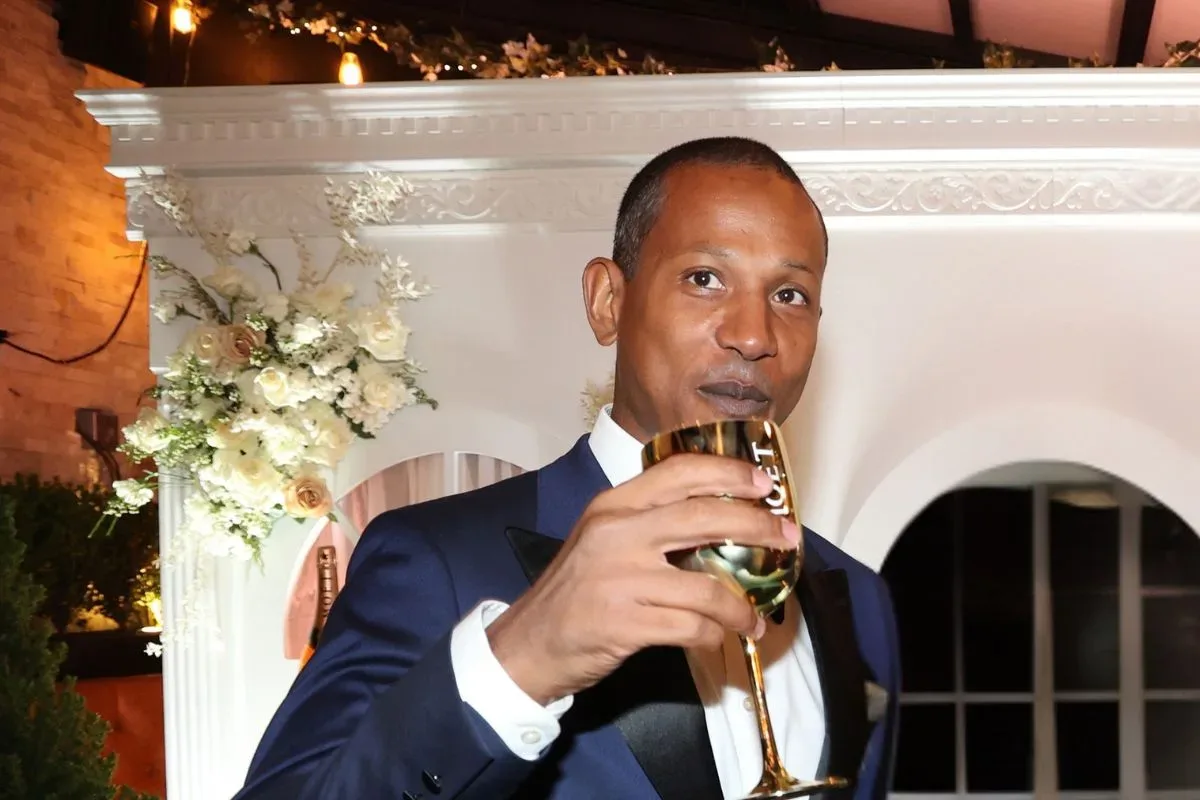
Shyne has revisited a pivotal and painful chapter of his return to music: a period when he says Jay-Z intended to sign him, only for a leaked studio recording with DJ Khaled to reveal how much his voice and energy had changed.
Speaking on the October 9 episode of Drink Champs, Shyne described coming out of prison expecting to resume his career with urgency. Instead, he said he confronted a basic but devastating obstacle for a rapper: he did not feel able to deliver with the voice he associated with his earlier work.
“He was going to sign me,” Shyne said of Jay-Z.
In Shyne’s recollection, the prospective opportunity was altered by a recording made with DJ Khaled that escaped the studio before he was ready for it to represent him. He said Jay-Z heard the track played on radio while attending a Yankees game and reacted to the condition of Shyne’s performance. Shyne’s assessment of that recording was blunt: his voice was gone, and he felt he could not perform as he wanted.
A comeback can hinge on one unfinished recording
The story is not simply about an agreement that did or did not happen. It illustrates why unreleased recordings can carry unusual weight during an artist’s comeback. A studio recording may be exploratory, incomplete, or made while an artist is attempting to regain form. Once it becomes public, however, listeners and potential business partners can treat it as a statement of where that artist stands now rather than a snapshot of a work in progress.
That distinction matters in Shyne’s account. He did not frame the leaked material as a finished representation of his intended return. He framed it as evidence of a difficult physical and creative adjustment, arriving at exactly the wrong point: while he believed a major signing was being considered.
For a rapper, “voice” has a broader meaning than vocal health alone. It can describe literal tone, breath support, force, timing, diction, cadence, and the sense of command that holds a verse together. Those elements are central to how a performer is recognized. If an artist hears a gap between their familiar delivery and their current recording, that can feel much larger than an imperfect vocal take. It can change the perceived identity of the performance.
Shyne’s comments make clear that he experienced that gap himself. Rather than presenting the leak as merely an unfair outside judgment, he said he thought the performance sounded bad. That self-critique gives the memory a sharper focus: the issue was not only lost control over when the music surfaced, but the fact that he believed the material captured him before he had regained the ability he needed.
Related coverage includes Shyne Recalls How a Leaked DJ Khaled Recording Affected Jay-Z Signing Plans.
The Jay-Z possibility had already been public
Interest in a potential Roc Nation arrangement was publicly discussed at the time. In October 2009, Jay-Z denied that he had met with Shyne, while also leaving open the possibility of signing him. That public ambiguity is important. It means the episode sits in the space between a potential deal and a completed one, not as confirmation that Shyne was formally signed.
Shyne’s newer account adds his personal explanation for why the situation did not develop as he expected: the leaked recording had reached Jay-Z before Shyne felt he was ready. It is still a recollection from Shyne, rather than a newly detailed account from Jay-Z or Roc Nation, so the precise internal discussions and decisions around any deal remain unconfirmed.
What is solidly established within the timeline is that the idea of a signing had been part of public conversation. The recent discussion provides a more human dimension to that old industry speculation. It is less about contract mechanics than the vulnerability of trying to return to a public-facing craft when the instrument at the center of that craft no longer feels dependable.
DJ Khaled’s place in the episode
DJ Khaled is a significant figure in Shyne’s retelling because the leaked recording came from their work together. In a 2010 interview, Khaled described Shyne as a friend, said he reached out after Shyne left prison, and credited Shyne with the concept for their beat. Those details suggest the session was a collaboration with creative intent, not simply a detached label exercise.
That makes the leak’s timing especially consequential in Shyne’s telling. A collaboration can be part of rebuilding: reconnecting with peers, developing a beat, experimenting with delivery, and searching for the right avenue back into the public. But recording itself does not guarantee readiness. A performer may need time between making a track and deciding it reflects the standard they want attached to their name.
There is a broader practical lesson in that difference between creating and releasing. A leak removes the artist’s ability to decide whether to revise, discard, hold, or contextualize the material. It also changes the listening environment. A rough session is normally heard by a small circle that understands its status; a public leak can be evaluated by people who have no reason to know its limitations.
That does not prove a single recording alone determined Shyne’s business future. His account does, however, show why he views it as a defining moment. It was music he believed did not demonstrate what he could do, played publicly while an important professional possibility was in view.
Why the story still matters in an era of permanent files
Shyne’s reflection also speaks to a modern reality: recordings can outlast the context in which they were made. A private studio moment can become a public document, then remain easy to recirculate long after the immediate controversy has passed. The stakes are not identical, but the underlying issue connects to the wider question of who controls creative and personal digital material, a concern explored in this look at digital legacy tools and game-era memories.
For musicians, that permanence can preserve a career’s milestones, demos, alternate versions, and collaborations. It can also preserve the moments an artist would rather treat as transitional. Shyne’s account underlines the difference between archival value and professional readiness. Something may later be interesting as a document of a comeback attempt while still being a recording its creator never wanted to serve as the first impression of that comeback.
It also complicates the familiar idea that exposure is always beneficial. Visibility can be helpful when it is attached to material an artist endorses and a plan they control. When the material is unfinished or emotionally loaded, visibility can turn into a loss of authorship. The audience gets a version of the artist’s present, but not necessarily the version the artist believes is accurate or complete.
Shyne is returning to the stage
The discussion arrives as Shyne prepares to perform again on the 2622 LGND Tour. The announced run follows a sold-out show at Kings Theatre in Brooklyn and is scheduled to begin October 21 at Denver’s Ogden Theatre.
Barrington Levy and Lil’ Cease were announced for nearly every date. Levy’s involvement has a clear connection to Shyne’s catalog: he appeared on “Bad Boyz” and “Bonnie & Shyne,” both from Shyne’s 2000 debut.
That pairing gives the tour an evident bridge to the music with which many listeners first associate Shyne. It does not erase the struggles he described from his post-prison recording period, but it places his present activity beside collaborators connected to his earlier output.
Shyne’s comments are striking because they resist a tidy comeback narrative. He did not portray his return as an immediate restoration of what came before. He described disappointment, a leaked recording, and a voice he felt had failed him at a critical time. With live dates now announced, the story has shifted from an old missed possibility to a current chapter in which he is again taking the stage.