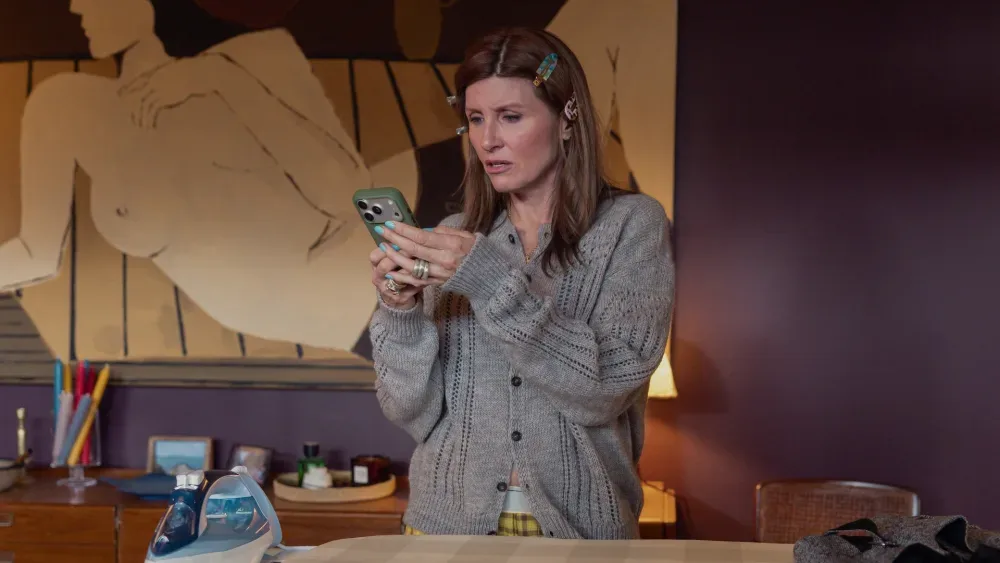
Sharon Horgan’s Youth takes a familiar romantic-comedy setup and moves it to a life stage TV too often treats as an epilogue. Alex, played by Horgan, is a successful London book agent with a beautiful apartment, a socially active life and no apparent difficulty attracting romantic attention. Her problem is not finding options. It is deciding what she wants from them—and what she wants from the suddenly unstructured years ahead.
The eight-episode HBO half-hour comedy begins from a change that is at once ordinary and destabilizing: Alex’s teenage son, Rauri, is preparing to leave home. Alex has been divorced for years, and the departure removes one of the defining routines of her adult life. The premise gives Youth its central irony. Its heroine is newly 50, but the title points toward a kind of second adolescence: an awkward, occasionally impulsive period of reinvention rather than a return to literal youth.
The first two episodes are set to premiere on HBO and HBO Max on September 20 at 10 p.m. ET, with the remaining episodes arriving weekly. For viewers building a television night around the debut, a missing remote does not necessarily have to halt the plans; a phone can help keep game night and streaming moving.
A rom-com heroine with a different clock
Alex has much of the architecture of a conventional rom-com lead: a glamorous metropolitan career, professional competence, messy romantic judgment and the tendency to let assumptions or bad timing make a situation more complicated than it needs to be. But Youth places those beats in a different context. Alex is not waiting to become an adult or starting a family. She is trying to understand what remains possible once a long-established family structure changes.
Perimenopause is part of that context. The term refers to the transitional period leading up to menopause, when hormonal changes can bring changes including irregular cycles and mood shifts. In the series, it helps frame Alex’s feeling that she is unexpectedly back in an emotionally volatile stage of life. The show’s comic point is not that she has become a teenager again, but that self-knowledge and maturity do not eliminate confusion, desire or poor decision-making.
That distinction matters to the series’ lighter approach. Alex is not portrayed as helpless, and the available details do not position the plot as a disaster narrative. She is good at her work, has a full life and can still be sharply observant. Yet she is also vulnerable to contradictions in how she sees herself and others. That makes her romantic life less about a grand quest for a single perfect partner than an ongoing attempt to find a usable direction through an unfamiliar phase.
An empty nest is not an empty life
Rauri, played by Aran Murphy, is about to begin university, but Alex’s responsibilities do not neatly end when he becomes a legal adult. A crisis involving him makes clear that a child leaving home does not erase parental care. At the same time, Alex has aging parents, putting her in what is commonly called the “sandwich generation”: adults balancing the needs of children and older relatives simultaneously.
Youth does not make those obligations its sole dramatic engine. They sit around the story rather than turning every episode into a lesson about caretaking. Alex can still go to book festivals, take trips to Ibiza and pursue hookups while dealing with family demands. That balance is one of the show’s defining ideas: aging brings constraints, but it does not cancel ambition, experimentation or pleasure.
There is practical emotional truth in that setup even when the situations are heightened for comedy. Major life transitions are often described as clean breaks—the child leaves, the divorce ends, the career stabilizes—but the show’s premise suggests a less tidy reality. Roles overlap. The parent remains a parent. The adult child remains a person who may need support. Personal freedom can arrive alongside obligations rather than after them.
Publishing provides the comic workplace
Alex’s job offers a second arena for the show’s humor. She works with Sam, played by Sharlene Whyte, who is both friend and employer. Their relationship is deliberately porous: professional conversations about deals and authors share space with Sam’s marital troubles. That combination gives the workplace plot a more personal tone than a standard office comedy, with business friction and friendship friction feeding each other.
The publishing material also lets Youth poke at author ambition and literary-fashion cycles. Damian Lewis appears as a version of himself who is determined to write a book about dog meat. Harriet Walter plays the daughter of a romance novelist seeking a more prestigious reception for her mother’s erotic fiction. And a self-published title, Goblin Seed, targets the current “romantasy” phenomenon.
Romantasy is a publishing label commonly used for fiction that combines romance with fantasy elements. The term has become useful shorthand for a visible commercial trend, and Youth turns it into material for a broad industry joke rather than asking viewers to treat it as serious literary taxonomy. The satire works because Alex’s work world is not presented as detached from her private anxieties. It is another place where taste, status, attraction and self-presentation become entangled.
Dating, desire and the discomfort of judgment
Alex’s most persistent preoccupation is sex and dating. Her principal romantic connection is Pat, played by Rupert Friend, an old flame who is described as habitually unattached and who now has a much younger girlfriend. Alex also encounters an age-gap setup of her own after Sam introduces her to an older acquaintance, and she has more casual encounters in between.
The series uses those relationships to examine an uncomfortable contradiction without pretending Alex stands outside it. She judges other people’s age-inappropriate pairings and physical signs of aging while being intensely alert to her own age, desirability and bodily changes. In other words, she can be ageist in more than one direction. That quality is not necessarily flattering, but it is useful comic character material: Alex is self-aware enough to spot social absurdity, not always self-aware enough to exempt herself from participating in it.
Pat does not appear to function as a simplistic endgame prize. Alex is not framed as someone who needs a fairy-tale resolution to validate her life. The smaller, more interesting stakes are about discernment—what she can accept, what she should avoid, and whether she can make choices that are genuinely hers instead of reactions to loneliness, habit or fear of getting older.
Part of a Sharon Horgan life-stage pattern
Horgan has described Youth as the final piece of a loose trilogy alongside Pulling and Catastrophe. The connection is thematic rather than a shared fictional universe. Pulling centered on chaotic twentysomethings, while Catastrophe, created with Rob Delaney, followed early parenthood and a long-term relationship. Youth moves forward to the uncertainty that can follow an empty nest.
The three projects are closely aligned with Horgan’s own life, which she has characterized as “auto-fiction-y.” That does not mean Alex should be read as a direct memoir substitute. Rather, the series appears to use recognizable life-stage pressures as a foundation for a specific comic character. Horgan’s past work also includes creating Divorce and acting and writing on Bad Sisters, making Youth part of a broader body of work that frequently puts emotionally complicated adults at the center of sharp, uncomfortable comedy.
That background helps explain why the new series can give Alex a breezy surface without making her concerns trivial. A book-festival fling, a problem with a son at university, a difficult author, an old romantic attachment and a clash with a friend may not look like world-ending events in isolation. Together, they create the pressure of a life no longer governed by one obvious next step.
What ‘Youth’ seems to be saying about middle age
Middle age is harder to reduce to a single story than early adulthood or new parenthood. People reach it with radically different family lives, careers, health circumstances and financial realities. Youth does not claim to speak for all of them. Alex has advantages—her job, home and social opportunities are central to the premise—and the show remains closely tied to her individual messes.
That specificity is a strength. Instead of presenting 50 as a grim boundary or a polished victory lap, the series makes it a period in which certainty has not arrived on schedule. Alex has experience, but experience is not a road map. She has responsibilities, but they do not eliminate her appetite for fun. She has freedom, but freedom can feel frightening when the old guardrails vanish.
For viewers who want a middle-age story that leaves room for libido, pettiness, professional confidence and genuine confusion in the same character, that is the invitation of Youth. It is a rom-com built not around the promise that life will finally become settled, but around the more unruly possibility that a person can still be figuring it out.