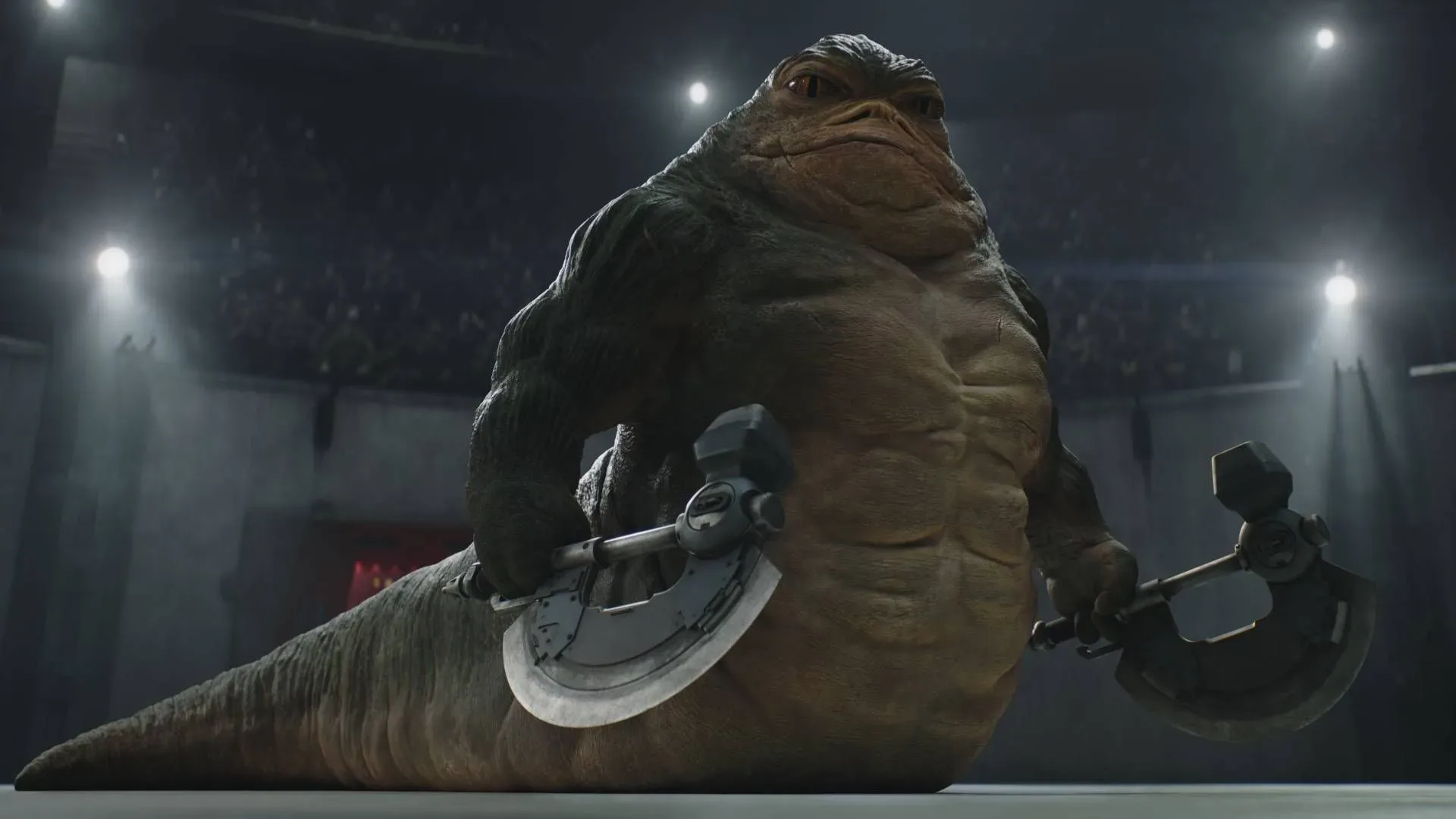
Star Wars has a funny way of making history repeat itself, especially when a Hutt’s tail is involved. In The Mandalorian and Grogu, Din Djarin’s encounter with Rotta the Hutt includes a blink-fast bit of action that echoes one of Han Solo’s most awkward meetings with Jabba the Hutt. The twist is that the parallel was not designed as an intentional callback. It simply happened to land in the same delightfully undignified corner of Hutt family history.
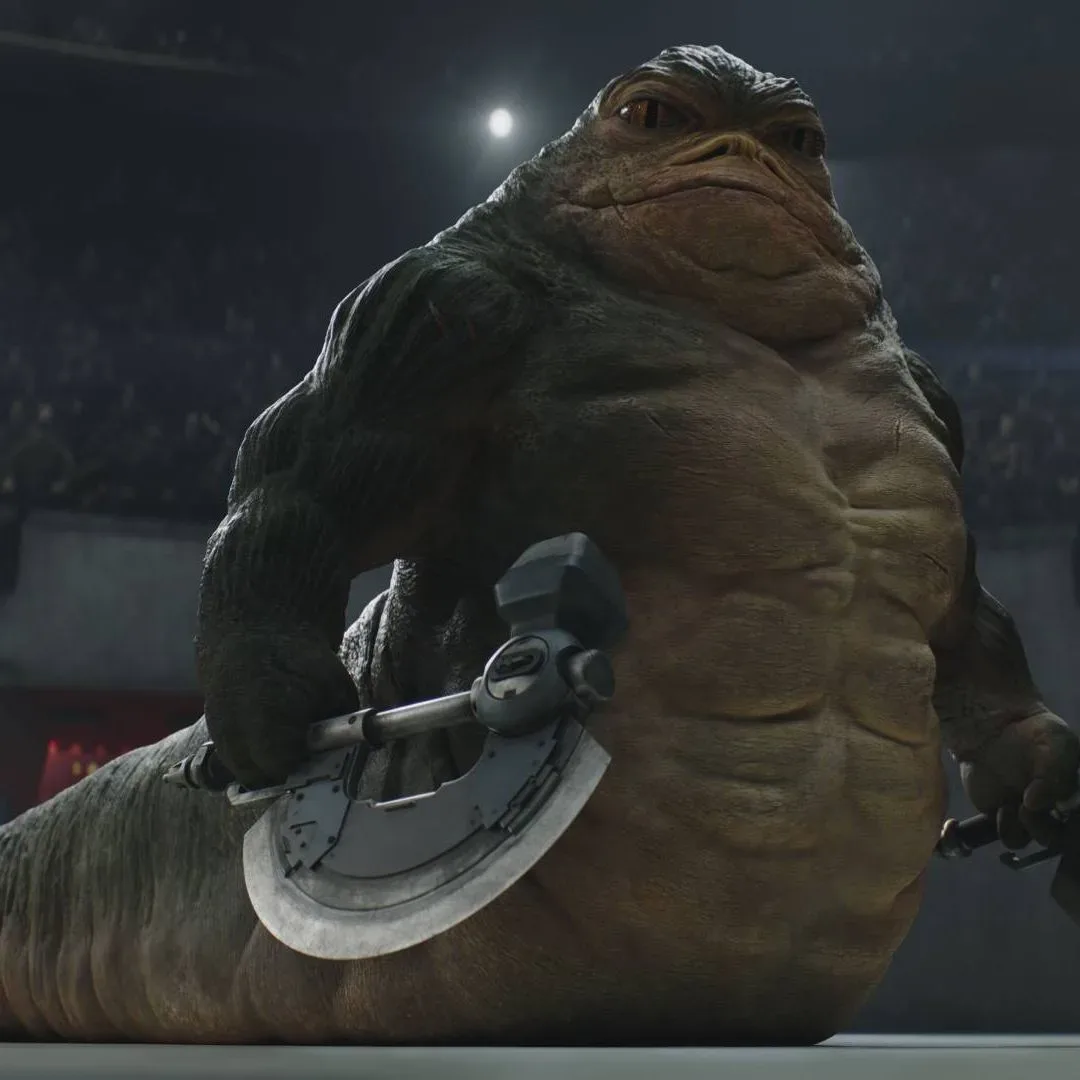
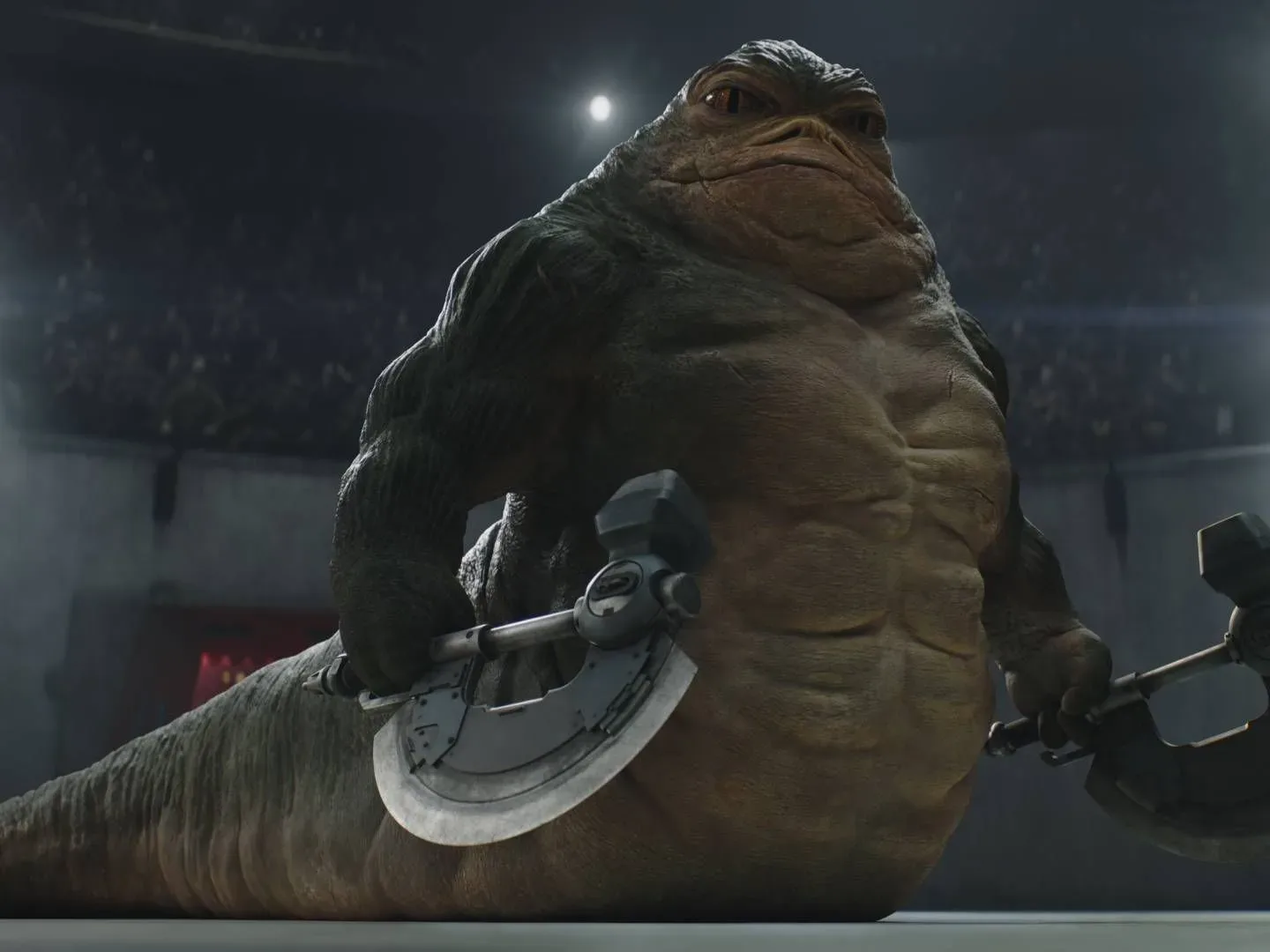
Rotta, Jabba’s son, faces Din in a gladiatorial-ring fight. During the sequence, Din circles behind him, steps on Rotta’s tail to gain a little extra height, and uses the position to knock Rotta’s arm aside. Industrial Light & Magic animation supervisor Hal Hickel highlighted the moment and explained that it moves by very quickly on screen.
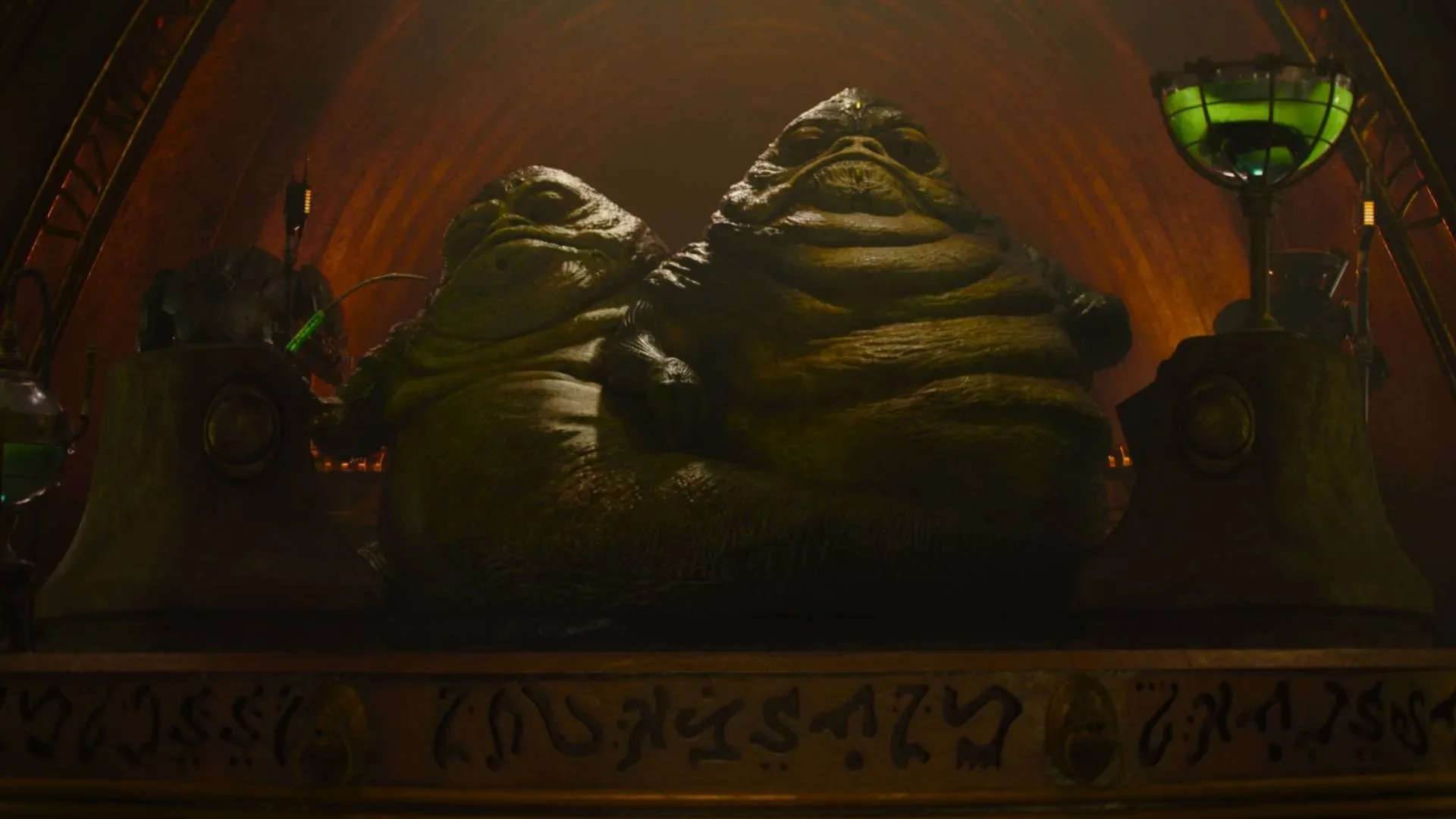
For longtime viewers, the image immediately recalls the scene added to the 1997 Special Edition of Star Wars: A New Hope. Han meets Jabba beside the Millennium Falcon in Mos Eisley, amid the fallout from Han’s debts and broken arrangements with the crime boss. At one point, Han walks over Jabba’s tail. Jabba is, understandably, not thrilled by the decision. There are countless ways to make an already tense discussion with a powerful Hutt worse; treating his tail like an inconvenient curb is high on the list.
An unplanned family resemblance
Hickel said the Rotta maneuver was not inserted as a deliberate nod to the Han-and-Jabba gag. Still, he recognized the pleasing connection, describing it as the kind of repeated pattern that rhymes across the saga. That distinction matters: this is not a case of creators hiding a frame-by-frame reference for viewers to decode. It is a practical movement in an action scene that happens to produce a remarkably specific visual echo.
That makes it a particularly charming kind of Easter egg. Intentional references can be rewarding, but accidental ones sometimes feel even more fitting because they emerge from character, blocking, and the enormous accumulated vocabulary of Star Wars. A scoundrel steps on a Hutt’s tail during a confrontation. Years later, a helmeted bounty hunter turned protector does something similarly useful in a fight with that Hutt’s son. The galaxy is vast, but the tails remain vulnerable.
There is also a neat difference in tone. Han’s moment is an insult, or at least a carelessly provocative move during a hostile negotiation. Din’s is combat problem-solving. He needs height, a better angle, and an opening against Rotta’s arm. In another context, it might be called tactical improvisation. In the Hutt family context, it is apparently a recurring form of disrespect.
Rotta gets a very Jabba-shaped problem
Rotta is adamant that he is not his father, which makes the resemblance all the more amusing. He is not merely inheriting Jabba’s name or place in the Hutt lineage; he has also inherited an oddly cinematic hazard. Whether the person nearby is Han Solo or Din Djarin, the tail may become an inconvenient part of the encounter.
The scene is useful beyond the joke because it puts Rotta at the center of a physical confrontation with Din. Rather than functioning solely as a legacy reference to Jabba, he is an active participant in the story’s conflict. The tail maneuver gives audiences a small, readable beat in the fight: Din repositions, gets the elevation he needs, and disrupts Rotta’s defense. That economy is likely why the resemblance arose organically. The action had to communicate quickly, and the character designs created an opportunity.
It also demonstrates why viewers should not assume every familiar detail is part of a giant pre-planned reference map. Star Wars productions absolutely contain deliberate visual and narrative callbacks, but filmmaking is also full of choices that become meaningful because audiences bring decades of memory with them. Sometimes a moment is a tribute. Sometimes it is just an effective piece of choreography that happens to walk into the shadow of an older scene.
Why the original Jabba moment still sticks
The Han Solo and Jabba encounter has endured partly because it compresses their relationship into one uncomfortable exchange. Han is confident, cornered, defiant, and reckless. Jabba is a looming threat who does not need to raise his voice to make the stakes clear. When Han steps on the tail, the moment turns that tension physical in an immediately understandable way.
Jabba’s response is a reminder that Han has pushed the conversation too far, while also keeping the scene rooted in the scrappy, comic energy that defines Han. The 1997 Special Edition placement by the Falcon in Mos Eisley made that confrontation part of the film’s revised presentation, and it gave audiences a direct on-screen Han-and-Jabba scene in the original trilogy era.
Now Rotta’s arena exchange with Din adds a second chapter to the very small but strangely memorable Star Wars subgenre of “do not step on a Hutt’s tail.” It is probably not a lesson anyone in the galaxy will heed. If anything, the two scenes suggest that the tail is exactly where a bold hero—or an embattled smuggler—is likely to put a boot when circumstances become inconvenient.
A quick Easter egg, not a rewrite of the scene
The practical takeaway is to keep expectations sensible when revisiting the fight. The Rotta beat is brief, not a giant signpost announcing Han Solo’s legacy. It is the kind of detail that can disappear during a first viewing because the scene is moving forward at full speed. Once noticed, though, it changes the flavor of the choreography without changing its purpose.
That is the sweet spot for a franchise Easter egg: it rewards recall but does not require homework. A viewer unfamiliar with the Special Edition scene can still understand Din’s move. A viewer who remembers Han’s confrontation with Jabba gets an additional laugh at the accidental father-and-son symmetry. Neither reading gets in the way of the other.
For a wider look at the habits, rivalries, and tiny visual echoes that make group viewing so noisy, our take on the unwritten rules of couch multiplayer may feel unexpectedly familiar. Calling out a detail that everybody else missed is, after all, a universal spectator sport.
What is next in Star Wars
The Mandalorian and Grogu is streaming on Disney Plus. The next Star Wars release mentioned on the current schedule is Ahsoka season 2, set to arrive on Disney Plus on January 20. Its first trailer was publicly shown at this year’s D23 and includes Hayden Christensen as Anakin Skywalker, Ezra Bridger in action, Grand Admiral Thrawn, and the New Republic’s conflict with Thrawn.
The projects occupy different corners of the larger galaxy, but their appeal rests in a similar balance: recognizable mythology, returning characters, and opportunities for smaller character beats to become memorable. The Rotta tail moment is not positioned as a major lore revelation. It does not require a new theory about Jabba, Han, or Din. It is simply a wonderfully specific visual coincidence that connects a gladiatorial scuffle to one of Han Solo’s least diplomatic choices.
For collectors and fans who enjoy tracking how tiny details become part of a larger obsession, the collector’s five stages of buying one small thing understands the slippery slope. One quick tail-step can become a rewatch, a scene comparison, a favorite-reference list, and perhaps an alarming number of Hutt-related display ideas.
Ultimately, the accidental callback works because it captures something fundamental about Star Wars: grand conflicts can coexist with jokes about bad manners. Din’s move is functional. Han’s was provocative. Jabba and Rotta may differ in temperament, and Rotta may reject comparisons to his father, but both have now encountered the same deeply discourteous tactical reality. In this galaxy, even destiny occasionally arrives wearing a boot.