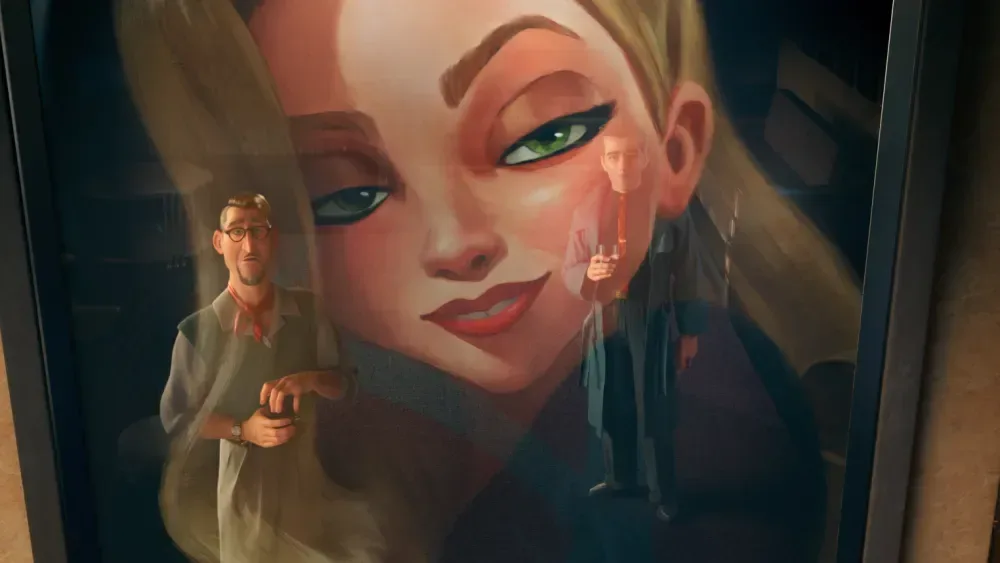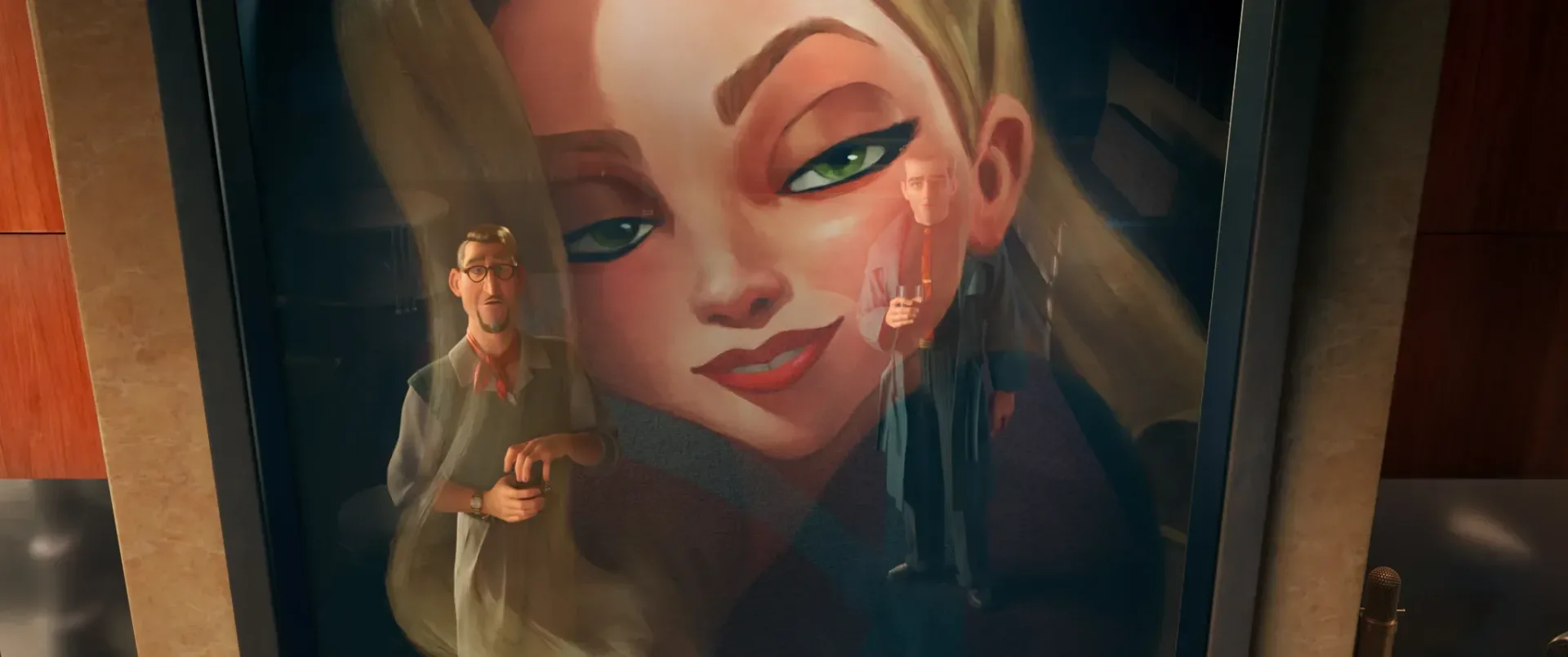
Ray Gunn is a spectacular place to visit, even when its detective story gives viewers less reason to stay emotionally invested. Brad Bird’s animated feature builds Metropia as a glowing, deeply stylized future imagined through the design language of 1939: Art Deco towers, impossibly long automobiles, smoky nightclubs, cramped rental rooms and a palette of scarlet, lilac and burgundy. Flying cars and jetpacks exist, but so do corrupt institutions, intrusive holographic advertising and entrenched discrimination between humans and extraterrestrials.
That collision is the movie’s core proposition. It is science fiction with the posture of classic noir, a genre built around private investigators, morally compromised clients, dangerous secrets and people who are rarely who they claim to be. Yet Ray Gunn keeps those ingredients in a bright, polished and PG-rated animated package rather than leaning into a grimy, rain-heavy dystopia. The result is an energetic mystery with an unusually handsome backdrop—and a persistent gap between its visual confidence and its character depth.
A future built from an older idea of tomorrow
“Retro-futurism” is the key term for what Bird is doing here. It does not simply mean putting old furniture in a science-fiction setting. It means imagining the future as people in an earlier period might have pictured it: streamlined machines, dramatic architecture, elegant silhouettes and technology designed with theatrical flair. Metropia’s vehicles may be advanced enough to fly, but their long, luxurious bodies resemble pre-World War II automobiles rather than compact contemporary transport.
The film uses that aesthetic with considerable force. Its settings move between high-rise grandeur, Hollywood-inflected nightlife and deliberately gaudy temporary accommodation. Every locale appears designed to sell the strange premise that the future modernized its machinery without surrendering a 1930s taste for curves, shine and spectacle. The approach also creates a useful tension: the city looks aspirational at a glance, while its social structure is plainly hostile beneath the surface.
That makes the setting more than decorative. Metropia is defined by contradiction. Its residents can travel through the air and encounter aliens, but the culture has not overcome prejudice. Advertisements can materialize as holograms around people, turning a familiar nuisance into an inescapable physical intrusion. The technology has advanced; the behavior has not. It is a clean, accessible sci-fi idea, and animation gives the film room to make every skyline, lounge and passing vehicle part of the joke.
For readers drawn to works that turn older visual vocabularies into new pop-culture objects, there is a parallel in the way Freestyle – Tales of Itch reframes an Amiga platformer through comic-book absurdity: style can be a major part of the appeal, but it still needs a story and characters capable of carrying it. Ray Gunn has no shortage of style.
The case begins with a pop star, a husband and too many bodies
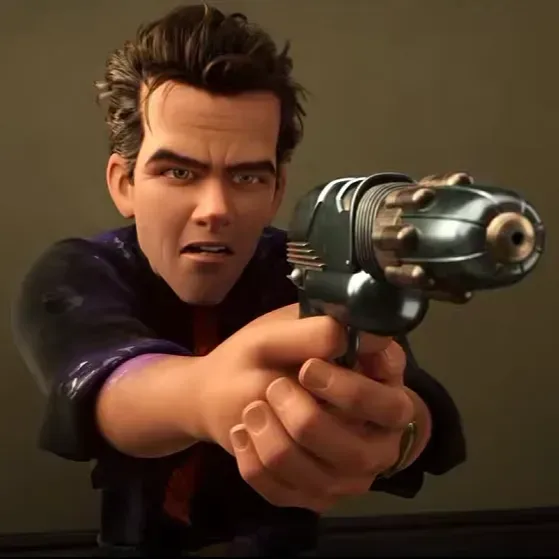
Sam Rockwell voices Ray, a smooth-talking private investigator whose name doubles as the name of his favored weapon. The pun establishes the movie’s preferred comic register: clever enough to earn recognition, but not necessarily a huge laugh. Ray is an old-fashioned trenchcoat type in an aggressively modernized city, an analog-minded gumshoe moving through a future that has gone glossy rather than fully futuristic.
His most important relationship is with his partner, Eye-Ra, voiced by Tom Waits. The pair run a struggling discreet-investigations business out of an office so rundown that repo men are steadily taking it apart around them. Eye-Ra is an alien cyclops, and the partnership is costly in a city where human-alien association is treated with suspicion.
Related coverage includes ‘Ray Gunn’ Brings Retro-Futurist Noir to Animated Metropia.
The discrimination is not left as a vague atmospheric detail. The rules of Metropia bar Eye-Ra from human hospitals, while aliens are allowed into certain clubs only as staff. These are direct signs of legalized separation, not just casual social friction. The film does not explain how humans and aliens came to share the planet, but it establishes that the hierarchy governing them is already old, normalized and difficult to escape.
The central mystery gets moving when Arnold, voiced by Bobby Cannavale, hires Ray to watch his wife, the pop superstar Venus Nova. Arnold is her fourth husband, and his request is not as straightforward as it first appears. Venus, voiced by Scarlett Johansson, is nearing a new-album launch when deaths and scandal push her into Ray’s orbit. His surveillance job becomes something much more involved: he has to keep tabs on Venus while following a case in which information is unstable, motivations are obscured and another clue does not necessarily make the picture clearer.
That is noir in functional terms. A protagonist is hired for an apparently contained job, meets someone magnetic and unpredictable, discovers a web of concealed interests, and gets dragged beyond the assignment he thought he accepted. The movie apparently moves through those turns briskly, with multiple murders and a busy sequence of revelations. It is a caper first, keeping the danger within a family-friendly rating while borrowing the language of adult detective fiction.
Venus Nova is deliberately out of time
Venus is one of the film’s most conspicuous deliberate mismatches. Her visual profile recalls an old-Hollywood siren: a narrow-waisted outline and Veronica Lake-style hair. But she is not a screen star or nightclub singer in the traditional sense. She is an electropop celebrity, a choice that introduces a present-day pop-industry note into a movie otherwise committed to a 2039-via-1939 identity.
That friction may be the point, but it does not always appear to blend cleanly with the rest of the design. Venus’s original songs were written by Kimbra, while Michael Giacchino’s score is described as busy and brass-forward, much more openly aligned with the film’s older influences. Johansson does receive a standout torch-style number as Venus reveals more of herself. Still, the music around the character can feel like two distinct ideas sharing the same room: sleek contemporary electropop and period-conscious orchestral bustle.
There is a thematic fit in the contradiction. Venus, like Ray and Metropia itself, is an attempt to combine different eras rather than choose one. Ray’s old-school detective styling is similarly complicated by his design. Rockwell brings a knowing, weary quality to the voice, but Ray has a smooth, youthful face and swooping hair rather than the rougher visual texture commonly associated with noir leads. He sounds more jaded than he looks.
That disconnect contributes to the larger issue: Ray may be constantly in motion, but he does not become a fully persuasive emotional center. A detective story can be propelled by plot, setting and one-liners, but its lead must still create an attachment strong enough to make viewers care which secret is uncovered and what it costs. The film’s lavish environment can compensate for some of that missing pull, not all of it.
Eye-Ra gives the film its strongest human connection
Ironically, the most affecting partnership in this human-alien detective story is the one that has the most to lose from the city’s prejudice. Tom Waits’s Eye-Ra stands out as the inspired piece of casting, and the relationship between Eye-Ra and Ray supplies much of the film’s emotional value. Their office, their financial trouble and the institutional barriers facing Eye-Ra give the premise a lived-in pressure beyond the mystery mechanics.
It also creates the film’s sharpest tonal challenge. Ray Gunn is fundamentally a bright caper full of chases, quips and stylized sights. Its depiction of alien segregation, however, is heavy material. There is an inherent difficulty in asking an audience to switch from a playful name-based weapon joke to restrictions on medical access and employment. The discrimination ultimately matters to the main plot, rather than being abandoned as background flavor, but the shifts in tone can still be abrupt.
That does not make the theme frivolous. Quite the opposite: the details are pointed enough to establish that Metropia’s futuristic sheen conceals a system built to privilege one group and constrain another. The issue is one of balance. The story has to hold both its breezy detective momentum and the consequences of that social order, and the two modes do not always seem fully integrated.
What works—and what remains just out of reach
At 119 minutes, Ray Gunn has substantial time to explore its city, mystery and ensemble. Brad Bird directs from a screenplay credited to Bird and Matthew Robbins, based on a story by Bird. Giacchino provides the music, while the voice cast also includes Alan Tudyk, Matt Berry, Michelle Rodriguez, Kathryn Hunter and Bird himself.
The clearest strength is craft. The film’s future is not generic glass-and-neon science fiction; it has a specific visual personality. Its buildings, interiors, colors and vehicles are part of a consistent aesthetic argument. That attention matters in animation, where world-building is not merely a location choice but a decision about every surface in the frame. The movie evidently has the energy, resourcefulness and sonic flair to keep an audience moving through that environment.
The limitation is that momentum and polish do not automatically create charm. The mystery is inventive in its zigzags, but not especially original. The jokes tend to prompt acknowledgement rather than sustained laughter. Ray, despite Rockwell’s sly vocal performance, lacks the texture required of a memorable noir lead. Venus is enticingly elusive by design, but the film’s dramatic attachment does not appear to deepen as reliably as its visual pleasures.
So Ray Gunn lands as a lavishly animated genre mash-up with more propulsion than warmth. It understands the look of a retro-futurist noir world exceptionally well: gleaming towers, glamorous danger, hard-boiled poses and tomorrow’s gadgets shaped by yesterday’s dreams. Its finest relationship is the one between Ray and Eye-Ra, and its most sustained attraction is Metropia itself. The city may be unfair, noisy and filled with pop-up holograms, but it is undeniably a dazzling place for a detective to get lost in.