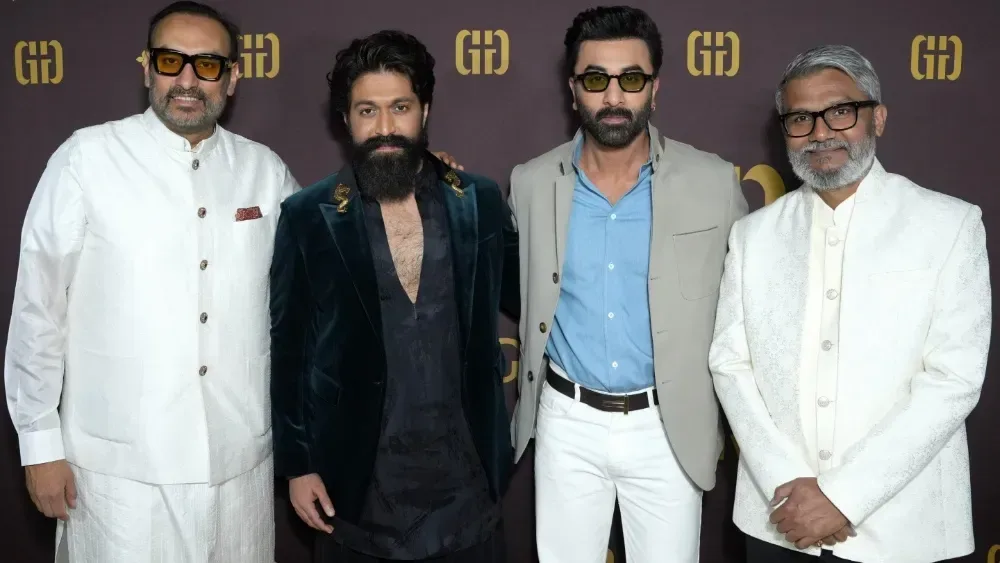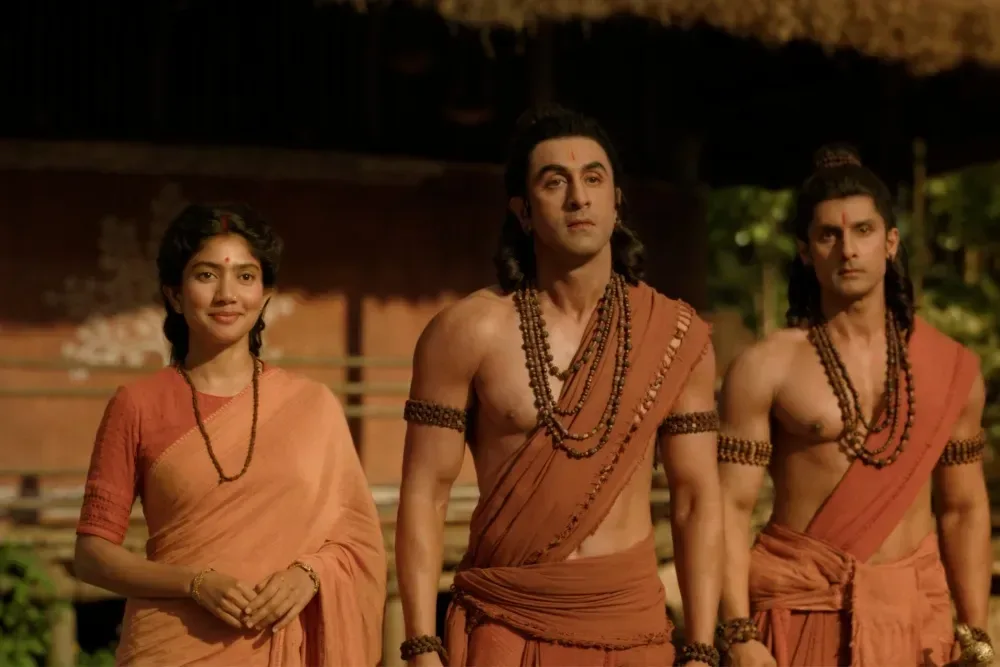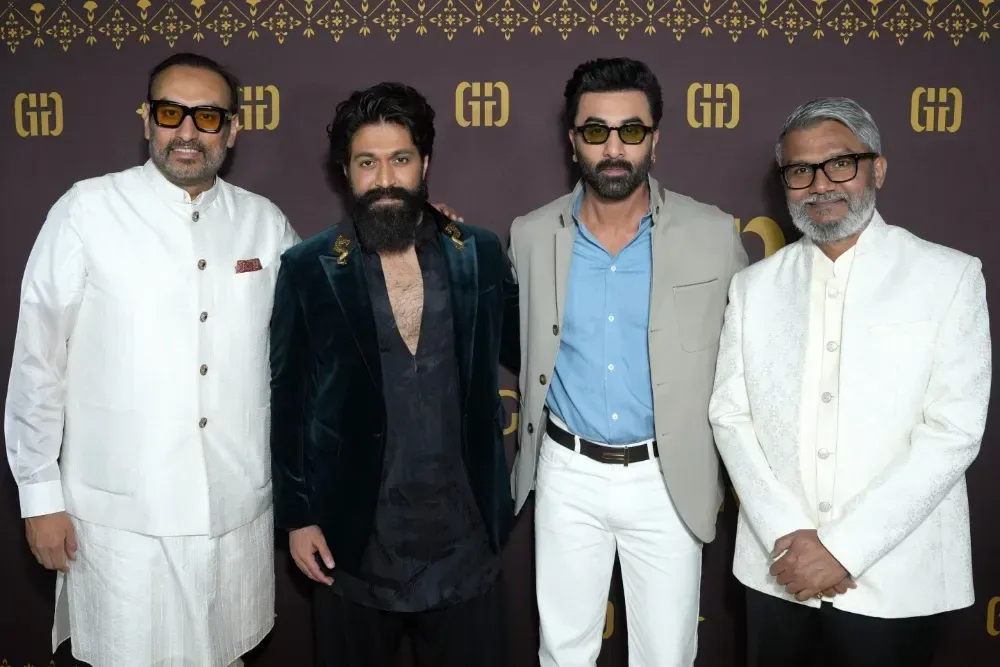
Ranbir Kapoor and Yash helped open Gold House’s largest Gold Diwali gathering to date at The Majestic Downtown in Los Angeles, appearing alongside Ramayana: Rise of a Legend filmmakers Nitesh Tiwari and Namit Malhotra ahead of the film’s Nov. 5 worldwide release.
The event arrived before Diwali, which falls on Nov. 8 this year, and placed a major Indian film adaptation at the center of an evening built around South Asian culture, creative community and business. Gold House works to support and celebrate the Asian Pacific community, while the organization has positioned Ramayana: Rise of a Legend, based on the ancient epic, as the biggest film produced out of India.
That combination is significant beyond the red-carpet element. The gathering used a forthcoming global film as a cultural anchor, but it also made room for a new funding initiative for South Asian storytellers, design work that reimagined a familiar tabletop game, food, music and a broad mix of people from entertainment, technology, fashion and business.
A Diwali event built around a global movie release
Kapoor and Yash’s appearance gave the evening a clear connection to Ramayana: Rise of a Legend. A DJ set and dance floor themed around the movie continued through the night, extending the film’s presence beyond the opening moment.
For more context, explore Challenges of Doom: Doctor Strange #1 Puts Marvel’s Sorcerers on a Multidimensional Chessboard.
The timing matters. Movie publicity events frequently aim to turn awareness into release-week conversation, but the film’s placement within a Diwali gathering adds another dimension: the story being promoted is rooted in an ancient epic, while the event was organized around a festival of light, community and connection. The evening did not offer new plot, casting or production specifics about the film, so the practical takeaway for audiences is straightforward: the title is set for a Nov. 5 worldwide opening, with Kapoor and Yash among the stars and Tiwari and Malhotra among the filmmakers who attended.
Gold House executive chair and CEO Bing Chen described Diwali as a celebration of “light, community and connection,” framing the gathering as a way to recognize culture’s role in identity and in creating possibilities. Later remarks broadened that idea beyond the holiday itself, emphasizing creators, founders and builders whose visible success may follow many years of work.
“It’s for the creators, founders, and true builders who know that shining, that overnight success, is decades in the making,” Chen said during the evening.
Related coverage includes Ranbir Kapoor and Yash Open Gold Diwali Event Ahead of ‘Ramayana’ Release.
That theme fits an event where a large-scale film release shared attention with emerging creators. It also keeps the focus from resting solely on celebrity attendance: the night was designed as an intersection of established entertainment visibility and infrastructure intended to help future work get made.
The Gold Stack Shorts Fund: what it is and why it matters
The biggest forward-looking announcement was the Gold Stack Shorts Fund, created by Gold House in partnership with South Stack Studios. The fund will support proof-of-concept shorts and micro-series built on South Asian stories.
A proof of concept is a short work made to demonstrate how a bigger creative idea might look, feel or function. It can help creators communicate a premise, tone and creative approach more concretely than a written description alone. A micro-series, meanwhile, is a short-form serialized project. The announced fund therefore targets work that can serve both as storytelling in its own right and as a persuasive demonstration of a larger idea’s potential.
Submissions are open through Nov. 30, and selected projects are scheduled to be named Jan. 10, ahead of Sundance. No details were given about funding amounts, the number of chosen projects, eligibility rules or distribution plans, so creators interested in applying should avoid assuming terms that have not been announced.
Even with those details still unspecified, the fund’s focus is clear: South Asian stories and early-stage short-form production. That is a meaningful distinction from a general prize or a finished-feature showcase. The stated objective is not simply to spotlight completed work; it is to support work that establishes a concept. For filmmakers and creative teams, that kind of support can be especially useful at the stage where an idea needs a tangible screen version before it can be pitched more broadly.
The initiative also reflects the event’s wider emphasis on builders. The actors and filmmakers connected with a major international release drew attention, while the fund created a route—however limited by the information currently available—for new South Asian narrative projects to be considered.
Carrom moved from the lounge to a design collaboration
Games had a visible role at Gold Diwali, centered on carrom, the tabletop game familiar in many South Asian homes. A dedicated carrom lounge gave guests space to play, and Indian luxury designer Anita Dongre unveiled a one-off hand-painted carrom board made in collaboration with Gold House.
The board was presented as a contemporary design object rather than just a piece of game equipment. That distinction is useful for understanding the collaboration. A standard game board is primarily made for play; a one-off artistic board can also function as a cultural and visual statement, using a shared domestic pastime as its foundation. The event did not provide any information about sale, production quantity beyond it being one-off, or future availability, so it should not be treated as a retail product announcement.
Guests also encountered the Cuyana x Gold House Marigold Charm, a limited-edition item that had been released earlier in October. Together, the charm and custom carrom board show how the event extended beyond film and conversation into physical design objects, though only the carrom board was described as a newly debuted, hand-painted one-off piece.
For Joking Joystick readers, the carrom presence is a reminder that games can be cultural touchstones without being digital. Here, carrom operated in two ways at once: as a playable social activity in the lounge and as the basis for a designer collaboration. The event’s gaming connection was not a product launch or competitive showcase; it was an example of a traditional tabletop pastime helping shape the night’s atmosphere and visual identity.
A broad South Asian creative and business gathering
The co-host list crossed multiple fields. It included Tan France, Freida Pinto, Avantika, Sarayu Blue, Dhar Mann, Blumhouse president Abhijay Prakash, Poshmark chairman Manish Chandra and Kabir Ahuja, McKinsey’s global head of TMT and consumer technology. Anita Dongre, Yash Dongre and South Stack Studios were also among the co-hosts.
That range helps explain the event’s scope. It was not restricted to actors and filmmakers, nor did it present culture as separate from entrepreneurship and media. Instead, people working across entertainment, fashion, technology, consulting and consumer business were part of the same occasion.
Attendees included Saheli Khan, Aishu Devan and Sehaj Sethi of Avatar: Seven Havens, as well as Hannah Simone, Janina Gavankar, Manish Dayal, Sanya Malhotra, Richa Moorjani, Nisha Ganatra, Asif Ali, Michelle Khare and Avani Gregg.
Programming supported that cross-disciplinary identity. Rasoi Catering served regional South Asian dishes. DJ MissNinja performed alongside KVS Tabla, an act that combines tabla with electronic music and other styles. Bhindi Jewelers ran a jewelry experience, while Dil Mil sponsored a portrait station produced by The Lounge Booth. Smartwater, Glance, McKinsey & Company and Google’s 100 Zeros backed the event, which was produced by BMF Productions.
Gold House’s Gold Diwali follows the rollout of its Diwali Cultural Guide. Taken together with the new Gold Stack Shorts Fund, the event presented Diwali not only as a date on the calendar, but as an opportunity to convene creators and companies while directing attention toward South Asian storytelling. The immediate entertainment headline remains the Nov. 5 worldwide arrival of Ramayana: Rise of a Legend; the longer-term development is whether the new short-form fund gives emerging projects a useful path from concept to screen.