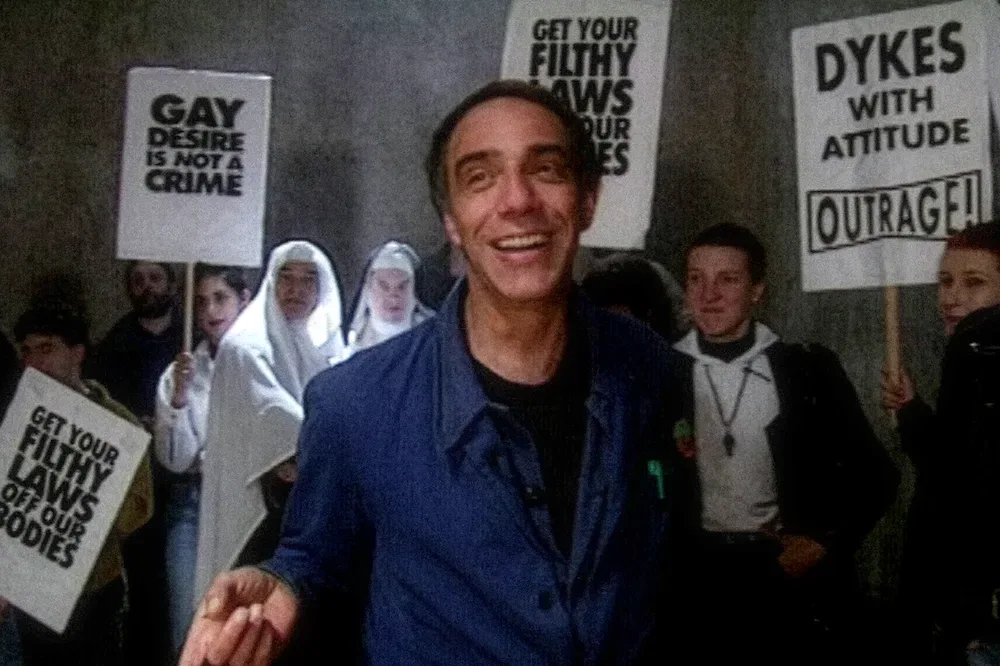
Queer Edward II is built around an archival find with unusual force: behind-the-scenes footage shot by Seamus McGarvey during the making of Derek Jarman’s 1991 feature Edward II. The material sat unseen for more than three decades before becoming the core of Theo Rollason’s 97-minute documentary. Rather than treating those rushes as mere bonus-feature curiosities, the film shapes them into an immediate record of an artist, a working set and a political moment all moving at once.
That immediacy is the point. Derek Jarman is widely remembered as a central voice in British queer cinema and a filmmaker whose work refused the false divide between art and activism. But reverence can turn historic figures into fixed icons. Rollason’s film appears designed to resist that effect. Its Jarman is not principally a monument or a subject for retrospective praise; he is a director dealing with a production, talking with collaborators, handling disruptions and making decisions in real time.
The foundational images came from McGarvey, who would later become known for films including Atonement and Die, My Love. His camera captures the creation of Edward II, Jarman’s deliberately stylized contemporary reworking of Christopher Marlowe’s play. The documentary’s great advantage is that this is not footage reconstructed through recollection. It lets a viewer look into the practical, crowded and sometimes improvised mechanics of getting an adventurous film made.
An archive that does not need a parade of talking heads
Rollason, who also wrote the documentary, reportedly avoids building the project around newly recorded celebrity testimony. That is an especially meaningful decision given the number of notable people attached as executive producers, including McGarvey, Sandy Powell, Tilda Swinton, Russell Tovey, Christine Vachon and Joe Bini. A conventional documentary might have placed their later memories at the center. Queer Edward II instead gives priority to the archive and to the people as they were in 1991.
Rollason edits alongside Nicole Hálová, with Bini contributing editorial input. The result uses the recovered material as a narrative engine rather than as a string of interruptions between present-day explanations. Contemporary television appearances and news reports are introduced selectively, supplying the public atmosphere around Jarman and Britain’s queer-rights struggle without taking the film away from its main subject.
That structure matters because Edward II was never isolated from the world beyond its set. Jarman’s adaptation was already a modern, openly queer confrontation with a canonical work. By pairing footage of the film’s staging with broadcasts from the period, the documentary locates the production amid the hostile political climate faced by LGBTQ people in early-1990s Britain.
For game and pop-culture audiences, it is a useful reminder that media can preserve conflicts in more than one way. A film can depict resistance; footage of its making can reveal how artists and activists shared the same cultural weather. Political history is also increasingly finding its way into interactive spaces, as seen in the discussion around The Uprising’s Fortnite tie-in and the 1381 rebellion. Jarman’s work represents a much earlier but similarly direct argument that form, history and present-tense politics can meet inside popular culture.
Edward II, OutRage! and a set caught in the crosscurrents
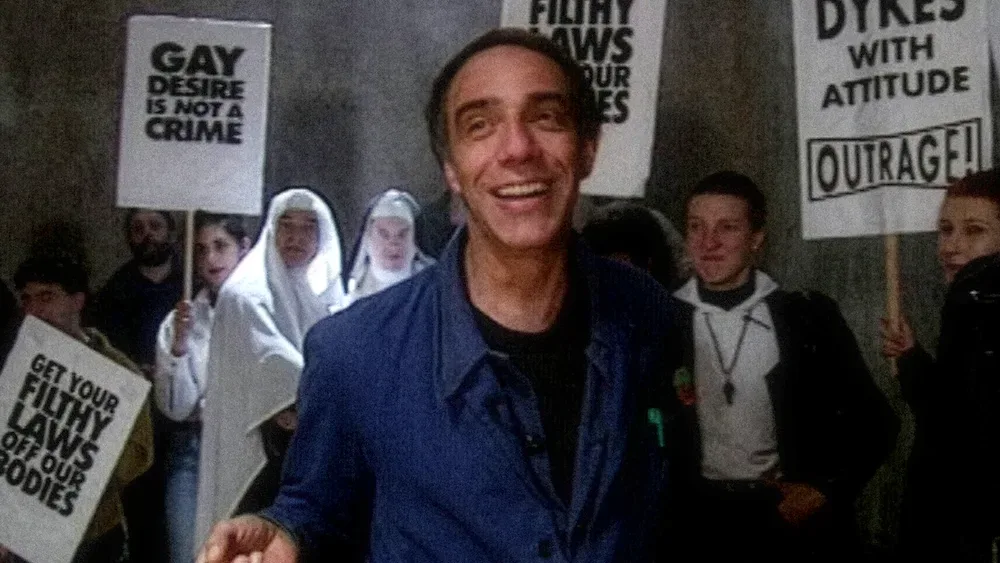
One of the documentary’s most revealing threads concerns the riot sequence in Edward II. Members of the gay-rights group OutRage! appeared as extras, and the production footage can be juxtaposed with coverage of actual demonstrations against anti-gay policy. That connection makes the scene more than a piece of screen spectacle. The people in it were connected to an ongoing fight outside the studio, and Jarman’s film becomes inseparable from that setting.
The set itself also becomes a site of news when OutRage!-affiliated extras, including members of the Sisters of Perpetual Indulgence, enter a neighboring studio where Cliff Richard was recording. They call for the singer to publicly identify himself as gay. The Sisters, known for their nun-inspired costumes, had called Jarman “Saint Derek of Dungeness.” The incident produced a media disturbance, even if it did not become a lasting storm.
There is a difficult historical wrinkle here. Jarman’s apparent sympathy for outing public figures who had not chosen to come out is a stance that sits uncomfortably with contemporary ethical standards. The documentary does not need to flatten that dissonance. The early 1990s were defined by a different and intensely pressured environment: Jarman had lived with an HIV/AIDS diagnosis for more than five years, while a Conservative government remained in power after the Thatcher era. Understanding that context does not require endorsing every tactic, but it does clarify the anger and urgency surrounding the debate.
The film’s archival television clips reportedly make that pressure visible in another register. Jarman comes across as gracious and composed even while interviewers’ hostility or patronizing attitudes can be unmistakable. That contrast is important. It exposes how prejudice often presented itself through supposedly respectable cultural conversation, not solely through explicit slogans or legislation.
The material reality behind avant-garde filmmaking
There is a temptation to romanticize the period as a time when British public funding gave experimental artists expansive freedom. Queer Edward II complicates that story. The film was supported through the BBC, but the behind-the-scenes material also shows the financial and logistical limits under which the team worked. This was not a lavishly resourced production floating above ordinary pressures.
Instead, the archive records a crew facing the familiar burdens of film work: budget strain, practical scheduling concerns, demands from unionized extras for further expenses and an office stretched thin by problems large and small. That apparent scrappiness is not a footnote. It is part of how Jarman’s cinema was made possible. The sharp visual imagination of Edward II had to coexist with the basic business of arranging bodies, costumes, space and time.
The tactile detail of the footage gives this history an additional charge. Beige telephones, analog equipment, period clothes and crowded workrooms evoke an industry just before digital tools would transform much of its day-to-day process. Yet the value is more than retro texture. These objects make a well-known filmmaker’s world feel physical and contingent. Great art did not arrive in finished form; it had to survive rooms full of cables, makeup, paperwork, laundry and interruptions.
Familiar names before the mythology hardened
Several future major figures appear in an earlier chapter of their careers. Costume designer Sandy Powell is seen and briefly interviewed long before her later Academy Award recognition. Annie Lennox’s performance of Cole Porter’s “Ev’ry Time We Say Goodbye,” filmed for Edward II, is included in full, with crew members assembled behind the camera in a scene said to resemble an informal concert audience.
Tilda Swinton, who played Queen Isabella in Jarman’s film, is another compelling presence. The footage captures her glamorous screen persona but also the everyday reality around it: a makeup-room moment involving the removal of false eyelashes, with drying tights hanging nearby. It is a small image, but that is why it works. Stardom has not yet erased the ordinary labor required to create a look.
These appearances are not simply a scavenger hunt for famous faces. They show the collaborative network around Jarman and the way careers can develop within a shared creative community. The documentary’s attention remains on Jarman, but it recognizes that his influence lived through people who made, performed in and carried forward work shaped by his example.
A portrait of activism that keeps moving
Jarman died only a few years after Edward II was released, though he completed two more features in that period. A documentary about him could easily become a memorial organized around absence. The archival approach gives Queer Edward II another route. It emphasizes motion, humor, problem-solving and creative momentum, preserving the sense of someone still actively engaged with colleagues and causes.
That perspective is especially resonant because the film’s subject is not only a director. Jarman’s political commitments were inseparable from his cultural work, and the documentary places neither above the other. It suggests that irreverence, generosity and persistence can be part of resistance, even when the political outlook is bleak and the practical conditions are frustrating.
Queer Edward II was screened online in the Venice Film Festival’s Out of Competition program on August 20, 2026. Its credited producers are Ben Fowlie, Sebastien Rabas and Michael Sherman. Simon Fisher Turner composed the music. For viewers interested in film history, LGBTQ cultural history or the unvarnished process behind a defining work of New Queer Cinema, its central archival discovery offers something unusually rare: not simply a record of what Derek Jarman meant, but a vivid sense of how he worked.