There is an immediate contradiction at the heart of Imperium, Sergei Loznitsa’s 175-minute archival documentary: it surveys a state built around the idea of unity, yet nearly every stretch of its recovered images demonstrates difference. The Soviet Union presented itself as an immense common project, managed from the center and tied together by confident political language. But the faces, landscapes, rituals, clothing, religious spaces and everyday work captured here point toward a far less easily standardized reality.
Loznitsa constructs the film from roughly 60 hours of 16mm material shot by Italian crews in the early 1970s. The footage was initially intended for an ambitious television project, although only a limited number of installments were aired in Italy, once, before the undertaking faded into archival obscurity. That history matters. These images were collected at a moment when much of the West imagined the USSR as a single gray block behind the Iron Curtain. The filmmakers were working with official authorization, but the surviving material appears more observant than celebratory. It records an empire’s public performance of cohesion while repeatedly noticing the people and practices that refuse to become interchangeable.
That makes Imperium a particularly fitting project for Loznitsa, whose nonfiction work has often found new meaning in surviving images and in the gaps between official record, public ceremony and private behavior. He directs and writes the film, with Audina Kučinskaitė sharing editing credit. Rather than layering an explanatory narration over the material, Loznitsa primarily restores and arranges it. Brief additions of conversation and music are present, but the governing sensation is one of sustained looking. The film invites viewers to spend time inside the frame and recognize how much political meaning can emerge from a parade, a shop window, a winter gathering or an uneasy social arrangement at the edge of a community.
A route through a continent-sized state
The documentary’s organization is geographical. It begins in Moscow, moves eastward through the vastness of the Soviet territory, then returns through Central Asia and the Baltic republics before reaching what was then Leningrad. The structure gives the film a travelogue-like skeleton, but it is not a tidy tourist tour. Each regional stop works against the premise that the USSR can be neatly summarized from its capital.
Moscow offers the clearest evidence of the official image. Imperium opens with a Red Square parade held for the 24th Congress of the Communist Party’s Central Committee. Banners promote production successes and familiar promises of targets surpassed. The spectacle is polished, formal and legible: a nation speaking to itself in slogans inherited from decades of Soviet public life.
Then Loznitsa’s assembly shifts to GUM, where displays include tuxedos, glossy patent-leather shoes and beaded handbags. The contrast is revealing without requiring the film to underline it. Political claims of collective prosperity coexist with an image of luxury consumption whose audience is not obvious. Elsewhere in the capital, Christmas decorations are being actively sold. In a state officially committed to atheism, such commerce is a small but telling indication that older customs could be accommodated, repurposed or simply endure beneath the grand ideological surface.
The further the film gets from Moscow, the less persuasive the notion of uniformity becomes. In Suzdal, an elderly woman washes clothes in an ice hole. Images from Vladimir evoke a place that seems remarkably untouched by the revolutionary transformation supposedly remaking all Soviet life. A winter carnival recalls traditions that predate Leninism by generations. These are not presented as quaint diversions from the main story. They are the main story: an enormous political system encountering the durability of local memory.
What the archive notices
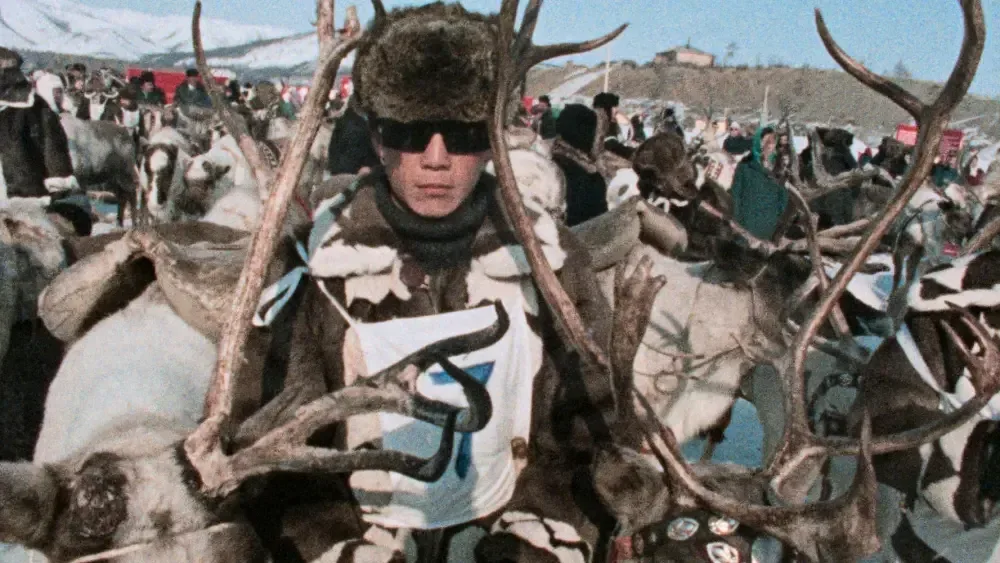
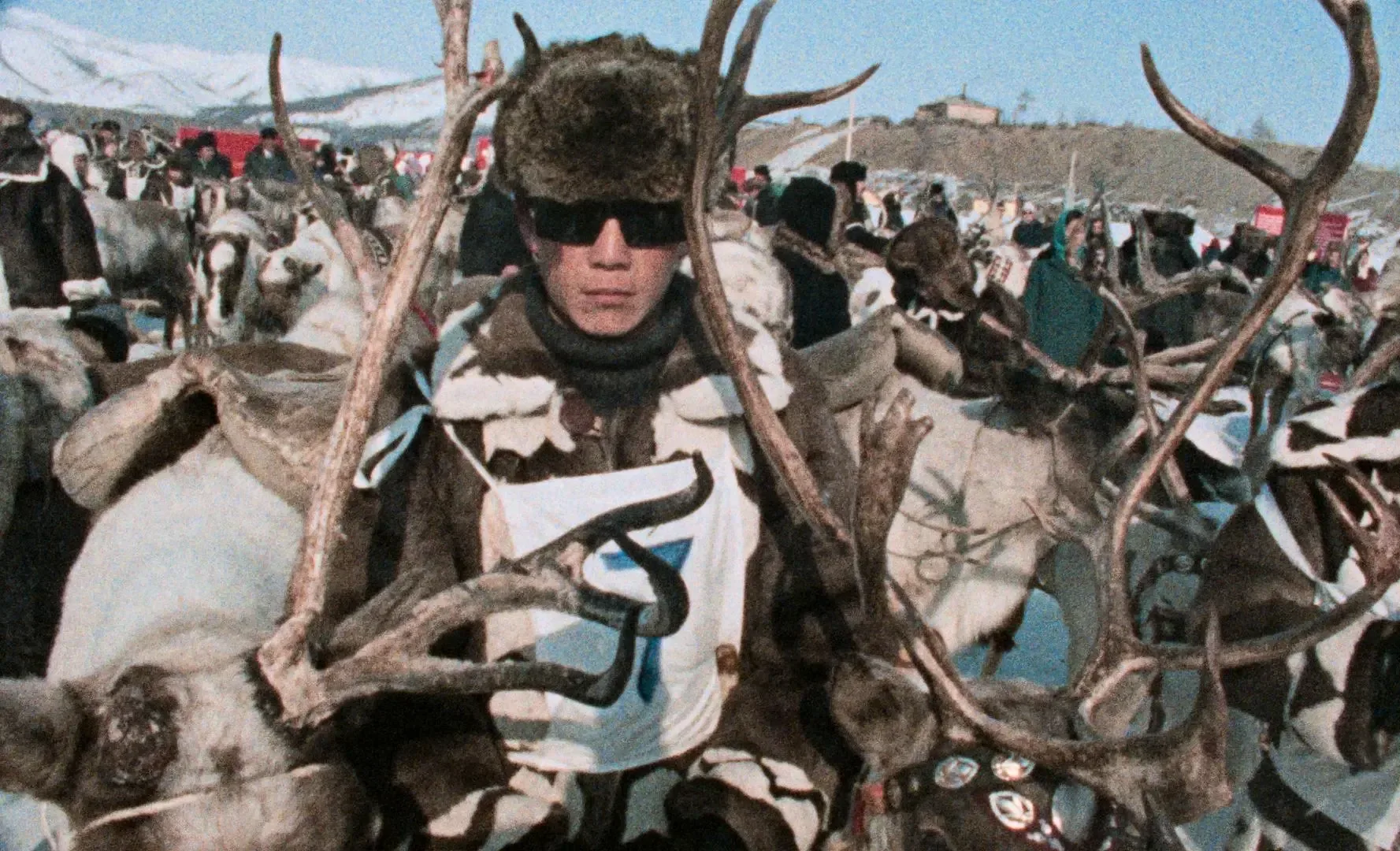
Some of the most powerful sequences appear in Siberia and the eastern reaches of the journey. The camera encounters Bactrian camel racing near the Mongolian border and reindeer sleds in the Sakha Republic. Such scenes expand the viewer’s sense of the USSR beyond the familiar metropolitan shorthand of party officials, apartment blocks and military pageantry. The country on screen contains radically different climates, histories and ways of moving through the world.
One Siberian passage sharpens the documentary’s critique of Soviet authority. A group of young Caucasian Russians, dressed in recognizably 1970s style, play guitar and sing Russian songs. Yakut locals watch from the side. The scene does not need an added lecture to suggest an unequal cultural relationship. The staging of who performs, who occupies the center and who is left observing communicates the force of a colonial dynamic within a state that proclaimed fraternity among its peoples.
That attentiveness to marginal positions is where Imperium is at its richest. Mosques in Bukhara and churches in Etchmiadzin show that religious life persisted. Communities maintain ceremonies and social rhythms that do not appear fully absorbed into the machinery of collectivization or bureaucratic messaging. The film’s most persistent argument is not that Soviet power had no reach; the parades, production slogans and visible structures of state authority make that impossible to claim. Instead, it observes the limits of imposed sameness. Centuries of custom prove stubborn, sometimes quietly and sometimes vibrantly.
For audiences interested in how moving images preserve everyday history, that quality is also a reminder of why physical and archival media remain valuable. Contemporary release collecting has its own priorities, but the broader impulse to preserve cinema runs through features such as this look at recent Blu-ray releases. Imperium demonstrates what can happen when a supposedly dormant body of footage survives long enough to be viewed with different questions in mind.
Duration is both the film’s method and its obstacle
At 175 minutes, Imperium asks for real commitment. Its length is purposeful: a shorter version could more easily turn this vast collection of regions into a brisk montage of cultural difference. Loznitsa instead gives places and encounters room to register, allowing viewers to feel distance, repetition and scale. The effect is often absorbing. One begins to understand the Soviet Union not as a single setting but as a difficult-to-contain accumulation of settings.
Even so, the running time can weigh heavily. Loznitsa’s archival works Maidan and State Funeral possess a powerful sense of historical momentum, their images moving toward or gathering around events whose consequences echo far beyond the frame. Imperium has a more diffuse objective. Its journey is illuminating, but it is not always propelled by a single escalating event. There are stretches where its central point is already clear and the viewer may feel the sheer duration more acutely than the film seems to intend.
That does not invalidate the approach. It changes what kind of experience Imperium is. This is not a conventional argument-driven documentary that briskly establishes a thesis and marches toward a conclusion. It is closer to an extended encounter with recovered time. Its repetitions matter because official sameness is repetitive; its detours matter because the map it follows is too large for one story. Still, viewers expecting the concentrated dramatic shape of Loznitsa’s most historically urgent films may find this work less forceful scene for scene.
The politics of seeing a vanished country
Imperium also arrives with the unavoidable complication of hindsight. The early-1970s USSR was viewed through competing ideological myths. In American-led public discourse, Soviet society was often reduced to an anonymous totalitarian mass. Elsewhere, particularly among sympathetic political movements, the abuses and contradictions of the Politburo could be minimized or ignored. The Italian project that generated this footage emerged within that contested atmosphere.
Loznitsa does not set out to merely correct one Western caricature with a rosy counter-caricature. The footage contains hardship, hierarchy, managed ceremony and the pressure of Russian cultural dominance. Yet it also contains ordinary social life in a degree of particularity that broad geopolitical labels cannot convey. Moscow consumers browse goods. Villagers gather in cold weather. Workers and families pass through frames. Faith continues in places where doctrine supposedly displaced it. People remain themselves while institutions attempt to describe them as parts of something larger.
The film can also be placed alongside Federico Ferrone and Michele Manzolini’s 2013 found-footage documentary The Train to Moscow: A Journey to Utopia, which examines an earlier Italian encounter with the USSR and the disillusionment that followed. Together, the films suggest how readily distant nations become screens onto which outsiders project hope, fear or certainty. Imperium is strongest when it leaves those projections behind and returns to what the camera caught: a population too diverse, too rooted and too human to fit an empire’s sales pitch.
An archival documentary with patience and perspective
Presented in Russian, Ukrainian, Kazakh, Uzbek and Georgian dialogue, Imperium is a Germany-Italy-France-Lithuania production produced by Philippe Bober, Anne-Claire Martin, Giovanni Pompili and Uljana Kim. Its multinational production history is apt for a film whose subject is the impossibility of treating a multinational polity as one culture.
The documentary does not offer easy uplift, nor does it turn its archival discovery into a gimmick. Its value lies in accumulation. A banner in Red Square, an ice hole in Suzdal, camel races, reindeer sleds, a church, a mosque, store displays, performers and spectators: each image challenges the previous one’s claim to represent the whole. Loznitsa’s great achievement is to let that incompatibility remain visible. Imperium may be demanding in its length and intentionally loose in its movement, but its recovered vision of Soviet life is expansive, unsettling and difficult to reduce.