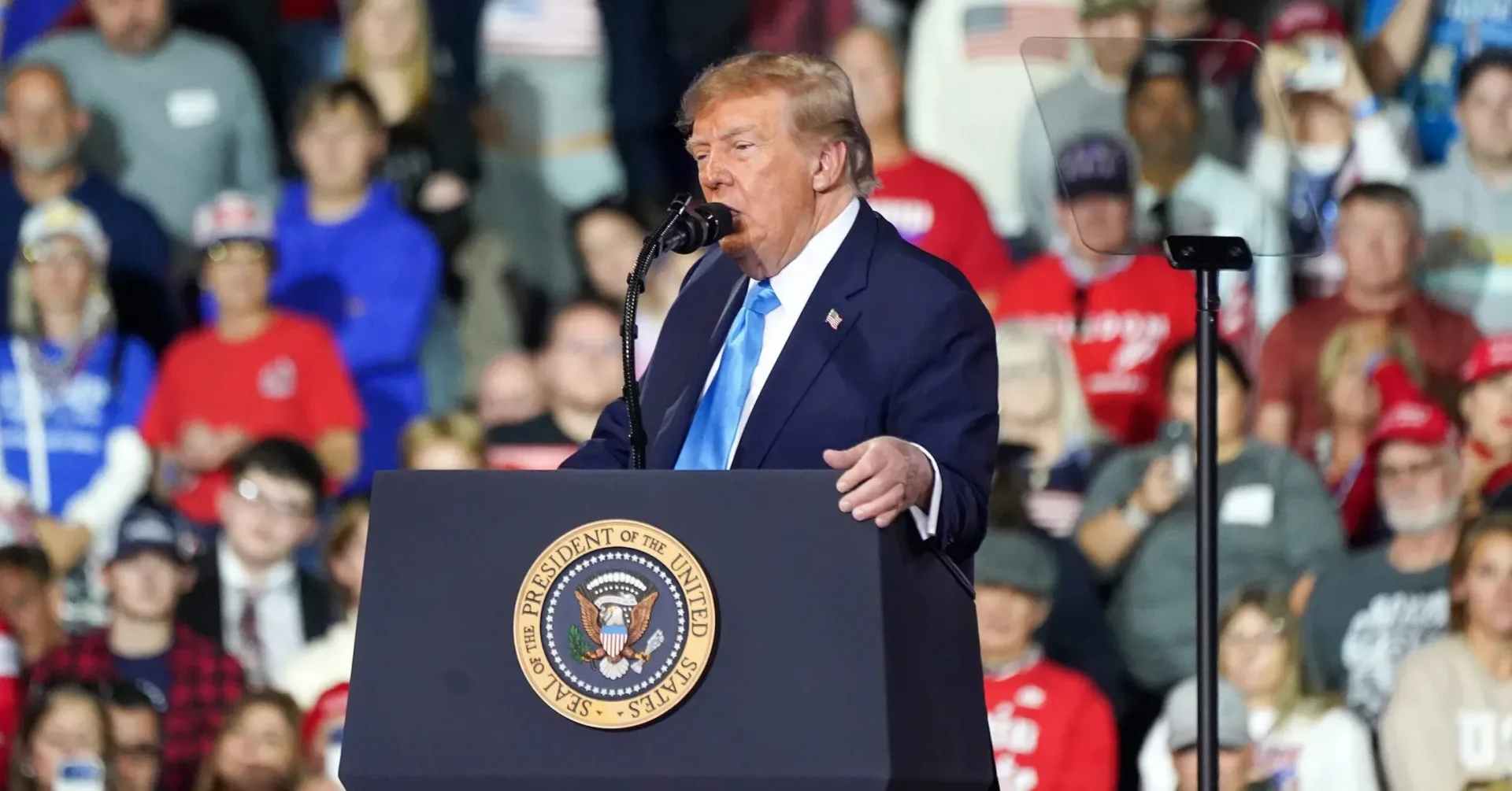
PlaqueBoyMax has publicly objected after his track “Man of the Year”, made with UnoTheActivist, appeared in a White House promotional video celebrating President Donald Trump.
The clip reportedly frames Trump as its “Man of the Year” and uses the song as backing for a fast-paced promotional edit. PlaqueBoyMax responded on social media with an expletive-laden message, making clear that he did not welcome the association between his work and the administration.
That reaction is the essential point here: whatever permissions, clearances, or distribution arrangements may exist behind the scenes have not been publicly detailed in the material available. It would therefore be inaccurate to present the dispute as a settled legal case. But an artist’s public disapproval can still be immediate and unambiguous, particularly when music is attached to political messaging.
A song title becomes a political message
“Man of the Year” is a phrase that does a great deal of work in this context. In an ordinary music setting, it can be a boast, a hook, an in-joke, or simply an attention-grabbing title. Placed beneath footage promoting a president, it becomes an endorsement-shaped statement. The edit effectively turns the song’s title into a caption for Trump.
That is why artists can react strongly even when a song is only part of the soundtrack. Music is not neutral decoration in a campaign-style video. It supplies pace, mood and cultural identity. A familiar or scene-specific track can make a message feel current, forceful or connected to an audience that might otherwise ignore conventional political communications.
For PlaqueBoyMax, whose work has included stream-based collaborations with underground artists, the objection also illustrates a collision between internet-native music culture and formal political branding. Tracks can spread rapidly across clips, uploads and social feeds; their context can change just as quickly. A record intended for one audience can be recast in a political video seen by a very different one.
Permission, approval and endorsement are not the same thing
The available information does not establish whether the White House secured authorization to use the recording. That distinction matters. Claims that music was used “without asking” should not be converted into a definitive legal finding without evidence about the relevant rights or licenses.
Still, there are separate questions that are often blurred together when music enters politics:
- Permission: Whether the necessary rights to use a composition and recording were obtained.
- Artist approval: Whether the performers or creators personally support the use.
- Perceived endorsement: Whether viewers reasonably take the music placement as a sign that its makers back the political figure or message.
Those questions may lead to different answers. A use can prompt a musician’s objection even if a party believes it has a route to use the music; conversely, a listener may infer endorsement simply because a song is paired with a politician, regardless of what the artist actually intended.
PlaqueBoyMax’s response speaks most clearly to approval and perceived association. He did not want the track functioning as a political prop for Trump. That is an especially sensitive concern in an era when a short video can circulate far beyond its original account, separated from any explanation and reduced to a memorable song-title-plus-image pairing.
Why political edits lean on recognizable music
Political communications increasingly use the grammar of online hype videos: quick cuts, bold text, dramatic pacing and music that tells viewers how to feel before they have processed the message. The White House video described here appears built around that approach. Calling Trump “Man of the Year” while using a song with the same name makes the edit’s intended message unmistakable.
For an administration seeking to energize supporters, that format has clear appeal. It is concise, shareable and designed for platforms where attention is scarce. It can also produce backlash, because the music does not merely support the image; it lends the image some of its own tone and credibility.
This is where the dispute reaches beyond one track or one post. Artists often cultivate a particular relationship with listeners. When a political institution adopts their work, it can alter how audiences interpret that relationship. Fans who oppose the political message may assume a collaboration that the artist never wanted, while supporters may treat the soundtrack as validation.
Political stakes heighten the reaction
The controversy arrives in the run-up to the November 3 midterm elections. The presidency is not on the ballot, but control of the House and Senate is at stake, with Democrats seeking to win both chambers from Republicans. Against that backdrop, promotional media featuring Trump carries more political weight than a routine institutional post.
Trump is a deeply polarizing public figure, and cultural associations around him are frequently contested. That makes the use of music particularly fraught. A catchy backing track can be an efficient communications tool, but it can also put an artist in the uncomfortable position of having to publicly distance themselves from a message they oppose.
The immediate practical lesson for musicians is not that every unexpected use has the same legal meaning. Instead, it is that public response and rights questions can unfold on different tracks. A creator who sees their work in a political clip may want to establish the facts surrounding the use while also deciding whether to make their position visible to fans. PlaqueBoyMax chose the latter quickly and plainly.
What remains unclear
There is no detail here about a formal complaint, a takedown request, a licensing arrangement, or any response from the White House, Trump, or UnoTheActivist. There is also no basis to infer what action, if any, could follow. The confirmed public-facing development is PlaqueBoyMax’s angry rejection of the song’s use in the Trump-focused video.
That makes this less a fully documented rights dispute than a clear example of the reputational stakes around political music placement. When a title such as “Man of the Year” is deployed to amplify praise for a president, the selection is part of the message—not merely background audio.
Music remains a powerful shorthand across entertainment, film and online culture; for another recent score-focused release, see coverage of Hans Zimmer’s “Desert Chant” for Dune: Part Three. In PlaqueBoyMax’s case, however, the question is not the track’s creative role in fiction. It is the artist’s refusal to let his music be read as applause for a real-world political figure.