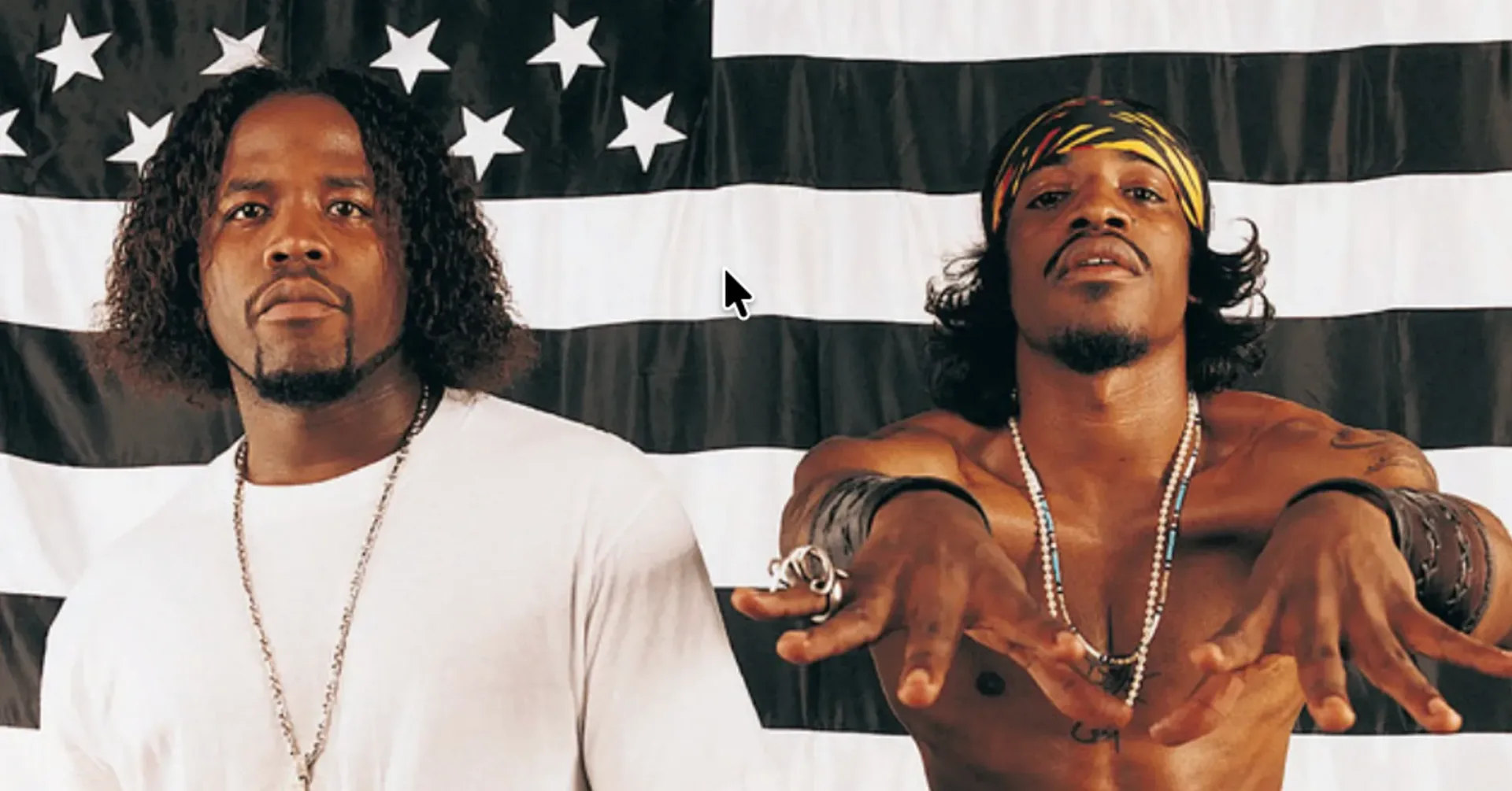
OutKast and Waffle House have joined forces on a merchandise collaboration that treats an unmistakably Atlanta reference as more than a logo swap. The collection arrived through OutKast’s website on October 2, following a tease on a Waffle House marquee that read: “GATOR BELTS AND PATTY MELTS.”
That phrase points to Big Boi’s verse on “So Fresh, So Clean,” turning a familiar lyric reference into the campaign’s central joke and signal. It is an efficient piece of shorthand: a diner staple meets a detail from an OutKast song, with neither side needing to explain why Atlanta is the connective tissue.
Crucially, the partnership does not come with an announced new OutKast release. Fans looking for new music should separate that hope from what has actually been presented: a wearable collaboration built around the duo’s cultural association with Atlanta and Waffle House’s place in Southern daily life.
Why the pairing reads as more than standard band merchandise
In comments about the collaboration, Atlanta hip-hop historian NuFace described it as bigger than merchandise. The idea is not that clothing suddenly carries the weight of an album; it is that the objects can work as a shared cultural reference. OutKast and Waffle House represent different, overlapping pictures of the same city: one associated with expansive, globally heard music and style, the other with an everyday restaurant presence tied to Atlanta and the broader South.
For more context, explore Lucki Appears Injured After Reported ComplexCon Altercation Involving Playboi Carti-Associated Group.
That distinction matters. Traditional merchandise often exists mainly to identify a fan with an artist, tour, team, game or event. A cultural collaboration works a little differently. Its value comes from recognition between communities and symbols. Someone who understands the lyric, the restaurant setting and the local context can read the design as a compact statement about place.
NuFace’s point is that the appeal is rooted in the meeting of those identities, not merely in the item itself. Waffle House evokes the ordinary hours before a show, after a night out, or during the stretches of life between headline moments. OutKast’s work, meanwhile, helped carry Atlanta’s creativity, slang, fashion and Southern outlook to a worldwide audience. Put together, the brands are speaking in a language that is local in origin but broadly recognizable.
“OutKast and Waffle House are two pieces of Atlanta culture that represent completely different sides of the same city,” NuFace said.
That is also why the marquee message lands better than a generic celebrity promotion would. “Gator belts” is not a phrase chosen at random to sit next to a menu item. The modification into “patty melts” makes the restaurant’s vocabulary part of the lyric reference. The campaign is deliberately playful, but the joke depends on a real connection rather than a borrowed aesthetic.
OutKast’s Atlanta identity has always been central
Big Boi and André 3000 made their debut in 1994 with Southernplayalisticadillacmuzik, bringing Atlanta character and Southern swagger into a national conversation. Their later albums—ATLiens, Aquemini and Stankonia—expanded the duo’s sound while preserving the sense that the work came from a particular cultural environment.
That context is important when considering an apparel project decades later. The OutKast legacy is not being framed only as a catalog of recordings. It is also about the ways the group’s ideas and language became entangled with how fans portray Atlanta: its humor, its fashion, its confidence and its point of view.
A lyric callback can therefore do two jobs at once. On the surface, it is an easter egg for listeners who know “So Fresh, So Clean.” At a deeper level, it reinforces the notion that OutKast’s words have remained usable cultural material. The reference can move from a song to a marquee and then to clothing without losing its meaning for people who know the connection.
That does not mean every buyer will approach the collection as an artifact of regional music history. Some will simply enjoy the phrase or the visual mix of two well-known names. But the collaboration has enough shared context that it can accommodate both reactions: casual appreciation and a more specific Atlanta reading.
What the collaboration does—and does not—promise
The clearest practical takeaway is simple: this is a merchandise drop, not confirmation of a recording project, reunion campaign or new OutKast music. The supplied information identifies the October 2 release through OutKast’s website and the Waffle House marquee tease, but it does not establish further musical plans.
That boundary is worth keeping sharp because high-profile artist partnerships can invite speculation beyond their actual scope. Fans may naturally see any new activity involving a celebrated duo as a possible prelude to music. Here, however, the evidence supports a narrower and still meaningful story: a collaboration that turns a lyric and a regional relationship into wearable cultural expression.
It also avoids reducing Waffle House to a decorative backdrop. The restaurant’s role in the concept is the everyday counterweight to OutKast’s artistic stature. One side represents a duo whose music carried Atlanta’s perspective far beyond the city; the other represents an institution woven into ordinary Southern routines. The juxtaposition is the product’s point.
For a broader look at the rollout’s Atlanta-centered framing, see this overview of the OutKast and Waffle House collaboration.
A wearable record of a shared reference
NuFace suggested that the collection may gain another layer of meaning over time. In 20 or 30 years, a garment from the project may be remembered less as a current product and more as evidence of how Atlanta’s music and everyday institutions were represented together at this moment.
That is not a prediction of rarity, resale value or collectibility; none of those claims can be drawn from the available details. It is a point about memory. Physical objects can preserve the visual language of a cultural moment, especially when they carry references that are immediately legible to one community and intriguing to another.
For OutKast, the partnership reinforces an already expansive legacy. Big Boi and André 3000’s influence extends beyond records because their work helped furnish the language through which Atlanta is often presented and claimed. For Waffle House, the collaboration places a familiar Southern setting within that same creative map.
The result is a piece of branded apparel with a more precise purpose than a routine logo print. “Gator belts and patty melts” connects a song reference, a restaurant sign and a regional identity in one line. No new track has been announced, but the message of the drop is clear enough: Atlanta culture has room for the grand, the everyday and the funny, sometimes all on the same marquee.