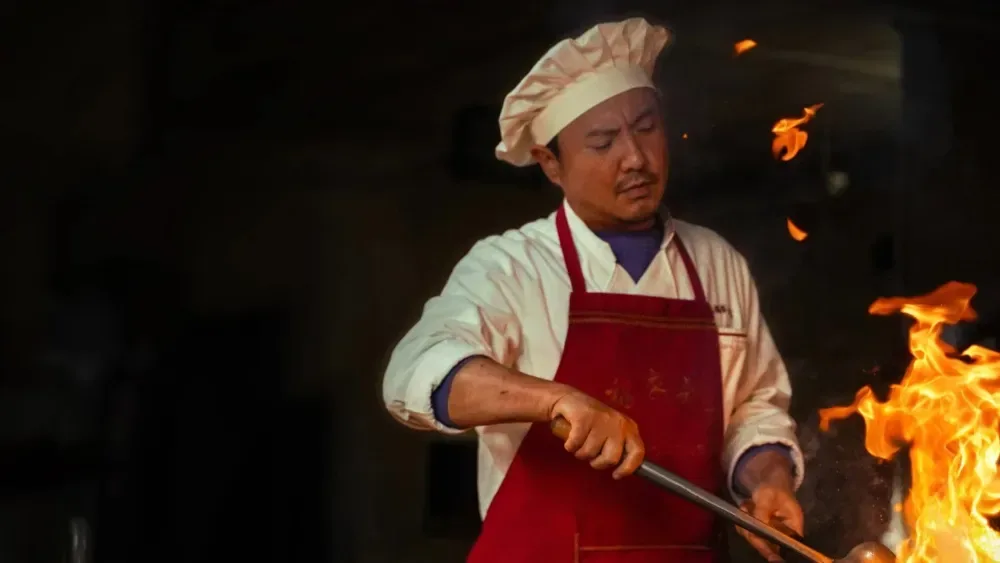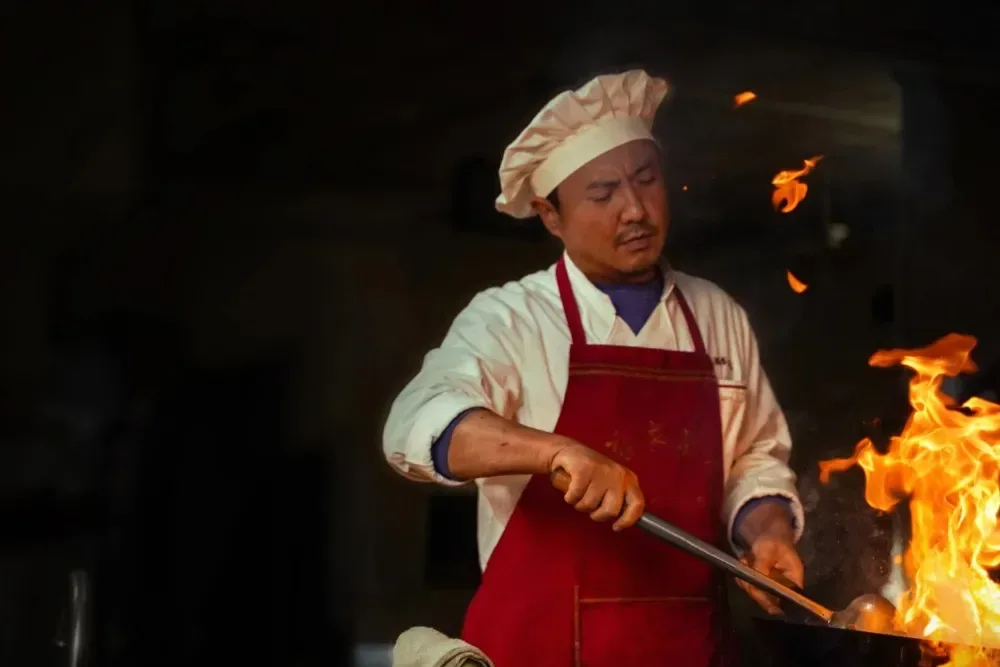
Once Upon a Time in the Middle East is a huge, unruly war epic built around an idea so peculiar it becomes its own engine: Chinese cooking can survive practically any geopolitical catastrophe. Directed by Wen Muyue and running 141 minutes, the film follows Xu Fu, played by Shen Teng, a debt-burdened chef who expects a temporary restaurant job in the fictional Gulf-region city of Bahata to last two years. Flash-forwards reveal that he eventually gets home to his daughter and mother in China, but only after a vastly longer and harsher detour.
That premise begins as a food-forward culture-clash dramedy and grows into a military occupation story, then a terror-stronghold thriller. The changes are not gradual. Bahata is devastated by bombing, its residents are pulled into war, and Xu Fu’s restaurant skills become the unlikely resource that repeatedly keeps him and others alive. The result is a movie with enormous production muscle and a relentlessly unstable tone: gleaming dishes, surrogate-parent sentiment, executions, child soldiers and large-scale destruction are packed into the same sprawling narrative.
A chef trapped in Bahata
Xu Fu arrives with an ordinary goal. He has agreed to manage a Chinese restaurant in Bahata and plans to return home once the job is done. Ma Junsheng, the anxious restaurant manager played by Jiang Qiming, helps him navigate the setting by translating between Arabic and Chinese while dealing with the restaurant’s owner, Zaid, played by Sherif Sobhy.
For a time, the movie leans into the pleasures of its restaurant setting. Close-ups celebrate grilled meat and simmering stone-pot dishes, while Xu Fu establishes himself as the kitchen’s indispensable center. He also takes in Seif, an orphan played by Omar Sherif, and teaches the angry young man Chinese cooking. Food is not simply visual decoration in this early stretch. It is presented as a discipline, a livelihood and a language shared across cultural boundaries.
The film’s belief in cuisine is both sincere and wildly overextended. Xu Fu’s food is treated as a near-universal diplomatic tool and, later, a practical means of survival. It is a bold narrative choice, but one that also signals the movie’s larger tendency to turn every crisis into an occasion for a grand symbolic gesture. The restaurant is a refuge, a workplace, a family home and eventually a site caught between armed powers.
From kitchen drama to war blockbuster
Once war arrives, Once Upon a Time in the Middle East abandons any expectation of a modest, contained story. The film has the scale of a major commercial production: a city burns amid collapsing buildings, and a military base later faces an attack amid blazing pyrotechnics. Its visual ambition is unmistakable. These sequences demand extensive worldbuilding and technical coordination, and the film puts that spectacle front and center.
But the escalation is also remarkably abrupt. Zaid’s home is bombed; a melodramatic scene finds him mourning his wife and child, and he then joins a terrorist group. Xu Fu, Ma Junsheng and Seif are captured by the U.S. Army and compelled to work in a military-base kitchen. Xu Fu must contend with an aggressive American soldier while trying to protect children sheltering at his restaurant. A liquor-smuggling arrangement with American troops becomes one of the methods he uses to keep those orphans safe.
This kind of plotting has a strange, compulsive momentum. Events do not pause long enough to settle into realism or reflection. They stack. One reversal launches the next, and the film repeatedly shifts location, danger and emotional register. Viewers looking for a disciplined war drama may find the construction exhausting. Viewers with an appetite for a maximalist, sometimes absurdly direct blockbuster may find it difficult to look away from.
Related coverage includes Once Upon a Time in the Middle East Turns Cuisine and War Into a 141-Minute Spectacle.
The film’s political framing
The story places China in a conspicuously benevolent symbolic role amid the wreckage of a conflict clearly tied to the Iraq War. Xu Fu is constructed as a compassionate, practical guardian figure whose kitchen and personal decency shelter those around him. The framing is not subtle, especially as American forces and the fictionalized Iraqi-side characters are drawn in broad strokes.
That is what makes the movie’s humanism difficult to separate from its political messaging. A film can use a fictional city and invented characters to discuss war without claiming documentary realism. Here, however, the symbolism is overt enough that the characters often feel designed to deliver a geopolitical argument rather than exist as fully credible people. The movie’s nominal effort to spread blame across opposing sides does not produce much nuance; it chiefly creates caricatures.
One of the most pointed recurring jokes and arguments concerns Chinese-American food. Xu Fu and Zaid bond over refusing to serve dishes such as General Tso’s chicken. Later, a Chinese-American private, played by Li Zhiting, forces his way into free meals at the restaurant. The movie treats this cuisine dispute as a marker of authenticity and national pride, even while it is surrounded by scenes of occupation, displacement and death. It is an unusually jarring use of food politics, and a good example of the film’s willingness to push every theme to its loudest possible expression.
Seif and the movie’s emotional contradiction
Seif is essential to the film’s attempt at an emotional core. Xu Fu and Ma Junsheng effectively become father figures to him, hoping that cooking gives him a future beyond anger and violence. The relationship provides some of the warmest material in the film: a small moment involving a smuggled can of soda, for example, carries a sense of brotherly care.
Yet those intimate scenes are placed directly beside increasingly graphic depictions of wartime cruelty. In its later movement, the story enters a terrorist stronghold where children are brainwashed into suicide attacks. Executions and imagery of young people being trained for violence sit beside soft, protective scenes between the central trio.
That collision is the movie’s defining contradiction. It wants the audience to recognize the horror inflicted on children and civilians, but it packages that horror with a slickness that can make the suffering feel like another escalatory beat in an action spectacle. The emotional appeal is explicit, sometimes intensely so, while the violence can be startlingly bloody and matter-of-fact. Rather than strengthening each other, the sentimentality and brutality often compete.
Shen Teng’s performance does much of the work of holding Xu Fu together through those shifts. The character is asked to move from comic fish-out-of-water chef to battered caretaker and moral anchor. The film’s flash-forward structure additionally tells the audience that survival is in Xu Fu’s future, turning the question from whether he lives to what outrageous sequence of events will keep him from returning home.
What “worldbuilding” means here
In films, worldbuilding refers to the work of making a setting feel functional and inhabited through locations, language, institutions, customs and visual detail. Bahata is not a real city, but the production uses its restaurant, civilian spaces, military base and terrorist compound to create a rapidly expanding environment for Xu Fu’s journey. The dialogue also moves among Mandarin, Arabic and English, reflecting the film’s transnational staging.
The worldbuilding is strongest as scale and atmosphere. Bahata can hold busy kitchens, military operations and scenes of urban destruction. It is less persuasive as social or political observation, because so many figures are reduced to roles in the film’s argument: the decent Chinese chef, the vulnerable orphan, the hostile occupier, the grieving resident turned militant. The setting is large enough for a blockbuster, but its people are frequently asked to carry symbolism heavier than characterization.
A massive film with a B-movie impulse
There is a B-movie impulse underneath the expensive surface. That phrase does not mean the production is technically small; quite the opposite. It describes the heightened, anything-can-happen sensibility that lets cooking, war, family melodrama, national messaging and explosive action coexist with barely any concern for restraint. A roasted duck is invited to compete with rage and radicalization. A kitchen staff becomes central to the survival of children amid military occupation. A man’s delayed trip home swells into a geopolitical odyssey.
Some viewers will reasonably reject the tonal whiplash and blunt propaganda outright. Others may be pulled through by the very excess that makes it so disorienting. Once Upon a Time in the Middle East has been selected as China’s entry for the Best International Feature race, and it showcases what a large commercial film industry can place on screen in terms of destruction, sets and action staging. But its grand scale does not resolve its central problem: the movie wants to be a tender story about care, children and food while treating wartime tragedy as combustible entertainment.
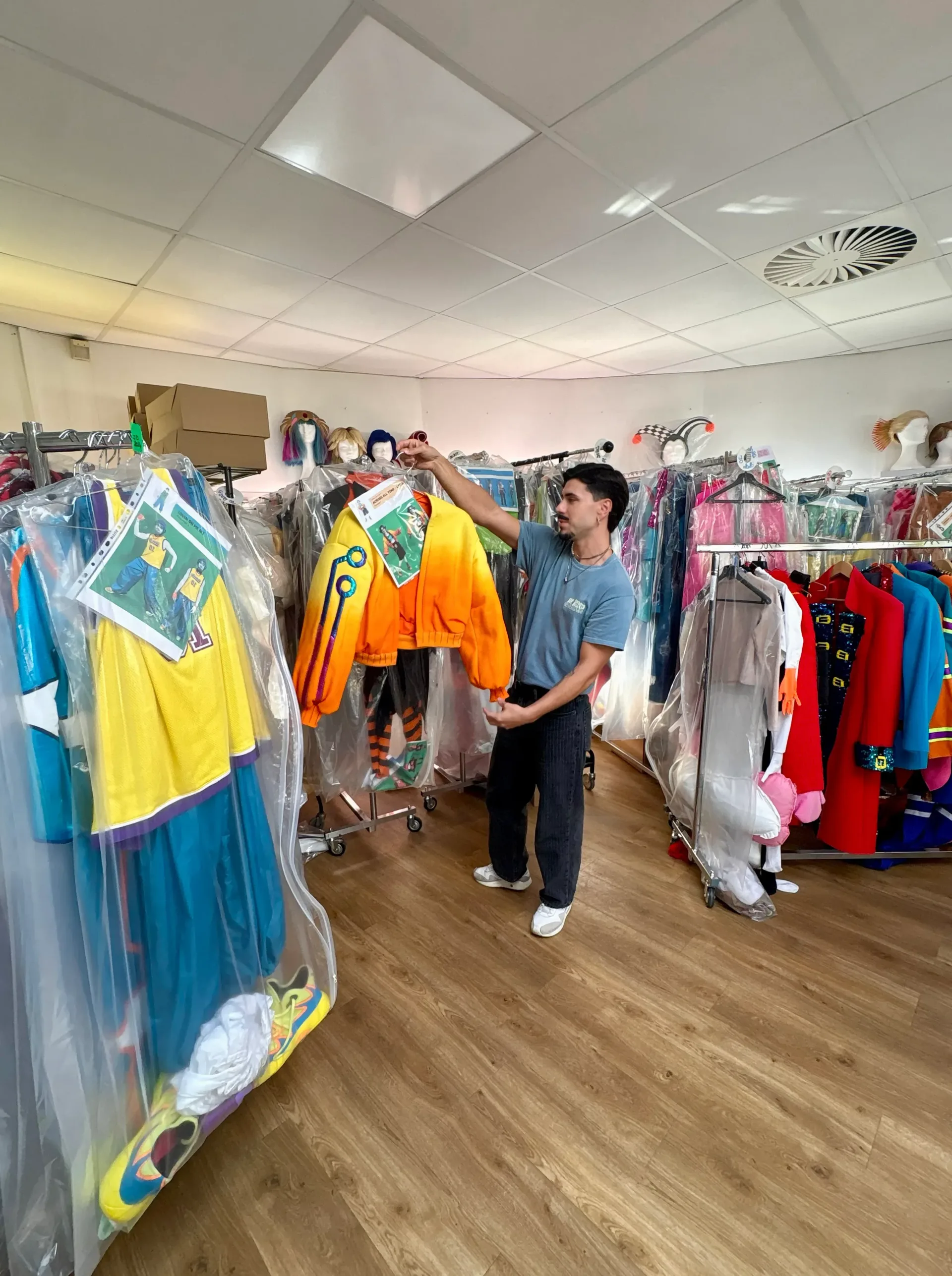
For more on how production choices shape spectacle across screen entertainment, see our look at why Just Dance keeps its costumes human-made. Wen Muyue’s film comes from a very different medium and genre, but it similarly makes craft and presentation impossible to ignore.
Cast and crew
- Director: Wen Muyue
- Screenplay: Wen Muyue, Lang Qunli and Wei Zhong
- Camera: Wang Boxue
- Editor: Liu Jinghao
- Music: Huang Chao
- Cast: Shen Teng, Jiang Qiming, Omar Sherif, Li Zhiting and Sherif Sobhy
- Languages: Mandarin, Arabic and English
- Running time: 141 minutes