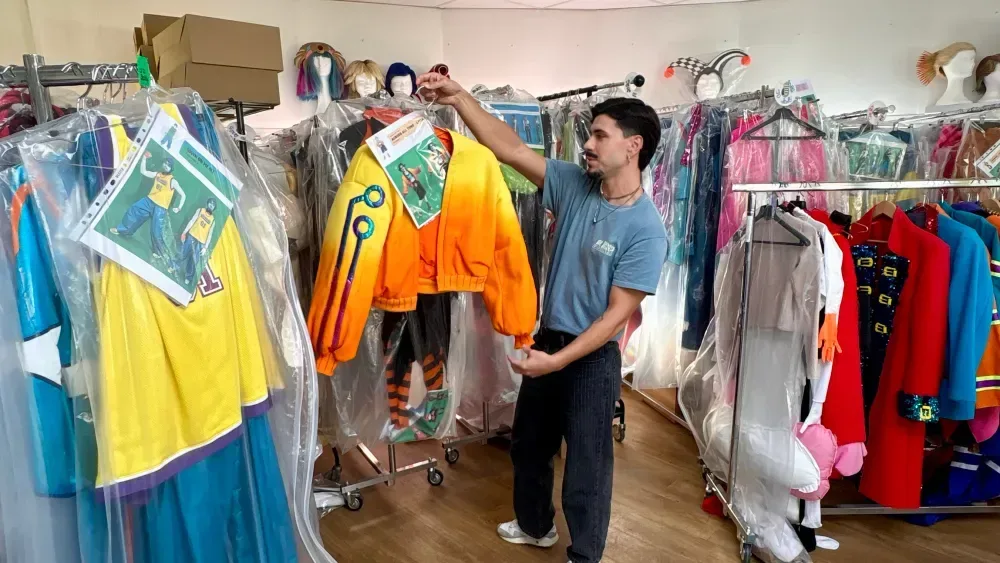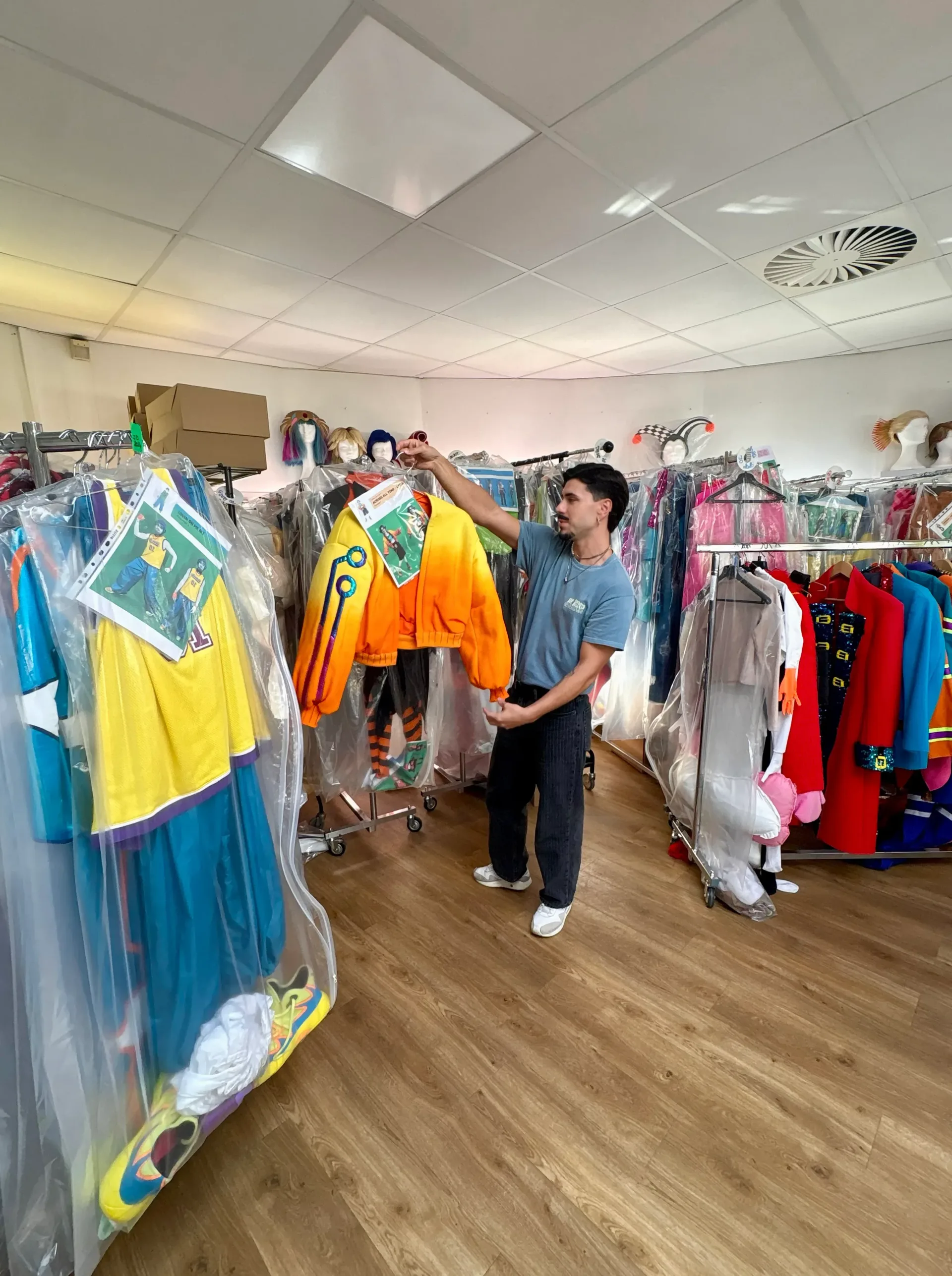
Just Dance: Decades of Hits is built around an unusually tangible part of game production: a performer puts on a real costume, gets styled with real hair and makeup, dances in front of a green screen, and becomes the on-screen coach players follow. That physical pipeline remains central to the series, with costume designer and character lead Benjamin Jouffret saying the team is committed to creating its characters without AI.
It is a meaningful creative choice because the game’s characters are not simply decorative wrappers around a track list. Their clothing, silhouettes, movement and surroundings help communicate what a particular routine is supposed to be before a player has even attempted the first move. A costume must look striking in the finished map, of course, but it must also withstand rehearsals and permit a dancer to execute choreography.
That is a much less glamorous requirement than a sparkling concept sketch, but it is the point where the design becomes a game asset rather than an image. The outfit has to work in motion. If it restricts an arm, catches during a turn, shifts uncomfortably or weighs down the performer, it can undermine the routine it was made to support.
A character starts with the song, not a prompt
The team’s process begins with a brainstorming day built around listening to the selected song and watching its music video. The creators decide whether to closely reference the performer behind the track or take a substantially different direction. That early call has consequences beyond the costume: it also shapes the map, meaning the larger combination of dancer, set, background and visual environment that accompanies the choreography.
For songs associated with major artists, recognizable nods can be especially important. Jouffret has explained that players who know an artist’s work may be looking for Easter eggs and visual connections. In practical terms, the costume department is working with fan expectation as well as color, fabric and silhouette. An artist-inspired coach has to feel connected enough to the song’s world to be satisfying, while still fitting the game’s own visual language.
The scale of a routine is decided here, too. A map may center on one performer, a pair or trio, or a larger group; some dances use as many as 10 characters. The character itself can be grounded in everyday clothing, or become something much more fantastical, such as an alien or mascot. The team also considers nonbinary characters as part of that range.
That variety makes the job closer to visual storytelling than a straightforward wardrobe assignment. A single design needs to establish a role quickly for somebody who may be seeing it only while trying to copy dance moves in a living room. Strong shapes and readable details are useful, but they cannot come at the cost of movement.
From mood board to green screen
After the opening discussion, the team creates mood boards from references including films, music videos and other media. Mood boards are curated collections of visual references: they give designers a shared shorthand for the atmosphere, styling, materials, colors and broader direction they want to pursue. The team then develops sketches and finalizes the design.
Related coverage includes Just Dance Keeps Its Costume Creation Human for Decades of Hits.
Once a concept is approved, a suitable dancer is selected from the available roster. That choice needs to serve both the character and the choreographer’s plan. It is not enough for an outfit to look right on a hanger or in a drawing; it needs to become convincing on the person performing the routine.
The stated schedule is brisk. Brainstorming takes one day, followed by roughly two to three weeks of character design and around four weeks of production. Production includes fittings, hair and makeup testing, and rehearsals. Filming itself occurs over one day.
That timeline helps explain why the design process cannot treat physical considerations as an afterthought. The team needs to identify potential issues before filming day, not discover halfway through a take that an elaborate piece prevents the performer from completing a key section of choreography. Fittings and rehearsal are therefore not merely finishing touches; they are part of validating whether the idea actually works.
“We can’t make beautiful costumes if they can’t be used by the dancers,” Jouffret said.
Why some 3D printing stays small
The production has experimented with 3D printing, but found that the material could be too heavy for dancers to wear comfortably. It is now used for smaller accessories with intricate detail rather than as a default solution for larger costume pieces.
That distinction is a useful reminder that new fabrication methods do not automatically solve costume design problems. A technique can produce a complex-looking component yet remain unsuitable for a routine requiring repeated, energetic movement. In this case, the practical test is direct: can the dancer wear it and dance well in it?
The human-centered approach also means working with specialists rather than trying to force every design through one generalized production process. The costume team collaborates with makers whose experience includes mascots, corsets and casual clothing. Each category brings different construction challenges, and each calls for different practical knowledge.
The result is a division of labor that is easy to miss after the footage is integrated into a game. Players see a polished coach and a colorful environment. Behind that image are sketching, fabrication, performer selection, testing and the accumulated expertise required to make a costume expressive without making it unwearable.
About 100 costumes for each installment
Across the Paris lead studio and its partner studio in Shanghai, the teams produce roughly 100 costumes per installment. That volume puts the commitment to handmade work in perspective. The series releases a new installment annually, so the work is not limited to a small number of showcase outfits. It is a continuing production practice across a substantial set of characters and routines.
It also leaves room for representation in casting and character work. The game has featured dancers from varied backgrounds and abilities. In a previous installment, the team worked with dancer Jana Bruno, who has one arm, in work that received recognition for diversity efforts. The detail matters because the performers are not abstract digital placeholders: their performance and presence are part of how a map takes shape.
For players, this does not mean every costume must be a literal reproduction of a pop star’s wardrobe, nor does it mean every map follows one aesthetic formula. The available evidence points in the opposite direction: the team may pursue artist references when that connection is useful, but it may also build a new concept around the music. Its work ranges from casual looks to overtly imaginary character types.
Decades of Hits adds a family thread
Just Dance sometimes returns to characters and storylines from earlier games. In Decades of Hits, a new character named Lyra is the daughter of a character introduced previously. Her storyline involves searching for her father through dance.
That continuing narrative gives the costume work another dimension. When a character belongs to an established thread, visual choices can carry continuity as well as immediate style. The new design has to function within its own routine while helping players recognize that it is part of a larger series history.
There is also a literal archive behind that history. Hundreds of costumes from the franchise’s 17-year run are stored in Paris. These are physical records of designs that players may remember only as bright figures on a screen. Jouffret has said the team would like to present them in an exhibition or runway-style event, though some items would need repair after the demands of filming.
That prospect is appealing precisely because it would reveal the gap between the final in-game image and the object used to create it. A screen can make fabric, wigs, makeup, accessories and performance feel like one seamless digital creation. The stored costumes make clear that the production is also made of garments that were cut, assembled, worn, moved in and, inevitably, put through their paces.
As game-industry conversations around AI keep expanding, Just Dance’s stance is specific rather than theoretical: its character pipeline still depends on people sketching concepts, making costumes, styling performers and filming dancers. For a dance game, that may be the most fitting answer possible. The avatar may live behind a green screen, but its outfit has to survive the dance floor first.
For another look at how game-adjacent music identities can thrive through character, design and audience anticipation, see the latest on K/DA’s returning social accounts.