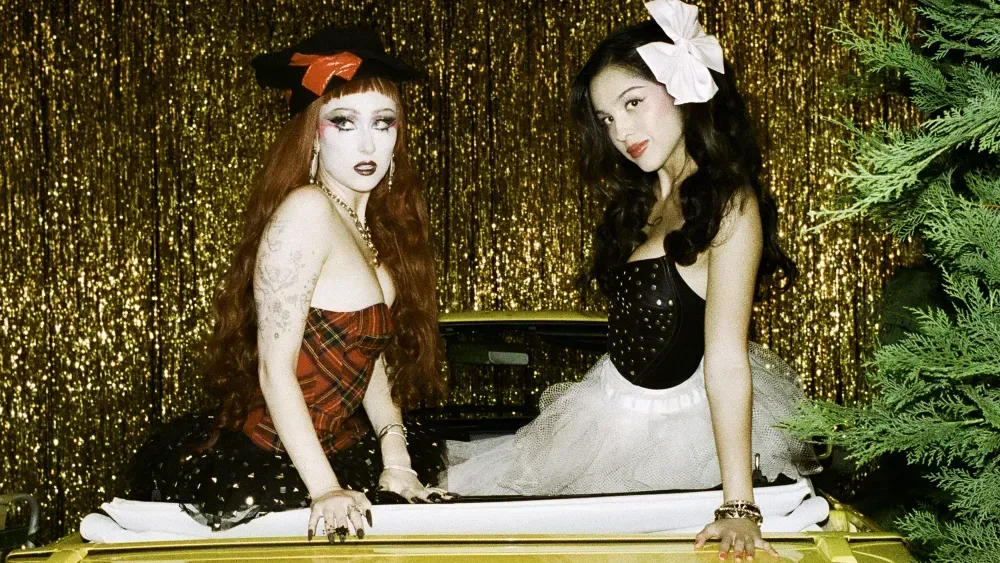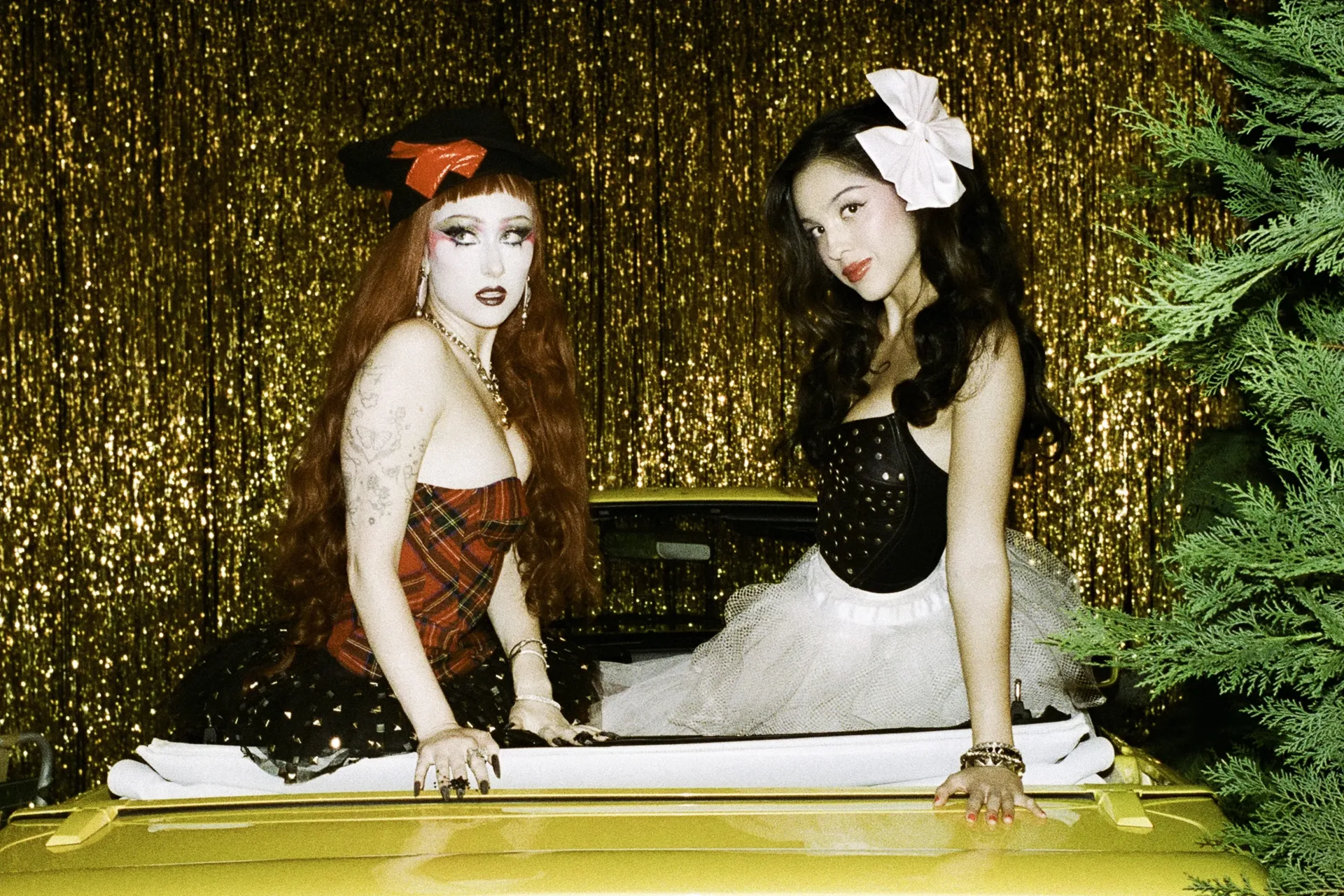
Olivia Rodrigo and Chappell Roan have taken “Expectations” somewhere pop collaborations do not often go: onto a deliberately artificial, brightly lit game-show floor. The video for the remix, directed by Bardia Zeinali, frames the pair inside a retro-TV world inspired by familiar quiz-show formats, using competition, costumes and staged television cheerfulness to give the song’s tension a visual counterpart.
It is a substantial moment for Roan, whose contribution is identified as her first-ever feature. Rather than treating that milestone as a simple guest spot, the video gives her a direct role in its central bit: a face-off with Rodrigo on a set called “Sister Squabble,” a playful spin on the family-versus-family setup associated with Family Feud. Elsewhere, the clip’s sets draw from the grid-like celebrity-panel language of Hollywood Squares.
The result is not a literal game adaptation, nor a video that appears interested in explaining rules or crowning a winner. The game-show imagery works more as a storytelling device. A song about an awkward, unresolved romantic encounter is placed in a setting built for quick answers, public judgments and performative confidence. That contrast gives the remix’s emotional uncertainty a sharper comic edge.
David Byrne hosts “Big Expectations”
David Byrne appears as Johnny Johnson, host of the video’s “Big Expectations” program. In one of the clip’s defining setups, he questions three differently dressed versions of Rodrigo, asking them, “a little bit how you got here.” The structure borrows the visual grammar of classic TV guessing games: multiple possible answers, a host directing attention and the premise that identity can be turned into a spectacle.
Rodrigo said she felt shy about asking Byrne to participate, but described him as immediately enthusiastic. She said he stayed for the full shoot, arrived with a developed character and improvised extensively as Johnny Johnson. That detail matters because the host role is more than celebrity decoration. A game-show emcee has to sell the imaginary program’s internal reality, and an actorly performance helps the video’s collection of parody sets feel connected rather than simply decorative.
Byrne’s appearance also helps establish the clip’s knowingly theatrical tone. The video is not chasing realism; it is interested in the old-screen idea of entertainment as a polished public contest. Every contestant, host and set exists under an implied studio gaze. For a song whose premise involves an interaction that did not receive a clean ending, that forced public clarity is the joke.
What Roan adds to the remix
Roan’s newly added verse is the remix’s key musical change. Its narrator describes taking someone to a concert, reading intimacy into the moment and then being left waiting after a promise of a later call. The last detail—three weeks passing—is delivered with a pointed assessment of “Classic L.A. behavior.” It is a compact scene, but it gives Roan a distinct perspective rather than having her merely echo Rodrigo’s role in the song.
A remix can mean several things in pop music. It may alter a song’s beat, rearrange its structure, feature a new performer or combine all of those approaches. Here, the supplied details center on a newly written Roan verse and a visual concept designed around the pair’s shared presence. The remix therefore functions as a collaboration with a narrative exchange at its core: Rodrigo and Roan are not simply adjacent voices, but competitors in the video’s invented TV universe.
Related coverage includes Olivia Rodrigo and Chappell Roan Enter Retro Game-Show World for ‘Expectations’ Remix.
Roan has said the song appealed to her because it puts a difficult concept inside a pop format. That observation explains why the collaboration has a clear fit beyond shared audiences. The verse is conversational and specific, yet it is carried by a format built for memorable phrasing. The video leans into the same balance: uncomfortable emotional detail dressed in the big, approachable language of a game show.
Why the game-show premise fits the song
Game shows are useful shorthand because their conventions are instantly understandable. There is an audience, an authority figure, a prompt, a response and an implied right answer. Even when a video only references those elements rather than reproducing an actual program, viewers understand the stakes in seconds. “Sister Squabble” can establish Rodrigo and Roan as rivals without a long introduction because the format does the explanatory work.
That makes the concept especially effective for a remix featuring two singer-songwriters. Their characters are put into a scripted competitive structure, but the song material deals in ambiguity: a date, attraction, silence and the inability to secure a straightforward explanation. The retro set promises resolution while the lyric refuses it. That friction is the video’s most useful idea.
The visual approach also avoids pretending that nostalgia is historically exact. The sets are explicitly inspired by older game-show touchstones, and Dan Nigro’s late appearance with an oversized 1990s-style brick phone extends the broad period-play rather than pinning the video to one precise decade. The phone is an exaggerated prop, a recognizable symbol of an earlier communications era and an apt accompaniment to lyrics about a call that never comes.
Dan Nigro’s small but meaningful cameo
Nigro appears near the end of the video holding that large phone. He produced “Expectations” and the parent album, You Seem Pretty Sad for a Girl So in Love, and he has also worked with both Rodrigo and Roan on their albums. His cameo makes the video’s creative overlap visible without shifting focus from the two performers.
In practical terms, a shared producer can provide continuity when artists with established individual styles join for a remix. That does not mean a producer makes two artists sound identical; rather, the producer is part of the team translating a collaboration into a finished recording. Nigro’s presence in the video becomes a light visual acknowledgement of that behind-the-scenes role.
For listeners interested in the larger conversation around pop authorship and artistic intent, the discussion has continued across contemporary music coverage, including A$AP Rocky’s comments on the ambitions behind “Don’t Be Dumb”. Rodrigo and Roan’s remarks focus less on awards or market positioning than on the appeal of lyric-driven pop, but both cases underline how artists publicly frame the purpose behind their releases.
A collaboration built on an existing connection
The pairing did not come from nowhere. Roan previously supported Rodrigo on both the Sour and Guts tours, giving the artists a professional history before this first feature. Roan also appeared at Rodrigo’s Daisy Chain Fields Festival in late August, on an all-female lineup that included Doechii, Rachel Chinouriri, Garbage and the Breeders.
That background helps the collaboration feel deliberate rather than opportunistic. Touring support is a demanding environment in which artists and their teams share stages, audiences and schedules; a feature arriving after those earlier connections carries a different weight from a completely unexpected meeting of names. The game-show frame makes the artists look like adversaries for a few minutes, but the real context is a longer creative association.
More performance than competition
Ultimately, “Expectations” uses the language of rivalry to make room for two complementary performances. Roan and Rodrigo contend with one another in “Sister Squabble,” while Byrne presides over the broader TV fantasy and Nigro gets the final prop-based wink. Each cameo and set supports the same central idea: emotional complications become absurdly visible once they are placed under game-show lights.
For a first feature, Roan’s role is neither hidden nor ornamental. She gets a new verse, a clear on-screen counterpart and a concept that lets her play against Rodrigo without requiring the song to become an actual contest. The title’s “expectations” are made literal in the video’s fictional programming, then gently undermined by the song’s unresolved human story.