Pablo Larraín’s My Sad Dead is a ghost story in which the ghosts are not simply an intrusion from another realm. They are part of the neighborhood’s daily weather: screaming in rooms, stumbling through familiar spaces, repeating the violence that killed them and making it impossible to pretend the past has been buried. That basic idea gives this sprawling Argentine-Chilean film an enormous emotional and political range. It is mournful, grotesque, mordantly funny and unusually alive to the ways a place can shape the people trapped inside it.
At 186 minutes, the film has room to accumulate encounters, tragedies and seemingly peripheral lives without converting them into tidy plot mechanics. Its setting, the Piedrabuena housing projects in Buenos Aires, is not a generic haunted building. The architecture and the social conditions around it are central to the movie’s meaning. The cluster of octagonal apartment blocks surrounding a looming water tower creates an environment that feels imposing rather than communal. People live close together but remain separated, and the result is a modern Gothic where concrete does not keep horror outside; it appears to preserve it.
Ema has heard the dead for a long time
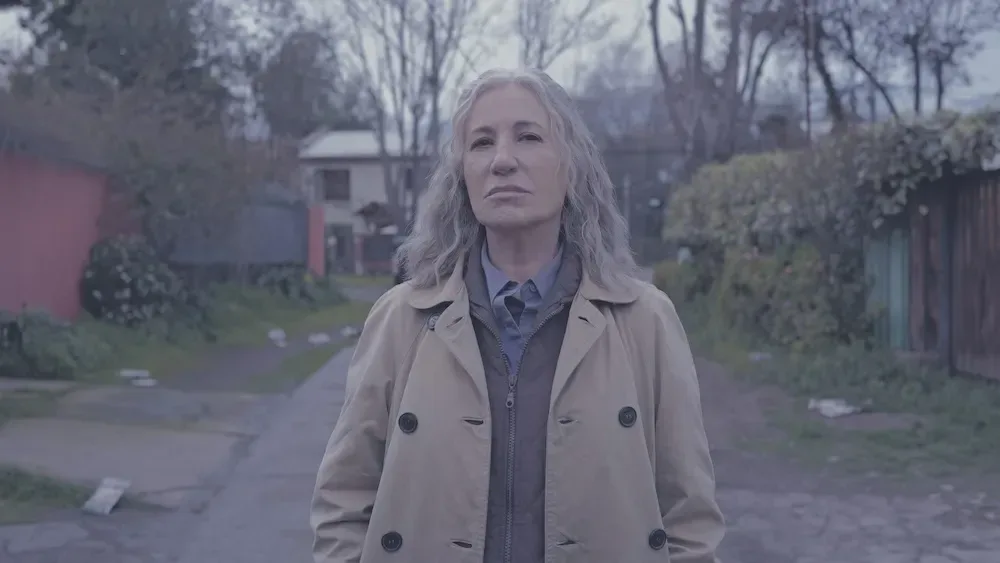
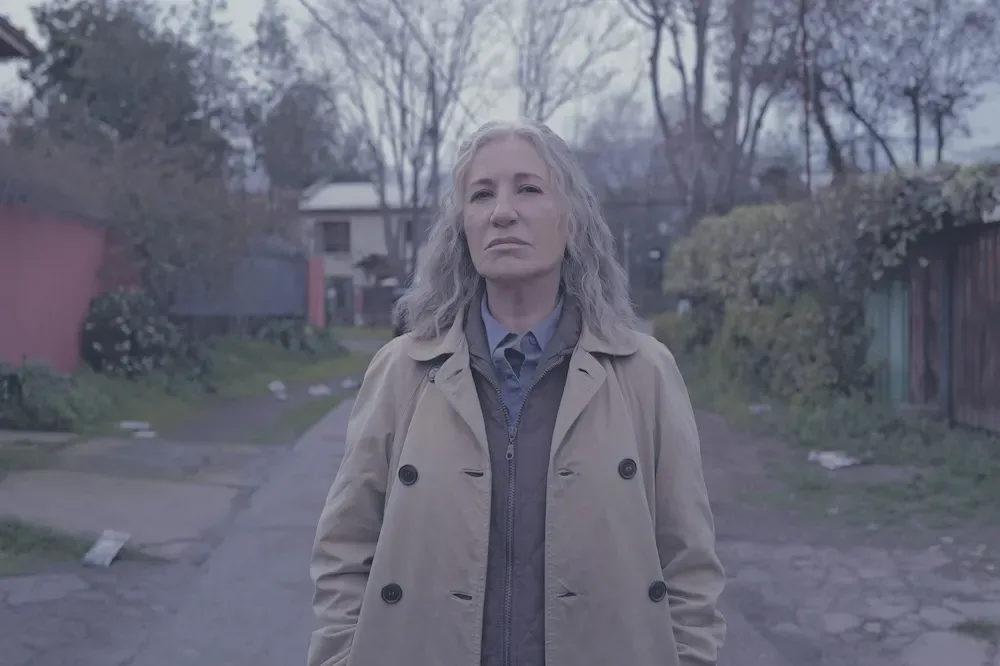
Mercedes Morán plays Ema, a retired doctor who has returned to Piedrabuena to care for her dying mother. Ema has an apartment elsewhere in the city that she intends to rent out, but family obligation draws her back to the house beside the projects. Her mother’s death establishes the movie’s uneasy rules: the dead return, though not as simple resurrections. They appear as faded, semi-opaque versions of themselves, tangible enough to recognize and disturbing enough to never mistake for the living.
Ema is able to hear them before almost anyone else can. More importantly, she is exhausted by that ability. This is not a protagonist thrilled to have been selected by the supernatural, nor is she a detective eager to use ghosts as witnesses. Morán’s performance is built around dry, weathered restraint. Ema’s wit and flashes of amusement do not erase the weight she carries; they show the survival skill of someone who has lived too long beside pain that others refuse to acknowledge.
That refusal has a personal as well as public dimension. There are hints around Ema’s forced retirement from medicine, tied to an ethically fraught decision involving COVID treatments. The details are not positioned as a courtroom-style case for the viewer to resolve. Instead, they deepen the sense that Ema is already someone acquainted with impossible choices, institutional judgment and the uneven allocation of care. She is not a saintly medium. She is a difficult, worn-down person whose compassion survives in incomplete, practical forms.
A supernatural premise that rejects procedural answers
The film’s ghosts often bear evidence of how they died. Some are badly wounded; others replay their last moments as if caught in a loop. Their behavior can seem childlike, confused and unable to accept an ending that arrived too violently. This makes the haunting less about jump scares than unfinished experience. Death has occurred, but understanding has not.
That distinction matters because My Sad Dead resists the familiar supernatural-procedural structure. A procedural is a story format in which a recurring problem is investigated, explained and usually resolved—think of the basic rhythm of a case-of-the-week show. Larraín’s film pointedly does not use Ema to solve murders, identify culprits or hand out moral closure. The dead do not arrive to make the world fairer. Their presence instead reveals a community that has learned to live beside suffering, neglect and violence by looking away.
When a problem with the local water supply means the rest of Piedrabuena begins to hear what Ema hears, the shift is not treated as a clever invitation to solve a paranormal mystery. It is a crisis of collective recognition. Gunshots, screams and pleas that previously went unanswered can no longer be edited out of daily life. The supernatural device becomes a brutally literal version of buried social memory rising to the surface.
Related coverage includes ‘My Sad Dead’ Turns Buenos Aires Into a Living Nightmare.
Julia turns the film’s morbidity into something stranger
Ema’s estranged sister Lidia, played by Alejandra Flechner, arrives from Seattle with her husband and teenage daughter Julia, played by Carolina Álvarez. Julia is isolated, stigmatized and at risk of being institutionalized by parents who do not know what to do with her. Ema recognizes that Julia shares her capacity to commune with the dead, but Julia’s response is radically different.
Where Ema is defensive and fatigued, Julia seeks intimacy with the spirits around her. The film approaches this through explicitly unsettling sexual situations, yet does not reduce Julia to a crude provocation. Her behavior is tied to loneliness, desire, exclusion and a relationship with the dead that feels more immediate than her relationship with the living. The material is deliberately uncomfortable, but its purpose is broader than shock. It brings the film’s central contradiction into focus: a story about the non-corporeal is intensely concerned with bodies—their appetites, wounds, illness, decay and the ways other people judge them.
Body horror is therefore only one component of the film’s design. In the horror genre, body horror uses physical transformation, injury or deterioration to provoke disgust and fear. My Sad Dead certainly contains gruesome images, including corpses marked by violent death and decomposition rendered with startling attention. But its physical imagery has a mournful quality as well. Decay is not merely a gross-out detail; it becomes part of the film’s visual language for time, abandonment and mortality.
Piedrabuena is more than a backdrop
The movie’s most powerful idea may be that a neighborhood can be haunted by its own design. Piedrabuena’s tower blocks and central water tower are filmed as stark geometry, at once monumental and imprisoning. The residents have occasional meetings in a disused recreation center, yet these gatherings do not build solidarity. They collapse into rage at immigrants, drug users, crime and calls for vigilantism. Fear moves sideways, toward convenient targets, rather than upward toward the systems that have left the community neglected.
That is where Larraín’s use of urban architecture becomes especially sharp. Brutalism is often used loosely to describe large, concrete-heavy buildings, but in this film the term matters less as an architectural label than as a feeling. The housing complex is presented as a hard, alienating structure that limits connection and gives resentment somewhere to echo. Its residents are not treated as monsters, but the movie does not romanticize their anger either. It shows what happens when insecurity becomes a politics of punishment.
Several side stories make that argument concrete. A failed burglar dies after a fall. Teenagers are caught in gang violence. A young worker conceals a dangerous dog bite because missing work is unaffordable. Each event is disturbing on its own, but together they reject the notion that every death is a singular freak occurrence. Piedrabuena’s ghosts are a population shaped by precariousness. The film’s horror comes from realizing how often preventable suffering is normalized until it becomes background noise.
A muted visual palette makes life and death share the frame
Cinematographer Sergio Armstrong gives the film a low-contrast palette that washes scenes in pale pinkish-gray tones. It is an apt choice for a story in which living bodies and spectral presences occupy the same domestic and communal spaces. The dead are visible without the need for flashy effects, and the image does not make the living look especially healthy by comparison. Everyone shares a kind of drained pallor.
This visual approach is crucial to the movie’s modern Gothic mood. Gothic storytelling traditionally finds dread in spaces that refuse to stay in the past: old crimes, family trauma, death and repression return to disturb the present. My Sad Dead relocates that sensibility to contemporary Buenos Aires, high-density housing and public neglect. It is not interested in cobwebbed mansions or aristocratic curses. Its haunted house is a whole community, and its inherited damage is economic, social and intimate all at once.
The cinematography also supports the film’s patience. Larraín gives scenes room for texture, awkwardness and observational detail rather than rushing to turn every appearance of a ghost into a scare. That is why the long running time feels connected to the material rather than merely ornamental. The film’s side characters and incidents form a mosaic. No individual story offers a complete explanation of Piedrabuena, but their accumulation makes the place legible as a lived-in system of pressure.
For viewers building a setup for visually detailed films, screen placement and listening position can meaningfully affect how a dense, low-contrast image and layered soundscape read at home. Our guide to home theater speaker height explains why aligning speakers with seated ear level is a useful baseline. That practical point will not make a deliberately bleached image brighter, but it can help preserve dialogue and ambient detail in a movie whose atmosphere depends on what seems to be murmuring at the edges of a scene.
Grief without easy consolation
The screenplay credits Larraín, Anastasia Ayazi, Guillermo Calderón and Mariana Enriquez, drawing on Enriquez’s short story “My Sad Dead” and other writings. The resulting film holds several registers together: bleak social satire, family estrangement, supernatural horror, oddball comedy and compassionate grief drama. That combination could easily become unruly, yet its contradictions are the point. The comedy does not cancel the sadness, and the grotesque does not prevent moments of beauty.
Morán is the anchor that makes those shifts believable. Ema may be unusually capable of soothing or distracting a disoriented ghost, but she cannot repair every death or undo the conditions that produced it. The film treats that limitation honestly. It offers neither a heroic savior nor a final cleansing of Piedrabuena. What it does offer is attention: to the dead who are ignored, to the living who are pushed aside, and to the corrosive consequences of treating both as disposable.
My Sad Dead ultimately finds an unlikely lift in its refusal to separate sorrow from vitality. To grieve the dead is also to register the value of being alive. Larraín turns that simple, difficult idea into a strange and startlingly physical work of cinema—one where a community’s unprocessed pain becomes visible, audible and impossible to politely leave behind.