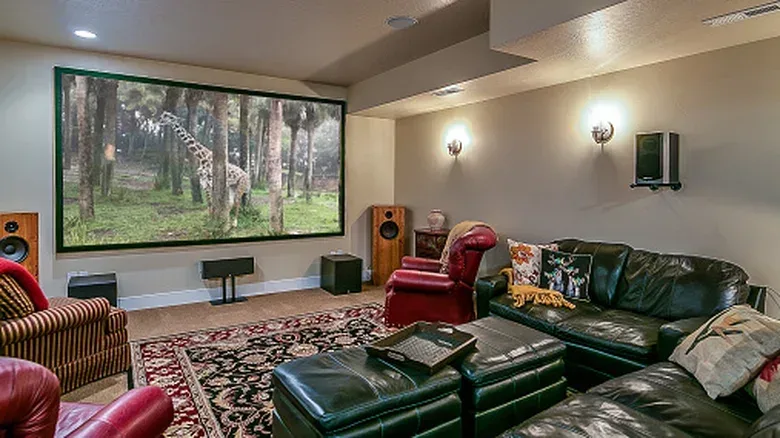
A home theater can be expensive, carefully chosen and perfectly capable of shaking a shelf—yet still make movie dialogue feel oddly distant. One of the simplest reasons is speaker height. For the front left, center and right channels, “too high” generally means the speakers sit well above the listener’s ears while they are seated.
The practical baseline is straightforward: create as direct and level a route as possible between the speakers’ high-frequency drivers and the main listening position. It is not a decorative rule, and it is not an instruction to put every speaker at exactly the same height. Different channels do different jobs. But for the speakers responsible for most dialogue, musical detail and screen-focused action, seated ear level is the target worth working from.
That distinction matters for games as much as films. A system may still deliver plenty of volume when its main speakers are mounted high on a wall or perched at the top of a unit. The issue is not whether sound arrives at all. It is whether the information that makes a mix feel intelligible and located—speech, cymbal detail and effects meant to appear in front of the player—arrives with enough directness and separation.
Why height changes what you hear
Sound from the main front channels contains a large share of a soundtrack’s important detail. The left and right front speakers handle music, action and much of the broad soundstage. The center channel is especially important for dialogue. These speakers are generally forward-firing, and their higher-frequency output is more directional than bass.
Directional here means that aiming and placement matter more. When a speaker’s high-frequency output is pointed over a seated listener’s head, the system can remain loud while fine detail seems less explicit. Dialogue may sound less direct, cymbals can lose definition, and positional cues may feel less firmly connected to the screen.
This is why a pair of bookshelf speakers placed at the highest available point can be a frustrating compromise. Their output does not disappear, but the richer details can seem muted compared with the same speakers moved down closer to ear height. A direct path to the ears is the basic goal; it is also why a speaker’s aiming direction matters after its mounting height is chosen.
There is no single universal measurement for ear height because people, seating and furniture differ. The usable method is simply to sit in the primary chair or couch position, identify ear level there, then place or aim the relevant speakers as close to that level as the room allows. The listening position—not standing height and not the top edge of the television—is the reference point.
The front stage: left, center and right
The front stage is the group of speakers across the front of a setup: left, center and right. Treat these as the priority when compromises are unavoidable. They do the bulk of the work for dialogue, music and on-screen action, making them the least suitable candidates for a very high installation.
Related coverage includes How High Should Home Theater Speakers Be? Placement Rules That Protect Detail.
Front left and right speakers
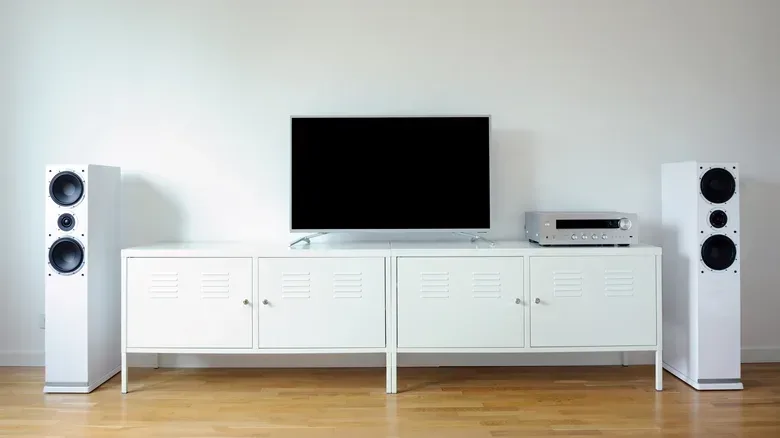
Place the left and right speakers so their high-frequency drivers are near seated ear level and directed toward the main seat. High-frequency drivers are the parts of a speaker that reproduce the finer, higher-pitched information in a soundtrack. Keeping those drivers near ear level gives the listener a clearer, more level line to the information that helps define speech and effects.
This does not mean every room will permit a laboratory-perfect arrangement. A television stand, shelves, windows and furniture layouts can all force tradeoffs. The useful priority is not perfection; it is avoiding a placement where the speakers are substantially above the people meant to hear them. Move in small increments, listen from the primary seat and keep the more successful position.
The center channel
The center speaker should sit as close as feasible to the height of the left and right speakers, though it does not need to match them with absolute precision. Real living rooms commonly put a center channel beneath the TV. When that is necessary, tilting it slightly upward toward the listener is a practical correction. The purpose is the same as with the other front speakers: aim the sound at the seated audience rather than sending it past them.
Because dialogue is such a central part of film and television mixes, a misplaced center channel can be particularly noticeable. Before treating unclear speech as a volume problem, check the physical relationship between the center speaker and the seating position. Raising dialogue volume does not recreate the directional clarity lost when the speaker fires away from the listener.
Surround speakers can sit higher—but not indefinitely
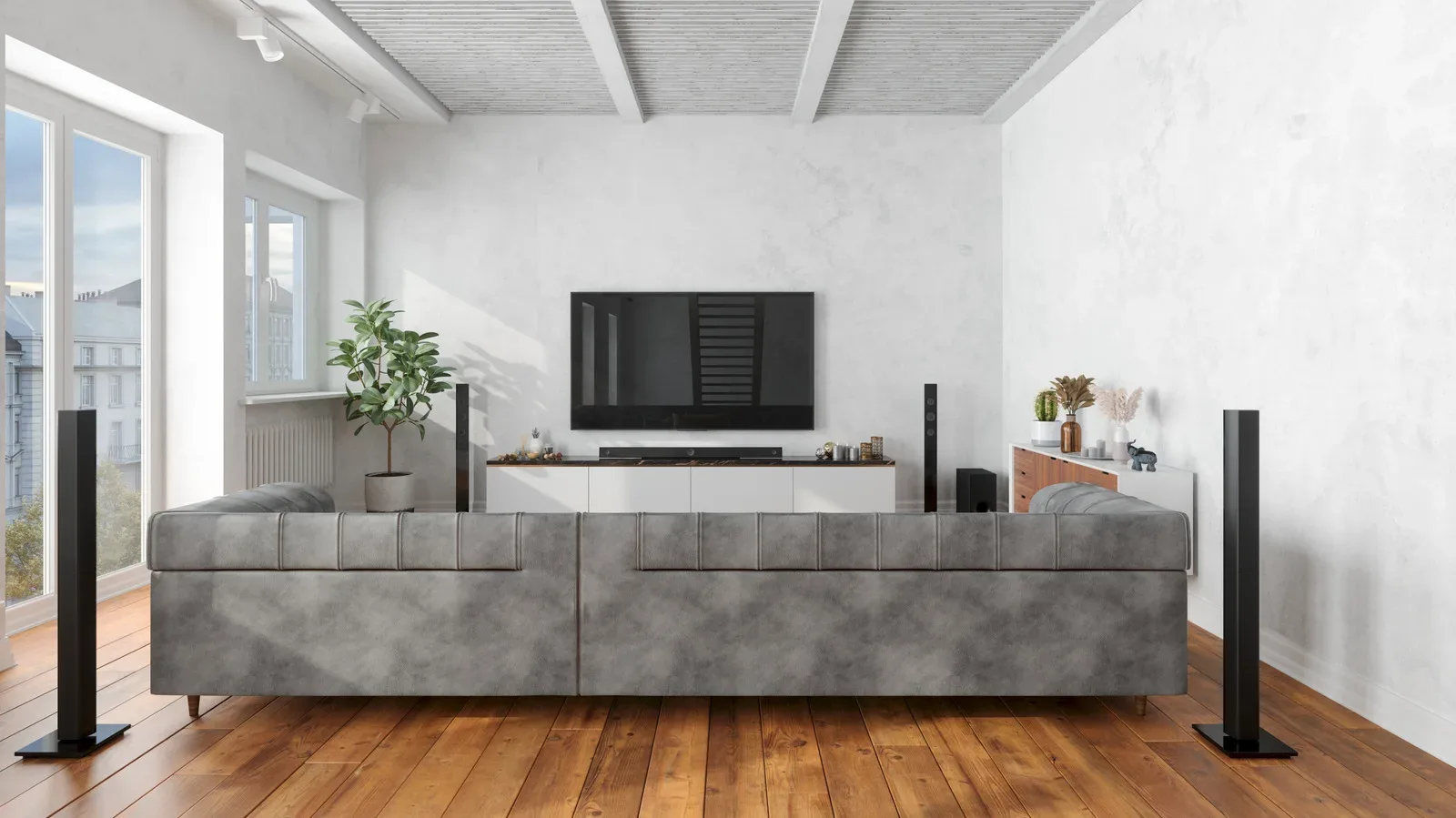
Surround channels have more vertical flexibility than the main front speakers. They can be installed above seated ear level, by roughly two or three feet. That added height can make sense around a couch or in a room where side and rear placement is constrained.
However, flexible does not mean limitless. Raise surround speakers too far and the distinction between side or rear effects and overhead effects begins to blur. The result can make effects seem as though they are rolling from the ceiling rather than occupying positions behind or beside the listener.
That separation is especially useful in games where the mix is communicating motion around the player. The aim is not merely to hear an effect; it is to preserve the impression that it came from the intended direction. If a surround channel is so high that it starts acting like an overhead speaker, that directional organization is weakened.
It is also important not to confuse conventional surrounds with upward-firing or height-oriented speakers. Upward-firing designs are intended to bounce sound off the ceiling, so their operating idea is fundamentally different from a forward-firing surround speaker. The seated-ear-height rule for front speakers should not be imposed blindly on every speaker type.
Why the subwoofer is the big exception
A subwoofer handles low-frequency sound, including bass-heavy effects. Low frequencies are much less sensitive to vertical aiming than the detailed, directional output from front and center speakers. That is why floor placement is normal and entirely appropriate for a subwoofer.
Still, “the floor is fine” should not be mistaken for “any floor position is identical.” A subwoofer’s location within the room has a substantial effect on the bass that reaches the seating area. One spot can produce more noticeable buildup or dips than another. In other words, height is not the main concern with a subwoofer, but placement remains a major one.
This difference is useful when planning a room. Do not spend the same effort trying to bring a subwoofer to ear level as you would on the front speakers. Instead, reserve the height-focused work for the channels where directionality and fine detail are at stake, then assess bass as its own room-placement problem.
Place the seat before treating speaker distance as final
Speaker positioning is not only about where the cabinets go. The main listening seat is part of the system. Two simple room-layout guidelines can provide a starting point in a rectangular room: the 38 percent rule for the primary seat and the 83 percent rule for the gap between front speakers.
The 38 percent rule begins at the front wall, where the TV and front speakers are located. Measure from that wall to the back wall, then put the primary listening position about 38 percent of that total room length away from the front wall. In a room measuring 20 feet front to back, that works out to roughly 7.6 feet from the front wall.
The logic is to avoid sitting directly in the middle of the room, where bass buildup and dips can be more noticeable. It is a starting point rather than a promise. Irregular room shapes, unusual furniture arrangements and practical living-space needs can all make an exact result impossible or less useful.
Once the seat is set, use the 83 percent rule as a check on front-speaker spacing. Measure the distance from the main seat to the midpoint between the left and right front speakers. The distance between those two speakers can start at about 83 percent of that measurement. If the main seat is 10 feet from that midpoint, begin with the speakers around 8.3 feet apart.
Neither number is a height instruction. They are distance guidelines intended to establish a sensible baseline for a rectangular room. After those distances are established, return to the separate job of setting the front speakers’ high-frequency drivers near seated ear level and aiming them toward the main seat.
A practical order for rearranging a system
Trying to solve every placement issue simultaneously makes it hard to know which adjustment helped. A more useful approach is to make the foundational decisions first, then refine.
- Choose the primary listening position. In a rectangular room, test the 38 percent position as a baseline rather than automatically sitting in the exact center.
- Set the front left and right spacing. Use the 83 percent check as a starting point, based on the distance from the seat to the midpoint between the speakers.
- Bring the front speakers toward seated ear level. Focus on the high-frequency drivers and a direct path to the main seat.
- Align and aim the center channel. Keep it near the front-speaker height where possible; if it must sit below the TV, angle it upward toward the listener.
- Place surrounds with restraint. They may sit two or three feet above ear level, but not so high that their effects become indistinguishable from overhead sound.
- Evaluate the subwoofer separately. Floor placement is typical, while its precise position can still materially change bass response.
- Make incremental adjustments. Rooms and furniture create exceptions, so small changes around this baseline are more meaningful than assuming one formula fits every space.
What this means for a gaming room
The most useful takeaway is not that every setup needs renovation. It is that speaker role should guide compromise. If a room forces one speaker to sit less than ideally, avoid making the front stage the sacrifice whenever possible. The front channels carry the detail that keeps dialogue understandable and puts action where the screen says it is. Surrounds tolerate some added elevation, while a subwoofer does not need to face the listener at all.
This also clarifies why a setup can feel underwhelming despite having enough power. Volume and clarity are not interchangeable. Turning up a system whose front speakers fire over the listener can deliver more sound without restoring the direct high-frequency detail that better placement preserves.
For people rebuilding an entertainment corner that also includes smart hardware, basic device housekeeping can be a separate task from acoustic positioning; this guide to resetting a Google Home Mini, Nest Mini or Nest Hub covers the button side of that work. The acoustic side starts more simply: sit down, look at where the front speakers are actually aimed, and make the direct route to the ears the priority.
Use the percentage rules and height guidance as a well-grounded first pass, not an inflexible verdict. A room with unusual dimensions or furniture may need exceptions. But if dialogue feels detached, fine effects lack definition or the surround field seems to have migrated to the ceiling, speaker height and aim are among the first physical variables worth correcting.