Resident Evil spoilers follow.
One of the strangest creatures in Zach Cregger’s Resident Evil has a surprisingly human starting point. The movie’s main stalker mutation—widely nicknamed the “Katamari Monster” by fans—was ultimately realized with computer graphics, but its unnerving movement was first explored by a connected group of stunt performers crossing a soundstage together.
Videos shared by Czech Republic-based performer Jakub Hudlicky show him and several fellow stuntpeople wearing vests and physically linked into a compact, moving formation. The group works its way across the floor as a single lurching unit, an experiment intended to answer a deceptively difficult monster-movie question: how does a creature made from a tumbling cluster of limbs actually move with enough purpose to pursue someone?
The answer was not simply “animate something creepy.” The performers gave the creature a bodily logic. Their shared weight, restricted spacing and coordinated effort create the impression of an unstable mass constantly having to negotiate its next step—or, in this case, its next roll. That work helped inform the digital creature that appears in the finished film.
A fan nickname that explains the monster
The “Katamari Monster” name is an informal fan label, not a formal character name supplied here. It makes immediate sense for anyone familiar with the Katamari games: the mutation’s tentacle-like elements reach toward infected bodies and incorporate them into an expanding sphere of arms and legs. It then rolls through Raccoon City as a gruesome, infection-fuelled counterpart to the rolling ball at the center of those games.
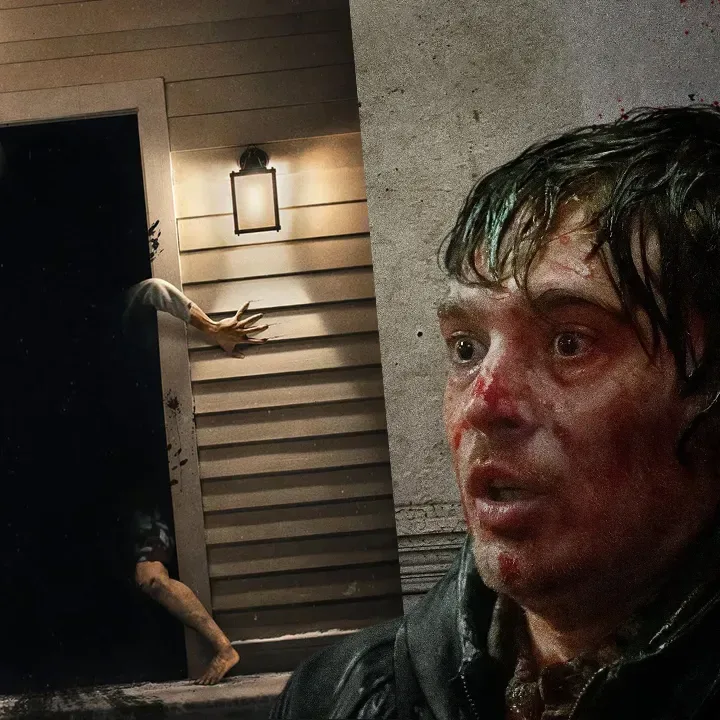
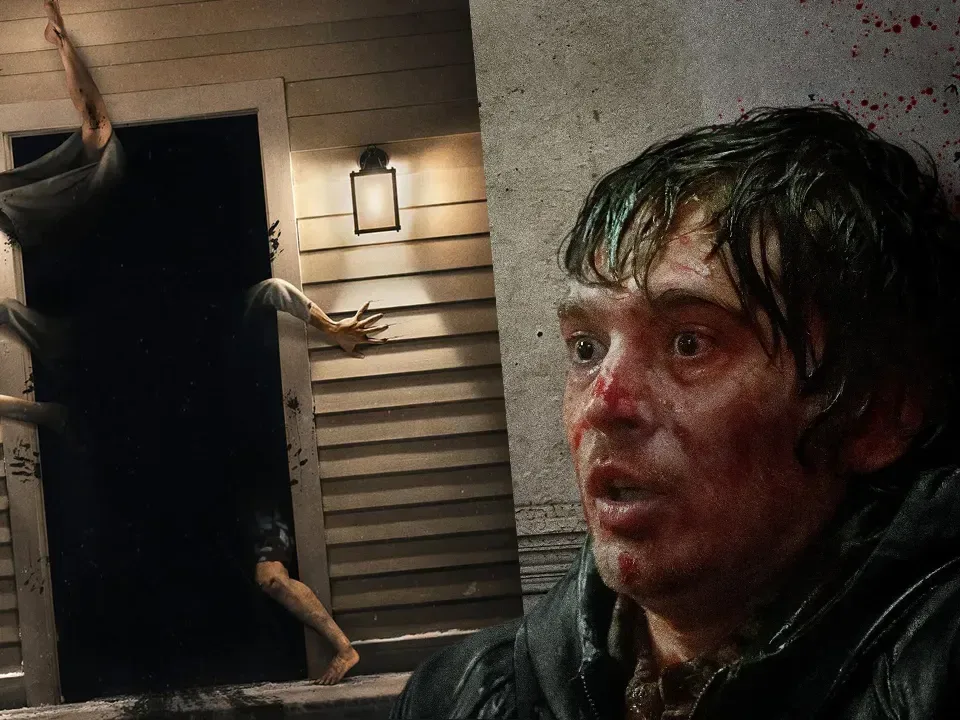
The comparison is funny because it is so visually clear, but the film’s creature is built to be alarming rather than playful. Its anatomy is defined by accumulation. Instead of one recognizable body moving through space, it is a combined mass whose parts create the sense that it could snag, pull in or run over anything nearby. Giving that mass a convincing locomotion is especially important when it functions as a stalker monster chasing Bryan through the city.
In film-effects terms, locomotion means the way a character or creature gets from one place to another: its gait, balance, force, acceleration, turns and stops. A human walk contains countless cues viewers understand instinctively. A creature made of interconnected infected bodies has no familiar natural reference point. The stunt-team exercise supplied one.
The performers were reference, not the final screen image
Hudlicky said the footage of the performers was not itself used in the finished movie. Rather, the group’s movement “kinda mimics” how the CGI version moves. That distinction matters. The videos are not evidence that the screen creature was a wholly practical effect, nor do they erase the substantial digital work involved in modeling and assembling its final form.
Related coverage includes Resident Evil's 'Katamari Monster' Used a Team of Stunt Performers to Find Its Horrifying Movement.
Instead, they show a collaborative bridge between physical performance and CGI. The stunt team created a tangible movement study; artists and animators then used that study as useful information while crafting the monster audiences see. The finished effect is digital, but it is informed by people dealing with a real shared physical problem in a real space.
This kind of reference work can be valuable because it preserves details that are easy to overlook when a creature is imagined only as a digital model. How quickly can the mass turn? Does one side lag behind another? What happens when several performers must maintain momentum while tethered together? Where does the apparent force of a roll come from? Even when the final creature can do things no person or stunt rig could safely reproduce, physical exploration can give the animation a starting rhythm.
The stunt videos were filmed in July 2025, when the performers gathered to work out the creature’s chase movement. The result is a useful reminder that “CGI” does not describe a single all-purpose process. Computer-generated imagery covers the digital construction and animation of an image, but it can draw on many forms of input: sketches, models, motion studies, performance reference and the practical expertise of stunt teams. In this case, the visible monster is computer-generated while its foundational motion was developed through an ensemble physical performance.
Why the behind-the-scenes footage is so effective
The clips are compelling partly because they reveal the practical challenge beneath a visual-effect spectacle. A polished screen monster can look frictionless: it rushes forward, rolls as a coherent shape and behaves as if its impossible anatomy has always made sense. A group of people strapped together removes that illusion. It makes the coordination visible.
That visibility also clarifies why the final motion feels different from a conventional single-character run. Multiple performers have to respond to one another. Their formation has a center of mass, awkward edges and limits on independent movement. Those constraints offer a credible visual language for a creature whose parts are not fully unified. The monster’s rolling horror is therefore not only a matter of digital texture or anatomy; it is rooted in collective timing.
There is an appealing contradiction at the heart of it. The creature is designed as a grotesque loss of individuality—a living pile of bodies—yet the movement reference required several individuals to collaborate carefully. What appears on screen as biological chaos began with performers finding a repeatable route across a soundstage.
For viewers interested in how effects-led horror is assembled, that distinction is more useful than framing practical and digital techniques as rivals. The available evidence points to a hybrid workflow: stunt performers tested the motion, while CGI artists and animators transformed that motion into the film’s fully realized mutation. Neither half alone describes the whole result.
The creature’s role in Cregger’s Resident Evil
The “Katamari Monster” has become a focal point of conversation because it is a new mutation in a franchise already associated with an extensive range of zombies and bio-organic horrors. Its design draws attention not just for its appearance but for the fact that it has a specific pursuit behavior: it rolls through Raccoon City in pursuit of Bryan. A stalker creature needs to communicate danger before it arrives, and its unusual movement helps establish that threat.
That design approach fits a survival-horror framework. The fear is not merely that an enemy exists, but that it can close distance in a way that is difficult to predict or comfortably categorize. A rolling collection of limbs does not offer the neat visual read of a familiar humanoid pursuer. Its body suggests that its direction, speed and reach may change as it moves.
The production insight also arrives alongside another detail about the movie’s construction. Cregger has said its ending was not the original conclusion he wrote. He described the version filmed as a contingency plan meant to preserve the stakes to the end, shifting the dramatic impulse from an earlier “kill them all” approach toward “save him, save him.”
That revelation and the stunt footage concern separate parts of the film, but together they underline how much revision and problem-solving can be involved in making a horror feature. The ending was reconsidered to sustain tension. The monster’s locomotion was physically investigated so its digital version could chase convincingly. Neither detail makes the film less authored; each shows authorship as a process involving options, experiments and contributions from specialists.
What the footage says about creature performance
It is tempting to treat performance in a creature feature as something reserved for a face, a voice or an actor in a recognizable suit. The stunt exercise suggests a broader definition. Here, performance includes the shared mechanics of several bodies attempting to move as one. The performers are not supplying a direct one-to-one portrayal of the completed monster, but they are supplying behavior: strain, rhythm, collision, imbalance and propulsion.
That is particularly relevant to a creature described as a mass of collected arms and legs. Its horror depends on the audience believing the mass has force. If it floated smoothly, it might look detached from the material bodies that form it. If it moved with too much ordinary human control, it could lose its unsettling wrongness. The linked team provides a middle ground—purposeful enough to chase, cumbersome enough to feel assembled rather than born.
The viral response to Hudlicky’s post is understandable. Audiences often see CGI as an endpoint, a finished layer placed over live-action footage. These videos instead make it easier to see it as a destination reached through practical investigation. The screen image may be digital, but one of its key ideas was developed by people physically negotiating straps, proximity and momentum.
Creative decision-making in film is frequently discussed in terms of directors and performers, but the “Katamari Monster” footage is a concise illustration of the wider craft network behind a finished scene. Stunt performers, digital artists and animators each address different aspects of the same storytelling problem: making an impossible pursuer feel present enough to be frightening.
A useful correction to the “all CGI” assumption
The strongest takeaway is not that the creature somehow is not CGI. It is that CGI can be shaped by physical labor long before viewers see the final pixels. Hudlicky’s videos correct the simpler assumption that the monster’s motion emerged entirely from a computer screen, while still recognizing the central role of digital artists in modeling and assembling the creature.
For a mutation that fans have reduced to an affectionate, absurd nickname, the underlying process is impressively exacting. The team needed to determine how a connected body mass could travel across a room, then translate that physical premise into a screen monster capable of rolling through Raccoon City. The final effect transforms the performers’ experiment into something no human group could literally become. Yet its movement retains the trace of real people working together, one awkward step at a time.