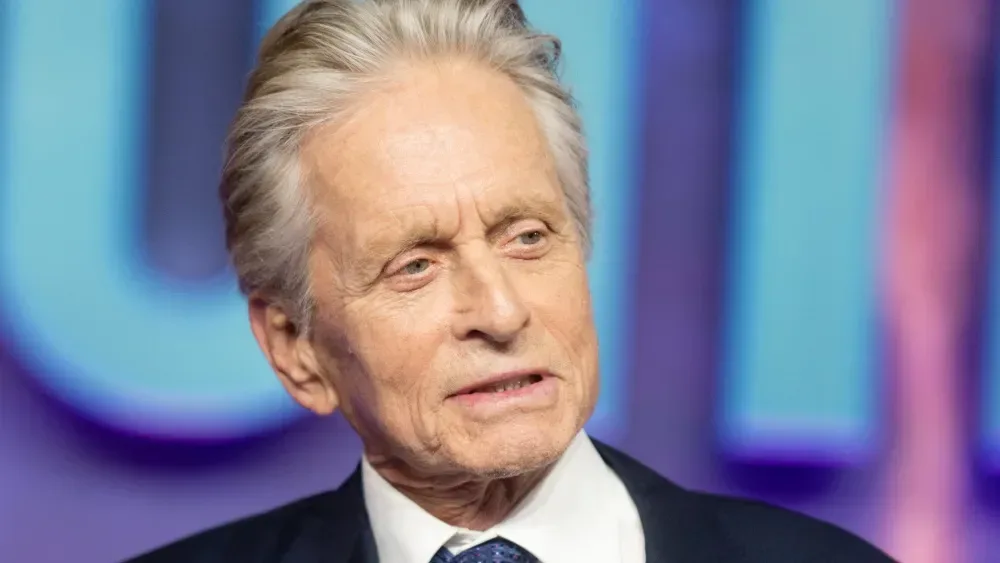
Michael Douglas has entered the continuing argument around the term “nepo baby,” and he is not particularly fond of the label. During an appearance on the Smartless podcast with Sean Hayes, Jason Bateman and Will Arnett, the actor said the description “really pisses” him off.
Douglas, the son of screen icon Kirk Douglas, framed the issue less as a uniquely Hollywood problem than as an ordinary family impulse. In his view, parents in many professions try to give their children a route into the work they know, and entertainment families receive a more pointed version of the criticism because their names are public.
“I don’t know a career where a father or mother don’t try to help their son or daughter get into their business,” Douglas said, questioning why the well-known aspect of Hollywood families has made the issue such a prominent target.
It is a concise response, but it touches the central tension in the nepo-baby debate. Family connections can be both normal and consequential. One side of the discussion recognizes that parents routinely share knowledge, contacts and opportunities with their children. The other focuses on whether access to introductions and early opportunities changes who gets the chance to build a career in an intensely competitive industry.
Douglas’ comments emphasize the first point: help from family is not restricted to actors, filmmakers or other public figures. His own career, however, also makes the conversation difficult to separate from the second. He grew up connected to one of the most visible stars of an earlier Hollywood era, a fact that naturally becomes part of any discussion about access, expectations and public scrutiny.
What the label is really arguing about
“Nepo baby” is shorthand for a person whose family connections are perceived to have helped them obtain work or visibility. The phrase is often used in entertainment, where surnames are familiar to audiences and professional relationships can be highly visible. It is not, by itself, a precise measure of talent, effort or the extent of anyone’s advantage.
That lack of precision is why discussions surrounding the term frequently become tangled. A family connection can mean many things: practical advice, an introduction, financial security while pursuing uncertain work, a first meeting with a decision-maker, or an opportunity to audition. Those are not interchangeable advantages, and none automatically explains whether a performer can sustain a career or deliver in a role.
Douglas’ objection appears directed at the selective public framing of inherited professional access. His point is that children entering a parent’s trade is common across occupations. In that framing, Hollywood is being treated as unusually suspect not necessarily because family assistance is unique there, but because famous families are easy for the public to identify and discuss.
There is also an emotional component to the term. It can compress a long body of work into a single explanation: famous parent, therefore undeserved career. For an actor with a decades-long résumé, that shorthand can understandably read as a dismissal of work done after any initial door may have opened.
Kirk Douglas’ legacy is part of the context, not the whole story
Kirk Douglas died in 2020 at the age of 103. His filmography included Spartacus, Seven Days in May, 20,000 Leagues Under the Sea, Champion, The Bad and the Beautiful, Lust for Life, Paths of Glory and Lonely Are the Brave. He received three Academy Award nominations and an honorary Oscar in 1996.
That is an imposing inheritance in the cultural sense. It also means Michael Douglas’ career was never likely to be assessed in a vacuum. Being the child of a major star can create recognition and proximity to the business, but it can also establish a comparison point few performers would choose for themselves. A recognizable family name attracts attention; it can also make every achievement and misstep part of a larger story about legacy.
Michael Douglas has assembled his own prominent set of credits, including Fatal Attraction and Behind the Candelabra. He has won two Oscars: best picture as a co-producer of One Flew Over the Cuckoo’s Nest in 1976, and best actor in a leading role for Wall Street in 1988.
Those distinctions do not settle the larger cultural question of inherited access. They do, however, make a simpler point: an opportunity and a career are not the same thing. The former can concern who gets in a room; the latter involves the work selected, completed and received over years. Douglas’ awards recognize achievement in two different capacities, as producer and performer, underscoring how varied a career in film can be.
Douglas’ more useful advice: recognize good material
Beyond the debate over family ties, Douglas offered a practical observation for aspiring actors. His advice was to learn to recognize “good material.” He described actors as people who do not necessarily play an instrument, paint or write; their task is to stand in front of an audience or camera, and the quality of the material can substantially help the result.
That sounds straightforward, but “material” is a broad industry term. It can mean a screenplay, a scene, dialogue, a character, a story premise or the full combination of elements an actor is asked to perform. In Douglas’ formulation, an actor’s judgment is not merely about chasing a role. It is about identifying whether the text offers something worth playing.
For an emerging actor, the advice is especially relevant because choices made early can define the work available later. Strong material may give a performer clearer motivations, sharper conflict, dialogue with a distinct rhythm, and scenes that let a character change or reveal something unexpected. None of those qualities guarantees success, but they give a performer more to work with than a thinly drawn role or unfocused story.
There is a useful distinction here between access and selection. Access affects which scripts, auditions and meetings a person may encounter. Selection concerns what they do when an opportunity arrives. Douglas’ remarks about material shift the emphasis toward the latter. However someone first reaches the industry, identifying a worthwhile role remains a skill that cannot be reduced to a surname.
Questions performers can ask of a script
- Does the character want something specific? Clear objectives tend to give scenes direction.
- Is there meaningful conflict? Conflict need not mean action or shouting; it can be a mismatch between what a character says and what they mean.
- Does the role change? A character who learns, loses, decides or reveals something may offer more dramatic range.
- Is the dialogue doing more than explaining the plot? Dialogue can establish personality, relationships and tension, rather than simply deliver information.
- Can the performer describe why the story matters? If the purpose of a scene or film is hard to identify, that may signal material that needs a closer look.
These are not rules for predicting awards or popularity. They are ways of reading a part with attention to what an actor can actually play. Douglas’ point is not that performers are passive; it is that acting depends on an underlying text, and the quality of that text materially affects the final work.
A debate unlikely to fit one answer
The nepo-baby conversation persists because it contains two truths that do not cancel each other out. Family support is common and often comes from a sincere desire to help. At the same time, access to a network, financial cushion or recognized name can matter greatly in a field where many capable people struggle even to be seen.
Douglas’ remarks focus on the broad human reality of parents helping children find a path. Critics of nepotism tend to focus on the structural reality that not all aspiring artists receive equivalent help. Both positions describe a different part of the same system.
What should be avoided is treating the label as a total biography. It cannot capture the quality of a performance, the choices behind a long career, or the complex ways family legacy can open doors while setting impossible standards. It also cannot replace a more concrete discussion about opportunity: who gains early access, who gets repeat chances, and what kinds of support are available outside famous families.
Douglas will soon revisit his life and career in his forthcoming memoir, One Helluva Ride, which is due Tuesday. For now, his podcast comments put an unusually direct voice behind one side of an argument that continues to shape how audiences interpret Hollywood success. Elsewhere in the acting conversation, performers are also discussing the work behind a role, including Andrew Garfield’s comments on looking past charisma when playing Sam Altman.
Douglas’ underlying career advice may be the most durable part of his response. Connections may influence where a person starts, but actors still need discernment about the stories they are asked to tell. For Douglas, spotting good material is not a minor preference. It is fundamental craft.