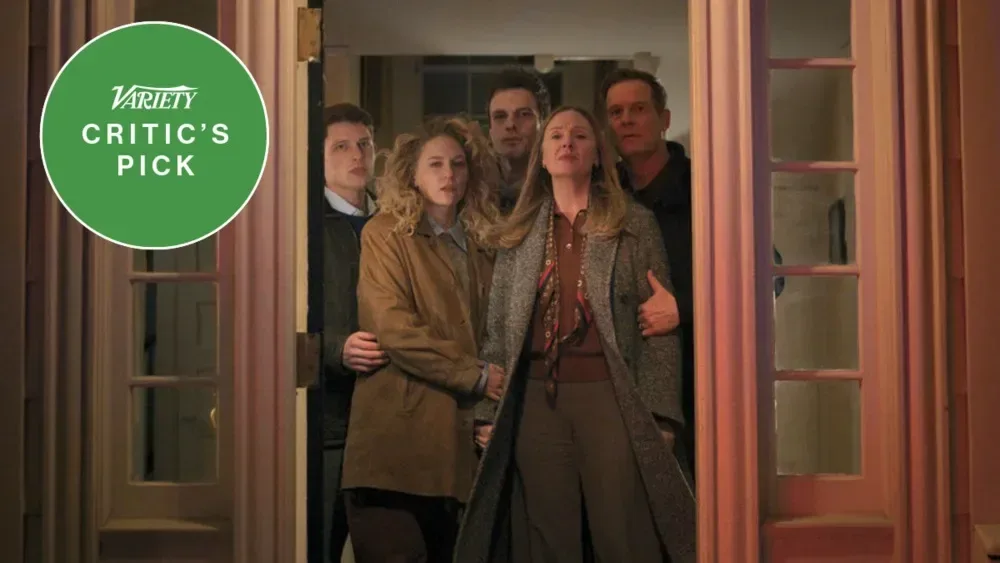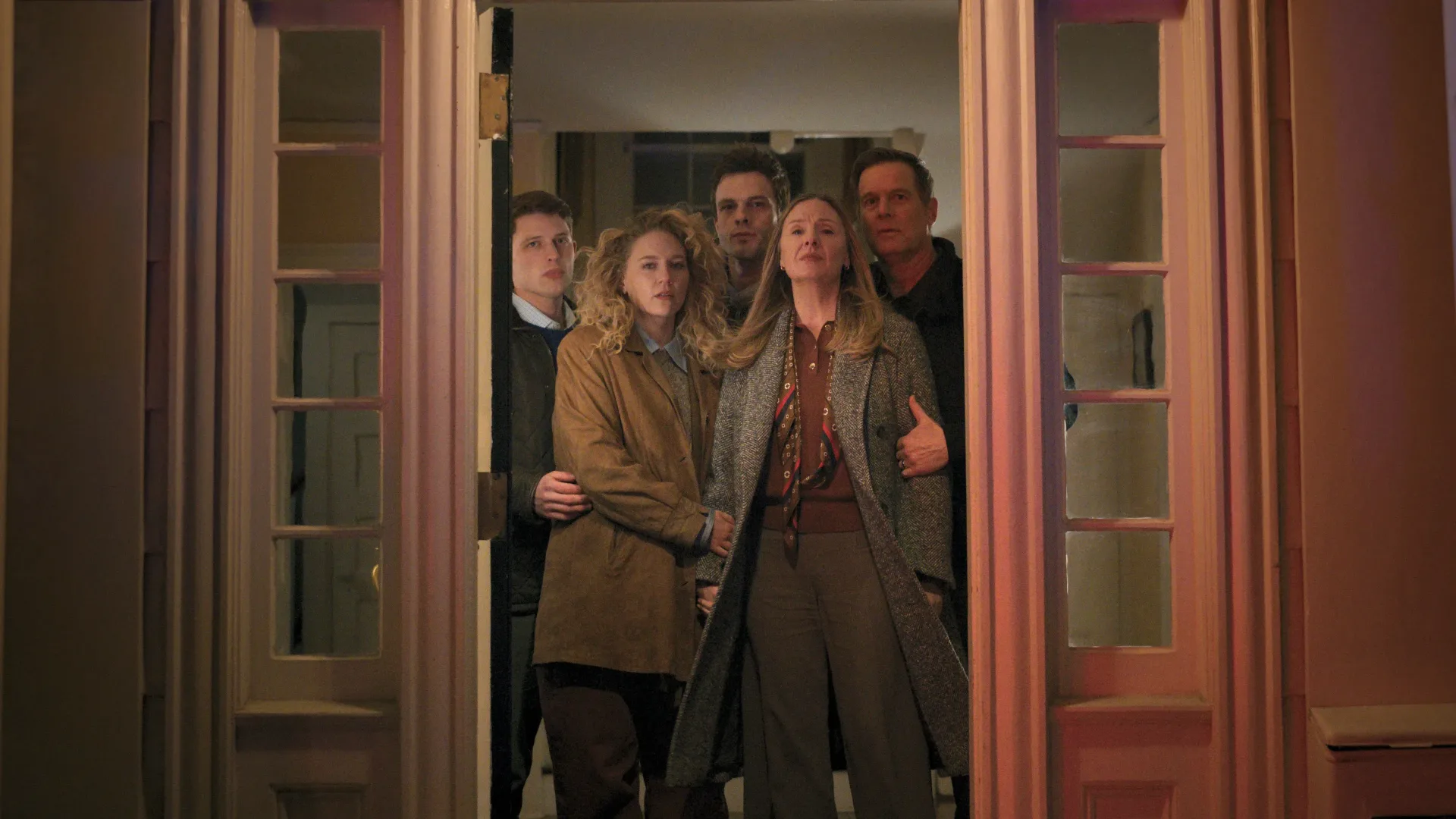
There is a familiar engine under Line of Fire: a law-enforcement case begins, agencies collide over jurisdiction and authority, and the investigation moves toward an answer. NBC’s new drama gives that dependable procedural structure a more complicated center of gravity. Its investigators are the Hollingsworths, a family whose members work across several connected corners of federal law enforcement.
The result is a series in which a request for help is rarely just a request for help. A lead may also be a favor from a parent. A boundary between agencies may become a boundary between siblings. And an ordinary professional disagreement can arrive carrying years of family history.
Line of Fire was created and written by Joshua Safran, who also executive produces with Jenna Bush Hager and Ben Spector. The 10-episode first season is produced by Universal Television. Its premise is loosely informed by Bush Hager’s experiences with the United States Secret Service, although the central family and the show’s stories are fictional.
A family dispersed through federal law enforcement
Peter Krause plays Mike Hollingsworth, a Secret Service agent approaching retirement. Hope Davis plays his estranged wife, Jane, a U.S. Marshal. Their adult children make the professional map still more crowded: Clare Hollingsworth, played by Kat Cunning, is an FBI agent; Mike “Micah” Hollingsworth Jr., played by Tommy O’Brien, is a Secret Service agent; and Russ Hollingsworth, played by Taylor Bloom, is beginning work as a Department of Justice analyst.
That distribution is the show’s key design choice. Rather than placing one ensemble in a single squad room, Line of Fire follows people who have different mandates, different bosses and different reasons to guard their territory. Yet they are also relatives who know exactly where to apply pressure when a case becomes difficult.
A procedural is a television drama built around investigative or official processes. Episodes often contain a self-contained crime, emergency or assignment, while character arcs and larger mysteries develop alongside them. The form can be especially effective when the weekly case does more than supply plot mechanics. Here, the cases create reasons for the Hollingsworths to see one another at their least filtered—and to test whether their job titles matter more than their personal loyalties.
The agencies in the show also provide distinct points of entry into the story. Jane’s position with the U.S. Marshals places her at the heart of the opening investigation. Clare can bring FBI resources and expertise to a problem that exceeds what Jane’s immediate team can manage. Mike’s Secret Service work connects the series to the White House, while Micah’s own assignment becomes a source of concern for his father. Russ, meanwhile, begins from a less field-facing role at the DOJ but finds that family demands immediately complicate his start.
The opening case starts with a killing in Virginia
The season begins in Crozet, Virginia, where a U.S. Marshal posing as a delivery driver is trying to locate a missing fugitive. By morning, both the Marshal and the fugitive are dead in the woods. Jane arrives to determine what happened, then reaches out to Clare for the FBI’s support.
That decision creates the show’s first professional friction. Jane needs broader reach, but her team is unhappy about the FBI moving into its investigation. Clare is willing to assist, but the request comes with an entirely separate set of pressures: Jane is also intent on meeting Clare’s new boyfriend, whom Clare has kept at a distance from the family.
The premise makes clear why the series has room for both tension and humor. A case can involve jurisdictional conflict, a dead federal officer and a fugitive, then turn into an awkward dinner-table question that no agent can proceduralize away. The personal and professional stories are not separate tracks that happen to run at the same time; they are built to interfere with each other.
The opening case also points toward a larger mystery. A seemingly routine investigation uncovers buried secrets that place the Hollingsworth family’s safety in jeopardy. With only the first two episodes available for assessment, the full shape of that conspiracy remains unresolved. Still, the show establishes that its season is not intended to be a collection of isolated cases alone.
What the family story brings to the format
Mike and Jane are separated, but their relationship has not become a simple feud. They remain friends with the kind of shorthand that comes from having shared much of a life and raised children together. They also have secrets of their own. That combination gives the series an emotional base more layered than a standard workplace partnership: they may disagree, but they understand the stakes of one another’s choices in unusually intimate ways.
The siblings have their own lines of strain. Micah is involved with Sydney, the president’s college-age daughter, played by Savannah Lee Smith. Mike worries that the relationship is distracting Micah from his professional obligations, adding a personal complication to an assignment already adjacent to the First Family. Russ is entering the DOJ, but the family’s habit of leaning on one another makes it difficult for him to establish a clean separation between his work and home life.
Clare’s story is similarly positioned between competence and intrusion. She is brought in because she can help with a dangerous investigation, but she is also the daughter Jane cannot stop parenting. The pilot’s family dinner, where Mike and the siblings gather at Jane’s home to meet Clare’s boyfriend, is designed to quickly show the family as a loud, unruly and closely connected unit.
That grounding matters for a crime drama. High-stakes cases can become abstract if the audience only sees the logistics of a chase, an arrest or a briefing. By giving the investigators longstanding personal ties, Line of Fire makes the cost of a bad decision more immediate. The drama is not simply whether a case will be solved; it is also whether the way it is solved will damage the people tasked with solving it.
Cases range from robberies to White House pressure
The early outline of the season gives the Hollingsworths a broad case load, including bank robberies, cartel killings and conflicts involving the First Family. That range lets the show shift between local crime scenes, interagency work and the peculiar scrutiny surrounding presidential protection.
The Secret Service connection is particularly useful because it brings the personal stakes of the family into an environment where privacy, security and public attention are naturally in conflict. Micah’s relationship with Sydney is not presented as a simple workplace romance; the identity of the person involved makes the consequences potentially more serious for everyone around them.
It also gives the series a White House backdrop without making the presidency its sole subject. The show’s focus remains on the people attempting to do their jobs while family loyalties blur their decisions. Readers interested in the real-world media pressures surrounding the White House can also read about how TV pool networks halted White House coverage after CNN was barred.
Importantly, the available episodes suggest that the cases are not merely excuses to assemble the cast. The central conspiracy gains weight because it threatens a family whose internal alliances, grudges and unresolved history are already carefully established. That is a useful inversion of the conventional procedural: instead of dropping character beats between plot points, the character relationships supply a reason for every investigative decision to feel volatile.
Why the cross-agency premise is the show’s advantage
Agency overlap can sound like a setup for convenient plotting, but it also provides a credible dramatic question for every collaboration: who is actually in charge? Jane calling Clare for assistance on the Virginia case helps move the investigation forward, but it immediately puts the Marshals and FBI in conflict. The show uses that collision not just for obstacles but to define its characters’ professional identities.
For viewers, the practical implication is a procedural that can change perspective without abandoning its core ensemble. An episode can start with Jane’s investigation, move to Clare’s FBI access, turn toward the Secret Service in Washington, D.C., and still feel like one family story. The roles are varied enough to broaden the kinds of cases the show can tell, while the Hollingsworth connection prevents that breadth from becoming scattered.
The setup also creates a recurring ethical pressure point. Family members may be uniquely positioned to help each other, but the same proximity can lead to crossed lines, divided judgment or a sense that someone is receiving access they have not earned. Line of Fire frames this tension as part of the everyday dysfunction of the Hollingsworths rather than an occasional twist.
Charlie Barnett is also part of the principal cast. The series’ early episodes build toward a season-long story while leaving room for the individual mysteries and operations that make the procedural format accessible week to week.
Release schedule and what remains unknown
Line of Fire debuted on NBC on September 21, with subsequent episodes scheduled to air weekly on Mondays. The first season consists of 10 episodes.
Only two episodes were available in advance, so any assessment of the larger mystery must remain provisional. The show has established its major components: Jane’s Virginia investigation, Mike’s looming retirement, Micah’s relationship with Sydney, Russ’s uncertain footing at the DOJ, Clare’s increasingly entwined family and FBI lives, and the secrets connecting Mike and Jane. Whether those threads pay off over the full run is the question the rest of the season is built to answer.
For now, the clearest appeal is the collision at its center. Line of Fire has the case-of-the-week machinery viewers expect from a network law-enforcement drama, but its strongest hook is that nobody in this family can simply clock out from the others. Every badge comes with baggage.