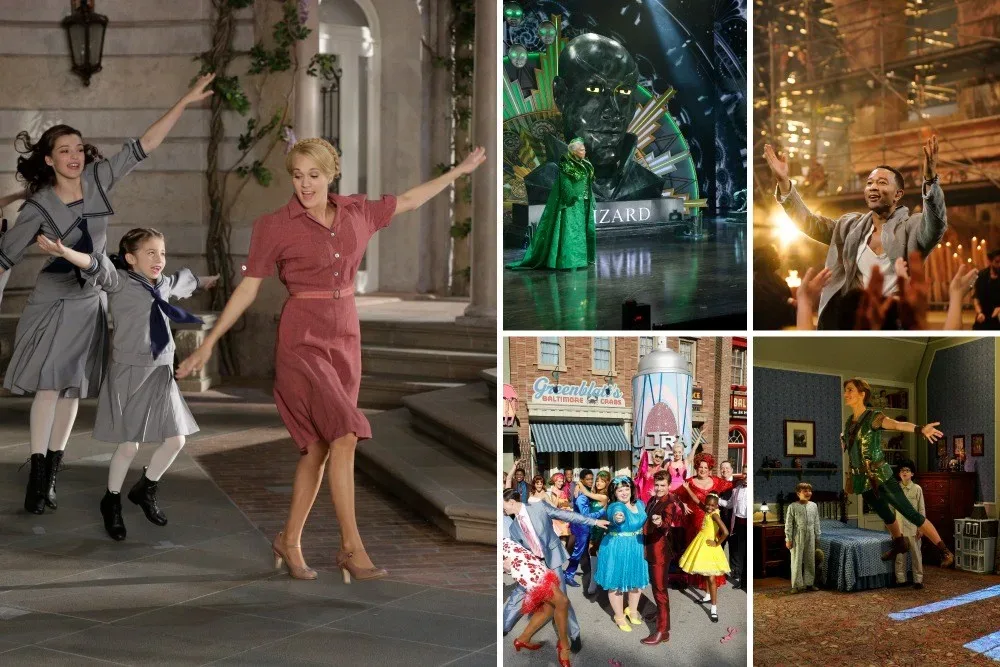
There was no modern how-to guide for NBC when it committed to The Sound of Music Live! in 2013. The network knew that television had once treated live musical spectacle as major programming, but it had been decades since it tried to mount a comparable production at this scale. That uncertainty was not a flaw in the plan so much as the plan’s defining risk: a live musical had to feel like an occasion precisely because it could not be made routine.
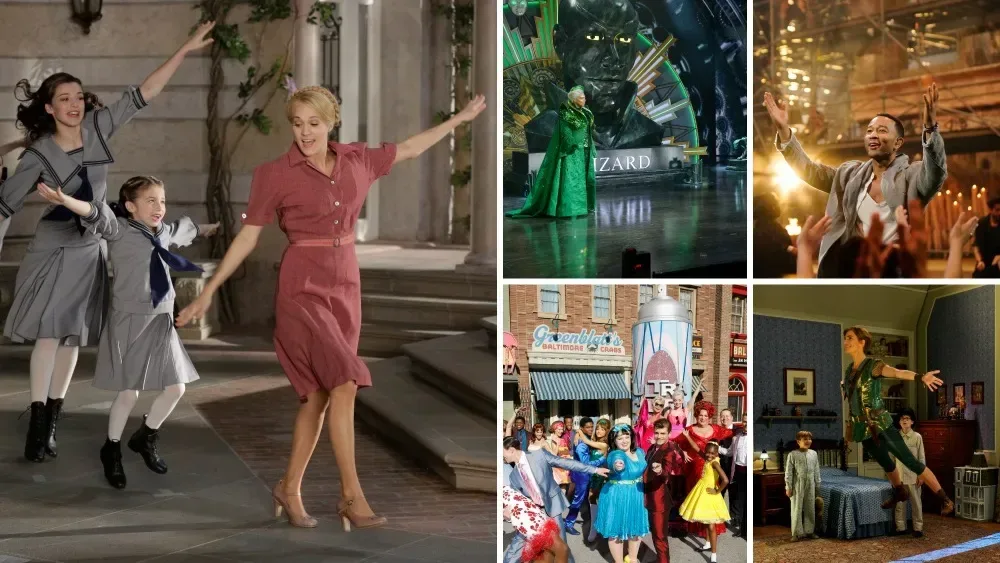
The result made the argument emphatically. NBC’s Dec. 5, 2013 presentation, led by Carrie Underwood as Maria and Stephen Moyer as Capt. Von Trapp, reached more than 18 million viewers. Internally, the hoped-for threshold had been 10 million. The gap between that target and the actual audience transformed a one-off bet into a broader programming strategy—and established a compact but consequential run of live network musicals through 2018.
A revival rooted in television’s oldest event instincts
Bob Greenblatt took charge of NBC Entertainment amid a leadership transition in 2011, after Comcast became NBC’s majority shareholder. The network had struggled late in the prior ownership era, and Greenblatt’s approach was not simply to add another series to the weekly schedule. He wanted to reclaim NBC’s association with oversized entertainment specials: programs designed to unite a broad audience at one particular time.
That was not invented from scratch. NBC had a meaningful historical connection to Broadway-style television presentations. In March 1955, the network aired Mary Martin in a live musical performance that became a major ratings success in the Trendex measurement of the era. A 1955 live Peter Pan presentation starring Martin was also strong enough to push CBS’ I Love Lucy to an all-time ratings low on the night.
The useful lesson was not that a production from the 1950s could simply be repeated six decades later. Television, its competition and the way audiences reacted in real time had changed. Instead, the history showed that theatrical material could become mass entertainment when it was packaged as a special rather than treated as niche programming. A familiar score, recognizable characters and a clear sense of “this is happening now” could give a broadcaster something unusually hard to recreate with ordinary scheduled fare.
Event television means programming whose value is tied not only to what it is, but to when audiences experience it. A live sports final is the clearest example. NBC’s musical strategy applied the same principle to scripted performance: viewers had an incentive to show up at broadcast time because the cast and crew were performing in the present tense, without the safety net—or polish—of a fully prerecorded production.
Why The Sound of Music was the logical first roll of the dice
Greenblatt’s experience as a Broadway producer gave the project an advocate who understood the theatrical side of the challenge. Veteran producers Craig Zadan and Neil Meron joined the effort, with Zadan and Meron selecting The Sound of Music as the title worth the risk. Their reasoning was straightforward: it was known across generations, embraced by adults and children, and continually produced around the world.
That kind of familiarity mattered. A live musical already asks viewers to accept an unusual proposition for prime-time television: extended songs, theatrical staging, scene changes and a performance form built around an ensemble. Starting with a title that contained widely known Rodgers and Hammerstein songs reduced the barrier to entry. It gave the show a built-in invitation to sing along rather than an obligation to arrive already invested in a new property.
Related coverage includes How NBC’s Live Musicals Revived a TV Event Tradition.
Yet recognition by itself was not enough. NBC had to solve the physical production challenge. The company built an elaborate production for a live transmission from Grumman Studios on Long Island. That point explains why these broadcasts were more than filmed stage shows. Live TV requires the coordination of performers, cameras, sound, lighting, sets and transitions to occur correctly in one continuous broadcast window. The preparation may be extensive, but the airing preserves the possibility that the unexpected can happen.
That tension is central to the format’s appeal. A prerecorded musical can refine individual moments indefinitely; a live musical trades some of that control for immediacy. In 2013, NBC was effectively betting that viewers would see that vulnerability as part of the attraction. The initial response suggested it was right. Social-media reaction began almost immediately, with viewers including Tina Fey and Cameron Diaz joining a wider wave of people sharing their enjoyment of the songs.
“Live” in this context is a production promise as much as a technical descriptor. It tells the audience that the broadcast is a shared appointment, not just another title waiting in a library. That distinction helped make the program feel communal, with social posts functioning as a running audience reaction rather than after-the-fact commentary.
The ratings answer—and the awards recognition
More than 18 million viewers gave NBC a result that exceeded its own expectations and made The Sound of Music Live! a milestone in the network’s revival. It also earned six Emmy nominations and one win. Ratings and awards do not measure the same thing: audience totals indicate the scale of reach, while Emmy recognition reflects peer acknowledgment in television. Together, though, they offered NBC two forms of validation. The musical had drawn a huge crowd, and its technical and artistic labor had registered beyond the night of broadcast.
The response also strengthened a wider programming direction. The network sought crowd-pleasing live events that could emphasize broadcast television’s ability to reach a national audience all at once. For a broadcaster, that is a distinct proposition. A large recurring series can create habits over a season; a special can create an immediate cultural moment around a date on the calendar.
That goal helps explain why the live-musical slate was relatively selective. These were not inexpensive or casual productions. The format demanded significant preparation and elaborate staging, while the inherent live element meant that every decision carried added pressure. NBC did not suddenly turn into a weekly musical-theater channel. Instead, it gave the format room to remain special.
The five-musical run
Following The Sound of Music Live!, NBC mounted four more live musical productions during Greenblatt’s leadership:
- Peter Pan Live!, starring Allison Williams and Christopher Walken, aired Dec. 2, 2014.
- The Wiz Live!, starring Queen Latifah, David Alan Grier and Shanice Williams, aired Dec. 3, 2015.
- Hairspray Live!, starring Marissa Jaret Winokur and Derek Hough, aired Dec. 7, 2016.
- Jesus Christ Superstar Live in Concert, starring John Legend and Sara Bareilles, aired April 1, 2018.
The sequence reveals a strategy that was consistent in format but not identical in texture. Peter Pan connected the newer experiment to a title already embedded in NBC’s live-musical past. The Wiz, Hairspray and Jesus Christ Superstar expanded the range of material while continuing to use prominent performers as part of the event appeal.
Production circumstances also varied. Hairspray Live!, though set in Baltimore, was made at the Universal lot in North Hollywood. Jesus Christ Superstar Live in Concert aired on Easter Sunday in 2018, a scheduling choice that naturally matched the material’s subject. Such specifics matter because live specials are inseparable from their setting and timing. They are not merely adaptations; they are broadcast occasions constructed around a particular place, crew, cast and night.
There was also a project that never reached the stage. A 2017 Bye Bye Birdie production planned with Jennifer Lopez did not come to fruition. That absence is a reminder that even after a hit, live musicals remained difficult undertakings rather than an automatic annual fixture. A successful format can create confidence without eliminating the logistical, creative and scheduling hurdles that come with mounting it.
The ripple effect beyond NBC
Other broadcasters took notice. Fox subsequently staged live versions of Grease in 2016 and Rent in 2019. That does not make every later musical a duplicate of NBC’s approach, but it does show that the 2013 breakthrough helped restore the form as a viable network-TV proposition.
Greenblatt viewed that wider adoption as evidence that the gamble had worked. His tenure at NBC ended in fall 2018, and he counted the five productions among his proudest accomplishments. He has also said he is discussing the possibility of a new live musical with NBC and ABC, though that should be understood as an ongoing conversation rather than a confirmed production.
For audiences, the lasting practical takeaway is that a live musical is built around a different contract than both a conventional drama and a polished movie musical. It prizes collective viewing, theatrical scale and the small charge of uncertainty that comes from a real-time performance. That same question of how a familiar world changes when it crosses formats is also at the center of Dungeons & Dragons: World of Warcraft’s attempt to bring Azeroth to the table: adaptation works best when it understands the new medium instead of merely copying the old one.
NBC’s achievement was not simply airing recognizable musicals with celebrity casts. It was recognizing that broadcast television still had one special strength: the ability to make millions of people feel they had a reason to be in the same place at the same time. In 2013, The Sound of Music Live! proved that theatrical spectacle could still activate that strength. The four productions that followed showed it was not an accident, even if it was never an easy formula to reproduce.