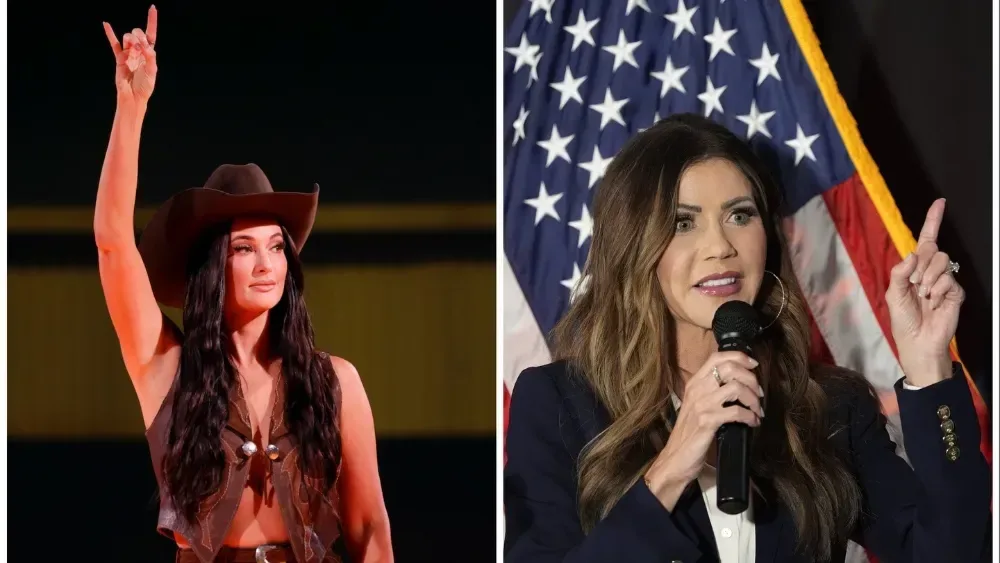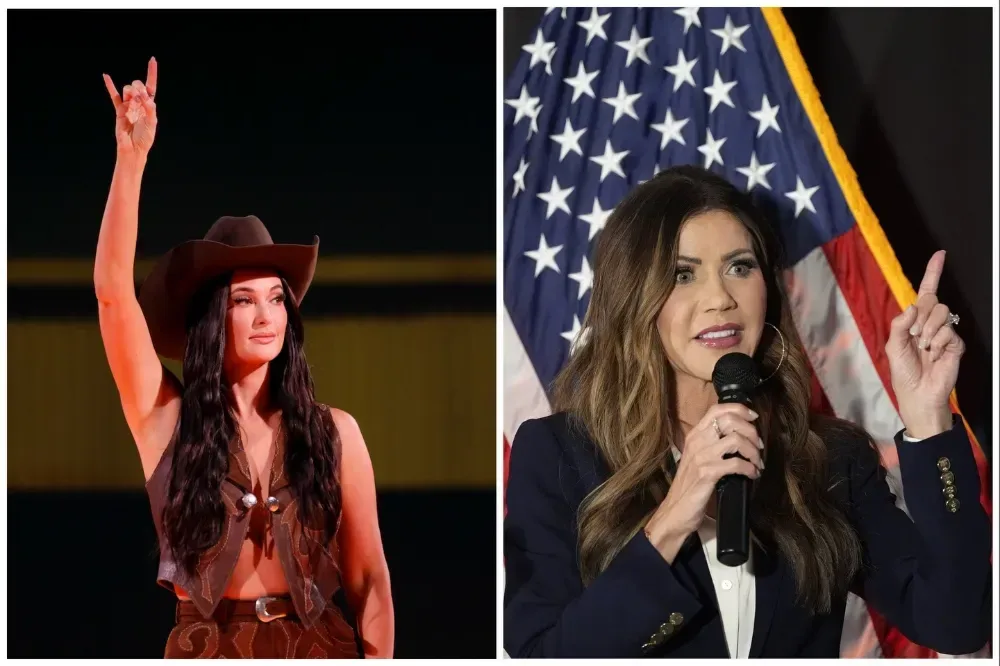
Kacey Musgraves turned a brief political provocation on X into a far sharper cultural punchline after Kristi Noem criticized the singer for welcoming Texas Senate candidate James Talarico at a recent concert.
The exchange began with Talarico, a Democrat running for Senate in Texas, sharing a photo of himself with Musgraves and thanking the singer for having him at the show. Noem then used the moment to declare a preference for Ella Langley over Musgraves, while also contrasting Republican candidate Ken Paxton with Talarico.
“I’ll take Ella Langley over Kacey Musgraves any day,” Noem wrote. “And if I’m choosin’ Texas, I’ll take Ken Paxton over James Talarico.”
Musgraves’ response was compact, targeted and built around a political controversy that has long followed Noem.
“I don’t think you have a dog in this fight but if you did you would have shot it,” Musgraves wrote.
The post refers to Noem’s memoir account of killing her 14-month-old dog, Cricket, in a gravel pit after characterizing the animal as difficult to handle. Noem had framed the episode as evidence that she could make hard decisions; the passage instead became a major source of public backlash during the 2024 presidential campaign. Musgraves’ line did not require a lengthy rebuttal of the original political message because it used a well-known piece of Noem’s public record as its entire retort.
For readers who want the primary post rather than paraphrase, Musgraves’ reply remains available on X.
A concert photo became a political proxy fight
The initial image was straightforward: Talarico attending a Musgraves concert, where he was warmly received and photographed with the Texas-born artist. Yet it quickly became a proxy argument about the place of entertainers, campaign figures and regional identity in a heated Senate contest.
Related coverage includes Kacey Musgraves Responds to Kristi Noem’s X Post Over James Talarico.
Noem’s post did more than criticize Musgraves’ association with Talarico. It also tried to make the episode a contest between Musgraves and Langley by naming Langley as the preferable country performer. That comparison is especially awkward as a Texas-centered argument: Musgraves is a Texan, while Langley is from Alabama.
Langley did not publicly embrace the framing. Her X account, or the team managing it, quickly removed the tag connecting her account to Noem’s post. That small piece of social-media housekeeping matters because public figures are often tagged into arguments they did not initiate. Removing a tag is not a detailed political statement, but it can be a clear boundary against being recruited into somebody else’s feud.
Musgraves’ answer also illustrates why a single, specific line travels farther online than a conventional statement. A quote-post is a social-media format in which a user republishes another post while adding their own commentary. It lets the reply address the original message directly and preserves its context for readers. In this case, the entire exchange was visible: Noem’s attempt to turn an artist’s concert hospitality into a partisan comparison, followed by Musgraves’ dog-related response.
Why the Cricket reference carried so much force
The effectiveness of Musgraves’ line comes from its precision, not its length. Noem’s story about Cricket had already become inseparable from her public image. By saying Noem did not have “a dog in this fight,” Musgraves first invoked a familiar idiom for a dispute in which someone lacks a direct stake. The second half immediately turned that idiom into a reference to Cricket.
That is a classic example of a callback: a joke or comment that draws power from an earlier event the audience already recognizes. It is not merely an insult aimed at Noem’s politics. It points to the mismatch between Noem trying to pick a winner in a music-and-politics dispute and the history that made any dog metaphor uniquely hazardous territory for her.
The reply also resisted the bait embedded in Noem’s post. Musgraves did not litigate whether Langley is better, defend Talarico through a campaign-style talking point, or try to make a lengthy case for artists’ political freedom. Instead, she redirected attention to the person who had initiated the conflict. That choice makes the post read less like an extension of a candidate’s messaging and more like an entertainer refusing a public ranking imposed on her.
As of the time covered here, Noem had not posted another response on X after Musgraves’ comeback. Silence online can mean many things, so it should not be treated as confirmation of motive or an admission. But in practical terms, it left Musgraves with the last word in the visible exchange.
Musgraves has not avoided public issues
The clash is consistent with Musgraves’ willingness to address issues beyond music. Earlier this year, she used a concert appearance to urge donations to the Young Center for Immigrant Children’s Rights, presenting it as a birthday wish. She described the organization as providing legal aid and financial assistance to children whose parents had been deported unfairly, and stressed that children needed help.
That appeal prompted criticism from some conservative voices, including a challenge to her use of the phrase “unfair deportation.” Musgraves has also spoken publicly in support of LGBTQ+ rights. The larger pattern is not that every concert appearance becomes a campaign event; it is that she has been prepared to use her platform when she considers a cause worth addressing, even when a backlash is likely.
That distinction is useful here. Welcoming a politician to a show can be interpreted by observers as political support, especially during an election cycle. But an artist’s decision to pose for a photo or acknowledge an attendee is not identical to a formal endorsement. The available details establish that Talarico attended the concert and was warmly received; they do not establish a Musgraves campaign endorsement.
Talarico has received overt support elsewhere from prominent Texas music figures. Willie Nelson recently endorsed him in a video. The Musgraves exchange therefore arrives amid a broader effort to connect the candidate with recognizable Texas artists, though each artist’s action should be assessed on its own terms rather than collapsed into one uniform campaign role.
The Texas race gives the moment its wider stakes
Beyond the viral joke, the political backdrop explains why an otherwise routine concert photo drew such attention. A Trafalgar poll cited in the reporting put Talarico at 47.1% among prospective Texas voters, compared with 43.6% for Paxton. That is one poll, not an election result or a guarantee of the final outcome. Polls are snapshots that measure a particular group using a particular methodology at a particular time, and they can change as the race develops.
Still, the reported numbers are notable in a state that has not elected a Democratic senator since 1993. They also help explain the impulse to use entertainment-world visibility as a campaign contrast. Texas identity has unusual political and cultural weight, particularly when country music artists are involved. Noem’s use of Langley’s “Choosin’ Texas” as a rhetorical device was an attempt to borrow that symbolism for Paxton’s side.
But symbolism is hard to control once it leaves a campaign message. Langley’s removal of the tag undercut the effort to present her as a willing participant, while Musgraves’ reply changed the subject entirely. Instead of a debate about which singer best represented Texas, the online conversation became a reminder of the Cricket episode.
What this says about celebrity political pile-ons
Public figures are frequently treated as though every photo, stage greeting or online interaction must function as a declaration of allegiance. That can turn ordinary fan-facing moments into raw material for political combat. It can also pressure artists into responding to comparisons they never asked for.
There is a strategic risk in that approach. Attempting to pit two musicians against each other can attract more attention to the person doing the pitting than to the intended political contrast. It may additionally hand the targeted artist a simple opening: reject the false choice, expose the premise, or—in Musgraves’ case—make the response memorable enough to eclipse the original post.
For Musgraves, the result was a pointed social-media victory without a long speech or a newly invented controversy. For Langley, the tag removal showed how easily an artist can decline an unsolicited role in a political narrative. And for the Texas Senate race, the exchange is another example of how celebrity, regional pride and electoral messaging increasingly meet in the same feed—often with the outcome determined less by the first post than by the cleanest comeback.
For more entertainment coverage where music and public conversation collide, see our look at Gucci Mane’s reflective run around Against All Odds.