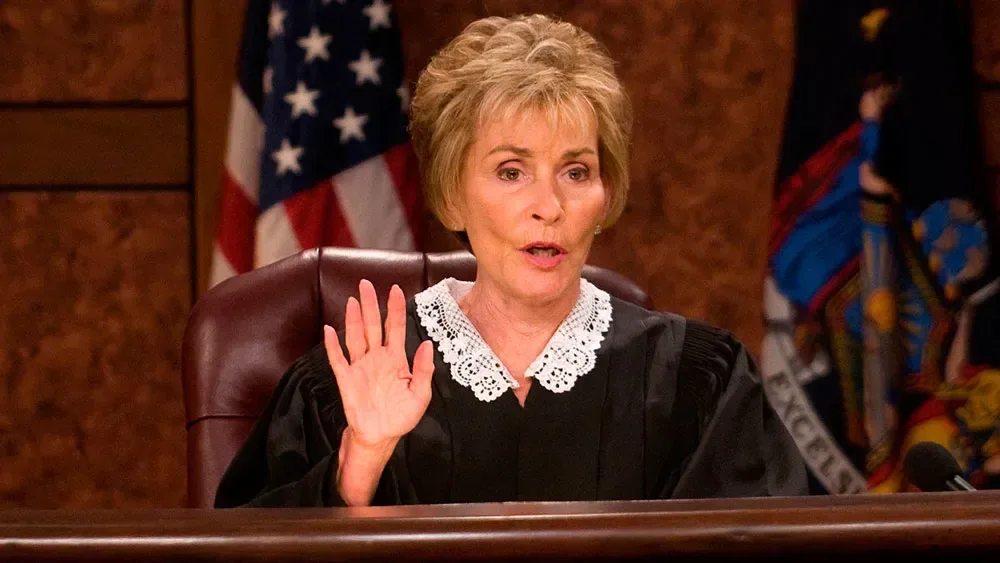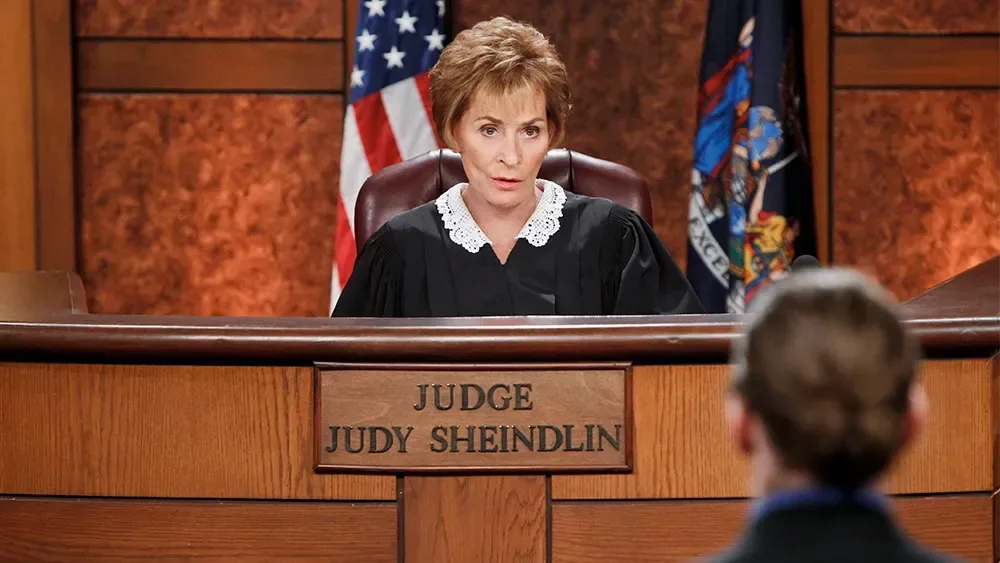
Judith Sheindlin’s next television project may put one of the internet’s most persistent visual jokes at the center of an animated courtroom. The former family-court judge and long-running TV personality is developing Baby Judy, an animated series inspired by memes that place a baby’s head on her recognizable judicial robe and lace collar.
It is an unusual next step for a figure whose screen identity has long been built on directness, impatience with evasions and an unmistakable command of a courtroom. But the project is not being described as a soft, child-oriented version of that persona. Sheindlin has characterized the material she wants to make as edgy, with a premise designed to turn an uncomfortable dispute into the sort of blunt adjudication associated with her work on television.
Sheindlin is developing Baby Judy through Queen Bee Productions. At this stage, the supplied details establish that the series is in development and that a sizzle reel exists; they do not establish a network, streaming home, release date, episode count or cast.
What ‘Baby Judy’ is—and what remains unknown
A sizzle reel is a short promotional presentation used to communicate the tone, premise and commercial potential of a prospective project. It is not the same thing as a completed pilot or a confirmed series order. That distinction matters here: the most concrete detail about Baby Judy is the scenario included in its reel, rather than a finalized production plan.
That setup concerns a college graduate seeking a first job. After telling a prospective employer that he needs a private bathroom because of a small penis, he is rejected for the position and brings a claim under the Americans with Disabilities Act. The matter then arrives before Baby Judy. The premise signals an adult-leaning comic framework built around a deliberately provocative complaint, with the animated judge functioning as a vehicle for pointed responses.
The idea also gives Sheindlin a route into animation without asking her to abandon the core ingredient of the Judge Judy image: a decisively delivered judgment. The baby-headed robe meme already compresses that image into an instantly legible format. Animation could potentially extend the joke into character-driven stories and heightened situations, while maintaining the familiar visual cue that makes the concept recognizable.
That premise places Baby Judy within a wider animation space where a distinctive vocal or screen personality can be the organizing principle for an entire production. The importance of voice performance and personality-led animation is also central to this look at Utopai’s animated feature plans, although the projects are otherwise unrelated.
A career shaped by an unexpected television pivot
Before becoming a daytime television institution, Sheindlin worked in New York family court, a role she has described as difficult but deeply meaningful. She has said it was a place where sustained effort could sometimes create an opportunity to change someone’s life. In her own imagined alternate path, she would have remained in family court until retirement at 72, possibly continued part-time as a judicial hearing officer, and spent winters somewhere warm.
Television intervened after a 1993 60 Minutes profile by Morley Safer brought her approach to broader attention. Producer Larry Lyttle subsequently persuaded her to try television through Big Ticket Television, then part of Spelling Entertainment. Paramount Pictures acquired Spelling in 1999.
Judge Judy premiered in 1996 and is credited with reviving the daytime court-show format. The format’s attraction was straightforward but difficult to replicate: disputes could be grasped quickly, decisions arrived with momentum, and the judge’s personality was inseparable from the program’s appeal. Sheindlin did not present herself as an actor working from a performance of judicial surprise. She has contrasted her approach with a more pre-prepared style, saying she could not convincingly pretend to be seeing evidence for the first time.
That preference for immediacy helps explain why the persona has remained usable beyond its original syndicated setting. The robe, collar, clipped phrases and emphasis on personal responsibility have become cultural shorthand. Meme culture did not create Judge Judy, but it gave viewers a simple way to recirculate the attitude in new contexts. Baby Judy is therefore an attempt to turn an audience-created image into a new scripted property.
‘Judge Judy: Unfiltered, Unforgettable’ revisits the long run
Sheindlin’s career is the focus of Judge Judy: Unfiltered, Unforgettable, a two-hour special scheduled to premiere September 22 on CBS and Paramount+. The program is positioned as both a retrospective on more than three decades of Sheindlin’s television work and a look ahead at the projects that continue to occupy her.
The scale of that run is substantial. At her peak, Sheindlin earned more than $45 million a year, placing her among television’s highest-paid stars. That figure reflects the strength of Judge Judy’s ratings and the durable commercial value of the personality at its center.
Her production slate now spans multiple versions of the courtroom and justice-oriented format. The shows identified as currently airing or available include Adam’s Law, the long-running Hot Bench, vintage episodes of Judge Judy, and the Amazon Prime Video series Judy Justice, Tribunal Justice and Justice on Trial. Rather than treating her original series as the endpoint, Sheindlin’s work has expanded into a wider set of programs with different benches and structures.
For viewers, that breadth is a practical reminder that “court show” can mean several things in television. It is a genre presentation with legal themes and disputes, not a substitute for personal legal counsel or a guide to how every real-world case will unfold. Its appeal rests partly in the understandable stakes of conflict and consequences, but it is also shaped for television by time, editing and personality. Sheindlin’s stated interest is not merely in procedure; it is in communicating views about responsibility, citizenship and self-sufficiency.
Adam Levy takes the on-air gavel
The newest branch of that screen legacy is Adam’s Law, the daytime court show launched by Sheindlin’s son Adam Levy with CBS on September 14. Levy previously served as a district attorney in Putnam County, New York, and later as a defense attorney. He also appeared regularly on Tribunal Justice for multiple seasons before moving into his own Monday-through-Friday program.
Sheindlin has drawn a clear contrast between Levy’s legal working style and her own. Levy prefers extensive preparation: reviewing evidence, researching litigants and going into a case with as much background as possible. It is the approach, she says, that has defined his work as a litigator.
Her own method was more instinctive and responsive. That contrast is notable because it suggests Adam’s Law should not be assumed to be a simple imitation of Judge Judy. The shared family connection and court-show setting create an obvious comparison, yet the judges’ stated approaches to preparation are different. Levy’s experience on Tribunal Justice gave him television exposure, but his mother frames his process as rooted in his separate professional habits.
Sheindlin sees the program as an opportunity for another audience to engage with themes she believes remain relevant: law and order, right and wrong, and useful guidance for everyday life. Her hope is that the newer show develops enough of an identity that, decades from now, viewers might identify it on its own terms rather than solely through its connection to her.
The enduring message behind the persona
For all the attention paid to Sheindlin’s sharp one-liners, her account of the career emphasizes authority as something that can have a constructive impact. She remembers a sixth-grade teacher, Irving Bernstein, calling her home after she had missed school for a day or two. That small act made her feel noticed and important, and it remains an example she cites of an authority figure changing a young person’s sense of self.
Her public philosophy is equally clear, if more severe in tone. Sheindlin describes herself as a believer in responsibility: support should be available to people who genuinely need it, while those capable of working should not simply choose not to do so. Whether audiences agree with every expression of that view or not, its consistency has been central to the Judge Judy brand. It is the message that transformed a former family-court judge into a television figure whose identity can still be recognized in a single meme image.
That continuity is what makes the current moment more than a nostalgia lap. A career special, a new show led by her son, a continuing group of producer credits and a developing animated concept all point in different directions, but each uses some part of the same foundation: clarity, confrontation and the promise that somebody on the bench will say what they think. Baby Judy may be the strangest expression of that foundation yet, but it is also a logical experiment in how a decades-old television persona can move through the internet age.