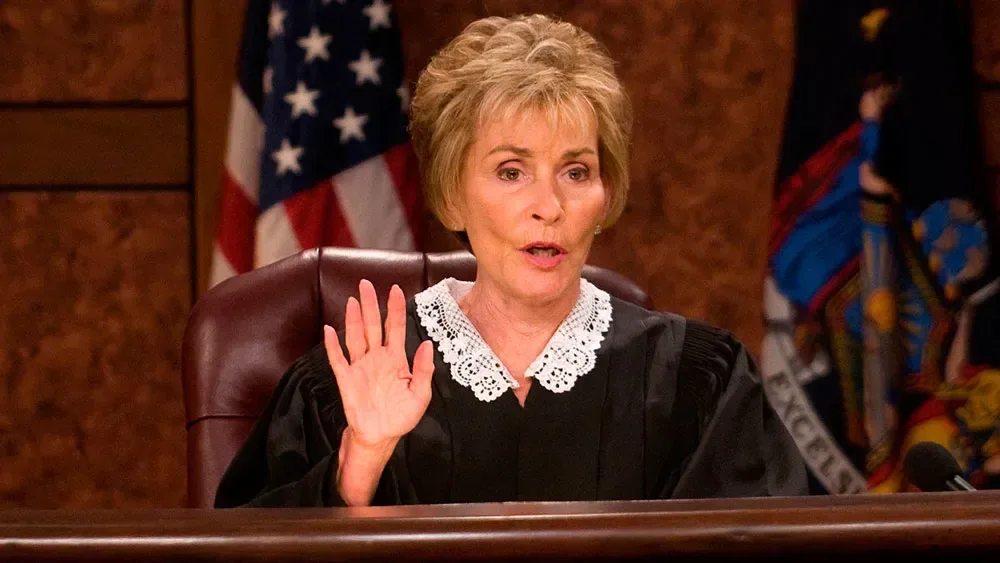
Judy Sheindlin, the television judge known to generations of viewers as Judge Judy, is preparing to end her onscreen work after three decades in televised courtrooms. The current series Judy Justice will conclude with its series finale on Oct. 22, closing the chapter on a run that began with Judge Judy in 1996.
The change is a retirement from appearing on camera, not a retreat from television production. Sheindlin intends to work behind the scenes and has identified Adam’s Law, a court show led by her son, Judge Adam Levy, as a central project on that producing slate.
That distinction matters. A familiar face leaving a series can sound like the end of a brand, format, or point of view. Here, Sheindlin’s comments point instead to a transfer in how that work is delivered: less time in front of the bench and more attention to shaping projects from off-camera. Her televised courtroom era is ending, but she has said she still plans to be creative.
From ‘Judge Judy’ to ‘Judy Justice’
Judge Judy debuted in 1996 and remained on the air for 25 seasons, ending in 2021. It was distributed in syndication by CBS Media Ventures. Syndication is a television distribution model in which a program is licensed to stations or carried across a broad collection of outlets, rather than existing solely as a regularly scheduled show on one network. That kind of reach helped make the courtroom show a durable daily-viewing fixture.
The series stood apart from many talk shows of its early era through its courtroom framing and Sheindlin’s direct, decisive screen presence. It also became a major ratings performer and helped encourage a wider wave of courtroom programming. The basic setup was easy to recognize, but its longevity came from the consistency of the person at the center: viewers understood the show’s rhythm, its expectations and the likelihood that arguments would be met with a brisk response rather than a long detour.
Sheindlin moved to Judy Justice in 2021. The program premiered on Freevee, Amazon’s now-defunct service, and currently airs on Amazon Prime Video. The move also captures a significant shift in the larger TV business across the span of her career. The original show was a syndication mainstay; the later program arrived through a streaming ecosystem. The platforms changed, while the courtroom format and Sheindlin’s role as its anchor continued.
Judy Justice has been executive produced by director Randy Douthit, Amy Freisleben and Scott Koondel. Its finale means the end of Sheindlin’s active role presiding over cases for television, following 30 years onscreen between the two series.
What Sheindlin said about the decision
In an appearance with Levy beside her, Sheindlin emphasized that he is ready to lead Adam’s Law. Her explanation mixed a practical vote of confidence in her son with the humor that has long been associated with her public persona. She described the next phase as taking her message into “a little bit of a different form,” and jokingly cast herself as the “Benjamin Button of court.”
The comment is useful shorthand for what is and is not changing. Sheindlin is not presenting the decision as a disappearance from creative work. Rather, she is moving from a highly visible performing role into producing. Producing, in this context, refers to the work of developing and guiding a television project behind the camera. The supplied details do not define her exact responsibilities on each forthcoming project, so it would be premature to assume a particular day-to-day role. But her stated focus clearly moves toward building shows rather than starring in them.
That makes Adam’s Law more than a simple footnote to a retirement story. It is the most clearly identified next project and places Levy, himself a judge, at the center of a new court show. The available information does not specify a premiere date, distribution platform, format differences, or other production details. What is known is the intended creative handoff: Levy leads the show, while Sheindlin turns her attention to producing.
A format built on clarity and personality
Televised court programming has an immediately legible structure. A dispute is introduced, people offer competing accounts, a judge questions them and a ruling follows. That structure offers a natural beginning, middle and end within a relatively compact segment. But a structure alone does not explain a 30-year onscreen career.
Sheindlin’s contribution was an unusually recognizable voice within that framework. The shows were associated with firm questioning, impatience for evasions and a clear sense that the person in charge would keep the proceeding moving. For viewers, that produces a particular kind of television promise: the case may vary, but the authority and tempo remain recognizable.
It is also important to distinguish the cultural function of a television courtroom from a broad claim about every court proceeding. A TV court show is designed as entertainment as well as dispute resolution. The supplied information describes Sheindlin as having presided over court cases on television, but it does not offer details about individual cases or make wider legal claims. The strongest takeaway is about television craft: over decades, Sheindlin made judicial bluntness into a repeatable screen identity.
That identity made the transition from Judge Judy to Judy Justice notable. In many television formats, a title, channel or distribution route may change without changing the core attraction. In this case, the recognizable element was Sheindlin herself. Her upcoming departure from the bench therefore carries more weight than a routine programming update; it signals the end of the performer-led phase of a format closely identified with her name.
The practical implications for viewers
The clearest date for audiences is Oct. 22, when Judy Justice is scheduled to air its series finale. The show currently airs on Amazon Prime Video. Beyond that finale, viewers should avoid reading more into the announcement than has been confirmed. There is no supplied indication of an additional onscreen project for Sheindlin, a new air date for Adam’s Law, or the precise shape of her producing work.
There is, however, a defined continuity point. Sheindlin’s next chapter includes involvement behind the camera, and Levy’s court show is positioned as a key part of it. The handoff preserves the broad courtroom-TV space associated with the family while making room for a new lead. Whether the new program adopts any particular stylistic elements from Judge Judy or Judy Justice has not been established.
For television audiences, the story also illustrates why long-running personalities can be more enduring than any one outlet. Sheindlin’s first signature program built its reputation through syndication, while its successor was launched through Freevee and now airs on Prime Video. Those are markedly different distribution contexts, yet the central appeal held through both. Related coverage of television-led pop culture continues to show how much a well-defined creative voice can matter when a program evolves; see, for example, this update on a showrunner drawing clear boundaries around a franchise’s direction.
Thirty years as a television fixture
Calling this a retirement from onscreen work is significant precisely because the time span is so long. From the 1996 premiere of Judge Judy through the final episode of Judy Justice, Sheindlin’s television presence crossed 30 years. The original series alone covered 25 seasons. Few formats remain culturally recognizable for that long, and fewer still maintain such a close association with a single host or presiding figure.
The announcement does not erase that legacy or render the later streaming chapter separate from it. Instead, it frames both programs as parts of one continuous television career: first the syndicated Judge Judy, then the streaming-era Judy Justice. The names and platforms shifted, but the courtroom remained the organizing idea.
Now the work is set to change shape once again. Sheindlin is stepping away from the bench viewers see, while remaining connected to the process that creates what they may see next. The final ruling on her onscreen era arrives Oct. 22; the producing chapter, with Adam’s Law at the forefront, is still being written.