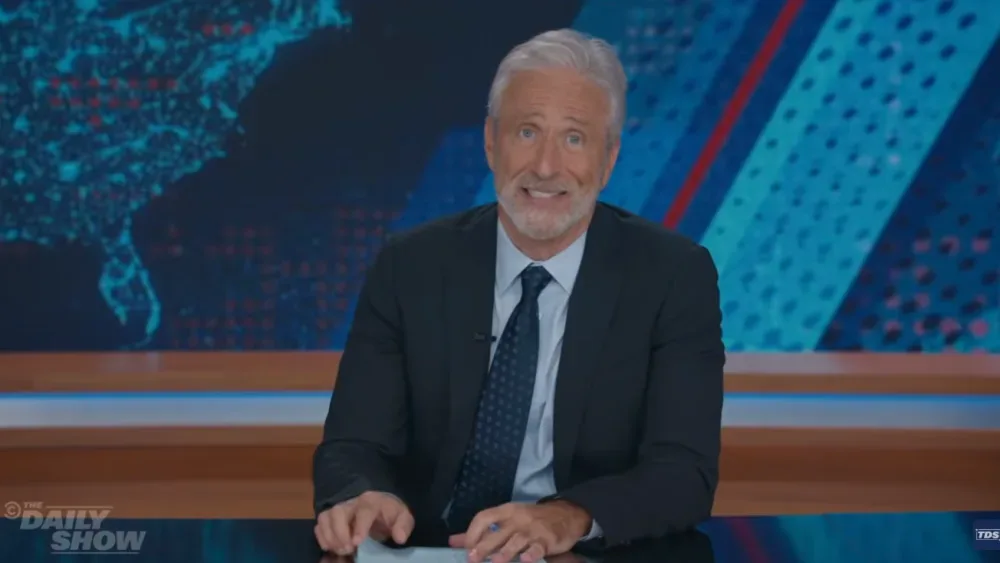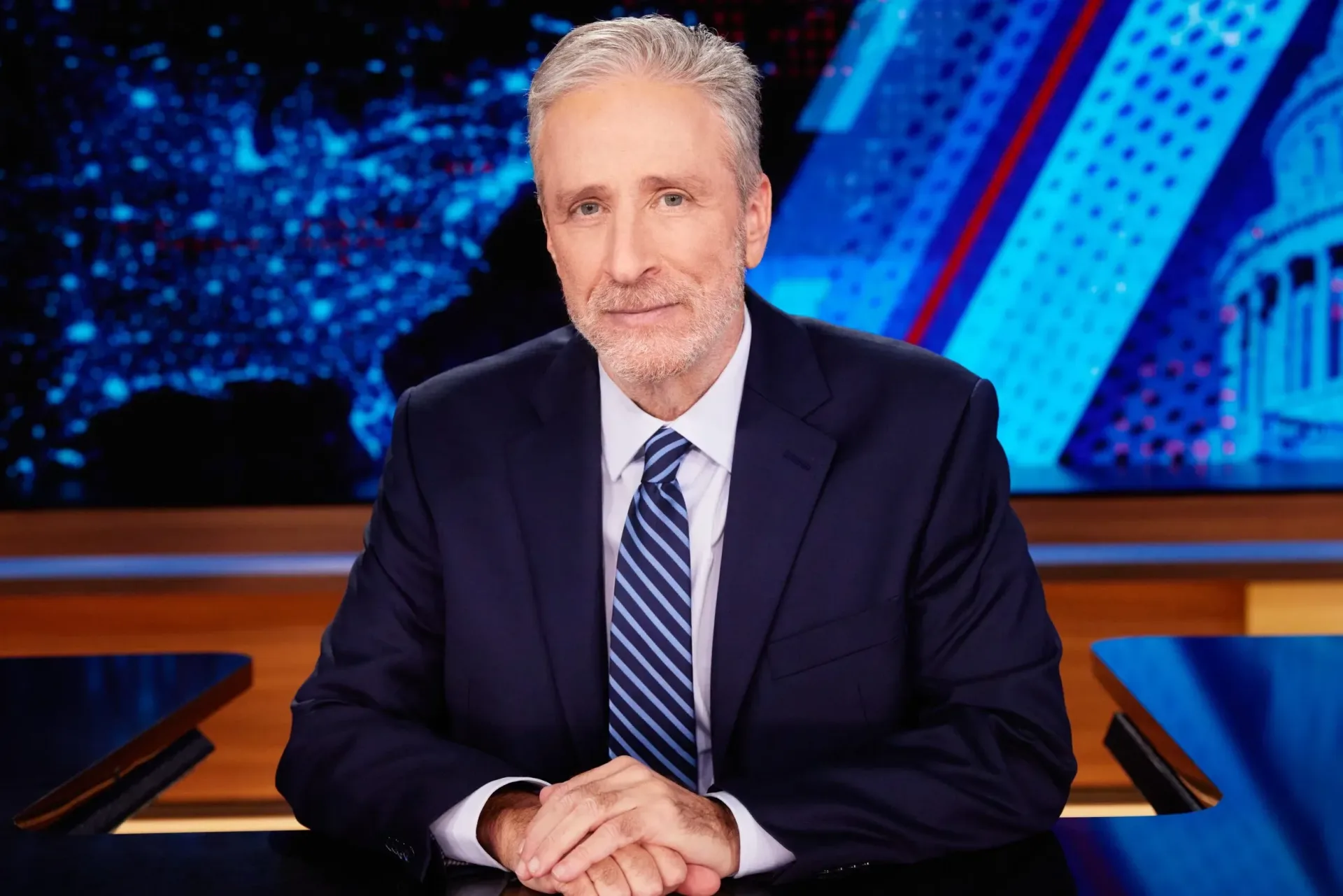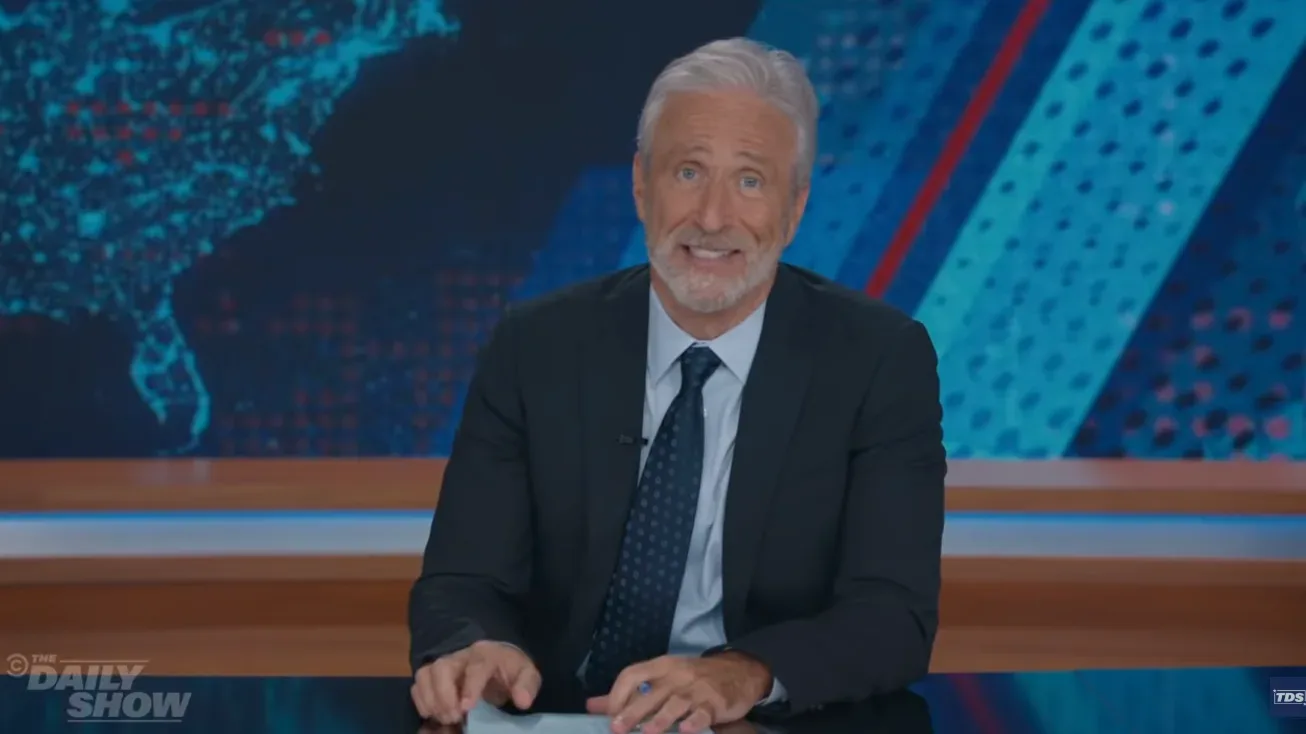
Jon Stewart has turned the announcement of his continued The Daily Show tenure into the first punchline of his next chapter. During Monday night’s episode, Stewart greeted guest David Corn with a wordplay joke, then abruptly added that the show’s renewal had been “pulled,” immediately apologizing for the bit.
The line was deliberately at odds with the news surrounding the episode: Stewart is set to remain host through 2028. His existing deal had been due to end at the close of 2026, following a one-year renewal signed in November 2025. Rather than treating the extension as a solemn corporate milestone, Stewart framed it as an excuse for a joke that is intentionally bad enough to invite its own rebuke.
That is a compact example of how the show’s monologue works. A current event supplies the premise, but the target is often bigger than the headline itself: political language, public posture, institutions trying to manage controversy, or the strange contrast between a serious event and the way leaders talk about it.
A renewal joke before the news jokes
Stewart first joined The Daily Show as host in 1999, departed in 2015, and returned in February 2024. The supplied information says ratings increased after that return. The new extension therefore keeps a familiar host at the desk for several more years while preserving the format audiences associate with him: a news-driven opening built around clips, commentary, exaggeration and comic comparisons.
George Cheeks, co-chair and chief content officer of Skydance TV, described Stewart as a “generational talent” and called The Daily Show a cornerstone of Comedy Central, while pointing to the continued partnership with Stewart and the program’s news team.
The early renewal gag is notable because it does not ask viewers to celebrate the business news for long. Stewart turns the subject into a self-own and moves on. That approach keeps the emphasis on the night’s political material rather than on the mechanics of the contract. It also recognizes that a late-night host announcing continued employment is, by itself, not necessarily a joke; the joke comes from pretending the opposite happened because of an awkward pun.
Vance and the question of “imperfect” rhetoric
The monologue’s first major political section focused on Vice President JD Vance. Stewart played a clip in which Vance apologized to a woman for what he described as “imperfect” rhetoric. Stewart’s response centered on the gap between that mild phrasing and what he characterized as rhetoric that can dehumanize immigrants and vulnerable communities.
His argument was comic but direct: calling consequential language a matter of sloppy wording, he suggested, sidesteps the question of whether it was part of a larger political strategy. Stewart’s use of an extreme nickname for Vance was plainly insult comedy, not a factual comparison. The substantive point beneath it was about accountability—whether a later apology sufficiently addresses language that critics regard as harmful.
Related coverage includes Jon Stewart Jokes About Renewal as ‘Daily Show’ Run Extends to 2028.
Why the distinction matters: “Rhetoric” means language used to persuade, shape perception or mobilize an audience. In political comedy, a host can scrutinize not only an official’s policy position but also the framing chosen to express it. Stewart’s punchline makes the framing itself the subject. He contrasts a description of an error as imperfect wording with his own far harsher reading of its potential effect.
That is not a neutral-news posture, and it is not intended to be one. Satire works by declaring a point of view, then heightening a contradiction until it becomes difficult to ignore. Viewers can distinguish the factual setup—a public apology—from Stewart’s interpretation of its meaning.
France, protest and a familiar revolutionary image
Stewart then shifted to unrest in France. French officials, as described in the supplied material, said the riots were not related to immigration, Islam or Muslim communities. Stewart juxtaposed that with a post from Vance claiming that Western liberals had “imported the third world” into France.
His rebuttal leaned on France’s long cultural association with revolution and protest. The gag asks viewers to see the premise as ahistorical: France hardly needs immigration as an explanation for the existence of demonstrations or upheaval. Stewart reinforced the joke with a theater reference to Les Misérables, invoking its well-known image of people singing amid a revolution.
The material then gave the protests an economic frame, describing rising living costs and fuel prices connected to the conflict in the Persian Gulf. Stewart used that premise to compare the French reaction with American political frustration. His joke about Americans perhaps responding by voting is a barb at perceived public inertia, not a claim that voting is unimportant. It turns on the distance between dramatic language about anger and the often slower, less spectacular ways democratic discontent may be expressed.
He also targeted French President Emmanuel Macron for attending a Celine Dion concert with his wife during the unrest. The joke spliced two pieces of pop-cultural shorthand: a reference to the viral Coldplay cheating scandal and Dion’s “My Heart Will Go On,” strongly linked with Titanic. Stewart’s imagined visual—enjoying the theme from a disaster movie while a country is in turmoil—was built entirely on metaphor rather than an assertion that the concert caused or resolved the crisis.
For another recent entertainment-and-public-life story, see Killer Mike’s involvement in the High Museum’s centennial event.
Trump, fuel sanctions and the “waver/waive” punchline
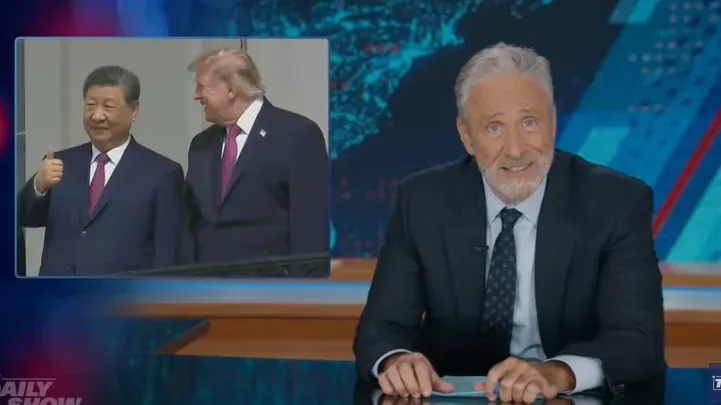
The final major segment addressed President Donald Trump’s comments on high gas prices, which Trump attributed to the war in Ukraine started by Russia. Stewart’s main comic target was what he presented as an inconsistency: sanctions on Russian fuel sales that were imposed and then quickly waived.
“We will not waver, but we will waive” compresses that criticism into a one-word switch. Waver means to hesitate or become less firm; waive means voluntarily refrain from applying or enforcing something. The humor comes from their similar sound and opposite political implications in this context. A government may project firmness while issuing an exemption, and Stewart uses the pun to portray those actions as contradictory.
He followed with a fake phone conversation featuring a Trump voice denying knowledge of a disruption to Ukraine’s access to “Starlink or Star Shield, whatever it’s called.” The uncertainty over the name is part of the sketch’s joke. Rather than offering a literal reconstruction of a call, the bit presents a caricature of evasive denial: the imagined speaker first says he did not do it, then says there was no action at all, then says he does not know where the system is, then argues it was not even slowed down.
Important context for watching the segment: a fake call in a comedy monologue is performance, not reporting. The underlying topic is presented as a serious one, but the dialogue is a device for criticizing the perceived logic of official responses. The viewer is meant to recognize the escalation of denial, not treat the exchange as a transcript.
What the extension means for the show’s format
The 2028 agreement offers continuity for a program that combines political satire with a rotating news agenda. The Monday monologue shows Stewart operating in the mode that defined much of his earlier run: assembling separate international and domestic subjects around a shared concern with language, leadership and public reaction.
There is no need for the subjects to be identical for the structure to work. Vance’s apology, French unrest, Macron’s concert appearance, fuel costs, sanctions and Ukraine-related communications are distinct topics. Stewart’s connective tissue is his recurring question: what does it look like when public figures explain away a contradiction, choose a tone that clashes with circumstances, or offer language that seems smaller than the situation it describes?
That is why the renewal joke belongs in the same monologue as the political material. It begins with Stewart puncturing his own good news, then spends the rest of the segment puncturing the explanations and optics of much more consequential news. His contract extension ensures that viewers will see more of that formula through 2028: current events converted into a mixture of clip analysis, theatrical exaggeration, cultural references and punchlines aimed at power.