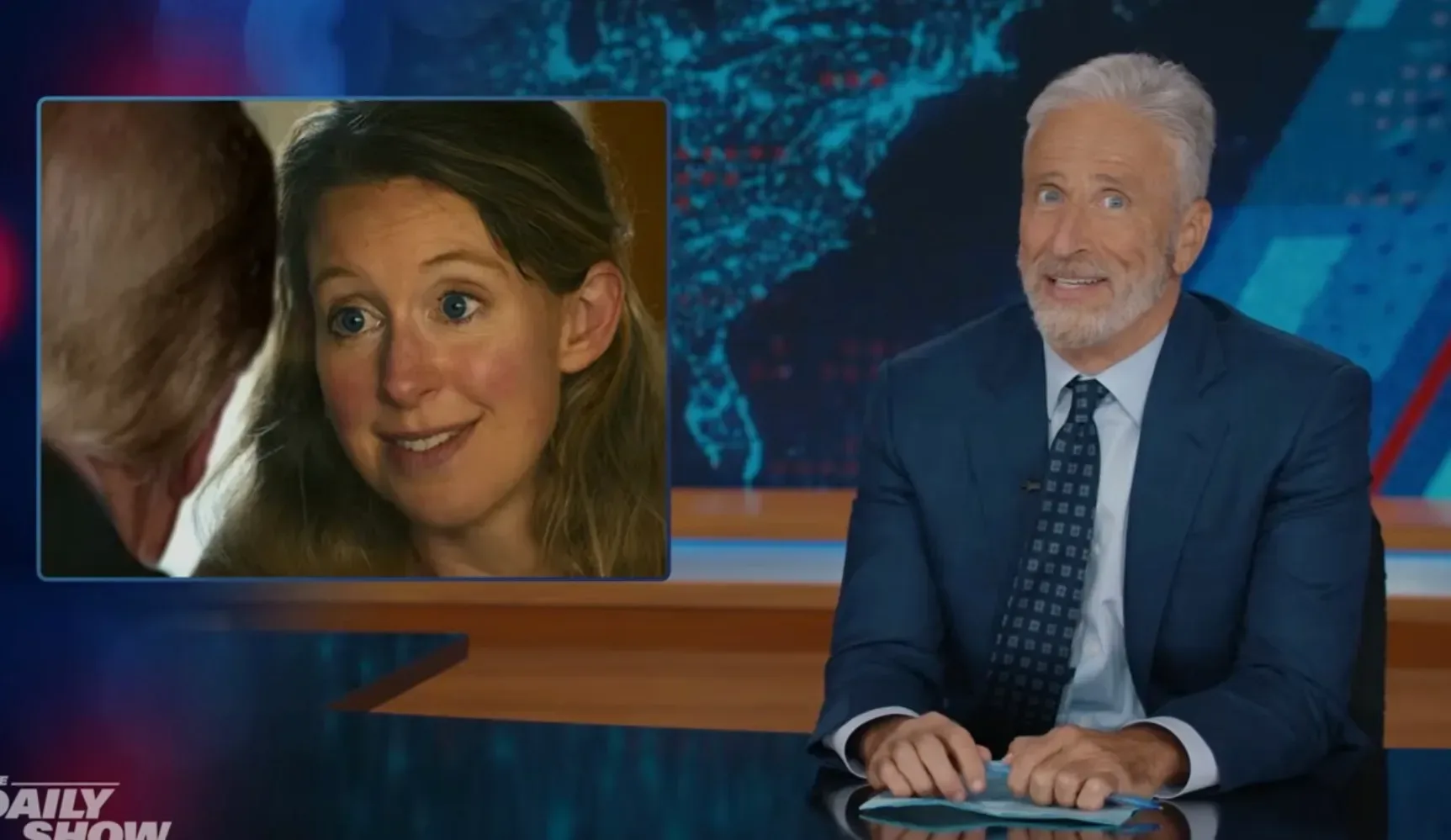
Jon Stewart took the most ceremonial parts of a reported Washington visit by Chinese President Xi Jinping and treated them like the opening cutscene to a diplomatic game that has forgotten its actual objective.
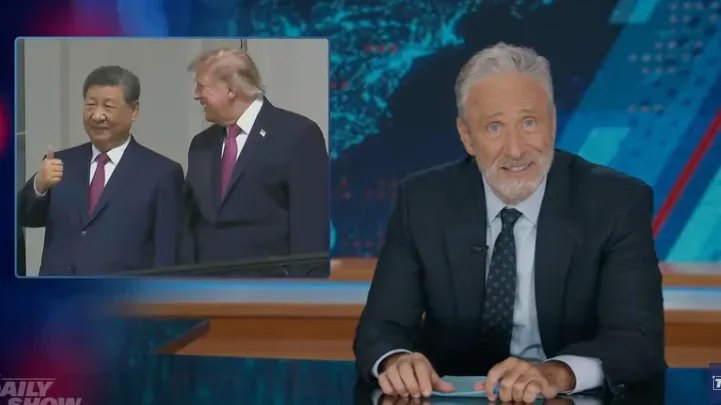
In a Monday-night The Daily Show monologue, Stewart focused on Donald Trump’s hosting of Xi during what the White House called a “reciprocal state visit.” His target was not simply the meeting’s existence, but the contrast between the stakes surrounding relations between the United States and China and the highly visual moments selected for public attention: an airport pickup, a tour of the White House, discussion of granite and a look behind a curtain at a ballroom project.
That contrast is the engine of the joke. A state visit is, by definition, an exercise in symbolism as well as policy. Hosts display ceremony, architecture, hospitality and access because every element can communicate status. Stewart’s routine instead asks viewers to imagine the visit as an awkward guided tour in which the host is enthusiastically pointing out home improvements while the guest is politely waiting for the consequential conversation to begin.
A house tour with geopolitical stakes
Stewart introduced Trump and Xi as leaders meeting over matters with implications for global safety and stability, then immediately undercut the gravitas by characterizing their opening activity as a “House Tour.” Footage showed Trump gesturing toward various features during the visit, and Stewart leaned into the physical comedy of one leader pointing while the other appeared reserved.
The premise works because it turns an image normally intended to convey warmth or prestige into something much more mundane. In Stewart’s telling, the summit had the vibe of a homeowner showing a visitor every renovation before getting to the reason they came over. It is a familiar social scenario, but here the “visitor” is the president of China and the setting is the White House.
Stewart then juxtaposed that visual material with Trump’s comment that Xi had “great interest in granite.” The comedian questioned whether Xi’s expression suggested such enthusiasm, escalating into a comparison with Shenzhen’s fully autonomous magnetic-levitation train. A magnetic-levitation, or maglev, train uses magnetic forces to lift and propel a vehicle rather than conventional wheel-on-rail contact. Stewart’s point was not a technical assessment of either country’s infrastructure; it was that a circular granite feature would be a difficult object to present as technologically awe-inspiring to a leader whose country is associated in the monologue with advanced transport systems.
In practical comedic terms, granite is perfect material for Stewart’s argument. It is solid, expensive-looking and permanent, but it is also inert. By placing it next to an autonomous maglev train, he creates a deliberately lopsided contest between decorative stonework and a complex piece of transportation engineering. The joke is about mismatched categories: one person seems to be pitching landscaping, while the audience has been reminded that the relationship between the two countries concerns far more than landscaping.
The ballroom becomes the recurring prop
Stewart brought the bit back to the proposed ballroom, citing a $600 million figure in a line about national security. He suggested that if security was the rationale, then the project would surely remain out of sight. The punchline arrived when Trump brought Xi and his wife through a curtain, with Stewart saying they were the first people to enter that area.
That is a classic late-night reversal. A setup establishes an apparently sensible expectation—sensitive or costly construction should not become a visitor attraction—then the clip supplies behavior that Stewart presents as contradicting it. He followed with a joke that Trump might be trying to rent the ballroom to Xi for a future event.
Stewart’s framing does not establish what was discussed privately, whether the ballroom carried the importance he assigns to it for comic effect, or what security procedures governed the visit. It is a satire segment, and its claims about priorities are an interpretation built around public footage and remarks. But the routine clearly identifies the perceived problem: high-level political imagery can become dominated by the easily televised, personally branded and visually extravagant parts of an event.
That concern has a broader resonance beyond this particular monologue. Diplomatic optics are the images and gestures that shape public understanding of a meeting: arrivals, handshakes, tours, press appearances and displays of personal rapport. They are not necessarily meaningless. At the same time, they do not tell viewers what agreements, disputes or warnings were raised behind closed doors. Stewart uses that gap—between what viewers see and what they need to know—to make the tour itself feel absurdly overpromoted.
A sharper turn toward weapons and security
The segment eventually shifts away from décor and into more serious territory. Stewart played reports saying that China had been sending weapons to Iran, then said that subject did not seem to arise in the public-facing material from the leaders’ meeting. He also reacted to footage that he interpreted as Trump offering to sell U.S. weapons to China.
After saying he needed to hear it from Trump directly, Stewart aired a clip in which Trump denied making such an offer while saying China would probably want to buy U.S. weapons because American equipment is better. The distinction matters. Stewart’s initial comic alarm rests on the tension between how remarks can sound in isolation and Trump’s subsequent denial that he had offered a sale.
This part of the monologue is noticeably less about a funny room or an uncomfortable facial expression. It turns the earlier question of priorities into a critique of public messaging around security-sensitive subjects. When weapons, China and Iran are introduced in the same portion of a comedy routine, the audience is invited to feel whiplash: the earlier talk of granite now looks trivial beside an issue with potential international consequences.
That does not turn the segment into a policy briefing. It remains a performance built from edited clips, timing and Stewart’s commentary. Still, the structure shows why political satire can be useful as a form of media criticism. It directs attention to sequencing and emphasis: what imagery was made prominent, what apparent subjects were left unresolved in public, and what statements require listeners to slow down and distinguish a suggestion from a denial.
Why Stewart’s format is built for this kind of story
Stewart’s best-known style often begins with a formal public event or media clip and applies the standards of ordinary human behavior to it. Here, an official visit becomes a house tour; praise for stonework becomes an overconfident sales pitch; a curtain reveal becomes an event-space advertisement. By shrinking the ceremony to the scale of a domestic interaction, he makes the larger political spectacle easier to question.
It also gives the audience a clean visual throughline. A complex U.S.-China meeting can involve numerous issues, but the supplied material offers only a handful of concrete public moments. Stewart does not pretend those clips account for the whole visit. Instead, he uses them as evidence of a communication problem: they are the moments that people are being asked to process, and they can create an impression of misplaced attention.
For viewers who follow late-night coverage of Trump, the approach should feel familiar. Another recent political-comedy story involved a Trump-related exchange on Jimmy Kimmel’s show that pivoted toward housing. The common thread is not that comedy programs replace reporting or diplomacy. It is that hosts frequently use the tonal mismatch between a public spectacle and its real-world backdrop as their entry point.
What the monologue actually leaves viewers with
The granite jokes are memorable because they are intentionally silly, but they are also a delivery system for Stewart’s larger point. He presents the Washington visit as an event that repeatedly invited viewers to notice the pageantry while offering ambiguous public signals about more serious matters.
His routine therefore moves in stages: first mock the tour, then question the display of the ballroom, then challenge the apparent handling of security concerns and weapons-related comments. The escalation is important. If the monologue only made fun of a president showing off a building feature, it would be a lightweight observational bit. By placing those images alongside U.S.-China competition and reports involving Iran, Stewart makes the humor a critique of what political leaders choose to foreground.
Whether viewers share that assessment will depend on how they interpret the clips and Trump’s denial regarding arms sales. What is clear from Stewart’s monologue is the comic case he makes: when a meeting between major powers is publicly remembered for a grand tour, granite and a curtain reveal, the images can make it seem as if the occasion’s symbolism has overwhelmed its substance.