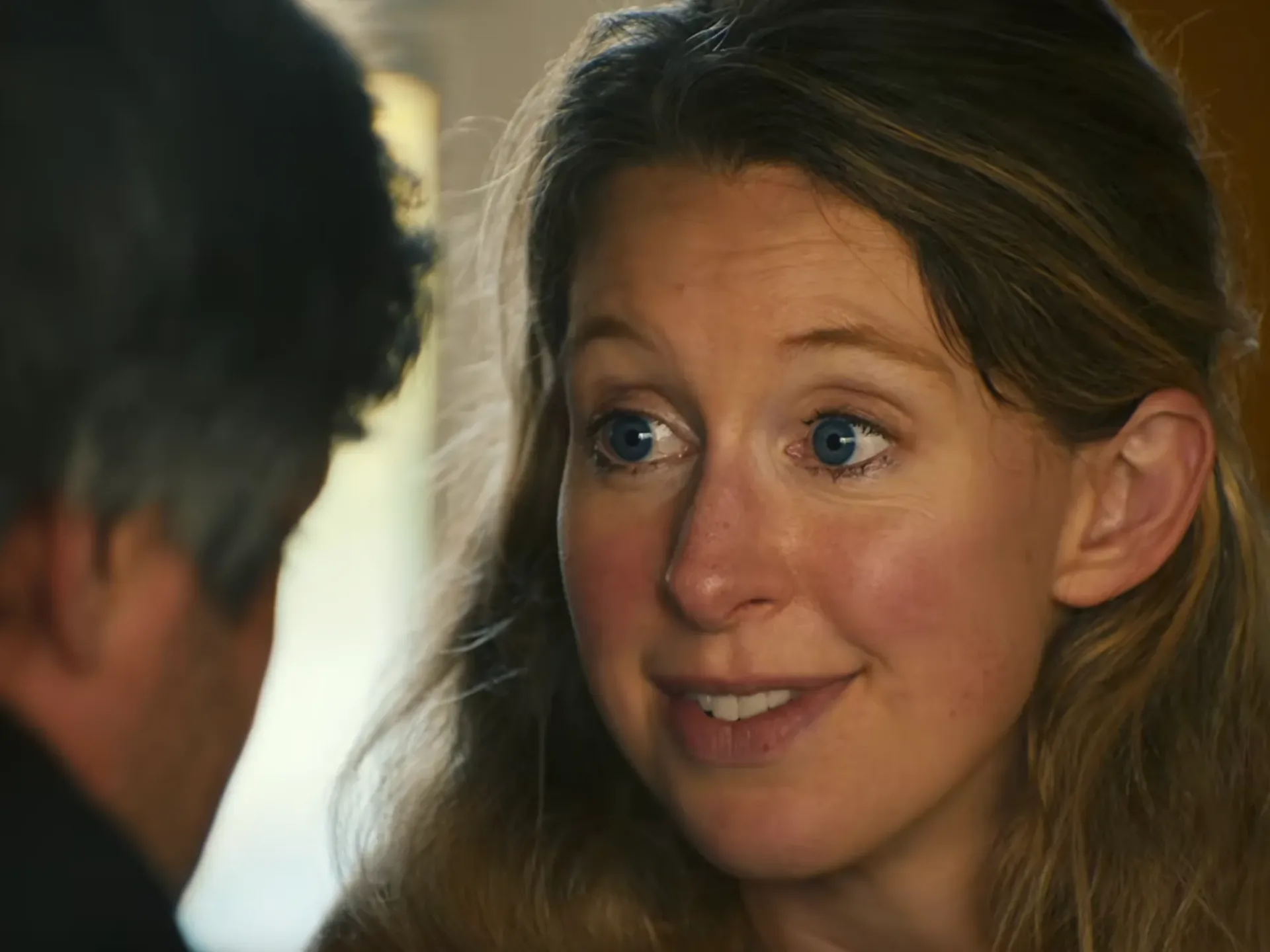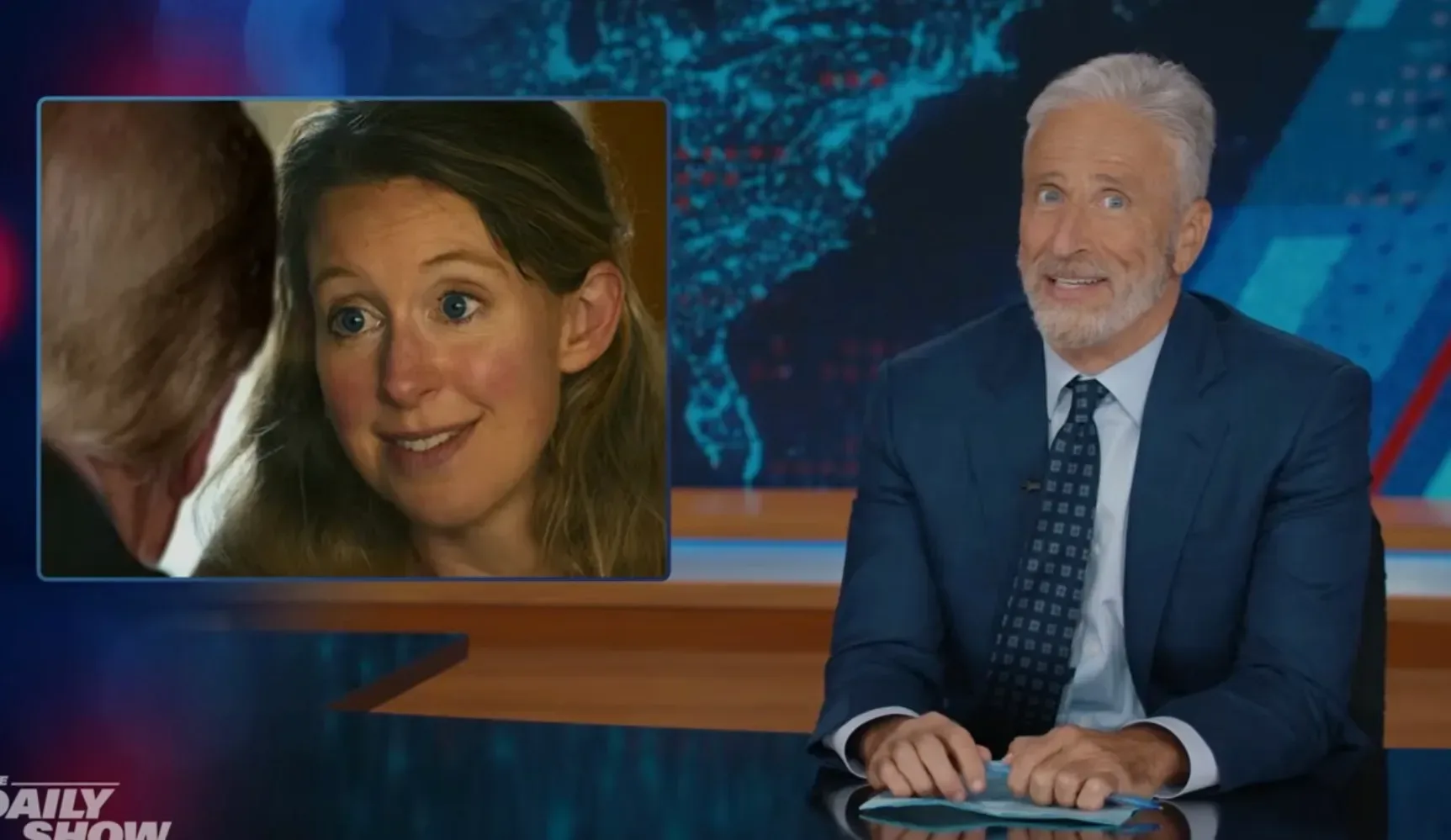
Jon Stewart returned to The Daily Show desk on Tuesday night with a familiar late-night-comedy tool: take a piece of current pop culture, place it beside political footage, and let the uneasy resemblance do the heavy lifting. This time, the borrowed framework was the trailer for You Can See Everything, Nathan Fielder’s documentary centered on Elizabeth Holmes.
The segment’s target was President Donald Trump and Natalie Harp, a staffer Stewart introduced through a run of televised news clips. Harp has been described as “the human printer,” a nickname connected to reports that she travels with a laptop and printer and supplies Trump with positive coverage. Stewart’s setup concerned what he called Trump’s “reality distortion field”: the idea that Trump frequently rejects the views of experts and journalists in favor of his own interpretation of events.
Rather than treat that observation as a policy debate, Stewart took the premise into a stranger, more cinematic direction. He referenced The Matrix and its famous choice between pills, suggesting that ignorance can look temptingly comfortable when reality is difficult to process. It was the kind of turn that makes a political monologue work as entertainment rather than merely a recap of a news cycle: an abstract complaint becomes a recognizable genre image, and a recognizable genre image becomes the runway for a trailer parody.
A documentary trailer becomes the punchline engine
The central gag was a re-edited version of the You Can See Everything preview. Stewart framed it as supposedly exclusive material collected after spending a month with Harp and Trump, then the show cut to the existing trailer concept with Trump superimposed over Fielder. The visual swap reframed the documentary’s mood of proximity, discomfort, and possible unreliability around the president and one of his closest aides.
The particular line selected from the trailer did a great deal of the work. In the preview, Holmes says, “Why would I deceive you? There’s no — there’s no reason for me to do that.” Put in this new context, the sentence becomes a deliberate collision of subjects rather than a factual comparison. Stewart’s bit did not need to argue that the people involved share the same history or legal circumstances. The comedy came from deploying a line about trust in a setting built around favorable information, loyalty, and the presentation of reality.
That distinction matters. Political satire is at its sharpest when viewers can see the mechanics of the edit. A recognizable clip carries its original meaning into the joke, but the new placement supplies the sting. The gag is not a documentary claim, and it is not presented as newly uncovered footage. It is an overtly absurd visual remix constructed for a late-night segment.
Why Natalie Harp is essential to the framing
Stewart did not build the segment around Trump alone. Harp is the hinge that makes the printer joke, the information-management theme, and the trailer parody fit together. The news clips used in the monologue described her close proximity to Trump and her role in delivering positive stories. Another clip said she once got into the trunk of an SUV so she could accompany Trump to a court appearance. A further report characterized letters she wrote to Trump as resembling love letters.
Those details gave Stewart an exaggerated but ready-made character setup: a fiercely devoted staffer acting as a personalized feed of flattering material. From there, the parody could borrow the anxious intimacy of Fielder’s documentary trailer. The result was less about a single topical jab than about how a political figure’s orbit can be presented through a familiar entertainment grammar: the devoted associate, the closed loop, the camera crew that appears to witness something it may not fully understand.
Related coverage includes Jon Stewart Reworks ‘You Can See Everything’ Trailer in Trump and Natalie Harp Segment.
Stewart introduced the edit by jokingly asking whether Harp could be trusted, before inviting the audience to make up its own mind. The wording plays into the trailer’s subject matter. Questions of belief, manipulation, and reassurance are not just themes attached after the fact; they are already embedded in the Holmes footage used for the punchline.
The unusual afterlife of a viral trailer
You Can See Everything arrived with a notably unusual premise and release-story context. The documentary debuted at the Telluride Film Festival in a secret screening. It follows Fielder and a reluctant camera crew as they film Holmes at her home in the weeks before she reports to prison. Holmes was sentenced in 2022 to more than 11 years in prison for defrauding investors through Theranos, the health-technology startup she founded.
That background explains why the trailer is such a potent object for parody. Its tone is not the polished, triumphant language of a standard celebrity documentary preview. It is inherently tense. It involves a public figure whose statements and image have long been examined, a filmmaker strongly associated with awkwardly engineered reality, and a camera crew whose hesitation becomes part of the story. Even in a very short clip, those elements create an atmosphere of unstable trust.
Stewart’s segment leverages that atmosphere without needing to reproduce its full narrative. A trailer can now become part of the shared toolkit of television comedy almost as quickly as a campaign ad, a press clip, or a blockbuster scene. Once a preview is familiar enough online, its cadence and individual lines can be repurposed as cultural shorthand. The audience arrives already carrying some of the original associations; the new edit simply redirects them.
That is also why the bit works better than a generic fake trailer. The emotional texture is specific. A conventional movie-preview voiceover could offer broad jokes, but this material already has an unnerving, intimate quality. Stewart’s Trump-and-Harp version uses that quality to suggest a relationship shaped by affirmation and carefully selected information, all while keeping the premise visibly comic.
Late-night satire and the remix tradition
Trailer parodies have long been a dependable late-night format because they combine speed with recognizability. They can respond to news without requiring an entire scripted sketch universe. A face replacement, a recontextualized line, and a short setup can create an immediate before-and-after contrast. The format is particularly flexible when politics and entertainment are both already commanding attention.
Stewart’s use of the Fielder-Holmes trailer sits squarely in that tradition, but the choice of material gives it an extra layer. Fielder’s work has frequently blurred performance, reality, elaborate setups, and the viewer’s ability to confidently separate one from another. A documentary involving Holmes, who was convicted over conduct tied to Theranos, carries its own public questions about credibility. Putting Trump into that visual space turns the parody into a joke about curated perception.
It is a reminder that entertainment references can be more precise than a simple celebrity cameo. A single trailer has a structure, a reputation, and an emotional temperature. When Stewart recasts it, he is borrowing all three. The result asks viewers to recognize not only Trump and Harp, but also why this particular trailer makes an effective vehicle for the joke.
For readers interested in how comedy properties are continually reshaped for a new era, there is a related entertainment development in the reported early move toward another Get Smart film reboot. The comparison is not one of subject matter, but of form: satire repeatedly finds new containers, whether that means reviving an espionage-comedy institution or turning a freshly viral documentary trailer into a political sketch device.
What the segment actually says—and what it does not
The monologue’s argument is ultimately about perception. Stewart portrayed Trump as someone surrounded by validation and disconnected from inconvenient expertise, then used Harp’s reported role and public descriptions to sharpen the picture. The altered trailer provided the final comedic image: a mock documentary environment where the viewer is encouraged to question the sincerity of what is being presented.
But the distinction between satire and reporting remains clear in the construction. The news clips establish the segment’s stated basis for discussing Harp. The “month” of access is a joke. The footage is a parody edit. Trump’s image replacing Fielder’s is a visual gag, not a claim that Trump appeared in the documentary or participated in its production.
That clean separation is part of the bit’s appeal. Stewart can go broad because the artificiality is obvious, while the comedic target stays tied to the theme introduced at the desk: who gets to shape the information around a powerful person, and what happens when positive reinforcement becomes its own private reality.
In a short span, the segment moved from The Matrix to Theranos-era documentary imagery and then to a pointed Trump-and-Harp parody. It is an unusually compact example of modern late-night comedy’s remix logic: topical reporting supplies the setup, film and television supply the language, and a highly recognizable trailer supplies the final boss battle of the punchline.