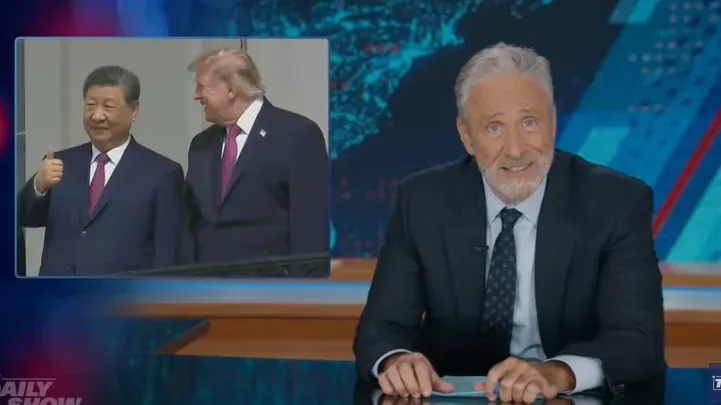
Jon Stewart’s latest The Daily Show monologue built its comedy around a jarring contrast: the public-policy concerns that shape an election campaign and the attention-grabbing clips that can rapidly take over the conversation instead.
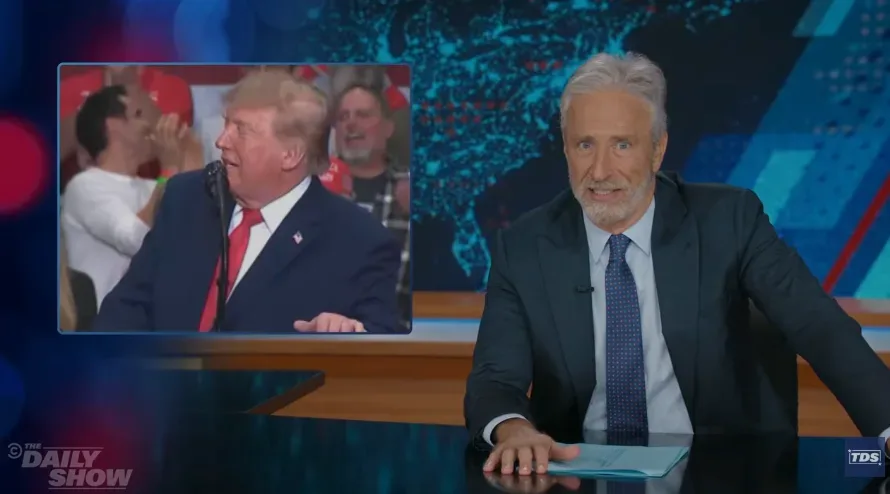
Opening on the midterm election environment, Stewart pointed to issues including the economy, the cost of living and the war in Iran. He then pivoted to footage of Donald Trump making conspicuous comments about people’s bodies, including a remark at a Michigan rally about Nicki Minaj. Stewart’s response was not simply that the language was inappropriate; the larger joke was that such a digression could become a campaign moment while voters are weighing weightier subjects.
The host framed Trump as someone seemingly unable to resist narrating what had caught his eye. In Stewart’s telling, that mismatch was the material: a political figure meant to be delivering a closing case to voters, interrupted by a fixation on a celebrity’s appearance.
From campaign message to comic detour
Stewart first played a clip in which Trump talked at length about a man’s physique, describing the person’s backside as unusually muscular. He followed it with footage from Saturday’s Michigan rally, where Trump referred to Minaj’s “beautiful” appearance. The comedian treated the progression as an escalating example of a candidate wandering far away from an expected campaign message.
Minaj is the rapper at the center of the second clip, but Stewart’s target was Trump’s behavior in the footage, not Minaj herself. Stewart imagined Trump summoning her to turn around for the crowd, then snapped back to the subject of inflation. That abrupt return was intentional: it underlined his argument that the campaign’s conversational priorities had become bizarrely inverted.
Stewart’s premise was that a discussion supposedly centered on voters’ financial concerns had been derailed by commentary that had nothing to do with them.
He extended the gag by describing Trump as visibly transfixed while Minaj spoke, comparing the expression to a cartoon character drifting toward a tempting pie. It is a familiar visual-comedy device: take a real clip, freeze on an expression or action, then assign it an exaggerated cartoon logic. The technique lets the host turn a fleeting reaction into a scene with a clear comedic point of view.
The segment also illustrates why celebrity references remain so potent in political comedy. A reference to a musician brings a political moment into the wider entertainment conversation almost instantly. It is recognizable, shareable and, in this instance, far more personal than a policy sound bite. That does not make it a substitute for discussion of policy. Stewart’s monologue was built around precisely that tension.
Minaj’s name has enough cultural reach that even a brief rally mention can eclipse the intended political message online. Entertainment and politics often intersect that way: the celebrity is not necessarily making the news, but becomes the recognizable point through which a political clip travels. For more music-and-public-culture coverage, see the report on Jay-Z’s planned 2027 Super Bowl halftime appearance.
A second target: an Ohio ad built around estrangement
The monologue’s other major topic was an advertisement from Ohio Republican gubernatorial hopeful Vivek Ramaswamy. The ad features the estranged mother of Democratic candidate Amy Acton. Stewart’s criticism focused on crucial context surrounding the appearance: Acton and her mother have not spoken for 50 years, and Stewart said the estrangement followed a family history in which Acton’s mother lost custody after her husband at the time was indicted for raping Acton.
That information changes the meaning of the ad’s premise. Political advertising frequently relies on testimony from relatives because family members carry an assumption of intimate knowledge and emotional credibility. But estrangement is not a minor disclaimer when it is central to the relationship being presented. It can fundamentally alter how viewers assess the speaker’s proximity to the candidate, their reliability as a witness to the candidate’s life, and the ethics of making a family rupture part of a campaign message.
Stewart approached the material through grim incredulity. He suggested the commercial might initially appear compelling, then dismantled that impression by laying out the circumstances he said were omitted. His joke about an “evil word generator” made the point in heightened form: the facts, as summarized in the monologue, were so severe that they could sound contrived if they were not being presented as the background to a real political attack.
Why the omitted context matters
“Context” can be an overused word in political coverage, but it has a specific practical meaning here. A campaign ad is usually brief by design. It selects an image, a claim and a narrator in order to make an impression quickly. Viewers then decide whether the ad has given them enough information to interpret what they have seen.
In this case, the relevant context is not peripheral biography. It speaks directly to why the person in the ad has been disconnected from Acton for decades. Stewart’s critique was that the commercial asks audiences to treat an estranged parent as a straightforward character witness without fully confronting the history behind that estrangement.
The host also played a clip of Trump defending the ad. When a reporter asked whether the sexual-abuse allegations mattered to him, Trump called the reporter a “horrible little reporter.” Stewart answered with a pop-culture comparison to Miss Hannigan, the abusive orphanage keeper from Annie. The reference packages the criticism into a widely understood archetype: an authority figure responding to vulnerability with callousness.
It is an especially sharp comparison because it does not require a long explanation. Stewart did not need to recap the whole musical or film. The name alone signals a mean-spirited caretaker, letting the audience connect the character shorthand to the exchange in the clip.
What the monologue is actually arguing
The two parts of the segment may look unrelated on the surface. One concerns a president’s comments involving a major rapper; the other concerns a state-level campaign ad and a painful family history. But Stewart linked them through a consistent criticism of political attention.
In the first section, attention moves from economic pressures, living costs and war to remarks about physical appearance. In the second, attention is directed toward a candidate’s family conflict without, Stewart argued, supplying the essential history needed to understand it. One is a distraction created through spectacle; the other is an attack that becomes more troubling when its framing is examined.
That structure matters. Political satire is sometimes mistaken for a string of reactions to individual clips. Here, the clips serve a broader editorial construction. Stewart began with the issues voters may reasonably expect to hear addressed. He then showed political communication veering into a celebrity-focused aside and a family-based attack. The laughter comes from the absurdity and the cruelty, but the editorial point is about what receives oxygen during a campaign.
There is also a difference between the two comic modes Stewart used. The Minaj material is performed as exasperated surrealism: his imagined dialogue and cartoon metaphor make Trump’s apparent fixation seem even stranger. The Acton material is more prosecutorial in form. Stewart introduces the ad, identifies the missing context and directs the audience to a response from Trump. Both are jokes, but the second relies far more heavily on the seriousness of the underlying allegation.
That distinction is worth keeping in mind when watching satirical news programming. A host may be entertaining, but the construction of the segment still tells viewers how the host believes they should weigh the clips: laugh at the spectacle, then examine the consequence of the messaging behind it.
Stewart’s extended Daily Show run
The monologue arrives shortly after confirmation that Stewart will remain host of The Daily Show through 2028. His agreement had been scheduled to end at the close of 2026 following a one-year renewal in November 2025.
Stewart originally began hosting the program in 1999 and left in 2015. He returned in February 2024, after which the show’s ratings increased. The new extension means the program will continue to have Stewart at its center across a longer stretch of political coverage, including the campaign climate reflected in this monologue.
That continuity is significant for a format that relies on a host’s voice as much as its nightly headlines. Stewart’s approach in this segment was recognizable: start with the gap between a public issue and political theater, isolate a revealing clip, turn it into an absurd image, and then move to a critique of the underlying conduct. Whether the subject is an unexpectedly personal celebrity reference or an ad built around a decades-long estrangement, the method is to make the framing itself part of the joke.
For viewers, the practical takeaway is not that a comedy show replaces detailed reporting on elections, candidates or allegations. Rather, the segment is a compact example of how satire can flag a messaging problem: what has been said, what has been left out, and why the mismatch is likely to draw a reaction. In Stewart’s latest monologue, Minaj’s name supplied the immediate viral hook, while the broader target was a political culture where spectacle can crowd out the issues that were supposed to be on the ballot.