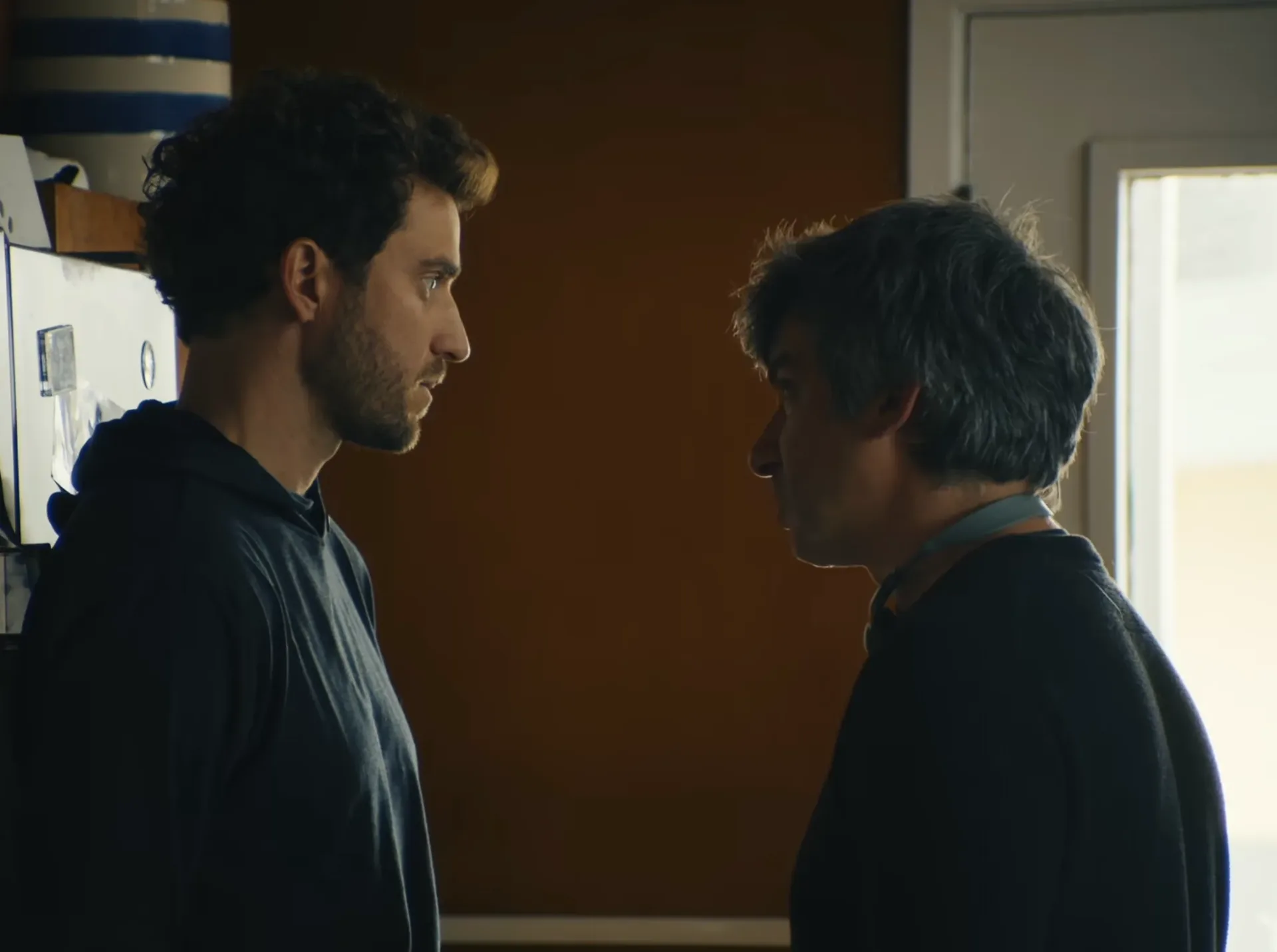
Jimmy Fallon and Jamie Lee Curtis turned a routine late-night guest appearance into a deliberately uncomfortable comedy exchange, spoofing the reported dynamic of You Can See Everything. In the cold open, Fallon performed as Nathan Fielder while Curtis, in a blonde wig, took on an Elizabeth Holmes-inspired role.
The basic comic engine was simple: Fallon’s character kept asking whether Curtis’s character was genuinely interested in being there, and Curtis responded with intensely assured denials. Rather than moving quickly to the guest’s actual project, the scene lingered on whether a promotional appearance can ever be entirely sincere. That is a familiar late-night setup made stranger by the particular figures being imitated: one person presses for authenticity, while the other insists so emphatically that nothing is being concealed that the claim becomes its own punchline.
An interview where reassurance is the joke
Fallon opens by asking Curtis whether she really wants to be on the program. Curtis replies that she loves talking to him, looking directly at him while delivering the line in the sketch’s Holmes-like voice. When Fallon asks if she is there only to promote Newlyweds, Curtis says she is engaging with him “as a human being,” then argues that she has no reason to deceive him and nothing to deceive him about.
The writing lets the repetition do the work. Each reassurance is technically an answer, but its over-specificity makes it funnier and less reassuring. Fallon ends the chat with another confirmation-seeking question about whether she is being real. Curtis says she always is. Once Fallon has left, however, her character abruptly drops the pleasant façade and curses him out.
That final reversal supplies the sketch’s payoff, but it also clarifies the parody’s shape. The scene is not simply a celebrity impression showcase. It is about performance inside performance: a guest playing a version of a person who is herself playing the perfect late-night guest. The public-facing politeness is treated as an unstable mask, and the joke lands when it finally slips.
Why the Fielder and Holmes pairing matters
The cold open draws from You Can See Everything, the film co-directed by Fielder and Lance Oppenheim. The movie debuted in theaters on Oct. 16 after more than three years of work and centers on Theranos founder Elizabeth Holmes in the month before she began an 11-year prison sentence for defrauding investors.
Within the sketch, Fielder and Holmes represent sharply different kinds of discomfort. Fallon’s Fielder-inspired character is framed as relentlessly inquisitive, asking a socially awkward question and then refusing to let it disappear. Curtis’s Holmes-inspired character responds with a polished, almost aggressively composed assurance. The satire comes from the collision: interrogation meets presentation, and neither side behaves in a way that permits an ordinary celebrity interview to proceed.
It is also an effective format for a cold open. A cold open is the pre-title segment that begins a television program before its regular introduction. It has to establish a recognizable premise quickly. Here, the recurring question of whether Curtis’s character is “real” gives the segment a clean spine, while the wig, voice, staring and sudden outburst make the references legible without requiring a complicated plot.
Related coverage includes Jimmy Fallon and Jamie Lee Curtis Spoof ‘You Can See Everything’.
The spoof does not establish that it is recreating a specific exchange from the film. Instead, it uses a stylized premise associated with the movie: probing questions about honesty and a subject whose insistence on credibility creates its own tension. That distinction matters. A parody can borrow a tone, relationship or public image rather than claim to reproduce events verbatim.
Curtis’s actual reason for visiting: Newlyweds
Underneath the sketch’s repeated suspicion about promotion was a real promotional stop for Newlyweds, the NBC sitcom that premiered Oct. 23. The series stars Téa Leoni and Tim Daly and follows a free-spirited woman and a buttoned-up professor who marry impulsively after a whirlwind courtship. Its premise places a later-in-life romance at the center of the show.
Curtis appears in a recurring guest-star role and co-created the series with Gail Lerner. Lerner was removed from the show earlier in the month over creative differences. In a statement issued when that news emerged, Lerner called her work on the series the most joyous television experience of her life.
There is a useful contrast between the sitcom’s stated premise and the cold open’s comic premise. Newlyweds is built around a rapid romantic commitment between two mismatched people. The spoof, meanwhile, is built around an interaction where no amount of verbal commitment can establish trust. One story starts with people acting on a life-changing belief in one another; the other turns a simple conversational exchange into a spiral of doubt.
That does not mean the two projects are thematically connected. It does explain why the cold open works as more than a detached topical reference. The sketch begins by pretending to challenge the premise of the guest’s appearance, then makes that challenge the entire subject of the scene. Curtis can promote a romantic comedy while also playing against her public persona in a heightened, hostile, knowingly artificial bit.
What the segment says about the promotion ritual
Late-night interviews run on a well-understood agreement. Guests have projects to discuss; hosts make that discussion entertaining; viewers accept that publicity is part of the exchange. The Fallon-Curtis sketch turns that agreement inside out by treating the promotional purpose as something that must be interrogated.
In practical terms, that is why Fallon’s repeated questions matter more than any one individual impression. Asking a guest if they are there to promote something is normally unnecessary because everybody understands the answer. The sketch pretends not to understand it. Curtis’s character then treats the obvious question as an existential accusation. The more she denies the obvious, the more conspicuous it becomes.
It is a compact example of dramatic irony: the audience knows the character is on the show in connection with a project, while the character insists that the visit is purely personal. Dramatic irony does not require the audience to know every detail of the underlying movie. It only requires viewers to recognize the mismatch between the social reality of the appearance and the performance of sincerity occurring onscreen.
The closing profanity changes the scene from awkward to openly adversarial. Without it, the scene would be an extended loop of question and denial. With it, the segment reveals that the politeness was not merely strained; it was false. That is a blunt ending, but it fits a spoof focused on claims of authenticity.
A timely parody built around a theatrical hit
You Can See Everything has generated both critical attention and commercial momentum. Its domestic box-office total stands at $45.1 million to date. The combination of a current theatrical release, recognizable public figures and an immediately understandable tension around deception gave the late-night show a topical foundation for its opening sketch.
For viewers following movie coverage more broadly, the piece sits alongside other recent discussion of how films are framed, sold and received, including a look at “The Mosquito Bowl” and its crowded WWII spectacle. The Fallon-Curtis segment takes a different approach: rather than assess a film directly, it uses a film’s cultural footprint as the setup for a performance about discomfort, credibility and the transparent machinery of celebrity promotion.
There is no need for the bit to resolve the questions it raises. In fact, its humor depends on refusing resolution. Fallon’s character cannot get a satisfying assurance because every assurance sounds more carefully managed than the last. Curtis’s character cannot make the conversation normal because she is playing someone for whom normal reassurance has become suspicious. The scene’s achievement is to make that deadlock entertaining in just a few escalating exchanges.