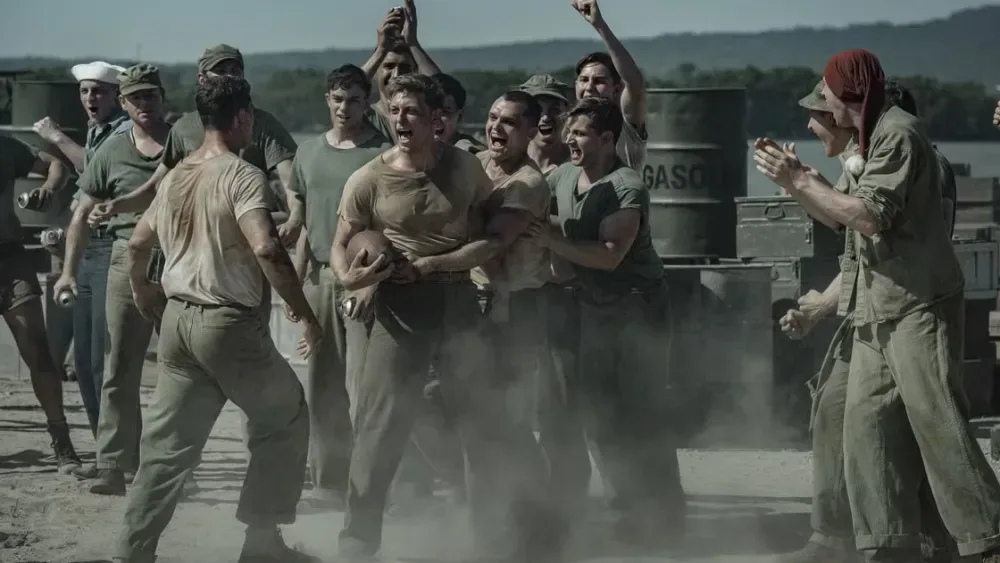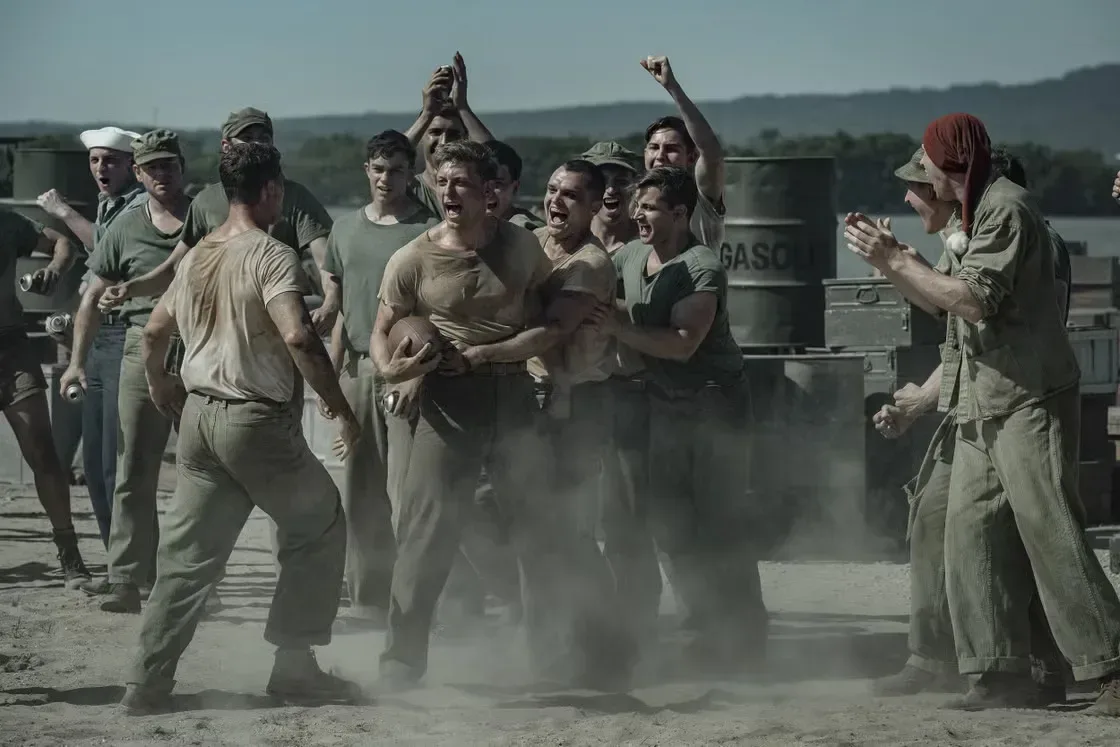
Peter Berg’s The Mosquito Bowl has an inherently striking premise: gifted college football players put their sporting futures aside, join the Marines after Pearl Harbor, and eventually take part in a football game on Guadalcanal amid the Pacific theater of World War II. It is a story built around collision—between sport and service, camaraderie and violence, ritualized competition and combat with life-or-death stakes.
Yet the film’s central tension is also its major hurdle. The Mosquito Bowl is most energized when it is depicting battle as a sensory assault: gunfire, injury, movement and a dense wall of sound. The actual football game promised by the title, however, is tasked with carrying an emotional and historical weight that the drama around it does not fully build. The result is a muscular war picture with undeniable technical impact, but a thin human core.
Directed by Berg and written by Berg with Mark L. Smith, the R-rated film runs 127 minutes. It adapts Buzz Bissinger’s 2022 historical novel, with Bissinger also serving as an executive producer. Berg and Bissinger are cousins, and the project joins two names with an established football connection: Bissinger wrote Friday Night Lights, which Berg previously adapted into a 2004 film before it expanded into a television series.
The real game behind the title
The title refers to a real football game held on Guadalcanal on Christmas Eve 1944. It was played between the 4th and 29th regiments of the 6th Marine Division and included players who had been college football talents before military service interrupted their paths. That factual basis gives the movie a potentially unusual way into the war-film genre.
Football is more than background decoration in Berg’s version. The script repeatedly connects the structure and shared purpose of a team to the Marine Corps. One line declares the Corps the greatest offensive line in history, a comparison that announces the film’s preferred vocabulary: toughness, formation, sacrifice, physical dominance and brotherhood.
That approach has a practical dramatic benefit. It quickly explains why these young men recognize one another’s abilities and cling to familiar routines. A game can offer a temporary framework of rules and identity to people whose lives have been overtaken by a vast, violent conflict. But the analogy is also limited. Football’s violence is regulated, symbolic and bounded by a final whistle; war is not. The film’s strongest idea should be the uncomfortable gap between those two realities, rather than simply treating one as a rousing metaphor for the other.
The film evidently aims to elevate the Guadalcanal game into a respite with the symbolic pull of the World War I Christmas truce matches between British and German forces. But the game itself proves difficult to make into a climax. It arrives after substantial anticipation, yet the surrounding battle sequences are so loud, graphic and kinetically staged that the contest carries less immediate force. Instead of becoming the emotional answer to everything that came before, it can feel like a brief pause inside a much more familiar combat epic.
Four players, one blurred perspective
The story centers on four football standouts who become Marines. Nicholas Galitzine plays John McLaughry, a Brown University graduate whose prospective future with the New York Giants is put aside following Pearl Harbor. The film gives McLaughry the framing perspective, showing him returning to a college football field years after the war and considering what was lost.
Related coverage includes ‘The Mosquito Bowl’ Review: Football, Firepower and a Thin Human Core.
Ray Nicholson plays Purdue graduate Tony Butkovich; Tom Francis plays Wisconsin Badgers player Dave Schreiner; and Bill Skarsgård plays another Wisconsin graduate, Bob Baumann. Each performer brings a recognizable screen presence, and the cast also includes Brent Comer, Pat McAfee and Dominic Bogart.
But the screenplay appears to give its quartet only light distinctions: an earnest leading man, a more jocular teammate, a more introspective figure and another player whose identity sits somewhere between those established types. These are capable actors, but capability is not the same as characterization. In a story asking viewers to feel the accumulated effect of training, combat, friendship and loss, the audience needs more than four square-jawed figures sharing an outline of patriotic resolve.
The problem matters especially because the film returns to McLaughry after the war. Framing scenes can create retrospective meaning: the survivor knows the cost even if the young version of himself does not. Here, that device offers solemnity, but apparently not enough specific reflection to turn memory into a fully developed point of view. The movie gestures toward the personal aftermath of war while concentrating far more insistently on the immediate spectacle of it.
Combat rendered at maximum volume
The Mosquito Bowl takes the men from Parris Island basic training to the Pacific. The training material and subsequent combat beats use familiar military-drama architecture, while the film’s craft departments push for visceral impact.
Jacques Jouffret’s cinematography uses a strongly desaturated image, draining much of the color from the frame. In visual terms, desaturation means reducing color intensity. Filmmakers can use it to make environments feel harsh, aged, bleak or emotionally depleted. Combined with point-of-view camerawork and anxious cutting from editors Jon Otazua and Garret Donnelly, it creates an agitated perspective that seeks to place viewers close to confusion and bodily danger.
Explosions in the Sky supplies a guitar-heavy score, while the sound design leans into relentless bursts of gunfire and impact. This is not a restrained treatment of combat. The film’s technical presentation is designed to be overwhelming, using graphic wounds and chaos as a blunt reminder that war destroys bodies and nerves alike.
There is a fine line between immersion and exhaustion. An immersive battle sequence lets an audience understand fear, disorientation and vulnerability. Exhaustion happens when escalation becomes the primary tool—when louder sound, faster cutting and more injury repeatedly replace a widening understanding of the people caught in the conflict. The latter seems to be the risk here. The filmmaking can generate force without necessarily generating deeper feeling.
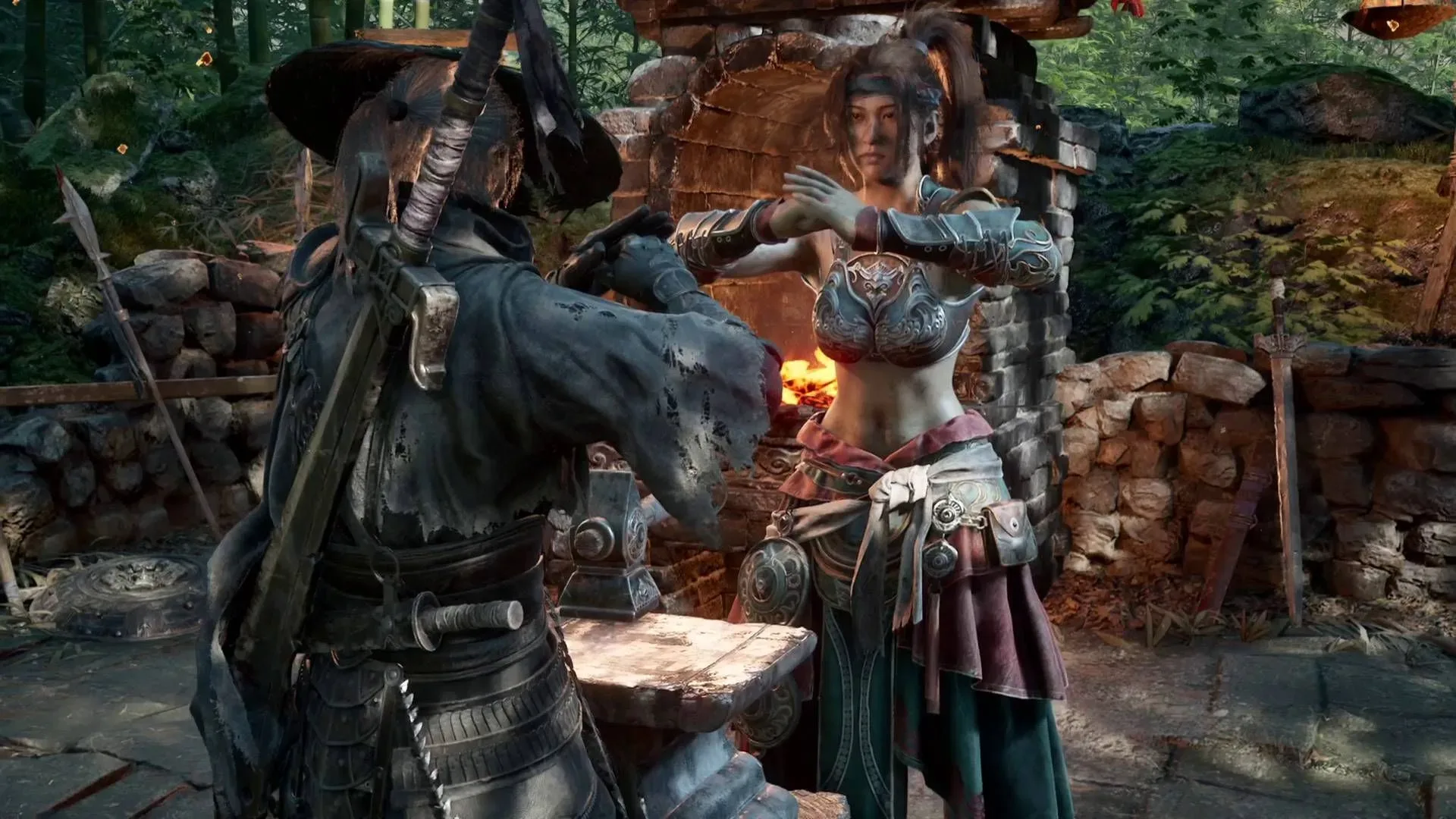
The movie’s high-intensity approach has also been compared to video-game visual grammar: aggressive point of view, frantic movement and action that presses forward with little downtime. That comparison is not automatically an insult. Games can make spatial confusion, pressure and split-second decision-making legible in powerful ways; readers interested in how combat mechanics turn those pressures into choices can see the design vocabulary at work in this breakdown of parrying, resource management and boss pressure in Phantom Blade Zero. In a film about an actual war, however, visual intensity needs character and perspective around it. Otherwise, the imagery can turn suffering into an endurance test for the viewer rather than an inquiry into what violence does to people.
The missing moral pressure
The deeper concern is not simply that the film celebrates Marine resilience or football culture. Stories about solidarity under extreme conditions can be moving, and war films are not required to abandon heroism to acknowledge horror. The issue is whether a film treats its heroes’ language and worldview as part of the moral terrain—or merely as period flavor beneath a flag-waving surface.
The Mosquito Bowl includes Japanese soldiers committing seppuku and being executed by American captors. It also features its American characters speaking in explicitly racist, gung-ho terms about killing Japanese people. Such material needs context, consequence and scrutiny. Jingoism is an uncritical, aggressive form of nationalism, particularly one that treats military power or national loyalty as a substitute for moral thought. A jingoistic undertow can emerge when a film frames one side’s fortitude as unquestionably noble while granting the other side little humanity and failing to interrogate the ugly language employed by its own protagonists.
The movie reportedly reaches toward the idea that war morally corrodes those who fight it, but it does not spend enough time challenging the leads’ racist invective or revisiting its effects later in their service. That leaves the film caught between two positions. It wants war to be horrible, and it depicts terrible things with enormous force. But it is less willing to complicate the heroic self-image that surrounds its principal Marines.
That imbalance weakens the title game as well. A football match might have offered an opportunity to examine what these men are trying to preserve: competition without annihilation, fellowship without hatred, and a version of masculinity that does not depend on destruction. Instead, the match reads more as a clean burst of consequence-free physicality after the film’s brutal battlefield imagery.
A capable production that needs more interior life
Berg’s experience with hard-charging action is evident throughout. The production has the personnel and scale to create formidable battle scenes, and the premise has a genuine historical hook rather than a purely invented “sports meets war” gimmick. Galitzine, Skarsgård, Nicholson and Francis make for a strong group on paper, while the Guadalcanal setting and the 1944 game provide a foundation for a more searching ensemble drama.
But scale cannot substitute for specificity. The film’s soldiers need inner lives distinct enough for viewers to see how service changes each man differently. Its depiction of Japanese combatants needs a perspective beyond spectacle and enemy imagery. And its football motif needs to illuminate war rather than repeatedly flatten war into football language.
The Mosquito Bowl ultimately appears most confident when it is throwing viewers into chaos. Its desaturated visuals, abrasive editing, crushing sound and guitar-driven score create an unmistakable physical sensation. What the film does not consistently supply is the quieter, sharper material that gives combat spectacle lasting meaning: individual memory, moral self-questioning, and characters whose identities are not swallowed by the noise.
That makes this a technically formidable but emotionally limited WWII drama. The game at its center remains a compelling historical episode. Onscreen, though, it struggles to become more than a momentary breather in a film far more committed to the roar of battle than to the people attempting to live beyond it.