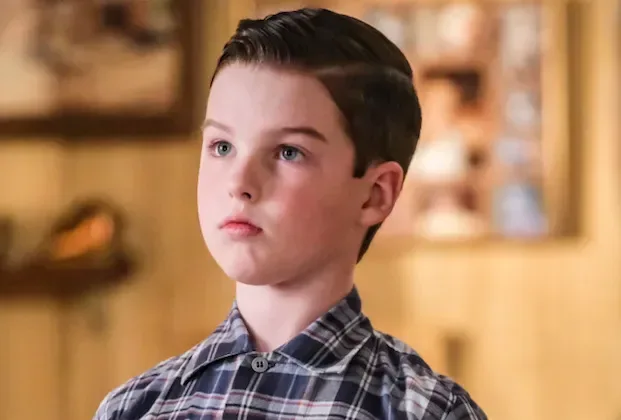
Iain Armitage has reflected on the particular responsibility of anchoring Young Sheldon while still a child himself, describing the role as both a privilege and a demanding assignment. The actor played Sheldon Cooper across all seven seasons of the comedy, which ended in May 2024, after beginning the series at age eight.
His comments appear in Jessica Radloff’s forthcoming oral history, Young Sheldon: The (Juicier-Than-Meemaw’s-Brisket) Inside Story of the Hit Comedy, due out October 20. The book’s cast recollections offer a more candid view of a premise audiences could easily overlook: although the show was an ensemble comedy, its central character was played by someone navigating ordinary childhood alongside a major television workload.
“It was a complete privilege to be on this show and play this character, but yes, it was a big undertaking for an 8-year-old,” Armitage said. “I always did the best that I could, and sometimes kids are not perfect. I was grateful to the people who understood that and gave me grace.”
The wording matters because it does not frame the experience as simply positive or negative. Armitage is appreciative of the opportunity, while also plainly acknowledging the expectation built into it. A lead performer is asked to carry scenes, maintain a character’s rhythm and remain available for the practical demands of production. For a child, that work exists alongside schooling and development rather than after those responsibilities are complete.
A sitcom built around a young lead
Young Sheldon was a prequel centered on the younger version of Sheldon Cooper from The Big Bang Theory. Its seven-season run placed Armitage at the heart of the storytelling, giving the actor an unusually visible role from the outset. The series’ success later produced the 2024 spinoff Georgie & Mandy’s First Marriage.
That context helps explain why fellow cast member Annie Potts, who played Sheldon’s grandmother Connie “Meemaw” Tucker, speaks about the situation in terms of psychological weight rather than merely a difficult workday. Potts said the series revolved around Armitage and that this was a great deal for a young person to manage. She described him as being asked to carry demands that would be hard even for an adult.
Potts also did not portray set life through an unrealistically polished lens. She said Armitage could sometimes be difficult, suggesting tiredness or the possibility that he tested boundaries, but paired that acknowledgment with a crucial comparison: she had worked with adults who were worse. Her point was not to excuse every tense moment. It was to insist on proportion when judging a child expected to work, behave and think with adult-level consistency.
“It’s a very challenging situation to be 9 years old and be expected to work, behave, and think like a grown-up,” Potts said, adding that her comments came with “absolute love and respect.”
That distinction is valuable. “Child star” can become a shorthand that treats a young performer as a fully formed professional first and a child second. The cast’s recollections instead point to the tension in that label: talent and responsibility do not erase fatigue, frustration, immaturity or the need for patience from the adults around a production.
School, work and a built-in peer relationship
Armitage’s closest on-set peer was Raegan Revord, who played Sheldon’s twin sister, Missy Cooper. He recalled that their relationship genuinely felt like a sibling bond, saying Revord was the only other person on set who fully understood the shared routine of filming and school.
Revord’s perspective makes the relationship sound recognizably sibling-like in both the affectionate and less tidy senses of the phrase. She said it was reassuring to have someone who understood the process, but noted that spending 12 hours a day together, five days a week, could naturally result in arguments and conflicting opinions.
That is a practical detail with real explanatory power. Their characters were siblings, but the performers also occupied a work environment in which they were repeatedly together, learning as well as filming. A “sibling-like” dynamic, then, was not simply an easy promotional description. It could include comfort, shared experience, irritation and repair—the ordinary complications of two young people spending extensive time in close proximity.
It also gives a clearer sense of why their connection mattered. An adult ensemble can offer guidance and care, but a peer who is facing the same unusual balance of school and set responsibilities can understand pressures from inside the experience. Armitage’s comments suggest that this mutual recognition was as important as the fictional Cooper-family relationship audiences saw on screen.
What an oral history can add after a series ends
An oral history is a retrospective account assembled from participant testimony. It is not the same as a scene-by-scene production record, and readers should treat it as people looking back on a long shared experience from their own positions. Its value here is the range of perspectives: Armitage describes responsibility and grace; Revord describes camaraderie alongside friction; Potts describes the adult responsibility to see the child behind the lead role.
Together, those perspectives resist the idea that a successful series must have been effortless for everyone involved. Success and strain can coexist. A show can become popular enough to support a spinoff while its cast members still remember long days, disagreements and the pressure concentrated on its youngest central performer.
For viewers who know Young Sheldon chiefly as a warm family comedy, the recollections add another layer without rewriting that legacy. They highlight the human work beneath a performance: the growing actor at the center, the young co-star sharing the unusual routine, and veteran colleagues trying to respond to the reality of a child carrying an adult-sized professional burden.
The comments also sit within a broader pop-culture pattern in which public figures revisit the personal realities behind highly visible work. For another example of a media personality discussing institutional and social pressures, see this discussion of Bill Maher, Cornell and Greek life.
There is no indication in these recollections that Armitage is reducing his time on the series to hardship. His description begins with gratitude. But it is equally clear that he does not want the scale of the undertaking minimized. At eight years old, being the title character in a long-running sitcom meant taking on an opportunity few children receive—and pressures few children are equipped to navigate without considerable support.
That is ultimately the most revealing element of the cast’s reflections. Their memories do not demand that audiences turn ordinary childhood disagreements into drama, nor do they pretend a child lead should meet an impossible adult standard. They describe a production where affection, professional expectation, exhaustion and patience could all exist at once. For the people involved, that seems to be a more honest account of what it took to make Young Sheldon.